










 (+1) 905 597 5955


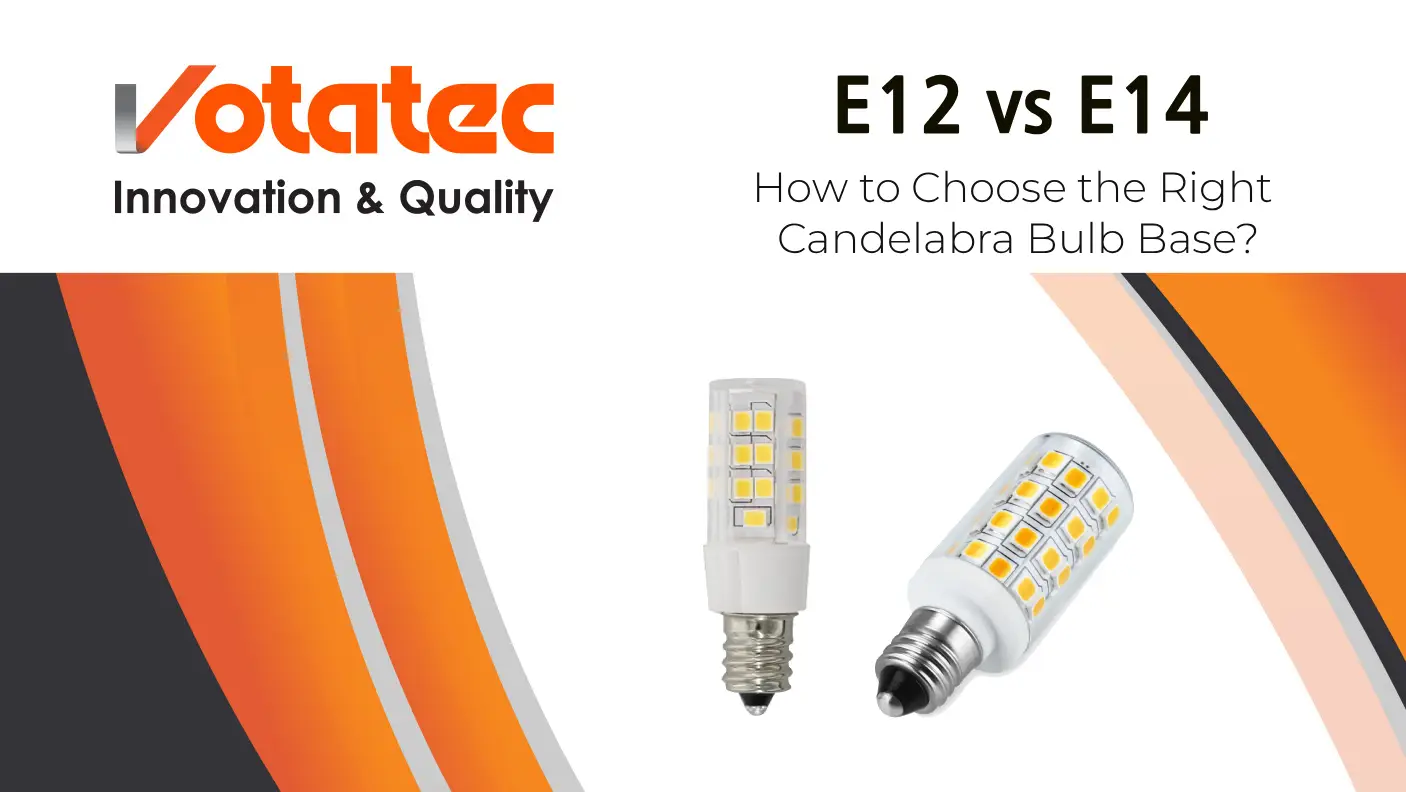

You ordered a box of candelabra bulbs online. They arrived. You unscrewed the old bulb, grabbed a new one, and it didn’t fit. Too loose. Or too tight. Either way, frustrating.
This happens all the time. And the reason is almost always the same: you grabbed an E12 when you needed an E14, or the other way around.
Here’s the short answer. E12 and E14 are not the same. The E12 base has a 12mm diameter screw. The E14 has a 14mm diameter screw. That 2mm difference means they don’t interchange without an adapter. In Canada, E12 is the standard candelabra base you’ll find in most fixtures. E14 is the European standard, common in imported fixtures and some decorative lighting.
That’s the core of the E12 vs E14 debate. But there’s more to know if you want to buy the right bulb the first time. Let’s get into it.
Quick Comparison: E12 vs E14 at a Glance
| Feature | E12 | E14 |
| Base Diameter | 12mm | 14mm |
| Common Name | Candelabra (North American) | Small Edison Screw (European) |
| Standard Region | Canada, USA, Mexico | Europe, UK, Asia, parts of South America |
| Thread Pitch | Coarser | Finer |
| Typical Wattage (LED) | 4W – 7W | 4W – 7W |
| Common Fixture Types | Chandeliers, sconces, night lights | European chandeliers, imported fixtures |
| Availability in Canada | Very high | Moderate (specialty/imports) |
| Voltage | 120V | 220-240V (but 120V versions exist) |
Is E14 the Same as E12? The Key Differences
No. And this is the most common misconception about candelabra bulbs.
The “E” in both names stands for Edison, referring to the screw-in base design that Thomas Edison popularized. The number is simply the diameter of the base in millimetres. So an E12 base measures 12mm across, and an E14 measures 14mm. Seems like a tiny difference. It is. But it’s enough that they won’t screw into each other’s sockets properly.
Here’s what actually differs between E12 vs E14 bulb bases:
Diameter. The most obvious difference. Hold them side by side and you can see it. The E14 is visibly wider, about the width of a nickel versus the E12 which is closer to a dime. Not a huge gap, but enough that an E12 bulb will wobble in an E14 socket and won’t make reliable electrical contact.
Thread pitch. This one’s less obvious. The E12 has a slightly coarser thread pattern than the E14. Even if you could force one into the wrong socket, the threads wouldn’t engage correctly. Bad connection. Potential arcing. Not worth the risk.
Voltage rating. This matters more than people think. Traditional E12 bulbs are designed for 120V North American circuits. Traditional E14 bulbs are designed for 220-240V European circuits. With LED bulbs, many manufacturers now make multi-voltage versions (100-240V), so this is becoming less of an issue. But if you’re using an older incandescent E14 bulb rated for 220V in a Canadian 120V fixture, it’ll glow dimly and look terrible.
Physical socket depth. E14 sockets are slightly deeper than E12 sockets. If you install a fixture designed for E14 in a Canadian home but use E12 bulbs, the bulb may not seat deep enough to make solid contact.
So is E14 the same as E12? Definitely not. They look similar, they serve similar purposes, but they’re different standards from different electrical traditions.
E12 vs E14 vs E17: All Three Candelabra Bases Compared
To make things even more interesting, there’s a third player: the E17 intermediate base. Here’s how all three stack up.
| Feature | E12 | E14 | E17 |
| Base Diameter | 12mm | 14mm | 17mm |
| Common Name | Candelabra | Small Edison Screw (SES) | Intermediate |
| Region | North America | Europe/UK/Asia | North America/Japan |
| Typical Use | Chandeliers, decorative | European fixtures | Appliances, some ceiling fans |
| Availability in Canada | Everywhere | Specialty stores | Common |
| LED Options | Extensive | Growing | Moderate |
| Adapter to E26? | Easy to find | Available | Easy to find |
The E17 is sometimes confused with E14 because they’re close in size. But again, 3mm matters when you’re threading a bulb into a socket. E17 bases show up most often in Canadian appliances like range hoods, refrigerator lights, and some older ceiling fan fixtures.
For most Canadian homes and businesses, you’ll deal with E12 or E26 (the standard medium base). E14 only becomes relevant when you’re working with imported European fixtures or specialty decorative lighting. And E17 pops up mainly in appliance replacements.
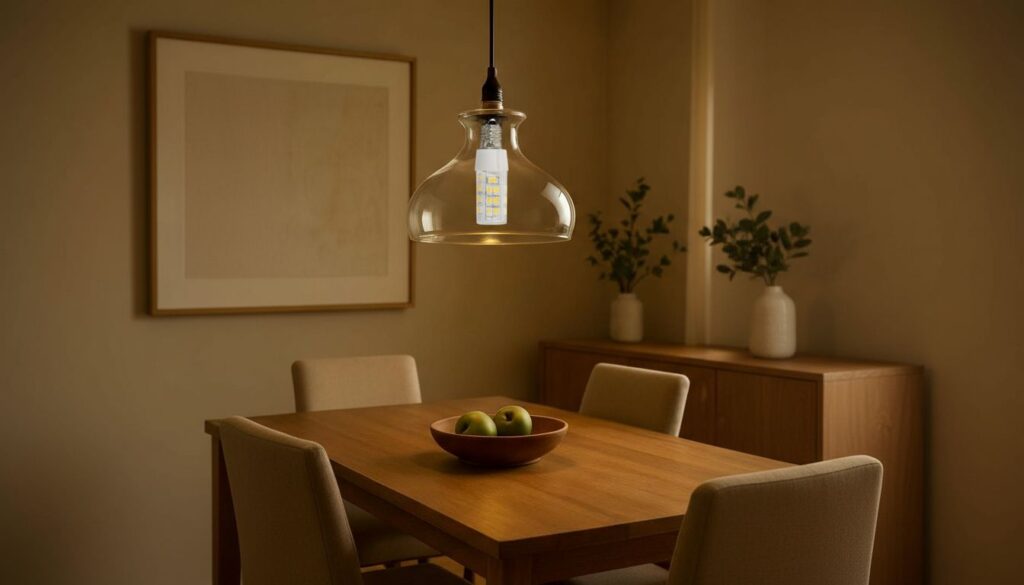
E12 Bulb Applications: Where This Base Is Standard
The E12 is the workhorse candelabra base in North America. You’ll find it pretty much everywhere decorative or compact lighting shows up.
Read more: What Is an E12 Bulb
Residential applications:
- Chandeliers and pendant lights (the most common E12 application by far)
- Wall sconces
- Vanity mirror lights in bathrooms
- Night lights and accent lamps
- Decorative string lights
- Candle-style window fixtures
Commercial applications:
- Hotel lobby chandeliers
- Restaurant decorative fixtures
- Retail display lighting
- Hospitality wall sconces
- Event venue chandeliers
Specialty applications:
- Some ceiling fans with light kits
- Decorative outdoor post lights
- Picture lights and cabinet accent lighting
E12 bulb applications are primarily decorative. The smaller base allows for slimmer, more elegant bulb shapes like flame tips, torpedo, and bent-tip candelabra styles. That’s why you see them in chandeliers and sconces where the bulb is visible and aesthetics matter.
In Canada, if your fixture takes a small screw-in bulb that isn’t an appliance, it’s almost certainly E12. That’s just the standard here.
E14 Bulb Applications: Where You’ll Find This Base
The E14 is Europe’s equivalent of the E12. Same concept, slightly different size. If you’ve ever bought a light fixture from IKEA, a European antique shop, or imported a chandelier from Italy or France, you’ve probably encountered E14 sockets.
Common E14 bulb applications include:
- European-made chandeliers and pendant lights
- IKEA table lamps, floor lamps, and fixtures
- Imported decorative wall sconces
- European-design range hoods
- Some smart home bulbs (Philips Hue and others offer E14 versions)
- Salt lamps and decorative accent lamps (many are made in Europe or Asia with E14 bases)
Where E14 shows up in Canada specifically:
- Condos and homes with European-imported fixtures
- Hotels and restaurants using European designer lighting
- Heritage buildings with original European fixtures
- Retail stores carrying European furniture brands
The tricky part? Many Canadians don’t realize they have E14 sockets until a bulb burns out and the replacement E12 doesn’t fit. If you’ve ever held a bulb up to a socket and thought “this looks right but it’s wobbling,” you’ve probably got an E14 socket with an E12 bulb in your hand.
Can E12 Fit E14 Socket? Compatibility and Adapters
Short answer: no, an E12 bulb won’t fit properly in an E14 socket without an adapter. And forcing it is a bad idea.
Here’s why. The E12 is 2mm narrower. If you screw it into an E14 socket, the threads don’t engage fully. The bulb might seem to hold, but the electrical contact at the bottom of the socket will be intermittent at best. That means flickering, poor connection, and potential overheating at the contact point. Not safe.
Can you use an adapter? Yes. E12-to-E14 and E14-to-E12 adapters exist and they work fine for most applications. They’re small metal or ceramic sleeves that thread into the socket and accept the other bulb size.
Things to know about adapters:
- They add about 15-20mm of height to the bulb. In fixtures where the bulb sits inside a shade or globe, this usually doesn’t matter. In exposed fixtures like chandeliers where the bulb is visible, the extra height can look awkward.
- Always buy CSA-approved adapters. Cheap unrated adapters from overseas can overheat, especially with higher-wattage bulbs. In Canada, CSA certification isn’t optional for electrical components. It’s a safety requirement.
- Match the voltage. If you’re using an E12-to-E14 adapter to put a European 220V bulb in a Canadian 120V fixture, the bulb won’t perform correctly. Make sure the bulb itself is rated for 120V or multi-voltage (100-240V).
- Don’t stack adapters. Using an E12-to-E14 adapter inside an E14-to-E26 adapter creates a wobbly, unreliable connection. If you need to go from E12 to E26, buy a single direct adapter.
The better solution? Buy the correct bulb base in the first place. LED candelabra bulbs are available in both E12 and E14 bases from most lighting suppliers, including Votatec. The cost difference is zero. So there’s really no reason to mess around with adapters unless you’re in a pinch.
Which Is Better E12 or E14 for Canadian Homes and Businesses?
This depends entirely on where you are and what fixtures you’re working with. But for Canadian buyers, the answer is straightforward.
E12 is the better choice for Canada in almost every situation.
Here’s why. The Canadian electrical system runs on 120V, same as the US. E12 is the North American candelabra standard. Virtually every chandelier, sconce, and decorative fixture sold in Canada comes with E12 sockets. Replacement bulbs are available everywhere, from hardware stores to Amazon to your local electrical distributor. And all E12 LED bulbs sold in Canada are rated for 120V.
E14 only makes sense if you already have fixtures with E14 sockets. Swapping out a perfectly good European chandelier just because it uses E14 bases would be silly. The bulbs are available in Canada, they just require a bit more effort to source.
For facility managers and building owners:
Standardizing on E12 for all candelabra-base fixtures simplifies your maintenance inventory. One base size means one type of replacement bulb on the shelf. When you’re managing 50 or 100 chandeliers across a hotel or commercial property, that consistency saves time and reduces ordering mistakes.
If you’re specifying new fixtures for a Canadian project, always confirm E12 sockets. Some decorative fixture brands import European designs and don’t always convert to North American bases. Check before you buy, not after you’ve installed 30 chandeliers.
For homeowners:
If your home has a mix of E12 and E14 sockets (common in homes with imported fixtures), label the E14 fixtures so you remember when it’s time to buy replacements. Or better yet, consider switching to E12 fixtures over time to standardize. The LED bulb selection for E12 is much larger in Canada, which means more options for colour temperature, dimming capability, and bulb style.
The bulb E12 vs E14 decision really comes down to what your fixture requires. Neither is technically “better.” But E12 is more practical in the Canadian market. That’s just reality.
How to Identify Your Bulb Base Size
Not sure what base you’ve got? Here are three quick ways to check.
Method 1: Measure the base diameter.
Grab a ruler or caliper. Measure across the widest point of the metal screw base. 12mm = E12. 14mm = E14. 17mm = E17. 26mm = E26 (standard medium base). Simple.
If you don’t have a caliper, a dime is about 18mm across. An E12 base is noticeably narrower than a dime. An E14 is just slightly narrower. And an E17 is almost the same width.
Method 2: Check the bulb packaging.
Every bulb sold in Canada lists the base type on the packaging. Look for “E12,” “E14,” “Candelabra,” or “Small Edison Screw.” If the packaging says “Candelabra” without a number, it’s E12 in Canada.
Method 3: Check the fixture documentation.
The fixture’s spec sheet, manual, or even the sticker inside the socket housing will list the base type and maximum wattage. For commercial fixtures, this information is also on the NRCan energy efficiency product listing if the fixture is registered.
Visual identification chart:
| Base | Diameter | Roughly Comparable To | Thread Style |
| E12 | 12mm | Width of a AAA battery | Coarser, wider threads |
| E14 | 14mm | Width of a pen cap | Finer, tighter threads |
| E17 | 17mm | Width of a dime | Medium threads |
| E26 | 26mm | Width of a quarter | Standard threads |
One more thing. If you pull out a burnt bulb and the base type isn’t printed on it (common with cheap imports), just bring it to your lighting supplier. Any decent distributor can identify it in seconds. Don’t guess and order online based on what you think it might be. That’s how you end up with a box of wrong bulbs.
Frequently Asked Questions About E12 vs E14 Bulbs
1. Is E14 the same as E12?
No. The E14 base has a 14mm diameter screw, while the E12 has a 12mm diameter. That 2mm difference means they’re physically incompatible without an adapter. They also have different thread pitches and originate from different regional electrical standards. E12 is the North American candelabra standard, while E14 is the European small Edison screw standard.
2. Can I use an E12 bulb in an E14 socket?
Not directly. An E12 bulb is too narrow for an E14 socket and won’t make reliable electrical contact. You can use a CSA-approved E12-to-E14 adapter, which adds a small sleeve to bridge the size difference. However, adapters add height to the bulb and should only be used as a temporary fix. Buying the correct base size is always the better approach.
3. Which candelabra base is standard in Canada?
E12 is the standard candelabra base across Canada, the US, and Mexico. If you buy a chandelier, wall sconce, or decorative fixture from a Canadian retailer, it will almost certainly come with E12 sockets. E14 appears mainly in European imported fixtures and some specialty decorative lighting.
4. Are E12 and E14 LED bulbs the same brightness?
They can be. Base size has nothing to do with light output. Both E12 and E14 LED bulbs come in similar wattage and lumen ranges, typically 4W to 7W producing 350 to 800 lumens. The base is just the connection method. A 5W E12 LED candelabra bulb and a 5W E14 LED candelabra bulb produce the same amount of light. The only difference is which socket they fit.
5. Should I replace my E14 fixtures with E12 fixtures in Canada?
Not necessarily. If your E14 fixtures work well and you can source replacement bulbs, there’s no safety reason to swap them out. LED E14 bulbs rated for 120V are available in Canada from various suppliers. However, if you’re renovating or replacing fixtures anyway, switching to E12 simplifies future bulb purchases since E12 has much wider availability in the Canadian market.
Bottom Line
The E12 vs E14 choice comes down to what your fixture needs. In Canada, E12 is the standard, the most available, and the most practical option for new installations. E14 works perfectly fine in imported European fixtures, just make sure you’re buying 120V-rated LED bulbs.
Don’t force the wrong base into a socket. Don’t stack adapters. And when in doubt, measure the base diameter or bring the old bulb to your supplier.
Votatec carries a full range of CSA-certified LED candelabra bulbs in both E12 and E14 bases, including flame tip, torpedo, and globe styles in multiple colour temperatures. All rated for Canadian 120V circuits with dimmable options available.
Looking for the right candelabra LED bulb? Browse Votatec’s LED bulb collection or contact our team for help matching the right bulb to your fixture.