













 (+1) 905 597 5955



Here’s some quick math. A standard 5-metre LED strip light runs at about 30 watts. Leave it on for 8 hours a day in Ontario at $0.13/kWh, and you’re paying maybe $11 a year. One 60W incandescent bulb doing the same job? Around $23.
So yes, LED strip lights use less electricity. But that’s the easy comparison.
The real question people are asking in 2026 isn’t “strips vs. incandescent.” It’s “are LED strips cheaper than the LED bulbs and pot lights I already have?” That answer is more interesting, and it’s what most guides completely skip over.
This guide breaks down LED strip lights energy consumption vs. every common type of house lighting, using 2026 Canadian hydro rates. No generic numbers. No guesswork. Real math you can check against your own power bill.
Quick Answer: Are LED Strip Lights Energy Efficient Enough to Save You Money?
Short answer: yes. LED strip lights are among the most energy-efficient home lighting options you can install. A typical 5-metre strip draws 25 to 50 watts depending on type and density. That’s less than a single old-school 60W bulb, but spread across a much larger area.
Here’s how they stack up against common house lighting:
| Lighting Type | Typical Wattage (similar brightness) | Annual Cost (8 hrs/day, $0.13/kWh) | Lifespan |
|---|---|---|---|
| LED strip (5m, standard) | 25-30W | $9.50 – $11.40 | 50,000 hrs |
| LED bulb (800 lumens) | 8-10W | $3.04 – $3.80 | 25,000 hrs |
| LED pot light | 9-14W | $3.42 – $5.32 | 50,000 hrs |
| CFL bulb | 13-15W | $4.94 – $5.70 | 10,000 hrs |
| Fluorescent tube (4 ft) | 32W | $12.16 | 20,000 hrs |
| Incandescent bulb | 60W | $22.78 | 1,000 hrs |
| Halogen bulb | 43W | $16.33 | 2,000 hrs |
A few things jump out. LED strips cost more to run than individual LED bulbs or pot lights per fixture. But strips cover more area. A single 5-metre strip can light an entire kitchen counter, hallway, or cove ceiling. You’d need 3 to 4 pot lights to cover the same space, which brings those costs much closer together.
Bottom line: LED strips are cheaper than incandescent, halogen, CFL, and fluorescent options. Compared to LED bulbs and pot lights, it depends on how many fixtures you’re replacing. For accent, task, and under-cabinet lighting, strips usually win.
LED Strip Lights Energy Consumption: What the Specs Say vs. What You Actually Get
This is where spec sheets and reality don’t always match up.
Manufacturers rate their strips by watts per metre. But independent testing tells a different story. A teardown lab tested 7 different LED strip samples and found that some drew 23% more power than the label claimed. A 60-foot installation rated at 220 watts actually pulled 270 watts. That’s 50 extra watts nobody budgeted for.
On the flip side, forum users measuring RGB strips with a Kill-A-Watt meter found they typically draw way less than maximum. At normal colour settings, most RGB strips pull about 0.8 to 1.7 watts per foot instead of the rated 2.0 watts. The rated maximum only happens when all three colour channels run at full brightness simultaneously. Most people never do that.
Here’s what typical LED strip lights energy consumption looks like in the real world:
| Strip Type | Rated W/m | Real-World W/m | Notes |
|---|---|---|---|
| SMD 2835 (standard) | 4.8-7.2 | 4.5-7.0 | Most common residential strip |
| SMD 5050 (bright) | 14.4 | 10-14 | Depends on colour and dimming |
| COB (continuous) | 8-12 | 7-12 | Even light, fewer hot spots |
| SMD 2835 (high density) | 12-19.2 | 11-22 | Can exceed rated in some samples |
| RGB (colour changing) | 14.4 | 5-12 | Varies hugely by colour setting |
The factors that actually affect power draw:
- Length. Every extra metre adds to the total. A 10m run draws double a 5m run.
- LED density. A strip with 120 LEDs per metre draws roughly twice what a 60 LED/m strip does.
- Colour temperature. Cool white LEDs draw slightly more than warm white in most designs.
- Dimming. Running strips at 50% brightness cuts power draw by roughly 40-50%.
- Voltage. 24V strips are more efficient than 12V strips on longer runs because they lose less power to voltage drop.
So do LED strip lights use less electricity than regular house lights? In most setups, yes. A 5-metre standard strip uses about as much power as leaving a phone charger plugged in. But don’t trust the box blindly, especially on cheap imports. Measure if you can.
LED Strips vs. Every Type of House Lighting: The Real Cost Comparison
Here’s the comparison most guides won’t make. Not strips vs. incandescent (that’s a blowout). The useful comparison: LED strips vs. the LED fixtures already in your house.
LED Strips vs. Incandescent and Halogen Bulbs
Not much to say here. A 60W incandescent produces about 800 lumens. A 10W LED strip section produces similar brightness at a fraction of the power. You save around 75% on electricity, and the strip lasts 50 times longer. If you’re still running incandescent or halogen, switching to any energy-efficient home lighting option, strips or otherwise, is an easy win.
LED Strips vs. CFL and Fluorescent Tubes
CFLs use around 13W for 800 lumens. Better than incandescent, but LED strips still win on efficiency. Plus, fluorescent tubes and CFLs contain mercury, have that annoying warm-up delay, and struggle in cold temperatures. In a Canadian garage or basement at minus 15, a CFL can take minutes to reach full brightness. LEDs? Instant. Full brightness from minus 40 to plus 50.
And here’s something most people don’t think about. Fluorescent tubes produce a lot of heat relative to their light output. Around 40% of their energy goes to heat. LED strips convert more energy to light and less to heat, which means your air conditioning works less hard in summer. Small thing. Adds up.
LED Strips vs. LED Bulbs and Pot Lights
This is the comparison that actually matters in 2026. And it’s closer than you’d think.
A single LED bulb (9W, 800 lumens) costs about $3.42 per year to run at Ontario rates. A 5-metre LED strip at 30W costs about $11.40. So per fixture, the bulb is cheaper.
But here’s the thing. You’re not lighting a room with one bulb. A typical kitchen has 4 to 6 pot lights at 12W each, totalling 48 to 72 watts. A 5-metre LED strip under the cabinets at 30W gives you even, shadow-free task lighting across the whole counter. The strip actually uses less total power than the pot lights, and forum users consistently say strips “reduce shadows” better than point-source fixtures.
For accent lighting, cove lighting, and under-cabinet applications, strips are both cheaper and better. For general overhead room lighting, pot lights and LED panels are usually more practical. The sweet spot? Use both. Pot lights for general illumination, strips for task and accent. That’s how most lighting designers set up modern kitchens and living rooms.
LED Strips vs. LED Panels and Troffer Lights (Commercial)
In commercial settings, the comparison shifts. A 2×4 LED troffer puts out 4,000 to 5,000 lumens at 30 to 40 watts. Very efficient. LED strips can’t match that kind of output in the same form factor.
But for retail display lighting, shelf lighting, and architectural accents, commercial LED strip installations make more sense. They use less power per linear foot than track lighting and give you continuous, even illumination. Grocery stores, for example, use LED strips in cooler cases because they perform well at low temperatures and draw minimal power in fixtures that run 16+ hours a day.
How to Calculate Your Actual Lighting Electricity Cost
Don’t trust anyone else’s numbers. Calculate your own. It takes about 30 seconds.
The formula:
Watts x hours per day x 365 days / 1,000 = kWh per year
kWh per year x your electricity rate = annual cost
Example 1: LED strip in a kitchen (Ontario)
30W x 6 hours x 365 / 1,000 = 65.7 kWh
65.7 kWh x $0.13/kWh = $8.54 per year
Example 2: Four pot lights in the same kitchen (Ontario)
48W x 6 hours x 365 / 1,000 = 105.12 kWh
105.12 kWh x $0.13/kWh = $13.67 per year
Example 3: Two fluorescent tubes in a garage (BC)
64W x 4 hours x 365 / 1,000 = 93.44 kWh
93.44 kWh x $0.095/kWh = $8.88 per year
Replace those with a 5m LED strip at 30W? That drops to $4.16 per year. Half the cost.
2026 Canadian Provincial Electricity Rates
Here’s where the numbers get real. These are current residential rates:
| Province | Rate ($/kWh) | Source |
|---|---|---|
| Ontario (TOU off-peak) | $0.076 | Ontario Energy Board |
| Ontario (TOU mid-peak) | $0.122 | Ontario Energy Board |
| Ontario (TOU on-peak) | $0.130 | Ontario Energy Board |
| Ontario (tiered, Tier 1) | $0.076 | Ontario Energy Board |
| British Columbia | $0.0950 | BC Hydro |
| Quebec | $0.0735 | Hydro-Quebec |
| Alberta | $0.12-0.18 | Variable (deregulated market) |
If you’re in Quebec, your lighting costs roughly half what Ontario pays on peak rates. A 5m LED strip running 8 hours a day in Quebec costs about $6.45 a year. In Ontario on-peak, that same strip costs $11.40. Same strip, same usage, different province. Worth knowing.
One more thing. If you run your lights mostly in the evening (which most people do), you’re hitting Ontario’s on-peak or mid-peak rates. The low energy consumption of LED strip lights matters even more during peak hours because every watt costs more.
Total Cost of Ownership: It’s Not Just the Power Bill
Here’s the part that changes the conversation.
A homeowner on a building forum shared their experience installing LED strip lighting throughout their house. They bought 30 metres of strips for maybe $60 total. Cheap. But then they needed aluminium channels for proper heat dissipation ($80), quality LED drivers that don’t flicker ($120), junction boxes to meet code ($40), dimmers ($60), and connectors and wiring ($30). Plus four hours of their Saturday.
Total project: around $390. Still running it on $50 a year in electricity, which is cheaper than the mix of halogens and fluorescents it replaced ($180/year). But that $60 strip didn’t stay $60 for long.
Here’s a realistic total cost comparison over 10 years:
| Cost Factor | LED Strips (30m whole house) | LED Bulbs (15 bulbs) | Mix (CFL + Incandescent) |
|---|---|---|---|
| Purchase | $60-150 | $45-75 | $20-30 |
| Drivers/ballasts | $80-200 | $0 | $0 |
| Installation materials | $80-150 | $0 | $0 |
| Replacement (10 yr) | $0-60 | $45-75 | $200-400 |
| Electricity (10 yr) | $500-650 | $350-550 | $1,500-2,200 |
| 10-Year Total | $720-1,210 | $440-700 | $1,720-2,630 |
LED bulbs are the cheapest option if you just need to screw something into an existing socket. No contest. But LED strips give you something bulbs can’t: continuous, even, shadow-free light in places where bulbs don’t fit. Under cabinets, inside closets, along cove ceilings, behind mirrors, inside display cases.
The electricity savings alone aren’t the reason to choose strips. The lighting quality is. The power bill savings are a bonus.
Where LED Strips Make the Most Sense for Energy-Efficient Home Lighting
Not every room benefits equally from strip lighting. Here’s where the economics work best.
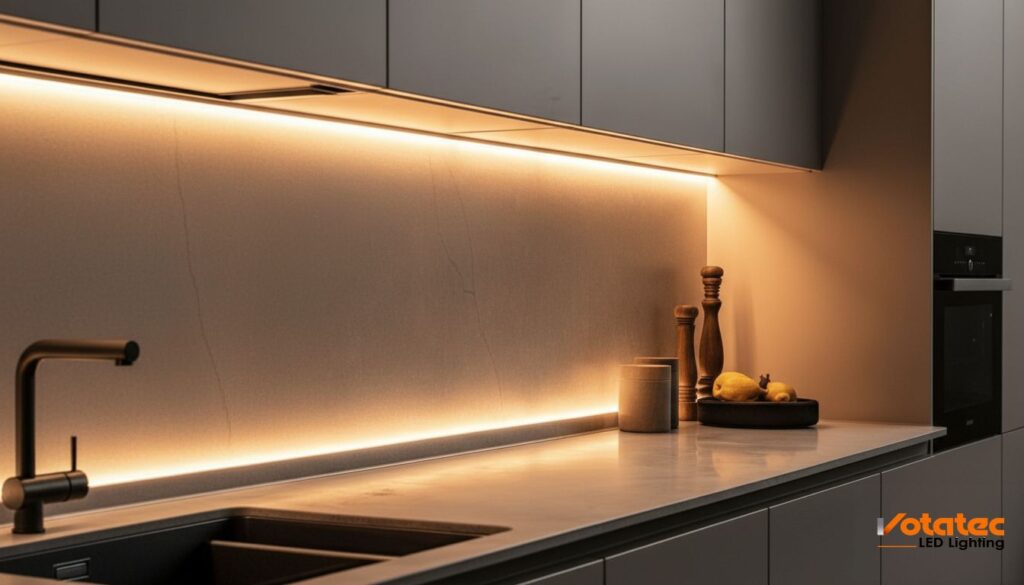
Under-cabinet kitchen lighting. This is the number one application. LED strips replace 20W halogen puck lights with 5-8W per metre of even, shadow-free task lighting. Most kitchens need 3 to 5 metres. Annual electricity cost: $5 to $8. Try getting that from puck lights.
Closets and pantries. A 1-metre strip with a door-activated switch uses almost nothing. Maybe $0.50 a year. Beats fumbling for a pull chain in the dark.
Hallway and stairway accent lighting. Low-profile strips along baseboards or under handrails use 3 to 5 watts per metre. They provide just enough light for safe navigation at night without turning on overhead fixtures. Great for families with kids.
Commercial display and retail. This is where LED strips really shine for businesses. Shelf lighting, cooler case lighting, and architectural accents run 12 to 16 hours a day. At those hours, every watt matters. LED strip retrofits in retail cooler cases alone can cut lighting energy by 40 to 60% compared to fluorescent alternatives.
Garage and workshop lighting (Canadian climate). LED strips work at minus 40. Fluorescents barely start. In an unheated Canadian garage, LED strips give you full, instant brightness from the moment you flip the switch. And they don’t care if the temperature drops to minus 30 overnight.
Tips to Lower LED Strip Lights Energy Consumption Even Further
You’ve got the strips installed. Here’s how to squeeze more value out of them.
Use dimmers. Running LED strips at 70% brightness instead of 100% cuts power draw by roughly 25-30%. Most rooms don’t need full brightness. A dimmer pays for itself within a year on a longer installation.
Pick the right colour temperature. Warm white (2700K-3000K) strips draw slightly less power than cool white (5000K+) in most designs. Plus, warm white is easier on the eyes for living spaces. Save cool white for task areas where you need maximum visibility.
Don’t skip aluminium channels. This sounds like an extra expense, not a savings tip. But heat is what kills LED strips early. Aluminium channels act as heat sinks and can extend strip life by 30-50%. That means fewer replacements. A $15 channel that makes your $30 strip last 12 years instead of 6? Good deal.
Watch out for cheap drivers. A bad LED driver doesn’t just waste electricity, it produces visible 120Hz flicker. People on building forums report headaches and eye strain from magnetic drivers. Quality electronic drivers from brands that meet DLC standards cost more upfront but run more efficiently and won’t give you headaches. Literally.
Avoid overlighting. Here’s an insight from the U.S. DOE: because LED strips are so cheap to run, people tend to install way more than they need. One forum user called it the “Jevons Paradox of LEDs.” You save 75% per watt, then install four times as much light, and your bill barely moves. Size your installation to what you actually need. Sounds obvious. People still overdo it.
Canadian Rebates You Might Be Missing
Most guides on this topic are written for Americans. They skip this entirely.
Canadian provinces offer rebate programmes for LED lighting upgrades, especially in commercial and institutional settings:
- Ontario (Save on Energy): Rebates for commercial and industrial LED retrofits. Can cover a significant portion of project costs depending on the programme stream. Check Save on Energy for current offerings.
- BC Hydro (Business Energy Saving Incentives): Incentives for commercial lighting upgrades through their business programme. Covers both new construction and retrofits.
- Hydro-Quebec: Programmes for energy-efficient lighting in commercial buildings. Historically generous with LED upgrade funding.
- Efficiency Nova Scotia: Rebates for business lighting upgrades.
For residential, the savings come from the electricity reduction itself rather than direct rebates. But if you’re a business, contractor, or building manager doing a larger LED strip installation, check your provincial utility’s programme before you buy. You could offset 30 to 50% of the cost.
Votatec’s LED products are DLC-qualified, which is typically required for rebate eligibility in Canadian programmes. Worth confirming before you purchase.
FAQs
Do LED strip lights use less electricity than regular house lights?
In most cases, yes. A 5-metre LED strip running 8 hours a day adds about $9 to $12 per year to your Ontario hydro bill. That’s less than $1 a month. An equivalent incandescent setup would cost $20 to $45 for the same brightness. Even compared to CFL, LED strips use less electricity across most applications.
How much does it cost to run LED strips 24 hours a day?
A standard 5m, 30W strip running 24/7 costs about $34 per year at Ontario rates ($0.13/kWh). In Quebec at $0.074/kWh, that drops to around $19. Still cheap, but 24/7 operation does add up across multiple strips.
Are LED strip lights energy efficient compared to pot lights?
Per fixture, a single 12W pot light uses less power than a 30W strip. But per area covered, strips can be more energy efficient. A 5m strip lights an entire kitchen counter for $11/year. You’d need 4 pot lights at $5 each ($20/year) to cover the same space. Context matters.
Do RGB strips use more power than white strips?
At maximum brightness with all colours on, yes. But in practice, RGB strips at typical colour settings draw 40-60% less than their rated maximum. Most people don’t run all three channels at full blast. A white-only strip gives you more lumens per watt if pure efficiency is the goal.
Can LED strips replace ceiling lights entirely?
For accent, task, and cove lighting, absolutely. For primary room illumination, it depends on the room. A bedroom or hallway? Probably. A bright office or kitchen? You’ll likely want overhead LED fixtures too. The most energy-efficient home lighting setups use both: overhead for general light, strips for task and accent.
Do LED strip lights work in cold Canadian garages and workshops?
Yes, and better than most alternatives. LEDs perform well down to minus 40, with no warm-up time. Fluorescent tubes struggle below 0 and can take minutes to reach full brightness in a cold garage. This is one area where LED strips have a clear advantage in Canadian conditions.
Final Thought
LED strip lights are cheaper to run than incandescent, halogen, CFL, and fluorescent lighting. Period. Compared to LED bulbs and pot lights, strips cost a bit more per fixture but cover more area per watt, especially for task and accent applications. Are LED strip lights energy efficient enough to justify the switch? For most Canadian homes and businesses, absolutely.
Three things to do right now:
- Calculate your current lighting cost. Use the formula above with your provincial rate. You might be surprised what your old fluorescents or halogens are costing you.
- Identify the best spots for strips. Under-cabinet, closet, cove ceiling, and display lighting are where strips make the most sense, both for savings and light quality.
- Check your provincial rebate programmes if you’re doing a commercial or multi-unit installation. Free money is free money.
This week: measure the spaces where you’d install strips and calculate the wattage you need. This month: compare your current lighting costs to what LED strips would cost using the tables above.
Votatec‘s indoor LED strip and fixture options are designed for Canadian conditions, DLC-qualified for commercial rebate eligibility, and rated to minus 40 for unheated spaces. Get in touch for product specs or a quote on your project.