









It’s one of the most searched LED questions on the internet. Can you make an LED that emits black light? Not ultraviolet. Not a dark purple glow. Actual darkness. A beam of black.
Here’s the straight answer. No. You can’t have an LED that emits darkness because darkness isn’t a thing you emit. It’s the absence of light. That’s like asking for a heater that produces cold. The physics don’t work that way.
But here’s where it gets interesting. The term “black LED lights” actually means two completely different things depending on who’s asking. Some people want to know about the physics of emitting darkness. Others are searching for blacklight LEDs, the ultraviolet fixtures used in parties, forensics, and industrial inspection. And a third group just wants LED light fixtures with a black finish for architectural or commercial applications.
All three are valid questions. And they have very different answers. Let’s sort it all out.
What Are Black LED Lights? Two Meanings, One Confusing Term
The confusion around black LED lights comes from the English language being wonderfully imprecise. “Black light” can mean a UV light source, a fixture with a black housing, or a theoretical light that produces darkness. Context matters. And search engines aren’t great at telling the difference.
So let’s separate the two real-world meanings from the physics thought experiment.
Blacklight LEDs (UV): What They Actually Do
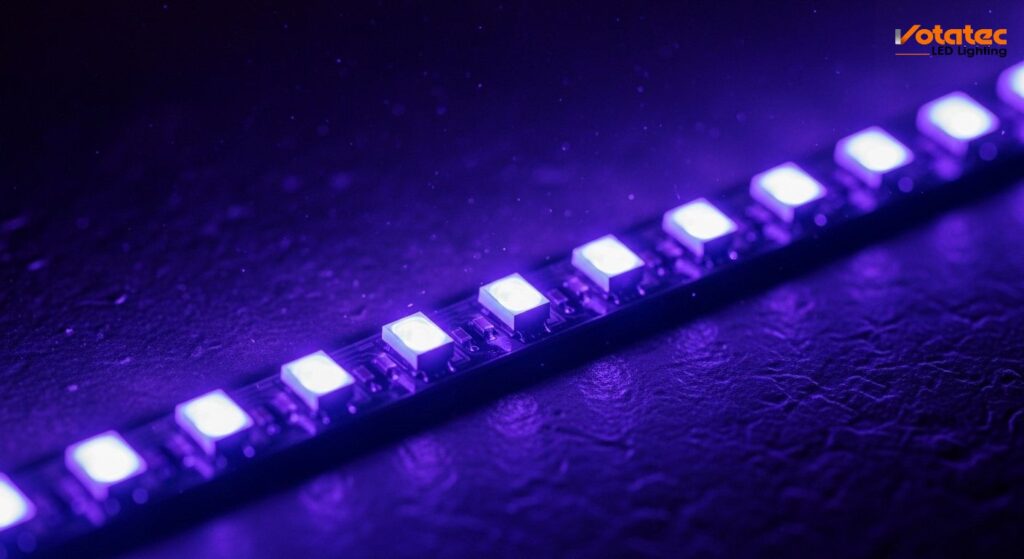
When most people say “black light,” they mean an ultraviolet light source. Traditional blacklights used fluorescent tubes coated with a phosphor that converts electrical energy into UV-A radiation, typically in the 365-405 nanometre wavelength range. That’s just below the visible spectrum. Your eyes can’t really see it, but it makes certain materials fluoresce, glowing white, green, blue, or orange under the UV exposure.
LED technology has made blacklights smaller, more efficient, and more practical. A UV black LED light uses a semiconductor that emits directly in the UV-A range without needing a phosphor coating or a glass tube filled with mercury vapour. They’re instant-on, dimmable, mercury-free, and last 25,000-50,000 hours.
The faint purple glow you see from a blacklight isn’t the UV itself. It’s a small amount of visible violet light that leaks through alongside the UV emission. Pure UV is invisible to human eyes. That eerie purple glow is just a byproduct.

Black-Finish LED Fixtures: What Most Buyers Actually Want
Here’s what most commercial and residential buyers are actually searching for when they type “black LED lights” into Google. They want LED fixtures with a black housing, trim, or finish. Not UV. Not physics experiments. Just a fixture that matches their design aesthetic.
Black-finish LED fixtures are everywhere in modern architecture and interior design. Black recessed slim panels, black track lights, black linear pendants, black outdoor wall packs, black bollard lights, black flood lights. The matte black or textured black finish has become one of the most popular architectural lighting choices for both residential and commercial projects.
And functionally, there’s nothing different about them. A black-finish LED downlight performs identically to a white-finish one. Same lumens, same colour temperature, same efficiency. The housing colour doesn’t affect the light output. It just affects how the fixture looks on your ceiling or wall.
Explore more: Where Can I Buy High-Quality LED Downlights in Canada?
Why Can’t We Have Black LED Lights That Emit Darkness?
Now for the fun part. This is the question that sparks debates on Reddit, physics forums, and YouTube comment sections. Why can’t we have black LED lights that shoot a beam of darkness into a room?
How Light Actually Works: A Quick Physics Refresher
Light is electromagnetic radiation. Specifically, it’s photons, tiny packets of energy travelling in waves. Different wavelengths produce different colours. Red is around 700 nanometres. Blue is around 450. Ultraviolet is below 400, invisible to our eyes. Infrared is above 700, also invisible.
An LED works by passing electrical current through a semiconductor material. The electrons release energy as photons. The wavelength of those photons, and therefore the colour of the light, depends on the semiconductor material used. Gallium nitride produces blue. Add a phosphor coating and you get white. Indium gallium nitride produces UV.
Here’s the key point. Every LED emits photons. That’s what they do. Photons are light. Darkness is the absence of photons. You can’t build a device that emits “absence.” It’s a logical impossibility, not a technology limitation.
According to NASA’s electromagnetic spectrum resource, all electromagnetic radiation, whether visible light, radio waves, X-rays, or UV, consists of photon emission. There’s no negative photon. No anti-light particle. Darkness is simply what exists when no photons are present.
So why can’t we have black LED lights? Because darkness isn’t something you generate. It’s something that exists when you stop generating light. Turning off an LED produces darkness. That’s as close as physics gets.
Could Future Technology Create “Dark Light”?
Short answer? Almost certainly not. And here’s why.
Some people point to theoretical concepts like “darkness beams” or suggest that future quantum technology might project darkness. But these ideas misunderstand what light is at a fundamental level.
There are a few things that come close, sort of:
Vantablack and ultra-black coatings. These materials absorb 99.965% of visible light. When applied to a surface, it looks like you’re staring into a void. But Vantablack doesn’t emit darkness. It absorbs light that hits it. Big difference. You still need to shine light on it for the effect to work.
Active camouflage and display screens. A screen can display black pixels by not emitting light from those pixels. OLED screens do this well because each pixel is self-emitting and can be turned completely off. But again, the black pixel isn’t emitting darkness. It’s just off.
Destructive interference. When two identical light waves are perfectly out of phase, they cancel each other out. This is real physics and it works in laboratory conditions. Noise-cancelling headphones use this principle with sound waves. But doing it with visible light across an entire room? The precision required makes it impractical for anything resembling a “dark flashlight.”
So no. Future tech won’t give us black LED lights that beam darkness. The concept contradicts the physics of electromagnetic radiation. But honestly? That’s okay. Because the things we can do with actual LED technology are impressive enough.
Black LED Light Fixtures: When “Black” Means the Finish, Not the Beam
Let’s pivot to the practical side. If you’re a property manager, contractor, designer, or homeowner searching for black LED light options, you’re probably looking for fixtures with a black finish. And there’s a lot to choose from.
Where Do Black-Finish LED Fixtures Work Best?
Black-finish fixtures work in applications where you want the fixture to visually disappear against a dark ceiling or blend with architectural elements. They also create contrast in spaces with white or light-coloured ceilings, making a deliberate design statement.
Common applications:
- Modern commercial offices with exposed dark ceilings. Black track lighting and black linear pendants are standard in creative offices, co-working spaces, and tech companies.
- Retail environments. Black recessed fixtures and track lights keep the focus on merchandise instead of the ceiling. The fixtures disappear visually.
- Restaurants and hospitality. Black pendants, black downlights, and black wall sconces create mood and intimacy. You notice the light, not the fixture.
- Residential kitchens and living rooms. Matte black has become one of the top finish choices for pot lights, under-cabinet lights, and decorative fixtures in modern Canadian homes.
- Exterior applications. Black outdoor wall packs, black bollard lights, and black flood lights blend with dark building facades and landscaping.
What to Look for in Black LED Light Fixtures for Outdoor Use
If you’re specifying black-finish LED fixtures for outdoor Canadian installations, the same performance requirements apply as any exterior fixture. The colour of the housing doesn’t change the engineering needs.
Finish durability matters most. Cheap black paint peels, chips, and fades in UV exposure within 2-3 years. Quality black-finish fixtures use powder coating over die-cast aluminum. Look for coatings rated to AAMA 2604 or AAMA 2605 standards, which specify UV resistance, salt spray resistance, and humidity tolerance. In Canadian coastal and salt-belt environments, this is the difference between a fixture that looks good for 15 years and one that looks shabby after 3.
IP rating remains critical. IP65 minimum for any outdoor installation. IP66 for exposed locations. The black finish doesn’t provide any additional weather protection. It’s purely aesthetic.
CSA certification is mandatory. CSA Group certification or cUL listing is required for every electrical fixture installed in Canada, regardless of finish colour. Non-certified fixtures violate the Canadian Electrical Code.
Temperature rating. For Canadian outdoor use, -40°C to +50°C operating range is non-negotiable. Black housings absorb slightly more solar heat than white ones, so verify that the fixture’s thermal management accounts for this in direct sunlight applications.
Blacklight LEDs: UV Applications in Commercial and Industrial Settings
While “true black” LED lights aren’t possible, UV blacklight LEDs are very real and serve serious commercial and industrial purposes beyond party decorations.
Are UV Blacklight LEDs Safe?
UV-A blacklight LEDs (365-405nm) are generally considered safe for incidental exposure. The UV-A range is the same wavelength present in natural sunlight. However, prolonged direct exposure to eyes or skin should be avoided, just as you’d avoid staring directly at any bright light source.
The bigger safety concern is with UV-B and UV-C LEDs used in germicidal and sterilization applications. Those wavelengths (200-315nm) are harmful to skin and eyes. UV-C LED fixtures used in HVAC systems and room sterilization must be fully shielded from occupied spaces.
For standard blacklight applications in commercial settings, UV-A LEDs pose minimal risk. But always follow manufacturer guidelines and applicable Health Canada safety standards for UV-emitting devices in workplace environments.
Common Uses for UV Black LED Lights
UV blacklight LEDs show up in more places than most people realize:
Forensics and security. Law enforcement uses UV lights to detect bodily fluids, document fraud, and verify currency authenticity. UV black LED lights have replaced bulky fluorescent blacklights in most field kits because they’re smaller, battery-powered, and more durable.
Industrial inspection. Non-destructive testing (NDT) uses UV-A LEDs to inspect welds, detect cracks in metal components, and verify surface coatings. Fluorescent penetrant inspection (FPI) relies on UV blacklight to reveal defects invisible under normal lighting.
Pest control. UV LEDs attract certain insects, making them effective in commercial bug zappers and insect monitoring traps for food processing facilities and restaurants.
Art authentication. Museums and galleries use UV blacklight to examine paintings, detect restorations, and verify authenticity of artwork and antiquities.
Cleanliness verification. Hotels, hospitals, and food service facilities use UV lights to inspect surfaces for biological contamination. Areas that appear clean under white light can reveal residue under UV.
Entertainment and events. The original use case. UV blacklights make fluorescent materials, white clothing, and certain paints glow in dark environments. LED UV fixtures have largely replaced fluorescent blacklight tubes in event lighting because they’re dimmable, instant-on, and contain no mercury.
Frequently Asked Questions About Black LED Lights
1. Can you buy an LED that emits black light (darkness)?
No. Darkness is the absence of light, not a type of light. LEDs work by emitting photons, and there’s no such thing as a “darkness photon.” What you can buy are UV blacklight LEDs that emit ultraviolet radiation (appearing as a faint purple glow) or LED fixtures with a black housing finish. Both are commonly referred to as “black LED lights” but they’re completely different products.
2. What’s the difference between a UV blacklight LED and a regular LED?
A regular LED emits visible light in the 400-700nm wavelength range. A UV blacklight LED emits primarily in the 365-405nm range, which is ultraviolet and mostly invisible to human eyes. The faint purple glow you see from a blacklight is a small amount of visible violet light that accompanies the UV emission. UV blacklight LEDs are used for inspection, forensics, pest control, and entertainment, not general illumination.
3. Are black-finish LED fixtures less efficient than white ones?
No. The housing colour has zero effect on the LED’s electrical efficiency, lumen output, or colour temperature. A black-finish LED downlight produces the same light as an identical white-finish model. The only minor difference is that black housings absorb slightly more heat in direct sunlight, which matters only for outdoor fixtures in full sun exposure. Quality fixtures account for this in their thermal design.
4. Why are black-finish LED fixtures popular in commercial design?
Black fixtures visually recede against dark ceilings and create clean, modern aesthetics in commercial spaces. They keep visual attention on the lit environment rather than the fixture itself. In retail, restaurants, offices, and hospitality settings, black-finish LED fixtures are chosen for their ability to disappear architecturally while still delivering full light performance. The matte black trend has grown steadily in Canadian commercial and residential design over the past five years.
5. Are UV blacklight LEDs safe for everyday use?
UV-A blacklight LEDs (365-405nm) are generally safe for incidental exposure, similar to UV-A in natural sunlight. Avoid prolonged direct eye exposure, as with any bright light source. UV-B and UV-C LEDs used for germicidal applications are not safe for direct exposure and must be shielded from occupied spaces. Always follow manufacturer guidelines and Health Canada safety standards for UV devices in workplaces.
Bottom Line: Are Black LED Lights Possible?
Are black LED lights possible? Depends on what you mean. An LED that emits actual darkness? No. That contradicts the physics of how light works. A UV blacklight LED that emits ultraviolet radiation? Absolutely, and they’re widely used in commercial, industrial, and forensic applications. An LED fixture with a black housing finish? Of course, and they’re one of the most popular design choices in modern Canadian lighting.
For the vast majority of people searching “black LED lights,” the answer they need is practical, not theoretical. Black-finish LED fixtures look great, perform identically to other finishes, and work in everything from residential pot lights to commercial track systems to outdoor wall packs.
Votatec offers CSA-certified LED fixtures, built for Canadian conditions. From slim panel downlights to outdoor wall packs and bollard lights, every fixture is rated for -40°C to +50°C operation with IP65+ weather protection.