









It’s January. You’re pulling into your driveway at 6pm and it’s already pitch black. There’s a patch of ice somewhere between your car and the front door, but you can’t see it. You’ve done this dance before.
Maybe you’ve taken that fall. Maybe someone visiting your property did. Either way, it’s the kind of problem that costs more to ignore than to fix.
Here’s the thing. A few well-placed outdoor pole lights LED fixtures would handle that entirely. And they’d make your property look great doing it.
This guide covers everything about driveway pole lighting, from brightness and spacing to installation, Canadian electrical codes, and smart controls. Whether you’re picking LED pole lights for a residential driveway or commercial pole lights for a building entrance, you’ll walk away knowing exactly what to buy and how to set it up.
Why Exterior Pole Lighting Matters More Than You Think
Driveway lighting safety and curb appeal. Both bigger deals than most people realize.
On the safety side, a well-lit driveway prevents slip-and-fall accidents. That matters year-round, but especially during Canadian winters when ice hides under a thin layer of snow. Outdoor light poles also guide vehicles, so nobody clips a garden bed or backs into a retaining wall in the dark.
And here’s one people forget: emergency services need to find your address. A dark house on a dark street at 2am costs response time. A pair of lit poles at the driveway entrance fixes that instantly.
Security is straightforward too. Well-lit properties are less attractive to trespassers. A dark driveway is an invitation. Bright, consistent exterior pole lighting says someone’s paying attention.
Then there’s the look. Good LED driveway lighting design adds a finished feel to your property. It highlights landscaping, defines the edges of the drive, and creates a welcoming entrance. For commercial properties, it signals professionalism. For residential, it adds real estate value.
Pretty good deal for a few light fixtures.
Types of Outdoor Pole Light Fixtures for Driveways
Not all outdoor pole light fixtures do the same job. Here’s how the main types of light poles for outdoor driveways stack up:
| Type | Best For | Height | Style |
|---|---|---|---|
| Post Top | Residential driveways, entrances | 2.1-3 m (7-10 ft) | Classic, decorative |
| Arm-Mounted | Longer driveways, commercial lots | 3.7-6.1 m (12-20 ft) | Functional, wide coverage |
| Bollard | Driveway edges, walkway borders | 0.9-1.2 m (3-4 ft) | Modern, low-profile |
| Solar | Remote areas without wiring access | 2.4-4.6 m (8-15 ft) | Self-contained |
| Street Pole Lights | Municipal driveways, public roads | 4.6-9.1 m (15-30 ft) | Institutional, high-output |
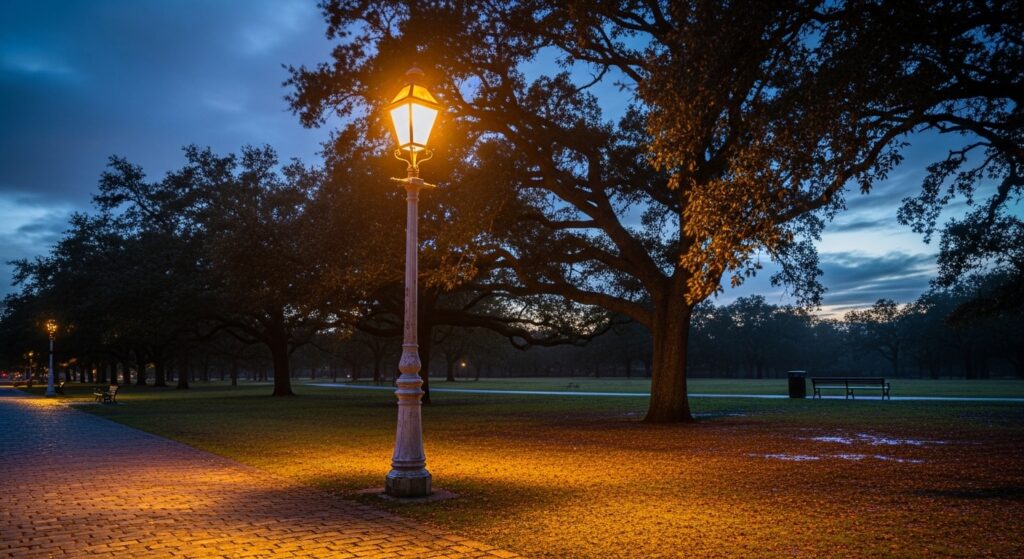
| Decorative Lantern | Heritage homes, upscale entries | 2.1-2.7 m (7-9 ft) | Traditional, warm |
Post top lights are the most popular for residential driveways. They sit on a pole, usually aluminum or steel, and cast light downward in a wide pattern. Classic look. Works with pretty much any home style.
Arm-mounted fixtures give you more reach. If your driveway is long or wide, these pole mounted outdoor lights cover more ground from fewer poles. You see these a lot on commercial properties and multi-unit residential buildings.
Bollards are shorter and work as edge markers. They won’t light a whole driveway on their own, but they’re great for defining curves and borders.
Street pole lights are what you see on municipal roads and public driveways. Taller, higher-output, and built for large-scale area lighting. Overkill for a residential driveway, but common for government facilities and transit properties.
For most Canadian driveways, a post top LED pole light in the 7 to 10 foot range hits the sweet spot between coverage and aesthetics.
Read more: What to Look for When Choosing LED Street Lights
Weatherproof Outdoor Pole Lights: What IP Rating Do You Need?
Canada throws freezing rain, heavy snow, salt spray, and UV at outdoor fixtures. Your pole lights need to handle all of it. That’s why choosing weatherproof pole lights matters so much here.
- IP65 (dust-tight, protected against water jets): The minimum for Canadian outdoor use.
- IP66 (handles powerful water jets): Better for coastal areas or locations exposed to pressure washing and heavy weather.
Don’t go lower than IP65. A fixture rated IP54 might work under a covered porch, but pole mounted outdoor lights exposed to freezing rain and ice buildup? Not worth the risk. Also check for an operating temperature range of -40°C to +50°C. Anything less and you’ll have problems in January.
Weatherproof outdoor pole lights with die-cast aluminum housings hold up best against corrosion. They outperform sheet metal, especially in regions where road salt is heavy.
How Many Lumens Do You Actually Need?
This is where most guides get vague. “Bright enough” isn’t helpful. So let’s talk numbers.
For residential driveways, you want 700 to 1,300 lumens per fixture. That gives you solid visibility without turning your front yard into a parking lot. For context, a standard 60W incandescent bulb puts out about 800 lumens.
Commercial driveways and building entrances need more. Usually 1,500 to 3,000 lumens per fixture, depending on pole height and spacing. Parking lot pole lights go even higher, typically 13,000 to 30,000 lumens for small lots with poles at 4.6 to 6.1 metres.
Colour temperature matters just as much as brightness:
- 2700K to 3000K (warm white): Best for residential. Creates a cozy, welcoming feel. Flatters landscaping and doesn’t annoy the neighbours.
- 3000K to 4000K (neutral white): Good for commercial entrances and longer driveways where visibility is the priority. This is the standard for most commercial pole lights and area lighting in parking lots.
- 4000K and above (cool white): Too harsh for most driveways. Save this for parking lot pole lights and security applications.
One tip from lighting professionals: aim your fixtures downward. Downlighting reduces light pollution, keeps the night sky visible, and actually creates better contrast on the ground. You see the driveway surface more clearly when light isn’t scattering everywhere.
A growing number of Canadian municipalities are adopting dark sky bylaws. Downward-facing, shielded outdoor pole light fixtures keep you compliant and neighbourly. Worth thinking about before you buy.
Spacing and Placement: How to Avoid the Runway Effect
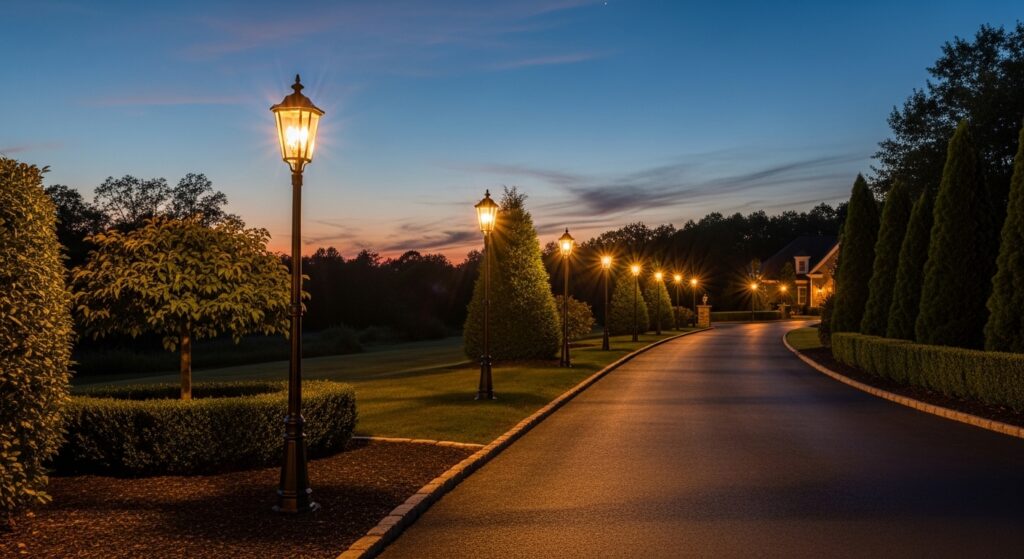
The general rule is to space outdoor light poles at 2.5 to 3 times the mounting height. So if your poles are 3 metres (10 feet) tall, space them 7.5 to 9 metres (25 to 30 feet) apart.
For shorter residential poles at 2.1 to 2.4 metres (7-8 feet), that works out to about 5.5 to 7.3 metres (18 to 24 feet) apart. Most driveways do well with lights every 3 to 4.6 metres (10 to 15 feet) on alternating sides.
Here’s a mistake people make all the time: lining up identical lights in a perfect row on both sides. Looks like an airport runway. Not great. Stagger them instead, alternating left and right. It looks more natural and still gives you even area lighting coverage.
Tighten the spacing at curves, intersections, and anywhere the driveway changes direction. These are the spots where visibility matters most, especially when there’s snow on the ground.
Don’t forget the entrance. A taller post light (or a pair) at the start of the driveway serves as a visual anchor. It helps visitors find your property and gives emergency vehicles a clear marker.
Quick placement checklist: – Pair of lights at driveway entrance – Alternating sides every 3 to 4.6 m (10-15 ft) – Extra light at curves and direction changes – Light near the garage or parking area – Avoid pointing lights toward neighbours’ windows
How to Install an Outdoor Light Pole: Canadian Requirements
Important: 120V outdoor electrical work should be done by a licensed electrician. The information below is for planning purposes. For Ontario, verify requirements with the Electrical Safety Authority (ESA). For other provinces, check with your local electrical inspection authority.
Knowing how to install an outdoor light pole starts with understanding burial depth and foundation requirements. A lot of homeowners get nervous about this part. Fair enough. But understanding the basics means you can either DIY a low-voltage setup or have a real conversation with your electrician instead of just nodding along.
Wire burial depth depends on your system: – Direct burial cable (120V): 600 mm (24 inches) minimum in most Canadian jurisdictions. Some areas allow 300 mm (12 inches) with GFCI protection on the circuit. – Low-voltage wiring (12V): 150 to 300 mm (6 to 12 inches) is usually fine. Check your local code. – In PVC conduit (120V): 450 mm (18 inches) minimum.
Here’s a lesson that keeps coming up in contractor forums. Use PVC conduit. Don’t pour wiring directly into concrete. One homeowner shared how they embedded their wiring in the concrete base and couldn’t repair a failed connection later. The whole base had to be jackhammered out.
Use 25 mm (1-inch) PVC at minimum, not 12 mm (1/2-inch). The larger conduit lets you pull new wire through later if anything fails. Sounds like a small detail. It isn’t.
Frost heave is the real enemy of light poles for outdoor driveway installations in Canada. Your concrete base needs to extend below the frost line, which is about 1.2 metres (4 feet) in most of Ontario and up to 1.8 metres (6 feet) in northern regions. If the base is too shallow, frost pushes the pole out of alignment over winter. By spring, it’s leaning.
A smart technique from experienced installers: set rocks or cement blocks around the base, add a small amount of quickcrete on top, then backfill with soil. This anchors the pole solidly but still lets you dig it out for future repairs. Way better than burying it in a solid block of concrete you can never undo.
Do you need a permit? For 120V circuits in most Canadian cities, yes. All outdoor pole lights for driveways must meet the Canadian Electrical Code (CSA C22.1) when hardwired. Low-voltage landscape lighting (12V) usually doesn’t require a permit. In Ontario, the Electrical Safety Authority (ESA) handles permits and inspections for electrical work. A quick phone call before you start saves headaches later.
Solar vs. Wired Pole Lights: What Actually Works in Canada?
Let’s be honest about solar.
Solar pole lights avoid trenching and wiring costs. That’s a real advantage on long driveways or properties without easy electrical access. But they depend on sunlight to charge, and Canadian winters give you maybe 8 hours of weak December sun in southern Ontario. Less up north. Snow-covered panels don’t charge at all.
Commercial-grade solar pole lights with properly sized panels and lithium batteries cost around $1,000 to $1,500 per unit. They work, but they’re not cheap.
Budget solar lights under $100? They’ll last maybe one season before the battery degrades. Forum users report inconsistent brightness and dead fixtures after the first winter. You get what you pay for.
Wired LED pole lights are more reliable year-round. They cost more upfront for installation (trenching, conduit, electrician), but they deliver consistent brightness every single night regardless of weather. And operating costs? LED uses about 75% less energy than traditional lighting. We’re talking maybe $15 to $30 per year per fixture to run.
Bottom line: if you can run wiring, go wired LED. If trenching isn’t practical, invest in commercial-grade solar. Don’t go cheap on solar. It just doesn’t work up here.
Dusk to Dawn Pole Lights and Smart Controls
You don’t have to walk to the garage to flip a switch. Modern driveway lighting can run itself.
Dusk to dawn pole lights use photocell sensors, the simplest automation option. They turn lights on at dusk and off at dawn automatically. No programming needed. Most outdoor pole light fixtures come with photocell compatibility built in. One tip: mount the photocell facing north in Canada. A south-facing sensor can get tricked by reflected light from snow, causing the fixture to cycle on and off.
Motion sensors add a security layer. Lights stay dim (or off) until someone walks or drives up the driveway. Good for saving energy and notifying you when someone’s approaching.
Smart relays take it further. Devices like the Zooz ZEN16 let you control multiple lighting zones through your smart home system. Set schedules, trigger lights from your phone, or connect them to cameras and doorbells. Some homeowners set up “welcome sequences” that light up the driveway zone by zone as a car approaches. Pretty slick.
The key is making sure your outdoor pole light fixtures are compatible with whatever control method you choose. Look for dimmable LED drivers and standard wiring connections.
Canadian Rebates and Energy Savings
Here’s the part most driveway lighting guides skip entirely. You might get money back.
Provincial utility programmes offer rebates for switching to outdoor pole lights LED:
- Ontario (SaveOnEnergy): Rebates for commercial LED projects. Can cover up to 50% of project costs in some cases.
- BC Hydro: Incentives for commercial lighting upgrades through their Business Energy Saving programme.
- Hydro-Quebec: Programmes for energy-efficient lighting in commercial and institutional buildings.
Even without rebates, the math works. Say you replace five 150W HPS driveway lights with 50W LED equivalents. That’s 500W less every hour they’re on. At 4,000 hours per year and $0.13/kWh (Ontario average), you save around $260 annually. The LED pole lights pay for themselves within 2 to 3 years.
Votatec’s LED pole lights are DLC-qualified, which means they meet the efficiency standards required by most Canadian rebate programmes. Worth checking before you buy.
Maintenance Tips for Canadian Conditions
Weatherproof pole lights are low maintenance. Not zero maintenance. Big difference.
Seasonal checklist:
- Spring: Check outdoor light poles for frost heave damage. Look for leaning, cracked bases, or shifted conduit. Clean lens covers, road salt buildup from winter plowing is real.
- Summer: Trim vegetation growing near fixtures. Overgrown shrubs block light and trap moisture.
- Fall: Test photocells and dusk to dawn controls before winter. Replace any dimming fixtures now, not in January when it’s minus 20.
- Winter: Clear snow buildup around bases. Heavy snow loads can stress mounting brackets on shorter bollard-style lights.
LED fixtures themselves should last 50,000+ hours at L70 rating (per DesignLights Consortium standards). That’s over 12 years at 10 hours per night. But check connections, seals, and gaskets once a year. Water intrusion is what kills outdoor pole light fixtures, not the LEDs themselves.
Frequently Asked Questions
How far apart should driveway pole lights be?
Space outdoor light poles at 2.5 to 3 times the mounting height. For typical 2.4-metre (8-foot) residential poles, that’s 6 to 7.3 metres (20 to 24 feet) apart. On alternating sides of the driveway, 3 to 4.6 metres (10 to 15 feet) between fixtures works well for even coverage.
Do solar driveway lights work in Canadian winters?
Budget solar lights struggle with short winter days and snow-covered panels. Commercial-grade solar units ($1,000+) with lithium batteries and oversized panels perform better, but wired LED pole lights are still more reliable year-round in Canada.
What height should driveway pole lights be?
Residential driveways: 2.1 to 3 metres (7 to 10 feet). Commercial entrances: 3.7 to 6.1 metres (12 to 20 feet). Taller poles cover more area but need wider spacing. Match the height to the scale of your property.
Do I need a permit to install driveway pole lights in Canada?
For 120V hardwired systems, most municipalities require an electrical permit and inspection. Low-voltage (12V) landscape lighting usually doesn’t need a permit. In Ontario, contact the ESA for specific requirements.
What’s the best colour temperature for driveway lighting?
2700K to 3000K for residential driveways. It’s warm, welcoming, and doesn’t create light pollution. 3000K to 4000K for commercial pole lights where visibility is the priority. Avoid 5000K+ unless it’s a pure security application.
Are weatherproof outdoor pole lights necessary in Canada?
Yes. Canadian weather includes freezing rain, heavy snow, salt spray, and extreme temperature swings. Choose weatherproof outdoor pole lights rated IP65 or higher with an operating temperature range of -40°C to +50°C. Anything less risks premature failure.
What to Do This Week
Three things to get right: brightness, spacing, and local codes.
Pick outdoor pole lights for driveways in the 700 to 1,300 lumen range for residential use. Go with warmer colour temperatures (2700K to 3000K). Space your outdoor light poles at 2.5 to 3 times the pole height, alternating sides. And bury your wiring in PVC conduit below the frost line.
If you’re in Canada, check provincial rebate programmes before you buy. You could save 30% to 50% on a commercial installation.
This week: measure your driveway and count how many poles you need. This month: check your local permit requirements and utility rebate programmes. You’ll be surprised how straightforward the project is once you know the specs.
Votatec’s outdoor LED pole lights are designed for Canadian conditions, DLC-qualified for rebate eligibility, and built to handle the freeze-thaw cycle. Request a quote to get started.