








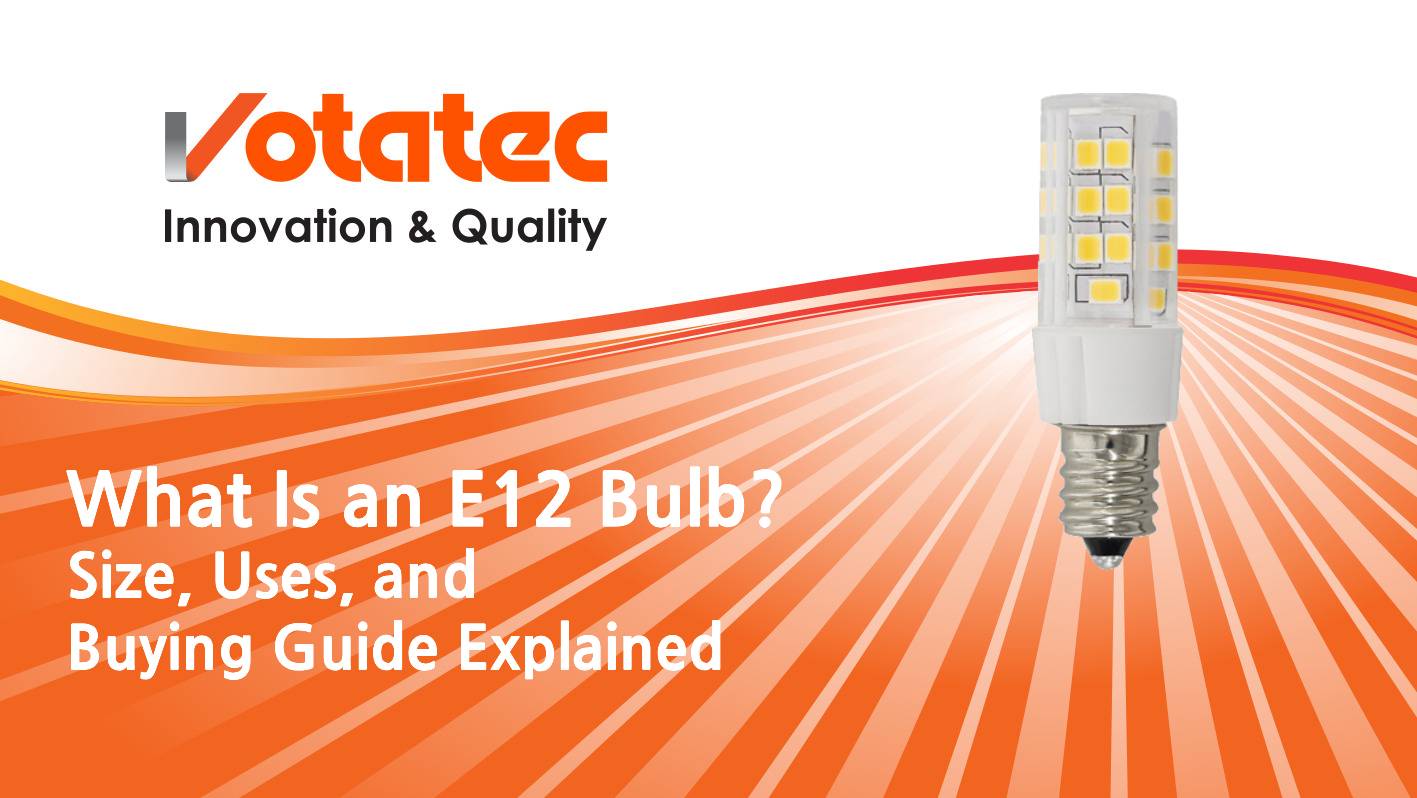

12 millimetres. That’s the whole story behind the E12.
If you’ve ever looked at a chandelier bulb or a small decorative light and wondered what is an E12 light bulb, you’re not alone. It’s one of the most common questions we get at Votatec. And honestly? The answer is simpler than most people expect.
An E12 bulb is a light bulb with a 12mm diameter screw base. The “E” stands for Edison (yes, that Edison), and the “12” refers to the base diameter in millimetres. That’s it. You’ll find these bulbs in chandeliers, wall sconces, night lights, and decorative fixtures across Canadian homes and businesses.
Pretty straightforward once you know what to look for.
Quick Spec Box: E12 Bulb at a Glance
| Specification | Details |
| Base Diameter | 12mm (0.47 inches) |
| Base Type | Candelabra / Small Edison Screw (SES) |
| Common Wattages | 4W-7W LED (25W-60W equivalent) |
| Voltage | 120V (North American standard) |
| Typical Lumens | 250-600 lumens |
| Common Shapes | B10, C7, CA10, G16, G14 |
| Certifications | CSA, Energy Star, cUL Listed |
What Does E12 Light Bulb?
So what does E12 mean on a bulb exactly? Let’s break it down.
The naming convention comes from Thomas Edison’s original screw-in bulb design from the 1880s. Every Edison base follows the same pattern: the letter “E” followed by a number. That number is always the diameter of the base in millimetres.
The E12 bulb meaning is literally “Edison base, 12 millimetres wide.”
Here’s why this matters. When you’re replacing a bulb, you don’t need to guess. Just measure the base. If it’s about 12mm across (roughly half an inch), you need an E12. If it’s closer to 26mm (about an inch), that’s an E26, which is the standard bulb size in North America.
Simple system. Works every time.
The E12 is also called a “candelabra base” because it’s the standard size for candle-shaped decorative bulbs. You’ve seen them in chandeliers, wall sconces, and those fancy decorative fixtures in restaurants and hotels.

E12 Bulb Size and Base Dimensions
Understanding the E12 bulb base size helps you avoid buying the wrong bulb. Trust us, it happens more than you’d think.
So what is an E12 bulb base in practical terms? It’s a small screw base that measures exactly 12mm in diameter. The threads are designed for a snug fit in candelabra sockets, which are common in decorative lighting throughout Canada.
Here are the key measurements:
- Base diameter: 12mm (0.47 inches)
- Thread pitch: Standard Edison screw
- Base height: Approximately 15-18mm depending on bulb style
The overall bulb length varies based on shape. A B10 candle bulb might be 90mm long, while a G16 globe could be 80mm. Always check your fixture’s clearance before ordering.
E12 Bulb Size Chart: Quick Reference
| Bulb Shape | Typical Length | Typical Diameter | Best For |
| B10 (Torpedo) | 85-95mm | 35mm | Chandeliers, wall sconces |
| C7 (Small Candle) | 50-55mm | 22mm | Night lights, indicator lights |
| CA10 (Flame Tip) | 90-100mm | 35mm | Decorative chandeliers |
| G16 (Globe) | 75-85mm | 50mm | Vanity mirrors, pendant lights |
| G14 (Small Globe) | 65-75mm | 45mm | Decorative fixtures |
| ST48 (Edison Style) | 120-130mm | 48mm | Exposed bulb fixtures |
Pro tip: Before ordering, measure your existing bulb from base to tip. And measure the socket opening on your fixture. Nothing worse than a bulb that doesn’t fit.
E12 vs E26 Bulb: Key Differences
The E12 vs E26 bulb comparison comes up constantly. Both are common in Canadian homes, but they’re not interchangeable. At all.
Here’s the quick version: E12 is the small candelabra base, E26 is the standard household base. You can’t put an E12 in an E26 socket or vice versa. Well, technically you could try. But it won’t work.
| Feature | E12 Bulb | E26 Bulb |
| Base Diameter | 12mm | 26mm |
| Common Name | Candelabra / SES | Standard / Medium |
| Typical Use | Decorative fixtures, chandeliers | Table lamps, ceiling fixtures |
| Wattage Range (LED) | 4W-7W | 8W-15W |
| Lumen Range | 250-600 | 800-1600 |
| Socket Size | Small | Standard |
The E26 is what most Canadians think of as a “normal” light bulb. It’s the one in your table lamps, ceiling fixtures, and garage door openers. The E12 is smaller, designed specifically for decorative and accent lighting.
Why does this matter? Because mixing them up is a common mistake. Make sure you know which socket you’re dealing with before you buy.
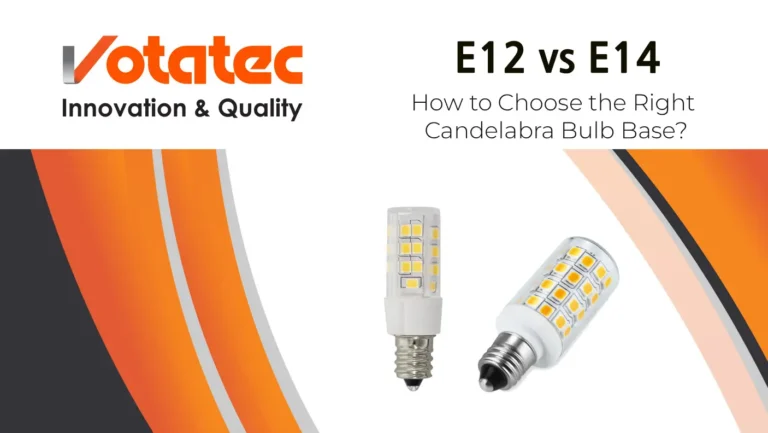
E12 vs E14 Bulb: Which One Do You Need?
Here’s where things get a bit tricky for Canadians who shop internationally. The E12 vs E14 bulb question matters more than you might think.
Both are candelabra-style bases. Both look almost identical. But there’s a 2mm difference that makes them completely incompatible.
| Feature | E12 Bulb | E14 Bulb |
| Base Diameter | 12mm | 14mm |
| Standard Region | North America | Europe, UK, Australia |
| Voltage | 120V | 220-240V |
| Thread Pattern | Edison screw | Edison screw |
| Availability in Canada | Very common | Less common |
The E12 vs E14 difference comes down to geography. E12 is the North American standard. E14 is the European standard. If you’ve bought a light fixture from IKEA or imported something from overseas, it might have E14 sockets.
Important: Even if an E14 bulb physically fits in an E12 socket (it won’t, but hypothetically), the voltage difference matters. European fixtures run on 220-240V. Canadian power is 120V. Using the wrong bulb in the wrong fixture can damage both.
Bottom line? Check your fixture’s origin. Canadian and American fixtures use E12. European imports typically use E14. When in doubt, measure the socket diameter.
Common Uses for E12 Candelabra Bulbs
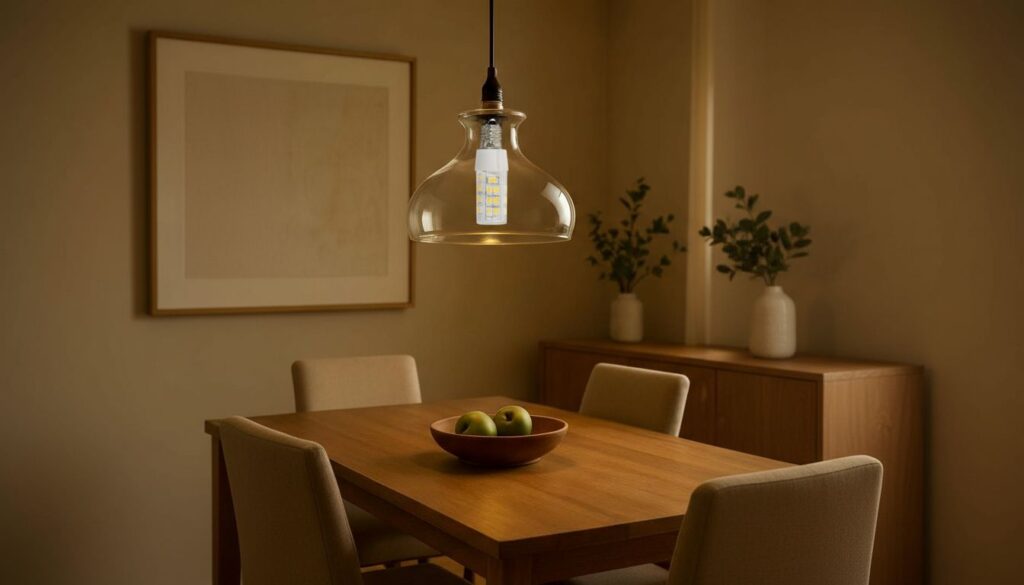
E12 bulbs show up everywhere once you start looking. They’re the go-to choice for decorative lighting in both residential and commercial spaces.
Chandeliers and Pendant Lights
This is the classic E12 application. Most chandeliers in Canadian homes use E12 candelabra bulbs. The small base allows for elegant, compact fixture designs. And the candle-shaped bulbs look great in exposed or semi-exposed settings.
Wall Sconces
Hallway sconces, bathroom vanity lights, exterior coach lights. Many of these use E12 bases because the fixtures are designed for smaller, decorative bulbs. The compact size works well in tight spaces.
Night Lights and Accent Lighting
Those plug-in night lights in your hallway? Usually E12. Small accent lamps on shelves or mantels? Often E12 as well. The low wattage and small form factor make them perfect for these applications.
Decorative Table Lamps
Some decorative lamps, especially vintage-style or candelabra designs, use E12 sockets. Always check before assuming a lamp takes the standard E26.
Commercial Applications
Restaurants, hotels, and retail stores use E12 bulbs extensively in decorative fixtures. Chandeliers in lobbies. Sconces in dining rooms. Accent lighting in display areas. The small base allows for more elegant fixture designs.
How to Choose an E12 Bulb for Your Fixture?
Knowing how to choose an E12 bulb comes down to four factors: brightness, colour temperature, shape, and dimmability. Get these right and you’re set.
Why Switch to an E12 LED Bulb?
If you’re still using incandescent E12 bulbs, it’s time to switch. Honestly, there’s no good reason not to at this point.
An E12 LED bulb uses about 85% less energy than an equivalent incandescent. A 5W LED produces the same light as a 40W incandescent. That’s a big difference on your hydro bill, especially if you have a 12-bulb chandelier running for several hours daily.
Here’s what LED gets you:
- Energy savings: 75-85% reduction in power consumption
- Lifespan: 15,000-25,000 hours vs 1,000 hours for incandescent
- Heat reduction: LEDs run cool, safer for enclosed fixtures
- Better light quality: Higher CRI options available
- Dimmable options: Many E12 LEDs work with standard dimmers
The math is simple. A chandelier with 8 incandescent bulbs at 40W each uses 320W. Replace them with 5W LEDs and you’re at 40W total. Same light, fraction of the energy.
According to Natural Resources Canada, LED bulbs are the most energy-efficient lighting option available to Canadian consumers.
E12 Bulb Equivalent Wattages
The E12 bulb equivalent chart helps you match your old incandescent wattage to the right LED.
| Incandescent Wattage | LED Equivalent | Approximate Lumens |
| 25W | 3W | 250 lumens |
| 40W | 5W | 400-450 lumens |
| 60W | 7W | 550-600 lumens |
Most E12 fixtures are designed for 25W-60W incandescent bulbs. Check your fixture’s maximum wattage rating before installing any bulb. But here’s the thing, LED wattage is so low that you’ll almost never exceed fixture limits.
Colour Temperature Options
Colour temperature affects the mood and functionality of your lighting. It’s measured in Kelvin (K).
- 2700K (Warm White): Soft, yellowish light. Best for living rooms, bedrooms, dining areas. Creates a cozy atmosphere.
- 3000K (Soft White): Slightly less yellow, still warm. Good for kitchens, hallways, bathrooms.
- 4000K (Cool White): Neutral, clean light. Better for task lighting, offices, commercial spaces.
- 5000K+ (Daylight): Bright, bluish-white. Not common in decorative E12 applications.
For chandeliers and decorative fixtures, 2700K is usually the right choice. It mimics the warm glow of traditional incandescent bulbs. Some people prefer 3000K for a slightly crisper look.
Bulb Shapes for E12 Fixtures
E12 bulbs come in several shapes. Each has its place.
B10 (Blunt Tip / Torpedo): Classic candle shape with a rounded tip. The most common choice for chandeliers.
CA10 (Flame Tip): Candle shape with a bent, flame-like tip. More decorative, often used in visible fixtures.
C7 (Small Candle): Smaller version, common in night lights and indicator applications.
G16 (Globe): Round, globe-shaped. Popular for vanity mirrors and pendant lights.
ST48 (Vintage Edison): Elongated shape with visible filament-style LEDs. Great for exposed bulb fixtures.
Match the shape to your fixture’s aesthetic. If your chandelier has upward-facing sockets, flame tips look great. Downward-facing? B10 or globe shapes work better.
Dimmable vs Non-Dimmable
Not all E12 LED bulbs are dimmable. This matters.
If your fixture is on a dimmer switch, you need dimmable LEDs. Using non-dimmable bulbs on a dimmer causes flickering, buzzing, and premature failure. Check the packaging.
Also important: not all dimmers work well with LED bulbs. Older incandescent dimmers can cause issues. If you’re getting flickering or limited dimming range, you might need an LED-compatible dimmer. Look for dimmers rated for LED or CFL use.
Canadian Certifications for E12 Bulbs
When buying E12 bulbs in Canada, certifications matter. Look for these marks.
- CSA Certification
The CSA Group certification confirms a product meets Canadian electrical safety standards. Any bulb you buy should have the CSA mark or cUL listing. This isn’t optional, it’s required for electrical products sold in Canada.
- Energy Star
Energy Star certified bulbs meet strict efficiency requirements set by Natural Resources Canada and the US EPA. They use less energy, produce less heat, and last longer. Look for the Energy Star logo if efficiency is a priority.
- DLC Listing
The DesignLights Consortium maintains a qualified products list for commercial lighting. While less common for residential E12 bulbs, DLC certification matters for commercial applications where utility rebates are available.
- Voltage Compatibility
All E12 bulbs sold in Canada should be rated for 120V. This is the standard Canadian voltage. If you’re importing bulbs from Europe or Asia, verify the voltage rating. Using a 220V bulb on a 120V circuit won’t work properly.
For electrical safety standards in Ontario, the Electrical Safety Authority provides guidelines on approved lighting products.
FAQ About E12 Bulbs What Is an E12 Bulb
1- Can I use an E12 bulb in an E26 socket?
No. The base sizes are completely different. An E12 base is 12mm diameter, while an E26 is 26mm. The E12 will be too small and won’t make contact with the socket. You’d need an adapter, but honestly, it’s better to just buy the correct bulb for your fixture.
2- Are E12 and candelabra bulbs the same thing?
Yes, in North America they are. “E12” is the technical designation, “candelabra” is the common name. When you see “candelabra base” on packaging in Canada, it means E12. Same bulb, different label.
3- How many lumens do I need in an E12 bulb?
It depends on the application. For ambient chandelier lighting, 250-400 lumens per bulb is usually sufficient. For task lighting like a vanity mirror, go higher, around 450-600 lumens. A 12-bulb chandelier with 300-lumen bulbs gives you 3,600 total lumens, which is plenty for most dining rooms.
4- Can I use E14 bulbs in my Canadian fixture?
Not directly. E14 bulbs are 2mm larger than E12 and won’t fit properly. Plus, many E14 bulbs are designed for European 220V power. If you have an imported European fixture with E14 sockets, you’ll need to source E14 bulbs rated for 120V, or replace the sockets.
5- How long do E12 LED bulbs last?
Quality E12 LED bulbs last 15,000 to 25,000 hours. At 3 hours of daily use, that’s roughly 14-23 years. Compare that to incandescent bulbs at 1,000 hours (less than a year at the same usage). LED costs more upfront but saves significantly over time.
Find the Right E12 Bulb for Your Fixture
Now you know what an E12 bulb is, how to measure for it, and what to look for when buying. The E12 candelabra base is a North American standard for decorative lighting, and LED versions offer major energy savings over incandescent.
Quick recap:
- E12 = 12mm diameter Edison screw base
- Also called candelabra or small Edison screw (SES)
- Common in chandeliers, sconces, night lights
- LED versions use 85% less energy than incandescent
- Always verify certifications (CSA, Energy Star) for Canadian use
Votatec carries a full range of CSA-certified E12 LED bulbs in various shapes, colour temperatures, and wattages. All our products are designed for Canadian electrical standards and backed by reliable warranty coverage.
Browse our E12 LED bulb collection to find the right fit for your fixtures.