









You picked the wrong overhead system. Now you’re rewiring an entire retail floor three months after opening. Sound familiar? It happens more often than you’d think, and it’s almost always because someone confused track lighting with a busway system like busSTRUT.
Here’s the short version. Track lighting is built for illumination only – you mount fixture heads on a rail, aim them where you want light, and that’s it. A busSTRUT system does something fundamentally different. It’s a full overhead infrastructure that carries lighting, power distribution, and data all on one structural channel.
In Canadian commercial buildings, lighting accounts for around 15% of total energy use (NRCan, 2020). Choosing the right system from the start saves money, time, and a lot of headaches down the road.
TL;DR: Track lighting is a fixture-focused system for directing light in small to mid-sized spaces – it costs $10-$50 per linear foot and handles lighting loads only. BusSTRUT is a full power-and-lighting infrastructure supporting 20A to 1,250A+ loads, built for large commercial spaces that need lighting, power drops, and data on one overhead system. Pick track for boutiques and galleries. Pick busSTRUT for warehouses and large retail.
What Is Track Lighting?
The global track lighting market is growing at a 4.8% CAGR through 2035, with commercial retail making up about 35% of end-use demand (IndexBox, 2026). That growth makes sense. Track lighting does one thing well – it puts light exactly where you need it.
Look, it’s simpler than most spec sheets make it sound. The system has four basic parts:
- A rigid or suspended rail mounted to a ceiling or wall
- Internal conductors (busbars) inside the rail that supply power
- Fixture heads that clip onto the track and draw electricity
- Connectors and hardware – feed points, joiners, end caps
That’s pretty much it. The whole point is flexibility in where your light goes, not in what the system can carry.

Where Does Track Lighting Work Best?
These rail-mounted systems show up in spaces where directional or accent lighting matters most. Retail boutiques. Art galleries. Showrooms. Residential kitchens. Anywhere you need to highlight a product, a painting, or a work surface and might want to move that light later.
Why do people pick it? A few reasons:
- You can aim and reposition heads without touching the wiring
- Upfront cost is lower – track rail runs around $10-$50+ per linear foot, with fixture heads adding $20-$200 each (Homewyse, 2025)
- Installation is straightforward in smaller or finished spaces
But here’s the deal – this type of setup doesn’t do much beyond illumination. It won’t support power drops for display monitors. It can’t carry data cables or heavy signage. And if your layout changes dramatically, you’ll probably need new wiring runs anyway. Make sense?
So when does it fall short? Basically any time you need your ceiling to do more than just hold lights. That’s where busSTRUT comes in.
What Is a BusSTRUT Lighting System?
The global busway market hit $14.59 billion in 2025 and is projected to reach $21.99 billion by 2034 at a 5.27% CAGR (Fortune Business Insights, 2025). That kind of growth tells you something – buildings are getting more complex, and they need overhead systems that do more than just hold lights.
A busSTRUT system combines a busway (electrical distribution) with structural steel channel support. Think of it as the backbone of your ceiling infrastructure. Not just lighting. Everything. And honestly, once you see one in action in a warehouse or big retail floor, a simple rail-and-heads setup starts to look pretty limited.
Here’s what goes into one:
- Heavy-gauge steel channel serving as both structural rail and mounting surface
- Embedded busbars (copper or aluminum) for power distribution
- Pre-wired runs with tap-off fittings, jumpers, and feeders
- Multi-purpose mounting for lighting, signage, data drops, AV gear, and more
The big difference? Busway systems are rated from 20A all the way up to 1,250A+ depending on the application (Eaton, 2025). A standard rail system? Typically 15A-30A per circuit. Big gap.
Where Does BusSTRUT Belong?
Large, open-ceiling spaces that need more than just light. Warehouses. Big-box retail. Industrial floors. Labs. Any facility where you’re running lighting, power outlets, data ports, and signage from the same overhead grid.
Why go this route?
- High structural capacity – supports fixtures, signs, and equipment on one rail
- Power, data, and lighting all integrated into a single system
- You can add or move tap-off points without rewiring from scratch
The catch? Higher upfront cost. More planning needed. And honestly, it’s overkill for a small boutique that just needs accent lighting. Right tool for the right job. Just being practical here.
How Do Track Lighting and BusSTRUT Compare?
According to ENERGY STAR (2025), lighting accounts for 17% of all electricity consumed in US commercial buildings, and LED upgrades can cut that by up to 90%. Whether you’re using track or busSTRUT, LED fixtures should be the default. The real question is what sits behind those fixtures.
Here’s a side-by-side breakdown:
| Feature | Track Lighting | BusSTRUT (Busway) |
| Primary function | Illumination only | Power distribution + lighting + data |
| Amperage range | 15A-30A per circuit | 20A-1,250A+ (scalable) |
| Voltage | 120V-277V | 120V, 208V, 240V, 480V |
| Cost (rail/track) | $10-$50+ per linear foot | Higher upfront, lower total cost over 5+ years |
| Installation time | 2-6 hours per run | Up to 50% faster than conduit for busway |
| Load types | Light fixtures only | Lighting + power drops + data + signage |
| Structural capacity | Lightweight – fixtures only | Heavy-gauge steel – supports equipment loads |
| Reconfiguration | Slide heads along track | Plug-and-play tap-offs at any point |
| Best for | Boutiques, galleries, showrooms | Warehouses, big retail, industrial |
The thing is, this isn’t really an either-or decision for most projects. The systems serve different purposes. Comparing them is like comparing a desk lamp to the electrical panel in your building. One illuminates. The other distributes power.
And here’s a stat that drives the point home: 84% of manufacturers make at least one significant change to their electrical distribution layout every year (Starline Power, 2025). If your space is going to change – and it probably will – your overhead system needs to handle that.
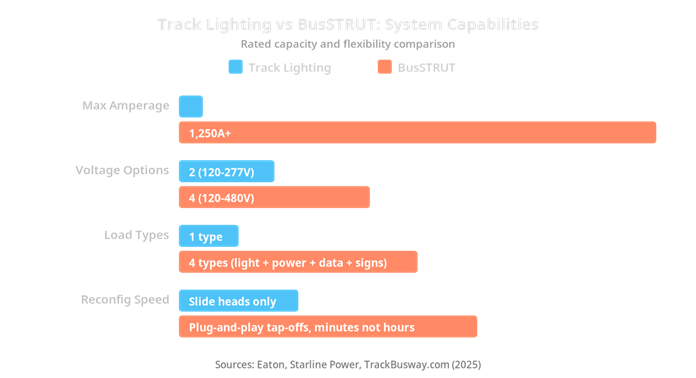
Track lighting handles basic illumination loads. BusSTRUT systems support multi-circuit power distribution, data, and signage on a single overhead infrastructure.
Decision Guide: Which Scenario Fits Which System
Track busway systems install up to 50% faster than traditional conduit, and repositioning takes minutes instead of hours (TrackBusway.com, 2025). But speed doesn’t matter if you’ve picked the wrong system. Here’s a quick decision guide:
| Your Situation | Best Fit | Why |
| Small retail or boutique, accent/task lighting, minimal changes | Track Lighting | Lower cost ($10-$50/ft), focused on illumination |
| Large showroom or warehouse with power/data needs and changing layouts | BusSTRUT | Supports lighting + power + data, 20A-1,250A+ rated |
| Open-ceiling commercial space planning future upgrades | BusSTRUT | Add tap-offs and reconfigure without rewiring |
| Residential or small gallery with tight budget and aesthetic focus | Track Lighting | Simple install, cost-effective for lighting only |
| Industrial floor or lab needing AV, signage, and equipment overhead | BusSTRUT | Heavy structural support, multi-voltage (up to 480V) |
How Do You Choose the Right System?
LED commercial lighting upgrades typically pay for themselves within 1-3 years (eLEDLights, 2025). But the payback depends on picking the right infrastructure behind those LEDs. Here are the three things that should drive your decision.
What Does Your Space Actually Need?
Look, start with these questions. Don’t skip them.
- How big is the space? What’s the ceiling height – open or suspended?
- Are you only mounting lights, or do you also need power drops, data cables, AV equipment, or signage overhead?
- How often will the layout change? Monthly? Yearly? Never?
If your answer to the second question is “just lights,” a rail-mounted system is probably your best bet. If you need anything else up there – power, data, signs – you’re looking at busSTRUT territory.
What’s the Real Cost Over 5 Years?
Upfront price isn’t the whole story. A rail system costs less to install initially. No question. But what happens when your tenant changes, your displays move, or you need to add power drops for digital signage?
With busSTRUT, the upfront investment is higher. But you’re not calling an electrician every time something moves. You just add a tap-off fitting and plug in. Over 5 years in a dynamic space, busSTRUT often costs less overall because it cuts labour for every future change.
Here’s the thing – in Ontario, programs like SaveOnEnergy can cover a portion of your commercial lighting upgrade costs through rebates. Other provinces have similar programs through their hydro utilities. Always check what’s available before you finalize budgets.
Can Your Building Handle It?
Check the structural basics. Does the ceiling support heavy-gauge steel channel? Are there enough hang-points? What amperage do your circuits need now, and what might they need in three years?
For busSTRUT specifically, you’ll need to plan feeder circuits, trunking length, tap-off locations, and structural supports. And in Canada, make sure everything meets CSA standards for electrical installations. Not optional.
Explore Votatec’s LED fixtures – including track lighting and architectural linear options designed for Canadian commercial applications.

Maintenance and Long-Term Value
LED fixtures last 50,000+ hours on average. That’s over 11 years at 12 hours a day. The fixtures themselves aren’t the maintenance concern. It’s the system behind them.
Rail system maintenance is straightforward. Replace a head, reposition it, adjust the aiming. Simple. But if you outgrow the setup or need to add power and data overhead, you hit a wall. The system just wasn’t built for that.
BusSTRUT maintenance takes a different approach. The infrastructure is designed for change. Adding a new lighting run, a power tap, or a data port later? That’s a standard operation, not a renovation project.
Here’s what we’ve found works for both systems:
- Use LED fixtures across the board – they use up to 90% less energy than incandescent and last up to 25 times longer (U.S. DOE, 2025)
- Schedule periodic inspections of connectors, hangers, and tap-off points
- Document your layout and circuitry – especially with busSTRUT, so future changes go smoothly
- Follow manufacturer spacing and load capacity guidelines
Worth noting: if widespread LED adoption were applied across all Canadian commercial buildings, the energy savings would be massive. NRCan data shows commercial building energy use for lighting reached 170.3 PJ in 2018, up 27% from 2000 levels (NRCan, 2020). There’s still a lot of room for improvement.
How much could you save? According to the Illuminating Engineering Society, proper lighting design combined with LED technology can reduce a facility’s lighting energy consumption by 50-70%. That’s not a small number. And the payback period for most commercial LED upgrades? Around 1-3 years (eLEDLights, 2025). After that, it’s pure savings.
Whether you’re running track or busSTRUT overhead, pairing either system with quality LED light fixtures is where the real energy savings happen.
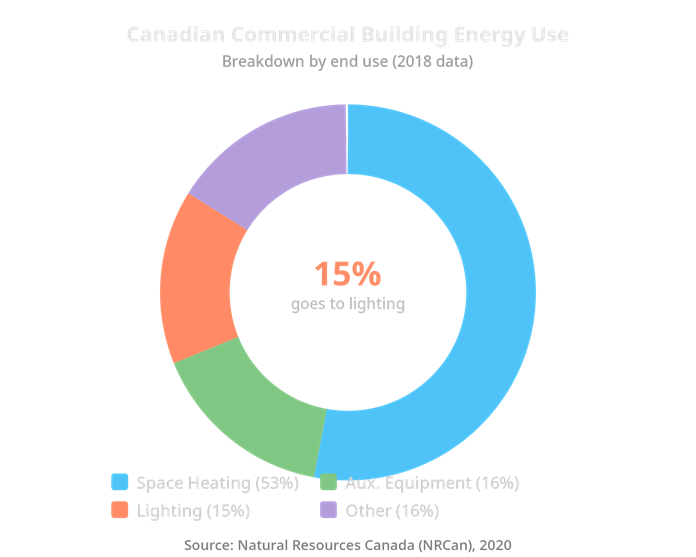
Lighting accounts for 15% of energy use in Canadian commercial buildings. LED upgrades with the right overhead system can reduce this significantly.
FAQs About What’s the Difference Between Track Lighting and BusSTRUT Lighting
What is the main difference between track lighting and busSTRUT lighting?
The main difference lies in their function: track lighting is about lighting fixtures and customizable lighting tracks for illumination, whereas a busSTRUT lighting system (or busway electrical system for lights) is about power distribution lighting, structural support and flexible overhead lighting systems that support lighting among other loads.
Can track lighting systems be used for power/data devices like busSTRUT systems?
No – track lighting is primarily designed to support lighting heads only and does not offer the structural load capacity or power/data distribution of a busSTRUT system. If you need power drops, data ports or heavy signage mounts overhead, a busSTRUT system is the appropriate commercial lighting option.
Is busSTRUT lighting always more expensive than track lighting?
Typically yes in terms of initial cost. However, when considering large spaces, future reconfiguration, lighting for retail and warehouses, and the flexibility of modular lighting solutions and overhead lighting systems, the long‑term cost of busSTRUT often becomes more favorable because it reduces labour, wiring revisions and retrofit work.
Which system is better for a retail store with changing layouts?
If the store layout will change often and you plan to add displays, signage, power/data drops and want to support flexible lighting layouts, then a busSTRUT lighting system is the better fit. If it’s a smaller boutique with simple lighting changes and minimal power/data needs, a track lighting solution might suffice.
Are there retrofit options if I have track lighting and want to upgrade to busSTRUT?
Yes, but retrofitting requires evaluating existing ceiling structure, power circuit capacity, suspension points and layout changes. Transitioning to a busSTRUT lighting system may involve replacing or reinforcing rails, adding feeders/trunks, tap‑off fittings and planning the integrated system of lighting + power + data. Votatec can assist with assessment and transition planning.
Conclusion on What’s the Difference Between Track Lighting and BusSTRUT Lighting
Picking between track lighting and busSTRUT isn’t a style choice. It’s an infrastructure decision. And honestly, it’s one of those decisions that gets a lot more expensive if you get it wrong the first time.
For small spaces where you only need to aim light at products or artwork, a rail system does the job at a lower cost. For large commercial environments where you need lighting, power, data, and the flexibility to reconfigure without rewiring, busSTRUT is the smarter long-term investment. Pretty clear decision once you know what your space actually needs.
Browse Votatec‘s track lighting and LED fixture collections to find CSA-certified options for your next Canadian commercial lighting project.