










 (+1) 905 597 5955


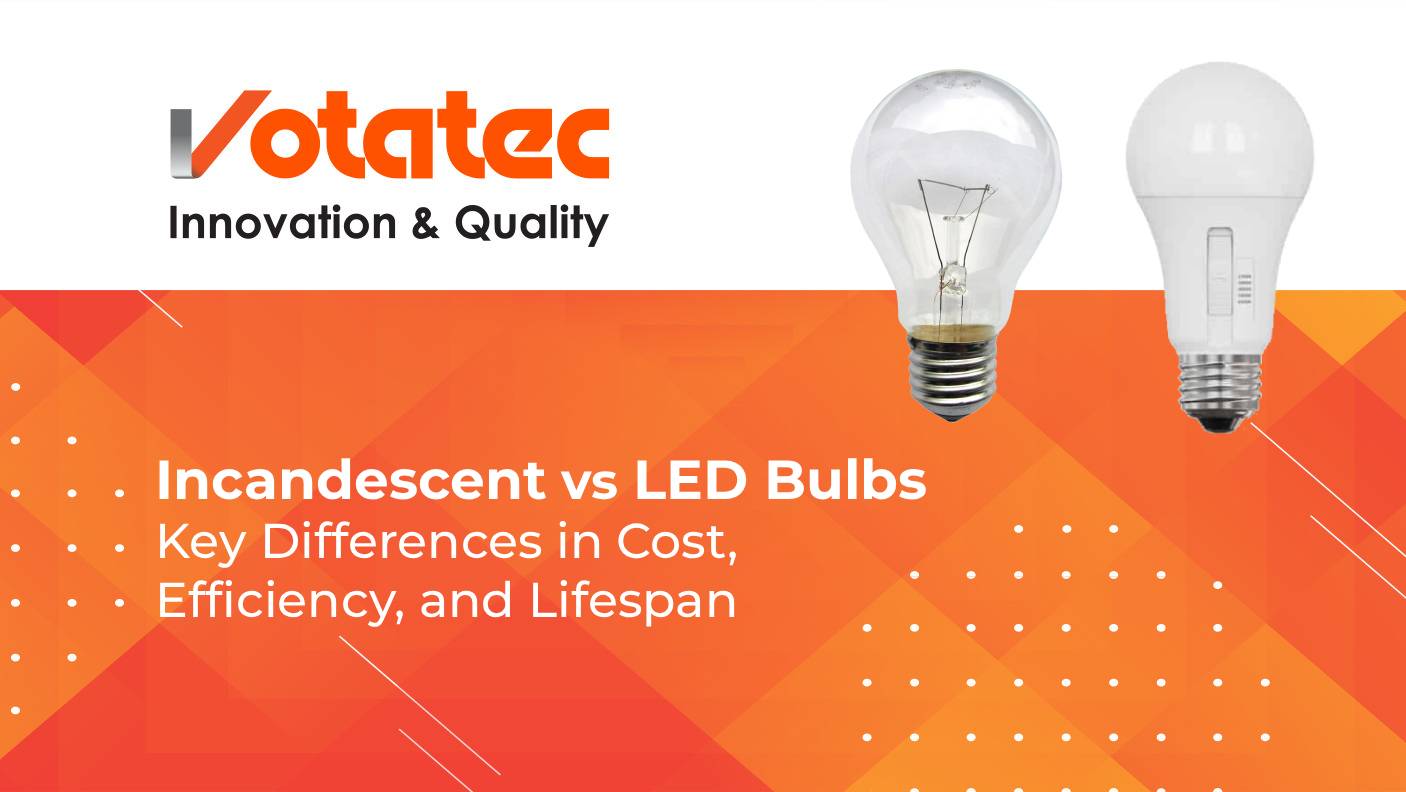

You’re standing in the lighting aisle. One box says 60 watts. The one next to it says 9 watts but “60W equivalent.” A third claims 50,000 hours. They all look like the same shape of bulb.
Which one do you actually buy?
If you manage a commercial building, the question gets bigger. You’re not picking one bulb. You’re picking 500. And the wrong choice costs you thousands in energy and replacements over the next decade.
Here’s the thing. The incandescent vs LED debate isn’t really a debate anymore. But the details still matter, and most guides skip the parts that affect your wallet the most: total cost of ownership, light quality beyond lumens, Canadian regulations, and what those lifespan claims actually mean.
This guide breaks down every difference between LED and incandescent, from wattage and brightness to colour and cost. No vague percentages. Real numbers.
What Is Incandescent Light vs LED?
Before comparing led lights vs incandescent light bulbs, it helps to understand what each technology actually does.
An incandescent bulb is simple. Electricity heats a thin tungsten filament until it glows white-hot. That glow is your light. The problem? About 90% of the energy goes to heat, not light. You’re basically running a tiny space heater that happens to produce some illumination. According to the U.S. Department of Energy, only about 10% of the energy in an incandescent bulb produces visible light.
LEDs work completely differently. A semiconductor chip emits light when electrical current passes through it. Most white LEDs start with a blue LED chip coated in a yellow phosphor layer. The combination of blue light and phosphor-converted yellow/red light creates what your eye sees as white.
Why does this matter? Because that phosphor recipe determines the quality of the light you get. Cheap phosphor blends produce that flat, hollow-feeling white light people complain about. Better phosphor blends produce light that feels natural, almost like sunlight. Same technology, very different results.
And here’s the efficiency gap: LEDs convert roughly 75% of their energy into light, compared to about 10% for incandescent. That’s not a small difference. That’s a completely different category of performance.
So when someone asks what is incandescent light vs LED at the most basic level, the answer is this: one burns a wire to make light. The other uses a chip. The chip wins on pretty much every metric.
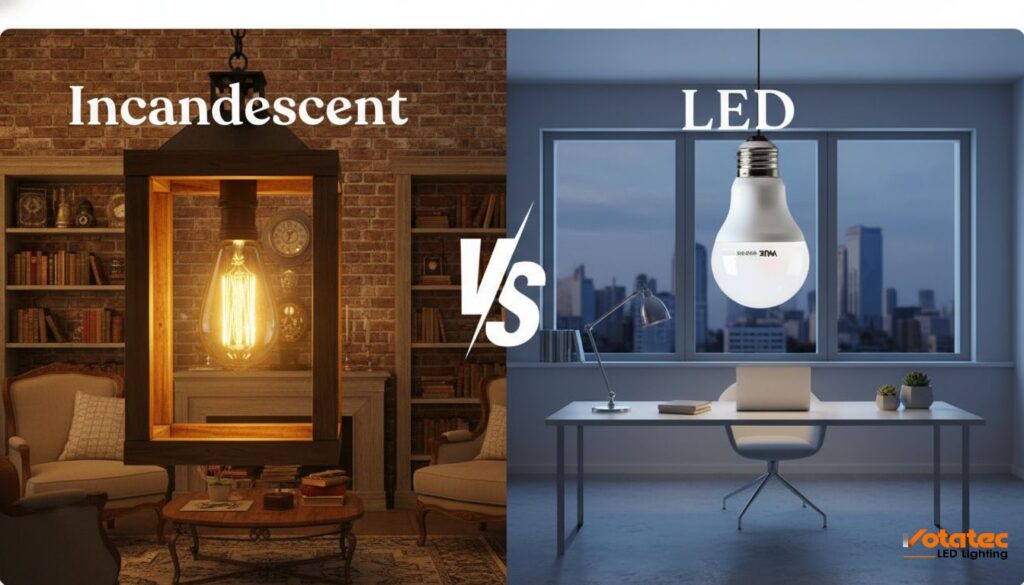
Incandescent vs LED Efficiency: The Numbers That Matter
Most comparisons say LEDs use “up to 80% less energy.” True, but vague. Let’s talk about LED vs incandescent wattage with actual numbers.
| Incandescent Wattage | LED Equivalent | Lumens | Annual Energy Cost* |
|---|---|---|---|
| 40W | 5-6W | ~450 | $2.28 vs $0.34 |
| 60W | 8-10W | ~800 | $3.42 vs $0.57 |
| 75W | 11-13W | ~1,100 | $4.27 vs $0.74 |
| 100W | 14-17W | ~1,600 | $5.70 vs $0.97 |
*Based on 3 hours/day, 365 days/year, at $0.13/kWh (Ontario average residential rate, 2025)
Look at the 60W row. A single incandescent light bulb vs led costs $3.42 per year to run, while the LED costs $0.57. Multiply that by 50 bulbs in a commercial space running 10 hours a day, and you’re looking at roughly $2,850 vs $475 per year.
That’s $2,375 in annual LED energy savings from bulbs alone.
The math isn’t complicated. It’s just that nobody bothers to show it with real numbers. And when you see the incandescent vs LED efficiency side by side like this, the gap is hard to ignore.
For commercial buildings, the numbers scale fast. A 100-fixture office running 4,000 hours per year saves about $4,300 annually switching from 100W incandescent to 17W LED equivalents, at Ontario rates. Payback on the LED fixtures? Usually under two years.
LED Lifespan vs Incandescent: Why “50,000 Hours” Needs Context
Here’s where honesty matters.
LED packaging says 25,000 to 50,000 hours. Incandescent packaging says about 1,000 hours. Pretty straightforward comparison, right? LED lifespan vs incandescent isn’t even close. LEDs last 25 to 50 times longer. Done.
Not quite.
Those LED lifespan numbers refer to the L70 rating, which is the point where the LED chip itself has degraded to 70% of its original brightness. The chip can hit that number. But the bulb as a whole? That’s a different story.
One insight that keeps coming up in lighting forums: the LED chip almost never fails. It’s the driver electronics, the little circuit board that converts your home’s AC power to the DC power the LED chip needs, that dies first. One experienced installer put it this way: around 80% of LED failures happen in the driver, not the chip.
So a $2 LED bulb with a cheap driver might last 2 to 3 years. A commercial-grade LED fixture with a quality driver? That’s where you actually see 50,000 hours. Big difference.
There’s a telling example from the off-grid community. One user reported running 12-volt DC LED systems for over 25 years with zero failures. His AC retrofit LED bulbs, plugged into standard home wiring? Those lasted about 2.5 years each. Same LED technology, different electronics. The driver is the weak link.
What does this mean for you? Buy quality. Look for fixtures from manufacturers who specify driver ratings, not just LED chip hours. And avoid putting LED bulbs in enclosed fixtures without checking the temperature rating. Heat kills drivers.
| Incandescent | Budget LED | Commercial-Grade LED | |
|---|---|---|---|
| Rated Life | ~1,000 hrs | 15,000-25,000 hrs | 50,000+ hrs (L70) |
| Real-World Life | ~1,000 hrs | 2-5 years | 10-15+ years |
| Failure Point | Filament burnout | Driver failure | Driver/capacitor aging |
| Replacements (10 yrs, 10 hrs/day) | ~36 bulbs | 4-8 bulbs | 0-1 fixtures |
LED vs Incandescent Brightness: Same Lumens, Different Visibility
This is the section most guides skip. And it’s the one that matters most to people who’ve actually tried comparing LED vs traditional light bulbs.
A machinist on a trade forum described the problem perfectly. He replaced his workshop’s incandescent lights with LED fixtures that had the same lumen rating. Same brightness on paper. But he couldn’t see fine detail on metal parts anymore. He said he “battles” with visibility under LEDs.
Same lumens. Worse visibility. How?
When people compare incandescent vs LED brightness, they usually look at lumens only. But lumens measure total light output. They don’t measure how well you can actually see under that light. The answer comes down to CRI and spectral completeness.
CRI: The Spec Nobody Talks About
CRI stands for Colour Rendering Index. It measures how accurately a light source reveals the true colours of objects compared to natural light. Incandescent bulbs score a perfect 100 CRI because they produce a continuous spectrum, every wavelength of visible light, similar to sunlight.
Standard LED bulbs? Typically 80 to 82 CRI. They produce a “spiky” spectrum with peaks at certain wavelengths and gaps at others. Your eye gets enough light, but the colour information is incomplete. That’s why people describe cheap LEDs as having a “faux white feel” or light that seems “hollow.”
But high-CRI LED bulbs (90 to 97 CRI) fill those spectral gaps. Users who switch to them describe the light as “almost like sunlight” and “full, not hollow.” Noticeably different experience.
CRI by application:
| Application | Minimum CRI | Recommended CRI |
|---|---|---|
| Warehouses, parking | 70 | 80 |
| General office, retail | 80 | 90 |
| Healthcare, art galleries | 90 | 95+ |
| Colour-critical work | 95 | 97+ |
Incandescent vs LED Colour: Understanding Colour Temperature
Colour temperature is the other half of the incandescent vs LED colour discussion. It’s measured in Kelvin (K), and it determines whether light feels warm or cool:
- 2700K (warm white): Closest to incandescent. Cozy, yellowish. Best for hospitality, residential.
- 3000K-3500K (soft/neutral white): Good balance for offices, retail. This is Votatec’s most popular commercial range.
- 4000K (cool white): Crisp, productive. Common in offices, healthcare, and industrial spaces.
- 5000K+ (daylight): Very bright, bluish. Best for task lighting, colour-matching work.
Incandescent bulbs only produce one colour temperature, around 2700K. LEDs give you the full range. That flexibility is one of the key advantages when comparing LED vs incandescent light bulbs for different spaces.
One user with Seasonal Affective Disorder found that switching from dim incandescent bulbs to 6500K daylight LEDs dramatically improved her mood during Canadian winters. She described herself as “instantly sad and depressed” under dim warm light on cloudy days. Different applications need different colour temperatures. There’s no single “best.”
Votatec’s commercial LED fixtures are available in CRI 90+ across the full colour temperature range. When you’re looking for an LED replacement for incandescent bulbs and want that same light quality, CRI is the spec to check, not just lumens.
LED vs Incandescent Cost: A 10-Year Comparison
Every comparison guide says LEDs “save money long term.” Here’s what the LED vs incandescent cost actually looks like with current Canadian pricing.
Scenario: 10 fixtures, 10 hours/day, 365 days/year, Ontario rate ($0.13/kWh)
| Cost Category | Incandescent (60W) | LED (9W) |
|---|---|---|
| Bulb cost (10 yr) | $180 (360 bulbs at $0.50) | $60 (10 bulbs at $6) |
| Energy cost (10 yr) | $2,847 | $427 |
| Replacement labour* | $900 | $0 |
| Total 10-Year Cost | $3,927 | $487 |
| Savings with LED | $3,440 |
*Labour estimated at $2.50 per bulb change (commercial rate for fixture access). Incandescent needs 36 changes per fixture over 10 years. LED needs zero.
That’s an 88% reduction in total cost. And the LED scenario uses a conservative $6 per bulb. Many quality LED A19 bulbs sell for $3 to $5 in Canada right now. The old claim that LEDs cost “$10 to $20 per bulb” is years out of date.
For a commercial building with 500 fixtures, those savings scale to roughly $172,000 over 10 years. At that level, the question isn’t whether LEDs save money. It’s how fast you can get them installed.
Heat, Safety, and Cold-Weather Performance
Incandescent bulbs run hot. A 100W incandescent reaches surface temperatures of 200 to 260 degrees Celsius. That’s a fire risk in enclosed fixtures and a real concern in recessed ceiling cans with insulation contact. It’s also why they’re restricted in many new energy codes.
LEDs run cool by comparison. Most LED bulbs stay under 60 degrees Celsius at the surface. Lower fire risk. Less strain on air conditioning in summer.
But what about winter? You’ll hear this argument in Canadian forums: “My incandescent bulbs heat my room. LEDs are too efficient, so I need more heating.” It sounds logical. But think about it. Incandescent bulbs are the most expensive heater you could run. At $0.13/kWh, that 100W incandescent “heater” costs about $47 per year for 10 hours a day. An actual electric baseboard heater is more controllable and heats the space where you need it.
And LEDs have a cold-weather advantage that matters in Canada. Incandescent bulbs don’t care about temperature. But LEDs actually perform better in cold conditions. LED drivers operate more efficiently at lower temperatures, and the cooler ambient air helps with heat dissipation from the chip. Most quality LED fixtures are rated to -40 degrees Celsius. They start instantly at full brightness in January. No warm-up period. No flickering. Just light.
Read more: Why Are My LED Lights Flickering? Top Causes and Easy Fixes
For parking garages, building exteriors, and warehouse loading docks in Canadian winters, that instant-on cold performance is a real operational advantage. Votatec’s outdoor LED fixtures are rated to -40 degrees Celsius for exactly this reason.
LED Replacement for Incandescent Bulbs: Dimming, Controls, and Compatibility
Finding the right LED replacement for incandescent bulbs is usually straightforward. Most LED A19 bulbs fit standard E26 sockets, same as incandescent. Screw it in and you’re done.
Dimming is where people get frustrated. And honestly, it’s the one area where incandescent bulbs still win on simplicity. You put an incandescent on a dimmer, it dims smoothly. No compatibility issues.
LEDs are trickier. Here’s why, and how to fix it.
Most older dimmers are leading-edge (TRIAC) dimmers designed for the high wattage of incandescent bulbs (300W to 1000W minimum load). When you swap in a 9W LED, the dimmer can’t regulate that tiny load properly. Result? Flickering, buzzing, or what one forum user called “a disco when I try to dim.”
The fix: trailing-edge (ELV) dimmers designed for LED loads. Lutron, Leviton, and other brands make LED-specific dimmers that handle low wattage smoothly. If you’re retrofitting incandescent to LED in a commercial space, budget for dimmer replacements on dimmed circuits.
Ghost glow is the other common complaint. You switch the LED off, but it stays faintly lit. This happens when a small residual current leaks through the wiring or smart switch, enough to trickle-charge the LED driver. It’s not dangerous, but it’s annoying. A minimum load resistor or a bypass capacitor solves it. Your electrician will know what to do.
Smart controls add another layer of capability. Motion sensors, photocell dusk-to-dawn controls, DALI and 0-10V dimming protocols for commercial buildings. Incandescent bulbs can’t participate in smart building systems. LEDs can. For facility managers, that means occupancy-based lighting, daylight harvesting, and zone control, all of which stack additional LED energy savings on top of the efficiency gains.
Canadian Regulations and Rebates
Here’s the part every other incandescent vs LED comparison misses entirely. Because they’re all written for the U.S. market.
Canada regulates lighting efficiency through the Energy Efficiency Act and NRCan’s Minimum Energy Performance Standards (MEPS). Most traditional incandescent light bulbs no longer meet Canadian efficiency standards. The phase-out has been gradual, but the direction is clear: incandescent is going away.
More relevant for commercial and institutional buyers: provincial utility programmes offer real money back for LED upgrades.
- Ontario (SaveOnEnergy): Rebates for commercial and industrial LED lighting projects. Can cover up to 50% of project costs for qualifying installations.
- BC Hydro: Business incentives for lighting upgrades through their commercial energy efficiency programmes.
- Hydro-Quebec: Programmes supporting energy-efficient lighting for commercial and institutional buildings.
- Efficiency Alberta: Incentives for commercial lighting retrofits.
To qualify for most rebate programmes, your LED fixtures need to be DLC (DesignLights Consortium) qualified. DLC certification confirms the fixture meets specific efficiency, lumen output, and lifespan thresholds. Not all LED products qualify. Check before you buy.
Votatec’s commercial LED fixtures are DLC-qualified and CSA-certified, meeting the standards required by Canadian rebate programmes and building codes. That eligibility can cut your project cost significantly.
Incandescent vs LED: Side-by-Side Comparison
Here’s the full picture. Every key difference between LED and incandescent in one table:
| Feature | Incandescent | LED |
|---|---|---|
| Energy efficiency | ~10% (light), ~90% (heat) | ~75% (light), ~25% (heat) |
| Lifespan | ~1,000 hours | 25,000-50,000 hours (L70) |
| Watts for 800 lumens | 60W | 8-10W |
| Annual cost per bulb* | $3.42 | $0.57 |
| CRI | 100 (by definition) | 80-97 (varies by quality) |
| Colour temperature | ~2700K only | 2700K-6500K (selectable) |
| Dimmable | Yes (all dimmers) | Yes (LED-compatible dimmers) |
| Warm-up time | Instant | Instant |
| Cold-weather performance | Normal | Improved efficiency |
| Mercury content | None | None |
| Heat output | 200-260°C surface | Under 60°C surface |
| Smart controls | Limited | Full integration |
| Canadian availability | Phasing out | Widely available |
| Rebate eligible | No | Yes (DLC-qualified) |
*Based on 3 hrs/day at $0.13/kWh (Ontario average)
FAQs About Incandescent vs LED Bulbs
Are LED bulbs really worth the higher upfront cost?
Yes. A $6 LED bulb saves roughly $2.85 per year in energy compared to a $0.50 incandescent, at Ontario electricity rates. The LED pays for itself in about 2 months of regular use. Over its lifetime, a single LED bulb saves $70 to $140 in energy and replacement costs. The difference between LED and incandescent total cost is significant even at the single-bulb level.
Why do my LED bulbs die faster than the box says?
The lifespan on the box refers to the LED chip under ideal conditions. Real-world failures usually happen in the driver electronics, not the chip. Enclosed fixtures trap heat and accelerate driver failure. Buy fixtures with quality drivers, check the enclosed-fixture rating, and avoid ultra-cheap bulbs if longevity matters.
Can I use LED bulbs with my existing dimmer?
Maybe. Older dimmers designed for incandescent loads (leading-edge/TRIAC) often cause flickering or buzzing with LEDs. You’ll need a trailing-edge or LED-compatible dimmer for smooth performance. Check the LED manufacturer’s dimmer compatibility list before buying.
Do LED bulbs affect sleep or eye health?
Colour temperature matters more than the bulb type. High colour temperatures (5000K+) emit more blue light, which can suppress melatonin production in the evening. For bedrooms and evening spaces, use 2700K warm white LEDs. During daytime work, 4000K to 5000K can actually boost alertness and mood.
Are incandescent bulbs banned in Canada?
Most traditional incandescent bulbs no longer meet NRCan’s Minimum Energy Performance Standards under the Energy Efficiency Act. They’re being phased out. Some specialty incandescent bulbs (appliance, rough-service) remain available, but standard household incandescents are disappearing from Canadian shelves.
What does CRI mean and why should I care?
CRI (Colour Rendering Index) measures how accurately a light reveals true colours. Incandescent scores 100. Standard LEDs score 80 to 82, which is fine for hallways and parking garages but makes colours look washed out in retail, healthcare, and workspaces. Look for CRI 90+ LEDs in any space where colour accuracy matters.
Is LED vs incandescent brightness the same at equal lumens?
Not always. Lumens measure total light output, but CRI and spectral quality determine how well you can actually see under that light. A 90+ CRI LED at 800 lumens will feel brighter and more natural than an 80 CRI LED at the same lumens. For detail work, CRI matters as much as brightness.
Bottom Line: What to Do Next
The incandescent vs LED comparison comes down to three things: efficiency, lifetime cost, and light quality.
LEDs use 75% less energy, last 10 to 50 times longer, and produce better light when you choose the right CRI and colour temperature. The price gap has closed. Quality LED A19 bulbs cost $3 to $6 in Canada. The payback period is weeks, not years.
If you’re still weighing LED vs traditional light bulbs, the numbers in this guide tell the story. Incandescent bulbs cost more to buy (when you count replacements), more to run, and more to maintain. LED wins on every financial metric.
This week:
- Check how many incandescent or halogen bulbs you still have in service
- Calculate your potential savings using the wattage table in this article
- Look up your provincial rebate programme if you manage a commercial building
This month:
- Replace your highest-usage incandescent fixtures first (the ones running 8 to 10+ hours daily)
- Upgrade any dimmer switches on circuits switching to LED
- For commercial projects, verify DLC qualification before purchasing
Votatec‘s LED lighting products are designed for the Canadian market, DLC-qualified for rebate eligibility, CSA-certified, and rated to -40 degrees Celsius. Whether you’re replacing 10 bulbs or 500 fixtures, get in touch for specs and pricing.