










 (+1) 905 597 5955



Your electricity bill just keeps climbing. And if you’re still running metal halides, fluorescents, or HPS fixtures in your facility, about 30% of that energy is turning into heat instead of light. Kind of ridiculous when you think about it.
Here’s the good news. An LED retrofit can cut your lighting energy costs by 50 to 70%. Sometimes more. And with Canadian utility rebates covering 20 to 50% of project costs, the payback period shrinks to under three years for most commercial buildings.
This guide walks you through everything you need to know about planning a commercial LED upgrade with LED retrofit kits. We’ll cover costs, savings math, rebate programs across Canada, how to pick the right retrofit approach, and the step-by-step process to get it done without disrupting your operations.
Whether you manage a warehouse, office tower, retail space, or municipal facility, this is the practical playbook.
What Is an LED Retrofit, Exactly?
An LED lighting retrofit means upgrading your existing light fixtures to use LED technology without ripping everything out and starting from scratch. You keep the housing, the mounting, the wiring. You swap out the guts.
There are three main ways to do it:
Direct lamp replacement (Type A). You pull out the old bulb and screw in an LED version. LED corn bulbs are a good example. They screw right into existing HID, metal halide, or HPS sockets. No rewiring. Takes about five minutes per fixture.
Ballast bypass (Type B). You remove the old ballast and wire the LED lamp directly to line voltage. A bit more work, but it eliminates the ballast as a failure point. Most LED tube replacements for T8 and T12 fluorescents work this way.
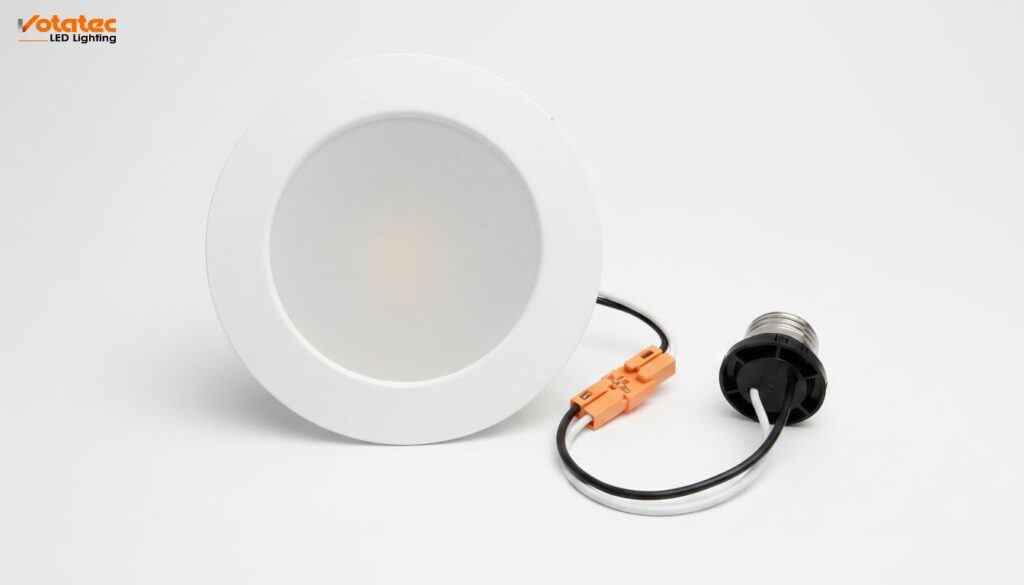
Retrofit kit (Type C). You replace the entire optical assembly inside the fixture, the lamp, driver, lens, reflector, but keep the original housing. This gives you the best light quality and efficiency while avoiding the cost of full fixture replacement.
You may also hear these called LED conversion kits, especially for HID-to-LED swaps. Same concept, different name.
Each approach has trade-offs. We’ll dig into those in a minute.
Why Bother With an LED Retrofit? The Numbers Tell the Story
Look, facility managers don’t make changes because something sounds nice. They make changes because the math works. So let’s talk math.
Energy Savings
Modern commercial LED fixtures use 50 to 70% less energy than the lighting they replace. A 400W metal halide high bay gets swapped for a 150W LED, same light output or better. That’s 250 watts saved per fixture, every hour it’s running.
Here’s some quick math for a mid-sized facility:
- 100 fixtures x 250W savings x 4,000 operating hours/year = 100,000 kWh saved
- At $0.13/kWh (Ontario average): $13,000 annual savings
- At $0.095/kWh (BC Hydro Tier 1): $9,500 annual savings
Pretty good deal. And that’s just the direct energy savings.
Maintenance Savings Most People Forget
Here’s the thing. Energy isn’t even the full picture. LED lamps last 50,000 to 100,000 hours. Your old metal halides? Maybe 15,000 on a good day. Fluorescents? Around 20,000.
That means fewer lamp replacements, fewer maintenance calls, fewer times you need a scissor lift in your warehouse at 6am.
Mike Torres manages a 200,000 square foot distribution centre outside Mississauga. Before his LED retrofit, his maintenance team was replacing roughly 15 HID fixtures per month. Each replacement meant a rental lift, two hours of labour, and the lamp itself. Call it $350 per swap. That’s $63,000 a year just keeping the lights on. After the retrofit? He’s replaced exactly four LED fixtures in 18 months. His maintenance budget dropped by 89%.
HVAC Load Reduction
LED fixtures produce significantly less heat than HID or fluorescent systems. Less heat means your cooling system works less. For facilities with large lighting loads, this hidden benefit can add another 10 to 15% to total savings. Most energy audits miss this one. Honestly, this one’s underrated.
Ready to calculate your specific savings? Contact Votatec for a free lighting assessment and custom ROI projection for your facility.
LED Retrofit vs. Full Fixture Replacement: Which Makes Sense?
This is the question every facility manager asks. And the honest answer is: it depends on your fixtures.
| Factor | LED Retrofit | Full Fixture Replacement |
| Upfront cost | $0.50-$1.50/sq ft | $2.00-$5.00/sq ft |
| Installation time | 15-30 min per fixture | 45-90 min per fixture |
| Disruption | Minimal | Significant |
| Energy savings | 50-65% | 60-75% |
| Light quality | Good to excellent | Excellent |
| Smart controls | Limited options | Full integration |
| Best for | Fixtures under 10 years old | Fixtures 15+ years old |
When Retrofit Is the Right Call
Go with a plan to retrofit LED lighting when your existing fixtures are in decent shape structurally. The housing is fine, the reflectors aren’t corroded, and the wiring is solid. You’re just swapping out the light source.
Retrofit makes especially good sense in:
- Office spaces with standard 2×4 troffer fixtures
- Warehouses with high bay fixtures that have good reflectors
- Parking garages where the fixtures are well-mounted
- Outdoor areas with wall packs or area lights in good condition
When Full Replacement Makes More Sense
If your fixtures are beat up, corroded, or older than 15 years, a retrofit might not be worth it. You’d be putting new technology into a deteriorating shell. Replace instead when:
- Fixture housings are visibly damaged or corroded
- You want integrated smart controls (occupancy sensors, daylight harvesting)
- The existing fixtures use outdated mounting systems
- You’re doing a major renovation anyway
Sarah Chen runs procurement for a school board in the Lower Mainland. When her team evaluated 340 classrooms, they found about 60% of the troffer fixtures were structurally sound. Those got retrofit kits. The other 40% with yellowed lenses and failing ballast clips got full replacements. Splitting the approach saved the district $180,000 compared to replacing everything.
Smart move. Don’t let anyone tell you it has to be all-or-nothing.
How to Choose the Right LED Retrofit Kit
Not all retrofit kits are equal. Here’s what to look for when you’re comparing products.
DLC Qualification
The DesignLights Consortium (DLC) sets performance standards for commercial LED products. If a product is DLC qualified, it means it’s been independently tested for efficiency, light output, colour quality, and longevity.
But here’s why it really matters: most Canadian utility rebate programs require DLC qualification. No DLC listing, no rebate. The DLC released SSL V6.0 requirements in January 2026 with 14% higher efficacy thresholds, so make sure any products you’re evaluating meet the current standard.
Colour Temperature and CRI
For commercial spaces, you’ll typically want:
- Offices: 4000K (neutral white), CRI 80+
- Warehouses: 5000K (daylight), CRI 70+
- Retail: 3500-4000K, CRI 90+ for merchandise displays
- Parking and exterior: 4000-5000K, CRI 70+
Many modern retrofit products, including Votatec’s 5CCT adjustable downlights, let you select colour temperature on the fixture itself. One SKU, five options. Makes stocking and specifying way easier.
Wattage and Lumen Output
Match your replacement to the light levels you actually need, not just what was there before. Old fixtures were often over-lit because the lamps degraded fast. LED stays consistent over its life, so you might not need a one-to-one wattage equivalent.
A rough guide:
| Old Fixture | Typical LED Retrofit Equivalent |
| 400W Metal Halide | 150W LED (same lumens) |
| 250W Metal Halide | 100W LED |
| 32W T8 Fluorescent (4ft) | 15-18W LED Tube |
| 150W HPS Wall Pack | 45-60W LED Wall Pack |
| 100W Incandescent Downlight | 12-15W LED Retrofit |
Dimming and Controls Compatibility
Check whether the retrofit product supports 0-10V dimming, which is the standard in most commercial buildings. Some Type A (direct replacement) lamps don’t support dimming at all. If you want occupancy sensors or daylight harvesting later, make sure the retrofit kit can handle those inputs.
Need help matching retrofit products to your fixtures? Browse Votatec’s commercial LED catalogue or call our technical team for spec-matching support.
Canadian Rebate Programs That Cut Your Costs
This is where the project economics get really interesting. Provincial utility programs can knock 20 to 50% off your LED retrofit project costs. Here are the big ones.
Ontario: Save on Energy Retrofit Program
Ontario’s Save on Energy program offers prescriptive and custom incentives for commercial and industrial lighting upgrades. The program covers interior and exterior LED retrofits, and they updated incentive rates as of June 30, 2025.
What you need to know:
- Products must be DLC qualified
- Pre-approval is required before starting work
- Both prescriptive (per-fixture) and custom (per-kWh saved) pathways available
- Covers lighting controls too, not just fixtures
British Columbia: BC Hydro Business Lighting
BC Hydro offers rebates for commercial lighting upgrades through their business energy programs. For smaller facilities (under 500 MWh/year), rebates can cover up to 75% of project costs. And there’s a 30% bonus incentive for eligible projects submitted between June 2025 and February 2026.
That’s a big window. If you’re in BC and you’ve been waiting, stop waiting.
Quebec: Hydro-Québec Commercial Programs
Hydro-Québec runs energy efficiency programs for commercial customers that include lighting retrofit incentives. Their programs have been restructured under the LogisVert initiative with expanded financial assistance options.
Alberta: Energy Efficiency Alberta
Alberta offers commercial lighting incentives through local utility providers including ENMAX and EPCOR. Specific incentive amounts vary by utility and project scope.
Tips for Maximizing Your Rebate
- Apply before you buy. Most programs require pre-approval. Start the paperwork first.
- Use DLC-listed products. Non-qualified products almost never get rebates.
- Include lighting controls. Adding occupancy sensors and daylight harvesting can increase your rebate by 20 to 40%.
- Get a professional energy audit. Many utilities offer free or subsidized audits for commercial customers.
- Stack incentives. Some facilities can combine utility rebates with federal programs like NRCan’s energy efficiency initiatives.
Step-by-Step: How to Plan Your LED Retrofit Project
Alright, so the business case for an LED lighting retrofit makes sense and you want to move forward. Here’s the practical process.
Step 1: Audit Your Current Lighting
Walk through every space and document what you have. Count fixtures, record wattage, note fixture types, and check fixture condition. You’ll need this inventory for both the retrofit plan and the rebate application.
Record operating hours per zone too. That warehouse that runs 24/7 will have different payback math than the office floor that’s lit 10 hours a day.
Step 2: Set Your Goals
Are you going for maximum energy savings? Better light quality? Both? Are there areas where light levels are currently too low or too high? Do you want dimming or occupancy controls?
Get these sorted before you start shopping. It’ll save you from buying the wrong products.
Step 3: Choose Your Retrofit Approach
Based on your fixture audit, decide which fixtures get retrofitted and which get replaced. Remember Sarah from the school board example. Mix and match if it makes sense financially.
Step 4: Select Products and Get Quotes
Specify DLC-qualified products that match your goals. Get at least three quotes from qualified contractors. Make sure the quotes include:
- Product costs (fixtures, lamps, drivers)
- Installation labour
- Disposal of old lamps (some contain mercury, this matters)
- Warranty terms
- Post-install light level verification
Step 5: Apply for Rebates
Submit your rebate application with your project details before ordering materials. Include your fixture inventory, proposed products, and expected energy savings calculations. Wait for pre-approval.
Step 6: Schedule Installation
Plan the install to minimize disruption. Most commercial retrofits can be done in phases, one floor or zone at a time. A typical office floor (50 to 100 fixtures) takes one to two days. Warehouses with high bays take longer because of lift access.
Step 7: Verify and Commission
After installation, verify light levels in key areas with a light metre. Make sure everything meets your design targets and local building codes. Document everything for your rebate claim.
Then submit your post-installation rebate paperwork. Most programs require invoices, product spec sheets, and sometimes before/after photos.
Common LED Retrofit Mistakes (and How to Avoid Them)
Every electrician and facility manager we’ve talked to has seen these. Don’t be the next cautionary tale.
Mistake 1: Skipping the Rebate Application
James Park retrofitted a 40,000 square foot office building in North York without applying for Save on Energy incentives first. The project cost $45,000. He would have qualified for roughly $12,000 in rebates. That money is gone. You can’t apply retroactively.
Mistake 2: Wrong Colour Temperature
Installing 5000K daylight bulbs in an office creates harsh, clinical light that people hate. You’ll get complaints within a week. Use 3500K to 4000K for offices and retail, save 5000K for warehouses and outdoor areas.
Mistake 3: Ignoring Fixture Condition
Putting a $40 retrofit kit into a corroded fixture that’s going to fail in two years makes zero sense. Inspect first. Replace what needs replacing.
Mistake 4: Not Planning for Controls
If you’re going to add occupancy sensors or daylight harvesting eventually, buy retrofit products that support 0-10V dimming now. Adding controls later can increase total savings by 20 to 40% on top of the LED upgrade.
Mistake 5: Cheap Products Without Certification
Non-DLC, non-CSA products might save you 20% upfront. But they void your rebate eligibility, might not meet electrical code, and tend to fail faster. Not worth the risk.
How Much Does a Commercial Lighting Upgrade Cost?
Budgets matter. The most common question we get: what’s the commercial lighting upgrade cost? Here’s what realistic pricing looks like for Canadian projects in 2026.
| Project Type | Cost per Fixture (Installed) | Typical Facility Cost | Annual Savings |
| Office (T8 troffers) | $60-$120 | $15,000-$35,000 | $8,000-$15,000 |
| Warehouse (high bay) | $150-$350 | $25,000-$75,000 | $15,000-$40,000 |
| Retail (mixed) | $80-$200 | $20,000-$50,000 | $10,000-$25,000 |
| Parking structure | $120-$250 | $15,000-$40,000 | $7,000-$18,000 |
| Exterior (wall packs) | $100-$200 | $8,000-$25,000 | $4,000-$12,000 |
These numbers include product and labour but not rebates. Subtract 20 to 50% for applicable incentives.
The payback math usually works out to 1.5 to 3 years for most facilities. High-bay projects in 24/7 operations can pay back in under 18 months. After payback, every dollar saved goes straight to your bottom line for the remaining 15+ years of LED life.
Get a custom quote for your facility. Contact Votatec for pricing on DLC-qualified LED retrofit products with Canadian inventory and same-week shipping from Toronto, Vancouver, and Calgary.
What About Smart Controls? Are They Worth Adding?
Short answer: yes. But maybe not all at once.
Adding occupancy sensors and daylight harvesting to your LED retrofit can increase total savings by another 20 to 40%. The incremental cost typically pays back in one to two years on top of the base LED upgrade.
Here’s what makes sense by space type:
- Open offices: Daylight harvesting near windows, occupancy sensors in meeting rooms
- Warehouses: High bay occupancy sensors in aisles, reducing light to 50% in unoccupied zones
- Stairwells and washrooms: Occupancy sensors (these areas are empty 80%+ of the time)
- Parking garages: Occupancy-based dimming, keep ambient at 30% and ramp to 100% when motion detected
- Exterior: Photocell + timer for dusk-to-dawn, dimming after midnight
Even if you don’t add controls when you first retrofit LED lighting, plan for them. Select products with 0-10V dimming and make sure your wiring can support sensor integration later.
How Does an LED Retrofit Support ESG and Sustainability Goals?
If your organization reports on sustainability, an LED retrofit is one of the easiest wins you can document. And increasingly, it’s expected.
Commercial lighting accounts for roughly 17% of total electricity consumption in Canadian commercial buildings, according to Natural Resources Canada. Cutting that by 50 to 70% through an LED upgrade has a direct, measurable impact on your carbon footprint.
For LEED-certified or BOMA BEST buildings, LED retrofits contribute points toward energy performance credits. If you’re tracking Scope 2 emissions for ESG reporting, the kWh reduction from a lighting upgrade gives you real numbers to put in front of stakeholders.
And here’s the practical side. Capital projects that align with sustainability targets are easier to get approved. When you can show the CFO that a lighting upgrade pays for itself in 2 years AND supports the company’s net-zero commitments, you’ve got a much stronger business case.
Frequently Asked Questions About LED Retrofits
How long does a commercial LED retrofit take?
Depends on the size. A typical office floor with 50 to 100 fixtures takes one to two days. A 100,000 square foot warehouse might take a week. Most projects are done in phases so you don’t have to shut down operations.
Can you retrofit any fixture to LED?
Most fixtures made in the last 20 years can be retrofitted. The exceptions are fixtures with severe physical damage, outdated wiring that doesn’t meet current code, or specialty fixtures that don’t have compatible LED retrofit kits available.
Do LED retrofit kits need an electrician?
For commercial buildings, yes. The Canadian Electrical Code requires a licensed electrician for any work involving building wiring. Type A (direct lamp replacement) is technically plug-and-play, but for Type B and Type C retrofits, you’ll need a qualified contractor.
What’s the difference between an LED retrofit kit and an LED conversion kit?
They’re the same thing. “Retrofit kit” and “conversion kit” are used interchangeably. Both refer to components that upgrade an existing fixture to LED without replacing the entire fixture housing.
Are LED retrofits eligible for tax deductions in Canada?
LED lighting upgrades may qualify for accelerated Capital Cost Allowance (CCA) under Class 43.1 or 43.2 for energy-efficient equipment. Check with your accountant, as eligibility depends on the specific project scope and equipment specifications.
Bottom Line: Is an LED Retrofit Worth It?
A commercial LED upgrade through retrofit is one of the highest-ROI capital improvements a building owner or facility manager can make. The technology is proven, the savings are documented, and Canadian rebate programs make the economics even better.
Here’s what to remember:
- LED retrofits cut lighting energy by 50-70%, with payback typically under 3 years
- Canadian rebates can cover 20-50% of project costs, but you must apply before starting work
- Retrofit vs. replacement isn’t all-or-nothing, audit your fixtures and mix approaches where it makes sense
- DLC qualification matters for both performance assurance and rebate eligibility
- Don’t forget maintenance savings, they can match or exceed energy savings in high-bay facilities
- Plan for smart controls even if you don’t install them right away
The best time to start was five years ago. The second best time is now. With DLC V6.0 raising efficacy standards and utility incentives still strong across Canada, 2026 is an excellent year to make the switch.
Browse Votatec’s full range of LED retrofit products or request a quote for your next commercial LED upgrade.