













 (+1) 905 597 5955


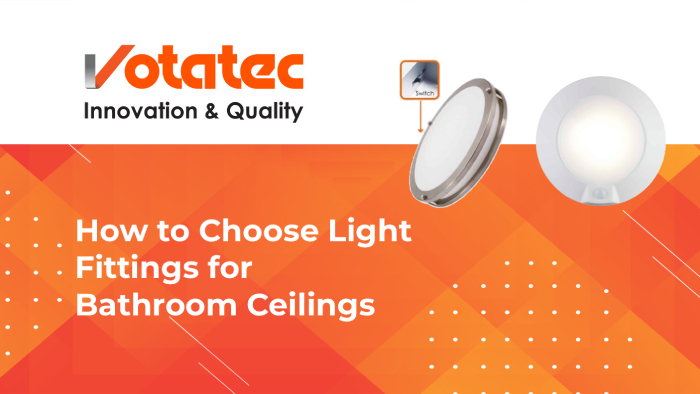

Picking a light fitting for bathroom ceilings comes down to one thing first: moisture. Get the moisture rating right and the rest is style and budget. Get it wrong and you’ve got a code violation, a failed inspection, or a fixture that quietly corrodes for two years.
Here’s the short answer. For a Canadian commercial or institutional washroom, match the fitting to its location. General ceiling areas need a damp-location fixture, usually IP44 or better. Anything over a shower or tub needs a wet-location fixture, IP65 or better. And it has to carry a CSA or cULus mark to pass inspection. That’s the core of it.
Do You Need a Special Light Fitting for a Bathroom?
Yes. Bathrooms and washrooms are wet or damp environments, and the Canadian Electrical Code treats them differently from a dry office or corridor.
A standard ceiling fixture rated for dry locations isn’t legal directly over a shower. It’s not just a rules thing either. Steam carries moisture into the fixture housing, hits the driver and the connections, and the failure shows up months later. Usually at the worst time.
Two systems decide what’s suitable:
- Location classification (Canadian Electrical Code) tells you what’s legally required.
- IP rating (the international IEC 60529 standard) tells you how well a specific fixture resists dust and water.
You read both together. One is the law. The other is the spec sheet.
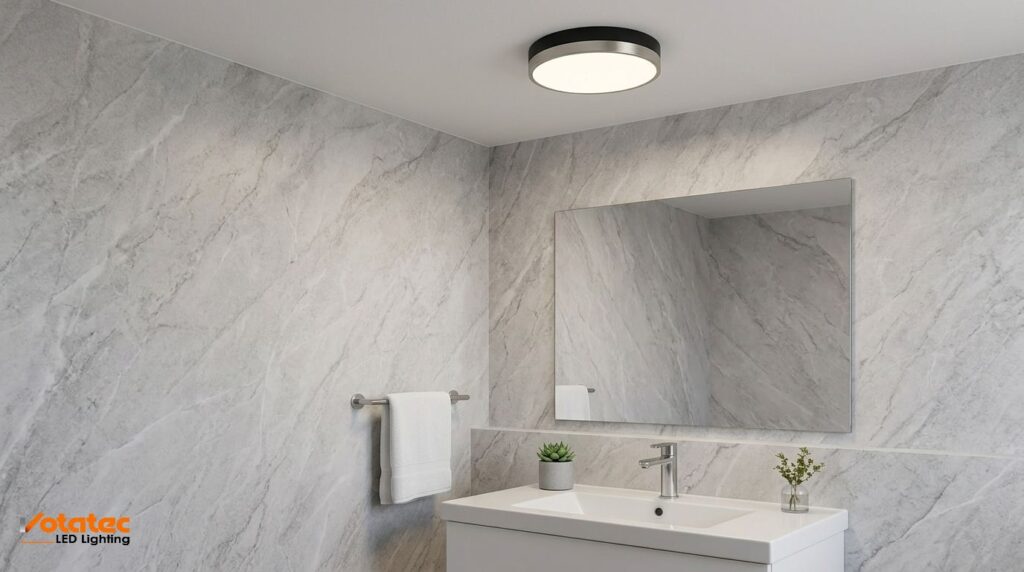
Wet Location vs Damp Location: The Canadian Way
You’ll see a lot of UK and US content talking about “bathroom zones,” Zone 0, 1, and 2. That zone system comes from British wiring regulations. Canada doesn’t use it.
What Canada uses is location classification under the Canadian Electrical Code, Section 30, which covers the installation of lighting equipment.
| Location type | What it means | Typical washroom area |
|---|---|---|
| Dry | No moisture exposure | Not relevant in a washroom |
| Damp | Moisture present sometimes, partially protected | General ceiling, over sinks, away from spray |
| Wet | Subject to saturation, direct water, heavy steam | Directly over a shower or tub, in a gang shower, steam room |
The practical rule: most of a washroom ceiling is a damp location. The space directly above and around a shower or tub is a wet location. A steam room counts as the equivalent of a shower for code purposes.
So you spec at least one wet-rated fixture for the shower area, and damp-rated fixtures for the rest. Simple framework. Hard to mess up once you think in those terms.
What the Code Says About Clearances
Section 30 has specifics worth knowing before you place anything. Rule 30-320 deals with luminaires in damp and wet locations and near tubs and showers, and the Electrical Safety Authority is the body that enforces it in Ontario.
A few points that come up on real jobs:
- Keep a vanity or general fixture back from the tub or shower enclosure. A 1 metre horizontal clearance is the common guidance.
- Where a luminaire sits within 2.5 m vertically or 1.5 m horizontally of a tub, plumbing fixture, or grounded metal, it has to be controlled by a wall switch.
- Switches near a tub or shower have placement rules too. A switch can sit between 1 m and 500 mm from the enclosure only when it’s protected by a Class A ground fault circuit interrupter (GFCI).
Always confirm against the current code edition your province enforces. Ontario, BC, Alberta, and Quebec each adopt the CEC with their own amendments and timing. When in doubt, your inspector or your provincial electrical safety regulator is the source of truth, not a blog. Not even this one.
IP Ratings for Bathroom Ceiling Lights, Explained
IP stands for Ingress Protection. It’s defined by IEC 60529, and it’s a two-digit code on the fixture or its spec sheet.
- First digit (0 to 6): protection against solids and dust.
- Second digit (0 to 9): protection against water.
Higher is more protected. Here’s what actually matters for washroom ceilings.
| IP rating | Water protection | Use it for |
|---|---|---|
| IP20 | None | Dry rooms only. Never a washroom. |
| IP44 | Splashing water from any direction | General washroom ceiling, away from direct spray |
| IP54 | Splash plus limited dust | Busier general areas, humid washrooms |
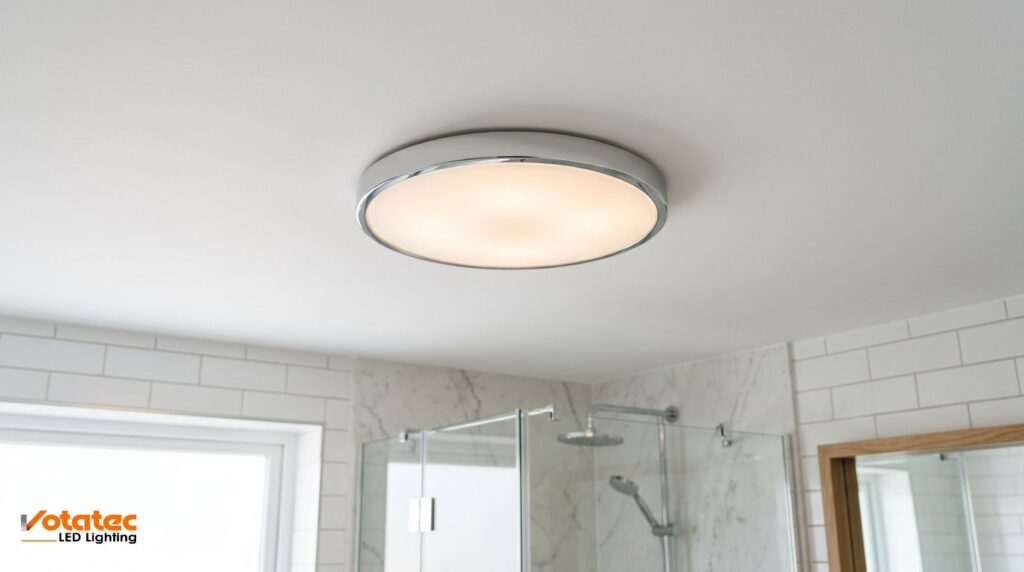
| IP65 | Dust-tight, low-pressure water jets | Directly over showers and tubs, steam-heavy rooms |
| IP67 | Temporary immersion | Wet-down areas, gang showers, change rooms with hose-down cleaning |
The working rule most electricians use: IP44 is the floor for any bathroom fixture. Step up to IP65 the moment a fitting sits over a shower or tub, or in a room that fills with steam.
One thing to watch. A high IP rating does not replace the code requirement. A fixture can be IP65 and still not be legal if it isn’t marked for the location and certified for Canada. You need both. IP for performance, certification for legality.
The Mark That Actually Gets You Through Inspection
This is where a lot of cheap online fixtures fall apart for commercial work.
To be legally installed in Canada, an electrical product needs certification from an accredited body. Look for one of these marks:
- CSA (CSA Group)
- cULus or cUL (UL marks valid for Canada)
- cETLus (Intertek, valid for Canada)
No mark, no install. An inspector can red-tag an uncertified fixture even if it looks identical to a certified one. For a facility manager ordering in volume, this is the single most expensive mistake to make. Buy 200 uncertified flush mounts for a school retrofit and you own 200 paperweights.
Want the fixture to qualify for utility rebates too? Then it usually needs a DesignLights Consortium (DLC) listing or ENERGY STAR certification on top of the safety mark. More on rebates below.
Choosing the Right Light Output: Lumens and Layout
Moisture and certification keep you legal. Lumens keep the room usable.
For washrooms, plan for roughly 70 to 100 lumens per square foot in the general space, and brighter at any grooming or mirror area. So a 50 square foot washroom wants somewhere around 3,500 to 5,000 lumens total. Scale up for multi-stall commercial facilities where the ceilings are higher.
A couple of things people forget:
Uniformity matters more than peak brightness. One bright fixture in the centre leaves the stalls and corners dim. Spread the light. Several smaller flush mounts or recessed pot lights beat one big pendant in a commercial washroom almost every time.
Mounting height changes everything. Light spreads as it travels, so a fitting on a 9 foot ceiling covers more floor but delivers less lux at face level than the same fitting at 8 feet. Run the layout, don’t eyeball it.
For the technical side of light levels and uniformity, the Illuminating Engineering Society publishes the recommended practice documents that lighting designers work from. Worth a look if you’re spec’ing a large facility.
Colour Temperature and CRI for Washrooms
Two more numbers on the spec sheet that shape how the room feels.
Colour temperature (CCT), measured in Kelvin:
- 3000K warm white. Softer, more residential. Fine for boutique or hospitality washrooms.
- 3500K to 4000K neutral to cool white. The standard for offices, schools, healthcare, and most commercial washrooms. Clean and alert without going clinical.
- 5000K daylight. Very bright and crisp. Common in industrial or back-of-house settings.
For most commercial work, 4000K is the safe pick. It reads clean and it’s easy to match across a building.
Colour Rendering Index (CRI) tells you how accurately colours show under the light. Aim for CRI 80 or higher. For healthcare washrooms or any space where colour accuracy matters, push to CRI 90+. Skin tones and signage both look better for it.
A practical tip many facility managers like: selectable CCT fixtures. One product, a small switch on the back, and you can set 3000K, 4000K, or 5000K on site. Cuts your SKU count and saves you guessing the colour before the room’s even finished.
Flush Mount, Recessed, or Surface? Picking the Form Factor
The fitting type depends on ceiling height and access.
- Flush mount and semi-flush sit tight to the ceiling. Best for low ceilings and the most common pick for standard washrooms. Low profile, easy to clean.
- Recessed pot lights and LED panels disappear into the ceiling for a clean look and even spread. Great for drop-ceiling commercial washrooms. Confirm the IC rating if there’s insulation above.
- Surface-mount panels work where you can’t recess into a slab. Quick to install, good light spread.
For wet locations over a shower, a sealed vapor-tight, wet-location fixture rated IP65 is usually the cleanest answer. No housing to trap steam, nothing dangling.
Whatever the form, favour sealed, gasketed LED units for washrooms. Fewer entry points for moisture means fewer callbacks. And a maintenance crew that isn’t pulling fixtures every season is a happy maintenance crew.
Why LED Is the Default Now?
Quick reality check. If you’re still putting fluorescent or incandescent in a washroom, you’re spending more than you need to.
LED uses around 75% less energy than the older technology it replaces. It runs cool, so less moisture-related corrosion from heat cycling. And a quality LED fitting is rated for 50,000 hours or more, which in a washroom that’s lit most of the day still works out to years between changes.
For a building owner, that’s two wins. Lower hydro bills every month, and far fewer maintenance lifts and labour calls. The payback on a washroom retrofit is usually well inside three years. Often faster with a rebate.
Don’t Leave Rebate Money on the Table
Canadian utilities run incentive programs for commercial LED upgrades, and washroom fixtures often qualify.
Programs change by province and by year, so check current terms before you order. A few to start with:
- Ontario’s Save on Energy commercial programs
- Provincial utility programs in BC, Alberta, Quebec, and the Atlantic provinces
- Federal efficiency resources from Natural Resources Canada
The catch is almost always certification. Most rebates require DLC-listed or ENERGY STAR fixtures. So the certified product that costs a little more up front frequently ends up cheaper after the incentive. Spec it right and the rebate pays you back for doing the job properly.
Common Mistakes to Avoid
Quick hit list from real jobs:
- Using a dry-rated fixture over a shower. It’ll fail inspection and fail early.
- Trusting IP rating alone. No Canadian certification mark means no legal install.
- Buying uncertified fixtures online to save a few dollars. Red-tag risk on every unit.
- One central fixture for a big washroom. Dim corners, dim stalls, unhappy occupants.
- Ignoring CCT consistency. Mismatched whites across a building look cheap and get noticed.
- Skipping the rebate paperwork. Free money left on the table because nobody checked DLC listing.
Avoid those six and you’re ahead of most retrofits.
Frequently Asked Questions
What IP rating do I need for a bathroom ceiling light?
IP44 is the minimum for a general bathroom ceiling fixture, protecting against splashing water. For a fitting directly over a shower or tub, or in a steam-heavy room, step up to IP65. In Canada the IP rating works alongside the Canadian Electrical Code location classification, so the fixture also has to be rated for a damp or wet location and carry a CSA or cULus mark.
Does Canada use the UK bathroom zone system?
No. The Zone 0, 1, and 2 system comes from British wiring regulations. Canada uses location classifications under the Canadian Electrical Code: dry, damp, and wet. Most of a washroom ceiling is a damp location, and the area directly over a shower or tub is a wet location. Spec your fittings to those classifications, not to zones.
Can I put a regular ceiling light in a bathroom?
Not over wet areas, and not without checking. A standard dry-location fixture isn’t legal directly above a shower or tub, and it’ll corrode from steam over time. For general washroom ceiling areas away from direct spray, a damp-location fixture rated IP44 or higher is the right call. Always confirm it carries a Canadian certification mark.
How many lumens does a bathroom ceiling light need?
Plan for roughly 70 to 100 lumens per square foot in the general washroom area, and brighter near mirrors and grooming spots. A 50 square foot washroom needs around 3,500 to 5,000 lumens total. For larger commercial washrooms, spread the output across several fixtures so the corners and stalls aren’t left dim.
What colour temperature is best for a commercial washroom?
4000K neutral white is the standard pick for most commercial, school, and healthcare washrooms. It looks clean without feeling clinical. Use 3000K for warmer hospitality settings and 5000K for industrial spaces. Selectable CCT fixtures let you set the colour on site, which cuts down on ordering the wrong one.
Bottom Line
Choosing a light fitting for bathroom ceilings in Canada is a sequence, not a guess. Classify the location, damp or wet. Match the IP rating, IP44 general and IP65 over showers. Confirm the CSA or cULus mark so it passes inspection. Then dial in lumens, CCT, and CRI for a room people actually want to use. Add a DLC listing and you open the door to rebates.
Need help spec’ing washroom fixtures for a building or a portfolio? Votatec supplies certified, wet and damp rated LED fittings for commercial and institutional projects across Canada, and our team can match products to your code requirements and rebate eligibility. Request a quote and we’ll size it with you.