









You grab a bulb off the shelf. Package says “standard base.” You get home, screw it in, and it doesn’t fit. Back to the store. The next one fits the socket but sticks out past the shade. Back again. Third trip, you finally get it right.
Sound familiar? You’re not alone. The word “standard” is maybe the most misleading term in lighting. It gets used for the base type, the bulb shape, and “regular bulb” all at once. No wonder people end up making three trips.
Here’s the short answer. The standard light bulb base in Canada is E26. That’s a screw-in base with a 26 mm diameter. The standard bulb socket size in most Canadian homes, table lamps, ceiling fixtures, and porch lights is built for E26. If you only remember one thing from this guide, remember that.
But base type is just the starting point. This guide covers every light bulb base type you’ll run into in Canada, from the tiny E12 candelabra to the large E39 mogul used in commercial buildings. You’ll learn the naming system, see a standard light bulb base chart with all sizes, and walk away knowing exactly how to identify bulb base size for any fixture. No more guessing at the hardware store.
What “Standard Base” Actually Means
Three things get called “standard” in lighting. They’re not the same.
E26 is the base type. It’s the screw part at the bottom of the bulb, 26 mm in diameter. The “E” stands for Edison (Thomas Edison’s original screw design). Every E26 bulb has the same threading and fits the same socket. When people search for the standard light bulb base size, this is the answer: 26 mm.
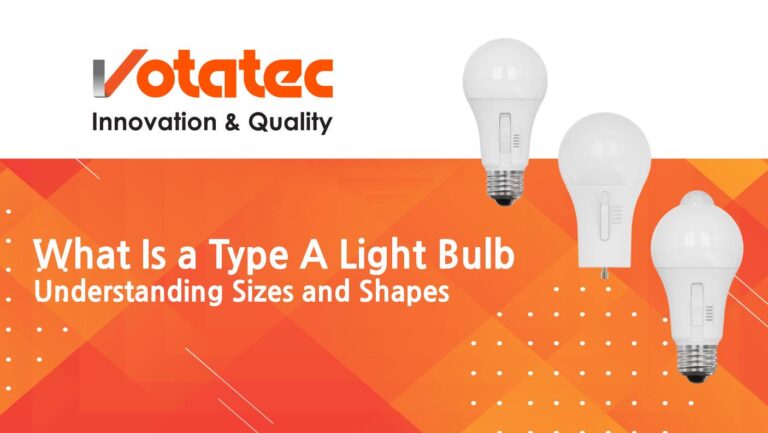
A19 is the bulb shape. It’s the glass part, the classic pear shape you picture when someone says “light bulb.” The “A” means arbitrary (the original shape designation), and 19 means 19/8 inches in diameter, which works out to about 60 mm.
Read more: What Is a Type A Light Bulb
Here’s what trips people up. You can have an E26 base with dozens of different shapes. A19, BR30, PAR38, globe, tubular. They all screw into the same E26 socket. But an A19 bulb that’s too tall won’t fit inside an enclosed fixture, even though the base is correct.
So when a package says “standard base,” it almost always means E26. When it says “standard bulb,” it usually means E26 base with A19 shape. Two different things. Knowing this saves you a return trip every time.
And here’s a related point people miss. Standard light bulb wattage used to mean 40W, 60W, or 100W in the incandescent days. With LED, those numbers don’t apply the same way. A 9W LED puts out about the same light as a 60W incandescent. The base size hasn’t changed, just the energy it takes to light up.
How the Naming System Works
Once you know the code, you can read any bulb label. Takes about 30 seconds to learn.
The first letter tells you the connection type:
- E = Edison screw (the number is the diameter in millimetres)
- G or GU = pin base (the number is the pin spacing in millimetres)
- B = bayonet push-and-twist (the number is the diameter in millimetres)
The number is always a measurement in millimetres. E26 = 26 mm screw. GU10 = 10 mm pin spacing. B22 = 22 mm bayonet cap. These codes apply across all light bulb fitting types, whether screw, pin, or bayonet.
Bulb shape codes are separate from base codes. A19 is the shape. E26 is the base. A bulb labelled “A19 E26” means it’s the classic pear shape with a standard screw base. That’s the most common combination in Canadian homes.
Pretty simple once you see the pattern.

Screw Base Types (Edison Bases)
Screw bases are what most people think of when they picture a light bulb. Understanding light bulb base sizes standard to North America starts here. These are every size you’ll find in Canada, with actual measurements.
| Base | Diameter | Common Name | Where You’ll Find It |
|---|---|---|---|
| E12 | 12 mm | Candelabra | Chandeliers, decorative sconces, night lights |
| E17 | 17 mm | Intermediate | Older appliances, some ceiling fans, vintage fixtures |
| E26 | 26 mm | Medium / Standard | Most residential fixtures, table lamps, porch lights |
| E27 | 27 mm | Medium (International) | European and imported fixtures |
| E39 | 39 mm | Mogul | Warehouses, parking lots, high-bay industrial |
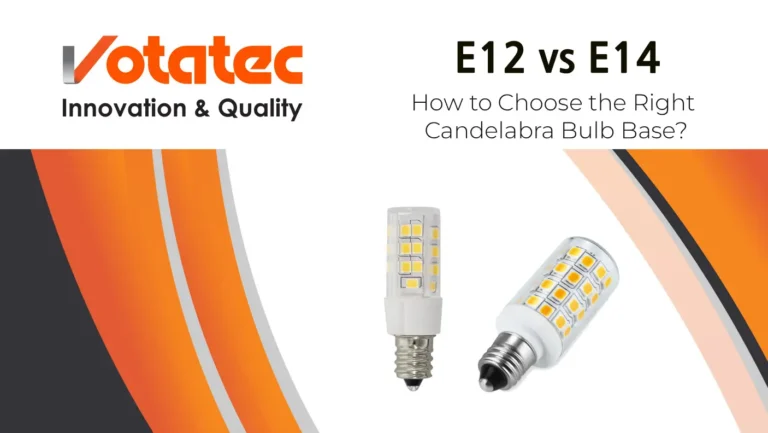
E12 (Candelabra) is the small decorative base. If you have a chandelier or wall sconce with flame-shaped bulbs, that’s probably E12. One thing to know: standard light bulb wattage ratings can be misleading across base sizes. A 60W candelabra bulb only puts out around 500 lumens. A 60W standard base bulb? Around 800 to 900 lumens. Same wattage, 40% less light. So if your chandelier seems dim, it’s not broken. The candelabra format just produces less light per watt. LED candelabra bulbs have mostly closed this gap, with some hitting 800+ lumens.
E17 (Intermediate) is the base nobody talks about. It’s 17 mm, right between candelabra and standard. You find it in some older appliances, certain ceiling fans, and a few vintage fixture styles. Here’s the trap: it looks close enough to E26 that people buy a standard bulb, it almost screws in, and they assume the socket is broken. It’s not broken. You just have an intermediate base. Measure before you buy.
E26 (Medium/Standard) is the one you already know. The base size of standard light bulb fixtures across North America is 26 mm, and E26 is it. Found in the vast majority of residential fixtures. When someone says “regular light bulb” or “standard base,” this is what they mean. Pretty much every LED manufacturer makes bulbs in this base, including Votatec’s full E LED Bulb range.
One question that comes up a lot: medium base vs standard base light bulb, is there a difference? No. “Medium base” and “standard base” are two names for the same thing, E26. Some manufacturers label it one way, some the other. Same socket, same bulb.
E39 (Mogul) is the big one. 39 mm diameter. You’ll see these in commercial and industrial settings, warehouse high bays, parking lot fixtures, and street lights. If you’re replacing old metal halide or high-pressure sodium lamps, E39 mogul base LED corn bulbs are the typical retrofit option.
What’s the Difference Between E26 and E27?
This is one of the most common questions in lighting. The difference between E26 and E27 trips people up, especially if you’ve moved to Canada from Europe or bought a fixture online from an overseas seller.
E26 and E27 look almost identical. The diameter difference is 1 mm. Physically, an E27 bulb will usually screw into an E26 socket. And that’s where most advice stops: “they’re basically the same.” But they’re not.
The real difference is electrical. E26 is rated for 120V (North American standard). E27 is rated for 220-240V (European standard). The insulator height at the base of the socket differs by about 1 mm per IEC 60061-1 specifications. That tiny gap matters because it affects how the bulb contacts the socket’s live terminal.
Here’s a real scenario. A family brings a lamp back from a trip to Italy. Beautiful fixture. They plug it in with a voltage adapter, use a Canadian E26 LED bulb. It fits. But it wobbles slightly. Maybe it flickers. The threading is close enough to engage, but the contact point isn’t making proper connection because the socket was built for E27 specifications.
Will it catch fire? Probably not with modern LED bulbs at 120V. But “probably not” isn’t a great standard for electrical safety. Forum users report that bulbs manufactured in China sometimes fall between E26 and E27 specs, which means some work in both sockets and some work in neither. Not exactly reassuring.
If you have imported fixtures, the safe call is to use bulbs rated for that specific base. Or have an electrician confirm the socket type. For new projects in Canada, stick with E26. It’s the standard here for a reason.
Pin Base Types
Pin bases are a different category of light bulb fitting types altogether. They don’t screw in. They push in or twist-lock. You’ll find them in track lighting, recessed fixtures, under-cabinet lights, and commercial fluorescent tube fixtures.
| Base | Pin Spacing | Connection | Common Application |
|---|---|---|---|
| GU10 | 10 mm | Twist-lock | Track lighting, recessed downlights |
| GU5.3 (MR16) | 5.3 mm | Push-in | Accent lighting, display cases |
| G4 | 4 mm | Push-in | Landscape lighting, accent fixtures |
| G9 | 9 mm | Push-in (looped) | Compact decorative fixtures |
| G13 | 13 mm | Push-in (bi-pin) | T8 fluorescent tubes (4-foot) |
| G5 | 5 mm | Push-in (bi-pin) | T5 fluorescent tubes |
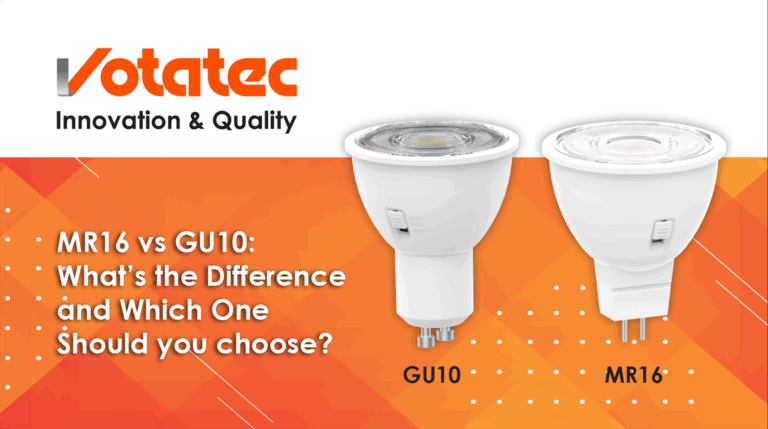
GU10 is the most common pin base in residential settings. The “U” means it has a twist-lock mechanism, push in and rotate clockwise. You’ll find these in kitchen track lighting and bathroom recessed cans. Votatec’s LED GU10 replacements are a direct swap for the old halogen MR16 GU10s that used to eat electricity.
G13 matters for commercial buildings. It’s the bi-pin base on the ends of 4-foot T8 fluorescent tubes. If you’re retrofitting fluorescent fixtures to LED, you’ll need to know whether to use Type A tubes (work with the existing ballast), Type B (bypass the ballast, wire direct), or Type A+B (work both ways). The base is the same G13 in all cases. The wiring is what changes.
G4 and G9 are smaller specialty bases you’ll find in accent lighting and decorative fixtures. They’re less common but worth knowing about so you don’t end up at the store staring at a wall of bulbs with no idea what fits your fixture.

Bayonet and Specialty Bases
Among the less common light bulb base types in Canada, bayonet and specialty bases show up mainly in imported fixtures or niche applications.
B22 (bayonet) is the standard in the UK, Australia, and parts of Asia. Push in and twist. If someone gives you a lamp from England, it’s probably B22. You’ll need an adapter or B22-compatible bulbs, which are available but not stocked at every hardware store in Canada.
GU24 is a twist-lock base found in some commercial fixtures, particularly in regions with energy codes that require non-screw bases to prevent incandescent use. Not common in Canadian residential.
2G11 and G24 are compact fluorescent bases found in commercial and institutional fixtures. If you’re retrofitting these to LED, pin-compatible LED replacements exist for both.
Standard Light Bulb Base Chart
Here’s the complete bulb base chart covering all common light bulb bases you’ll find in Canada. Bookmark it or snap a photo before your next hardware store trip.
| Base Code | Type | Size (mm) | Voltage | Common Shapes | Typical Use |
|---|---|---|---|---|---|
| E12 | Screw | 12 dia. | 120V | B10, CA10, C7 | Chandeliers, night lights |
| E17 | Screw | 17 dia. | 120V | A15, B11, S11 | Appliances, some ceiling fans |
| E26 | Screw | 26 dia. | 120V | A19, A21, BR30, PAR38 | Most residential fixtures |
| E27 | Screw | 27 dia. | 220-240V | A60, A65 | European/imported fixtures |
| E39 | Screw | 39 dia. | 120-277V | ED28, BT56 | Industrial, commercial high-bay |
| GU10 | Pin (twist) | 10 spacing | 120V | MR16 | Track, recessed downlights |
| GU5.3 | Pin (push) | 5.3 spacing | 12V | MR16 | Accent, display lighting |
| G4 | Pin (push) | 4 spacing | 12V | T3, JC | Landscape, accent |
| G9 | Pin (push) | 9 spacing | 120V | T4 | Compact decorative |
| G13 | Pin (push) | 13 spacing | 120-277V | T8 | 4-ft fluorescent/LED tubes |
| G5 | Pin (push) | 5 spacing | 120-277V | T5 | Slim fluorescent/LED tubes |
| B22 | Bayonet | 22 dia. | 220-240V | A60, A65 | UK/Australian fixtures |
This standard light bulb base chart covers about 95% of what you’ll run into. For anything not on this list, check the markings on your fixture or bring the old bulb to the store.
How to Identify Bulb Base Size
Bulb base identification doesn’t have to be complicated. Not sure what base your fixture takes? Here’s how to identify bulb base size in five steps.
Step 1: Turn off the power. Flip the switch. For ceiling fixtures, use the breaker if you want to be safe. Then remove the old bulb.
Read more: How to Replace LED Ceiling Light in 7 Simple Steps
Step 2: Check for markings. Look inside the socket or on the fixture body. Many fixtures stamp the base type right on them, something like “E26 MAX 60W” or “GU10” near the socket. Check the old bulb too. The base type is sometimes printed near the bottom.
Step 3: Measure. If there are no markings, grab a ruler. For screw bases, measure straight across the widest part of the metal screw section. That measurement tells you the standard light bulb base size directly. For pin bases, measure the distance between pin centres.
Quick trick: a Canadian quarter is 23.88 mm across. Hold it against the base. If the screw diameter is slightly larger than the quarter, you’ve got an E26. If it’s noticeably smaller, it’s probably E12 or E17.
Step 4: Match to the chart. Use the bulb base chart above. 12 mm = E12. 17 mm = E17. 26 mm = E26. Done.
Step 5: Bring the old bulb. When in doubt, bring it to the store. Match it physically. This beats guessing every single time.
Here’s a common fixture-to-base cheat sheet for quick bulb base identification:
| Fixture Type | Most Likely Base |
|---|---|
| Table lamp | E26 |
| Floor lamp | E26 |
| Ceiling flush mount | E26 |
| Chandelier | E12 |
| Wall sconce (decorative) | E12 or E26 |
| Recessed can (4-6 inch) | E26 or GU10 |
| Track lighting | GU10 |
| Under-cabinet | G4, G9, or integrated LED |
| Bathroom vanity light | E26 (globe shape) |
| Garage / workshop | E26 or G13 (tubes) |
One thing that catches people off guard. Sometimes the LED replacement bulb has the right base but doesn’t screw in all the way. The chrome sleeve on certain LED brands is slightly wider than old incandescent bases. If this happens, the bulb might not make contact with the socket’s centre terminal.
The fix is surprisingly simple. With the breaker off, use a wooden toothpick or small plastic tool to gently lift the brass contact tab at the bottom of the socket. Just a millimetre or two. Screw the bulb back in. That 30-second fix saves a return trip and the cost of a new bulb.
Choosing the Right Base for Commercial and Industrial Projects
For facility managers, contractors, and procurement teams, base type directly affects your retrofit strategy and rebate eligibility.
E26 dominates residential retrofit projects. If you’re upgrading a multi-unit residential building, you’ll order E26 LEDs for the vast majority of fixtures. The standard bulb socket size in these buildings hasn’t changed in decades, so LED retrofits are a direct swap.
E39 mogul base is your go-to for HID-to-LED conversions in warehouses, parking structures, and outdoor area lighting. LED corn bulbs and retrofit kits in E39 replace old 250W to 1000W metal halide and high-pressure sodium lamps. Votatec’s outdoor LED light fixtures cover many of these applications. The energy savings are typically 60% to 75%.
G13 bi-pin covers T8 fluorescent tube replacement. This is the most common commercial retrofit in Canada right now. Three options:
- Type A (plug-and-play): LED tube works with existing fluorescent ballast. Fastest install. But when the ballast eventually fails, you replace it anyway.
- Type B (ballast bypass): Wire the sockets directly to line voltage, remove the ballast. More labour upfront, zero ballast maintenance going forward.
- Type A+B (hybrid): Works both ways. More flexibility, slightly higher cost per tube.
For any commercial lighting project in Canada, check two things. First, make sure the LED product carries CSA certification (look for the CSA mark on the product). Second, check DLC qualification if you want to qualify for provincial utility rebates. DLC-listed products meet the efficiency thresholds required by programmes like Ontario’s SaveOnEnergy, BC Hydro’s business incentives, and Hydro-Quebec’s commercial lighting programmes.
Votatec’s commercial LED products carry both CSA certification and DLC qualification across the full range of base types, E26, E39, G13, and GU10.
What If the Bulb Doesn’t Fit or Doesn’t Work?
Bought a bulb with the right base and it still doesn’t work? Here’s what’s probably going on.
“It won’t screw in all the way.” Some LED bulbs have a slightly wider chrome heat sink at the base compared to incandescent bulbs. The threading engages, but the bulb can’t seat fully. Try a different LED brand first. If that doesn’t work, gently lift the socket’s centre contact tab (breaker off) as described above.
“It flickers or won’t turn on.” If the base fits but the bulb doesn’t light reliably, check whether you have an E26 socket or an E27. Imported fixtures sometimes use E27 sockets, and the difference between E26 and E27 contact gaps can cause intermittent connection. Also check if the fixture is on a dimmer, not all LED bulbs are dimmable, and incompatible dimmers cause flickering.
“It fits the socket but doesn’t fit the fixture.” Right base, wrong shape. An A21 bulb is taller than an A19. A BR30 is wider. Enclosed fixtures and fixtures with narrow openings or globe shades need specific bulb shapes. Always check the fixture’s maximum bulb dimensions, not just the base type.
“The bulb is loose in the socket.” You might have an E27 socket (from an imported fixture) with an E26 bulb. The 1 mm difference means the bulb screws in but wobbles. Don’t force it. Get E27 bulbs or use a proper adapter.
When to use a base adapter. Adapters exist for most conversions, E12 to E26, E26 to E39, B22 to E26. They work fine for low-wattage LED applications. But don’t use adapters for high-wattage or high-heat situations, and don’t stack adapters. If the adapter path gets complicated, replace the fixture instead. Cheaper in the long run and safer.
When to call an electrician. If you see scorch marks, smell burning, hear buzzing from the socket, or the bulb keeps burning out quickly, stop troubleshooting and call a licensed electrician. These are signs of a wiring or fixture problem, not a bulb problem.
FAQ’s About Standard Light Bulb Base
What is the standard light bulb base size in Canada?
The standard light bulb base size is E26, which means a 26 mm diameter Edison screw. It’s the most common light bulb base in North America. When a package says “standard base” without specifying, it means E26.
Is E26 the same as A19?
No. E26 is the base (the screw part). A19 is the bulb shape (the glass part). An A19 bulb typically comes with an E26 base, but E26 is also available in BR30, PAR38, globe, and many other shapes. Base and shape are independent.
What is the difference between E26 and E27?
E26 is rated for 120V (North America) with a 26 mm screw diameter. E27 is rated for 220-240V (Europe) with a 27 mm diameter. They look similar and often physically fit each other’s sockets, but they have a 1 mm insulator height difference that affects electrical contact. For new installations in Canada, always use E26.
Is medium base the same as standard base?
Yes. Medium base vs standard base light bulb is the same thing, just different labelling. Both refer to E26. Some manufacturers call it “medium,” others call it “standard.” Same 26 mm screw socket.
What base does a chandelier use?
Most chandeliers in Canada use E12 candelabra base. Some larger chandeliers use E26. Check the socket or measure the diameter, 12 mm for candelabra, 26 mm for standard.
How do I identify my light bulb base?
For bulb base identification, remove the old bulb and either check the markings on the socket or measure the screw diameter (or pin spacing) with a ruler. Match the measurement to a bulb base chart: 12 mm = E12, 17 mm = E17, 26 mm = E26, 39 mm = E39. Or just bring the old bulb to the store.
What to Do This Week
Three things: identify, measure, match.
The standard light bulb base in Canada is E26. If you have a residential fixture and you’re not sure, it’s most likely E26. For everything else, measure the diameter or pin spacing and check the chart above.
Base type and bulb shape are different things. Know both before you buy. An E26 BR30 won’t fit the same way as an E26 A19, even though the base is identical.
This week: walk through your home or building and check which base types you actually have. You might be surprised, most spaces have two or three different types. This month: replace any remaining incandescent or CFL bulbs with LED equivalents. The energy savings alone make it worth doing.
For commercial lighting and industrial projects, Votatec carries LED replacements in every standard base type, E26, E39, G13, GU10, and more. All CSA-certified and DLC-qualified for Canadian rebate programmes. Browse our catalogue or request a quote to get started.