










 (+1) 905 597 5955



You’re standing in the lighting aisle at Home Depot. There are maybe forty options on the shelf. Some say 60W equivalent. Some say 800 lumens. One box says “soft white,” another says “warm white,” and you’re pretty sure those might be the same thing. The prices range from $1 to $15 for what looks like the exact same bulb.
Sound familiar?
Here’s the short answer. There are three main types of light bulbs most people choose from: LED, CFL and incandescent. But there are also halogen light bulbs, fluorescent light bulbs (the long tube kind) and smart light bulbs. LED wins on pretty much every metric that matters, cost, lifespan, energy use, and safety. And if you’re in Canada, the choice just got even simpler. CFLs are being banned as of 2026.
This light bulb buying guide breaks down every type with real numbers, real costs and practical advice on picking the best type of light bulb for home use or commercial spaces. No vague “it depends” answers.
How Many Types of Light Bulbs Are There?
So how many types of light bulbs are there, really? If you count every variation, there are dozens. But for practical purposes, these are the different types of light bulbs you’ll run into:
| Light Bulb Type | Energy Use | Lifespan | Still Available? |
|---|---|---|---|
| LED light bulbs | 8-10W (for 800 lumens) | 25,000-50,000 hours | Yes – the standard now |
| CFL light bulbs | 13-15W (for 800 lumens) | 10,000 hours | Being phased out in Canada |
| Incandescent light bulbs | 60W (for 800 lumens) | 1,000 hours | Limited availability |
| Halogen light bulbs | 43W (for 800 lumens) | 2,000-4,000 hours | Being phased out |
| Fluorescent light bulbs (tubes) | 32W (for 2,800 lumens) | 20,000 hours | Being phased out in Canada |
| Smart light bulbs | 8-10W (for 800 lumens) | 25,000 hours | Yes – growing fast |
The big three, LED, CFL and incandescent, are the light bulb types that matter most for a direct comparison. But halogen, fluorescent tubes and smart bulbs each have their place too. Let’s break them all down.
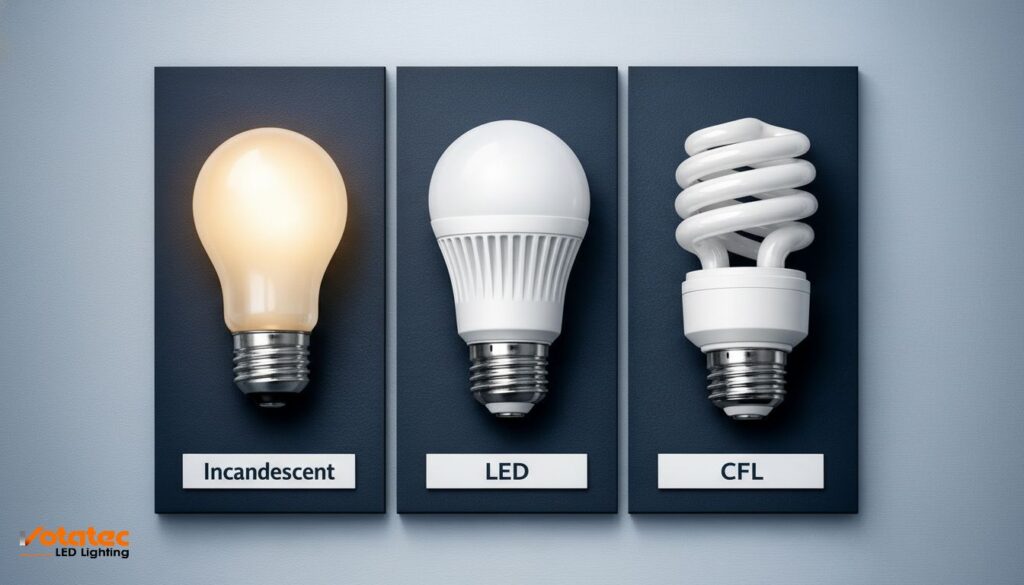
The Big Three: LED vs CFL vs Incandescent at a Glance
Before we get into the details, here’s the side-by-side comparison most people are looking for when they search for different types of light bulbs:
| Feature | Incandescent | CFL | LED |
|---|---|---|---|
| Lifespan | 1,000 hours | 10,000 hours | 25,000-50,000 hours |
| Wattage (60W equivalent) | 60W | 13-15W | 8-10W |
| Annual energy cost (per bulb) | ~$11.50 | ~$2.50 | ~$1.50 |
| Purchase price | $1-2 | $2-4 | $2-8 |
| Colour Rendering (CRI) | 100 | 80-85 | 80-98 |
| Heat output | Very high (170°C/335°F) | Moderate (82°C/179°F) | Low (31°C/87°F) |
| Contains mercury | No | Yes (~4 mg) | No |
| Dimmable | Yes (all) | Rarely | Yes (most) |
| Instant full brightness | Yes | No (10-30 sec warm-up) | Yes |
Pretty clear winner. LED beats both alternatives on almost every line. The one exception is CRI, where incandescent holds a perfect 100. But modern high-CRI LED light bulbs hit 90 to 98, which is close enough that most people can’t tell the difference.
How Each Type Works (The 30-Second Version)
You don’t need a physics degree for this. But knowing how the different types of light bulbs actually produce light explains why they perform so differently.
Incandescent Light Bulbs
Electricity passes through a thin tungsten filament. The filament heats up to about 2,500°C and glows. That glow is light. Problem is, about 90% of the energy goes to heat instead of visible light. So a 60W incandescent is really a 54W space heater with a small light attached.
That’s why incandescent light bulbs burn hot to the touch and burn out fast. The filament literally evaporates over time.
CFL Light Bulbs
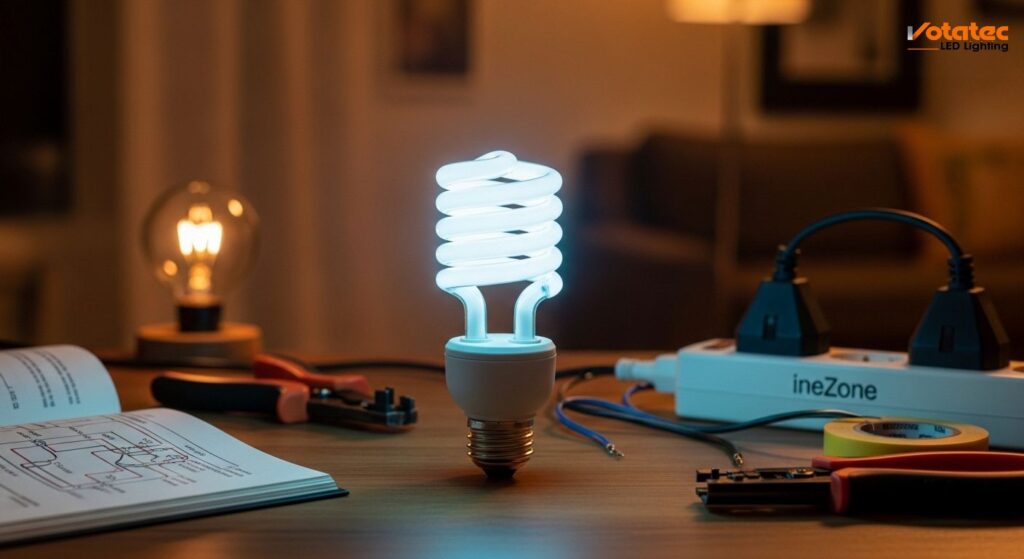
A tube filled with argon gas and a tiny amount of mercury vapour. When electricity flows through, it excites the mercury atoms, which produce ultraviolet light. That UV light hits a phosphor coating on the inside of the tube, which converts it to visible light.
CFL light bulbs are more efficient than incandescent (around 75% less energy), but the mercury is a real drawback. If a CFL breaks, you need to ventilate the room and follow specific cleanup procedures from Environment Canada. Not a huge deal, but not nothing either.
LED Light Bulbs
A semiconductor chip that emits light when current passes through it. No filament, no gas, no mercury. The chip itself is tiny. Most of the bulb is just the housing, driver electronics and a lens to shape the light.
Because there’s no filament to burn out and minimal heat waste, LED light bulbs last dramatically longer and use much less power. A 10W LED puts out the same light as a 60W incandescent. Same 800 lumens from one-sixth the energy.
Halogen Light Bulbs
Think of these as a souped-up incandescent. Same tungsten filament, but sealed in a smaller capsule filled with halogen gas (usually iodine or bromine). The halogen gas recycles evaporated tungsten back onto the filament, so the bulb runs hotter, brighter and lasts about twice as long as standard incandescent.
Halogen light bulbs produce excellent light quality with a CRI near 100. But they still waste a lot of energy as heat and they run very hot to the touch. You’ve probably seen them in desk lamps, car headlights and pot lights. Canada is phasing these out too, along with fluorescent light bulbs, under the same mercury and energy regulations.
Fluorescent Light Bulbs (Tubes)
Same basic technology as CFLs but in long tube form. You know them from offices, schools and garages, those 4-foot T8 and T12 tubes in ceiling fixtures. Fluorescent light bulbs are efficient for their era but still contain mercury.
Canada’s 2026 ban covers fluorescent tubes as well as CFLs. If your building still runs fluorescent, LED tube replacements are drop-in compatible with most existing fixtures.
Smart Light Bulbs
Smart light bulbs are LEDs with built-in Wi-Fi, Zigbee or Bluetooth connectivity. You control them through an app or voice assistant. They can change bulb colour temperature on demand, dim without a dimmer switch, set schedules and even sync with your security system.
The technology inside is the same as a standard LED. The “smart” part is an added wireless module. So you get the same energy efficiency and lifespan, just with remote control features.
Worth it? Depends on your setup. For a bedroom where you want warm light at night and cool light in the morning, smart bulbs that shift from 2700K to 5000K automatically are genuinely useful. For a closet? Probably overkill.
What You Actually Pay Over 5 Years
Everyone says “LEDs save money.” Let’s see what that actually looks like with real numbers.
Assume you have 10 bulbs running 8 hours a day (pretty typical for a home or small office). Using Ontario’s average electricity rate of $0.13/kWh. These are the different types of light bulbs compared on total cost of ownership:
| Cost Factor | Incandescent | CFL | LED |
|---|---|---|---|
| Bulbs needed over 5 years | 15 per socket | 2 per socket | 1 per socket |
| Bulb cost (5 years, 10 sockets) | $225 (150 x $1.50) | $60 (20 x $3) | $50 (10 x $5) |
| Energy per year (10 bulbs) | 1,752 kWh | 438 kWh | 292 kWh |
| Electricity cost (5 years) | $1,139 | $285 | $190 |
| Total 5-year cost | $1,364 | $345 | $240 |
LED saves you about $1,124 over 5 years compared to incandescent. For 10 bulbs. That’s real money. Even compared to CFL, LED saves $105 and you never deal with mercury, warm-up delays or the hassle of finding CFL light bulbs that still exist on store shelves.
For commercial buildings with hundreds of fixtures, multiply those savings accordingly. A 100-fixture facility switching from older technology to LED A-shape bulbs can save $10,000+ annually. Energy efficient light bulbs aren’t just a nice idea. They’re a financial decision.
And that’s before provincial rebates. Ontario’s SaveOnEnergy programme, BC Hydro and Hydro-Quebec all offer incentives for commercial LED upgrades that can cover 30% to 50% of project costs.
Bulb Colour Temperature: Soft White vs Daylight
This is the question that confuses people most. You see “soft white” and “daylight” on the box and wonder what the difference is. Here’s the deal.
Bulb colour temperature is measured in Kelvin (K). Lower numbers are warmer (more yellow/orange). Higher numbers are cooler (more blue/white). When people compare types of light bulbs soft white vs daylight, they’re really comparing colour temperatures.
- 2700K (Soft White): Warm, cozy glow. Matches the old incandescent light. Best for living rooms, bedrooms, dining areas. This is what most Canadians want in their homes.
- 3000K (Warm White): Slightly brighter but still warm. Good for kitchens, bathrooms, hallways.
- 4000K (Cool White/Neutral): Clean, alert feel. Works in offices, garages, workshops.
- 5000K+ (Daylight): Bright blue-white. Too harsh for most home spaces. Better for task lighting, workshops and commercial settings.
So which one should you pick? For most rooms in a home, soft white (2700K) is the answer. It feels natural and doesn’t mess with your sleep cycle. The blue light in daylight bulbs (5000K+) can suppress melatonin production, which is why you don’t want them in your bedroom.
Quick rule of thumb: if you’re relaxing in the room, go soft white. If you’re working, go neutral to daylight.
Lumens vs Watts: What Actually Measures Brightness?
Here’s one of the biggest misunderstandings in the light bulb buying guide world. People still shop by watts. “I need a 60-watt bulb.” But watts don’t measure brightness. Watts measure energy use.
Lumens measure brightness. A bulb that produces 800 lumens gives you the same amount of light whether it’s a 60W incandescent or a 10W LED. The LED just does it with a lot less electricity.
So when you’re comparing different types of light bulbs, always compare lumens, not watts. Here’s the conversion:
| Old Incandescent Watts | Lumens You Need | LED Equivalent |
|---|---|---|
| 40W | 450 lumens | 5-6W LED |
| 60W | 800 lumens | 8-10W LED |
| 75W | 1,100 lumens | 11-13W LED |
| 100W | 1,600 lumens | 16-20W LED |
Understanding lumens vs watts is the single most useful thing you can learn from this guide. It saves you from buying a bulb that’s too dim or too bright, and it makes comparing light bulb types across brands straightforward.
CRI: Why Some Bulbs Make Colours Look Wrong
Ever replaced an incandescent with an LED and felt like something was off? Colours seemed flat or slightly blue. Your skin looked weird.
That’s not your imagination. CRI (Colour Rendering Index) measures how accurately a light source shows colours compared to natural sunlight. Scale of 0 to 100.
Incandescent light bulbs score a perfect 100. That’s why colours always looked “right” under the old bulbs.
Cheap LEDs can score as low as 70 to 80. Colours look washed out. Reds look dull. Skin tones look off. That’s why people say “I don’t like LED light” and it’s usually not the LED’s fault. It’s a cheap LED’s fault.
Here’s what’s interesting. Independent lab testing found that a $3.50 Philips Ultra Definition LED scored 96.1 CRI, nearly matching incandescent quality. A $22 specialty bulb scored 96.5. The price difference barely mattered.
Look for LEDs with CRI 90 or higher for living spaces. For a kitchen or bathroom where you’re looking at your face, CRI matters. For a garage or closet? 80 is fine.
The Dimmer Problem: Why Your New LEDs Flicker
This is the number one complaint people have after switching to LED. They screw in the new bulb, turn the dimmer and the light flickers. Or buzzes. Or won’t dim below 50%.
The fix is usually simple, but the reason isn’t obvious.
Most dimmer switches installed before 2015 were designed for incandescent light bulbs. Those dimmers expect a load of 300 to 600 watts. An incandescent bulb draws 60W each, so five bulbs on one circuit gives you 300W. The dimmer works great.
Now swap those five bulbs for 10W LEDs. Total load: 50W. The old dimmer can’t handle a load that low. It flickers, strobes or just doesn’t work.
The fix:
- Check if your LED bulbs are labelled “dimmable” (not all are)
- Replace your old dimmer with an LED-compatible dimmer switch
- Make sure all bulbs on the same dimmer circuit are the same brand and model
That third point catches people off guard. Mixing LED brands on one dimmer causes problems because different drivers respond to the dimming signal differently. Same brand, same model, same circuit. That’s the rule.
Read more: how to install a dimmer switch
Light Bulb Shapes: What Do Those Codes Mean?
Walk into any lighting aisle and you’ll see codes like A19, BR30, PAR38 on the packaging. Those describe light bulb shapes. Here’s a quick decoder:
| Shape Code | What It Looks Like | Common Use |
|---|---|---|
| A19 | Classic bulb shape | Table lamps, ceiling fixtures, general use |
| BR30 | Wide flood shape | Recessed pot lights (6-inch cans) |
| BR40 | Larger flood | Recessed pot lights (6-8 inch cans) |
| PAR20/PAR30/PAR38 | Spotlight with flat face | Track lighting, outdoor floods, accent lights |
| B11 / CA10 | Candle / flame tip | Chandeliers, decorative sconces |
| G25 | Globe / round ball | Bathroom vanities, decorative fixtures |
| T8 / T12 | Long tube | Overhead office/garage fixtures |
| MR16 | Small reflector | Landscape lighting, display cases |
The number after the letter is the bulb diameter in eighths of an inch. So an A19 is 19/8 inches (about 2.4 inches) across. A BR30 is 30/8 inches (3.75 inches). Most Canadians just need to match the shape they’re replacing. If your old bulb looks like a classic bulb, grab an A19. If it’s in a recessed can, it’s probably a BR30 or PAR30.
Light bulb shapes matter because the wrong shape won’t fit the fixture properly or won’t distribute light the way you need it.
Types of Light Bulb Bases: Will It Fit Your Socket?
Understanding types of light bulb bases saves you a return trip to the store. These are the most common light bulb bases in Canadian homes and commercial buildings:
- E26 (medium screw): Standard base. Fits most table lamps, ceiling fixtures and porch lights. This is probably what you need.
- E12 (candelabra): Smaller screw base. Chandeliers, decorative sconces, night lights.
- GU10 (twist-lock): Two-pin twist base. Track lighting, recessed spotlights, range hoods.
- MR16 (two-pin): Landscape lighting, display cases, accent lighting. Runs on 12V.
- GU24 (two-pin twist): Common in newer energy-code construction in Canada. Similar to GU10 but different pin spacing.
- Bi-pin (G4, G9): Small two-pin bases for compact fixtures and under-cabinet lights.
If you’re replacing a bulb, just bring the old one to the store. Or check the existing fixture for a label. Most LED bulbs are direct replacements. Same base, same shape, just better in every measurable way.
Canada’s CFL Ban: What You Need to Know
This is the part most light bulb guides skip, because most of them aren’t written for Canadians.
As of December 31, 2025, Canada banned the manufacture and import of most mercury-containing lamps. That includes CFL light bulbs and fluorescent light bulbs. The regulation falls under the Products Containing Mercury Regulations amendment, aligning with the Minamata Convention on Mercury.
What this means:
- No new CFLs or fluorescent tubes are being made for the Canadian market
- Retailers can sell existing stock until end of 2029
- After 2029, these light bulb types won’t be available at all
- Replacement lamps for specialty applications have a grace period until end of 2027
So if you’re still using CFLs, now is the time to switch. Not because they’ll stop working overnight, but because replacement stock is shrinking, prices will go up and the alternative (LED) is already cheaper to run anyway.
For facilities with hundreds of CFL or fluorescent fixtures, don’t wait until 2029 when everyone else is scrambling. Plan your LED retrofit now while rebate programmes are still active and electricians aren’t booked solid.
Best Type of Light Bulb for Home: Room-by-Room Guide
Picking the best type of light bulb for home use depends on the room. Here’s a quick guide:
| Room | Colour Temperature | Brightness | Why |
|---|---|---|---|
| Living room | 2700K (soft white) | 1,500-3,000 lumens total | Warm, relaxed feel |
| Bedroom | 2700K (soft white) | 1,000-2,000 lumens total | Calm, sleep-friendly |
| Kitchen | 3000K (warm white) | 3,000-5,000 lumens total | Task visibility without harshness |
| Bathroom | 3000K (warm white) | 2,000-4,000 lumens total | Accurate colours for grooming |
| Home office | 3500-4000K (neutral) | 2,500-5,000 lumens total | Alert, focused, less eye strain |
| Garage/workshop | 4000-5000K (daylight) | 5,000-10,000 lumens total | Maximum visibility for detail work |
One trick from machinists and hobbyists: if you do detail work at home, mix a warm (2700K) and cool (5000K) light source at your workbench. The overlapping spectrums fill in the gaps that a single LED might miss. Colours show up more accurately.
For residential lighting that works well across your whole home, LED downlights in 3000K handle kitchens, bathrooms and hallways without looking clinical. Energy efficient light bulbs don’t have to look sterile. Pick the right colour temperature and they feel just as warm as the old incandescent.
Frequently Asked Questions
What are the different types of light bulbs?
The main light bulb types are LED, CFL, incandescent, halogen, fluorescent and smart bulbs. LED is the most energy-efficient, lasting 25,000 to 50,000 hours while using about 75% less energy than incandescent. CFL and fluorescent are being phased out in Canada due to mercury content. Halogen is also being phased out for efficiency reasons.
What is the best type of light bulb for home use?
LED light bulbs in 2700K (soft white) with CRI 90+ are the best option for most Canadian homes. They match the warm glow of old incandescent light bulbs, last 25+ years at average use and cost about $1.50 per year to run. Look for 800 lumens to replace a standard 60W incandescent.
Are CFL bulbs still available in Canada?
For now, yes. Canada banned the manufacture and import of CFL light bulbs as of December 31, 2025. Retailers can sell remaining stock through 2029. After that, CFLs won’t be available. LED is the recommended replacement.
What’s the difference between soft white and daylight bulbs?
Soft white bulbs (2700K) produce a warm, yellowish glow similar to incandescent. Daylight bulbs (5000K+) produce a bright, blue-white light. When comparing types of light bulbs soft white vs daylight, soft white is better for living spaces and bedrooms. Daylight is better for workshops and task areas.
Do LED bulbs work with dimmer switches?
Most LED bulbs labelled “dimmable” work with LED-compatible dimmer switches. If your dimmer was installed before 2015, it was likely designed for incandescent and won’t work properly with LEDs. Replace it with an LED-rated dimmer for smooth, flicker-free dimming.
What do lumens and watts mean on a light bulb?
Lumens measure brightness. Watts measure energy use. A 10W LED producing 800 lumens gives the same brightness as a 60W incandescent at one-sixth the energy cost. When comparing different types of light bulbs, always compare lumens for brightness and watts for energy use.
What does CRI mean on a light bulb?
CRI stands for Colour Rendering Index. It measures how accurately a light source shows colours compared to sunlight, on a scale of 0 to 100. Incandescent scores 100. Look for LEDs rated 90+ for kitchens, bathrooms and living spaces. CRI below 80 can make colours look dull or off.
What to Do This Week
Three things worth doing right now.
Check your sockets. Walk through your home or facility and count how many incandescent and CFL bulbs you’re still running. Each one is costing you money and, in the case of CFLs, contains mercury you’ll need to dispose of properly.
Pick the right LED. For most rooms, an 800-lumen, 2700K, CRI 90+ LED with an E26 base covers it. That’s the direct replacement for the old 60W incandescent. Look for “dimmable” on the label if you have dimmer switches. Now you understand lumens vs watts, light bulb shapes and types of light bulb bases, so picking the right one should take you about two minutes.
Check rebates. If you’re managing a commercial building in Ontario, BC or Quebec, provincial utility programmes can cover 30% to 50% of LED upgrade costs. The programmes exist because the government wants you to switch. Take advantage of it.
LED is the only type of light bulb that’s still moving forward. Incandescent is old technology. CFL is being pulled from shelves. Halogen is following right behind. LED keeps getting cheaper, brighter and more efficient. There’s no reason to wait.
Votatec’s LED bulbs are designed and rated for Canadian conditions, with DLC qualification for rebate eligibility and high CRI options for spaces where light quality matters. Get in touch to find the right fit for your project.