














 (+1) 905 597 5955



You walk into a dark garage with both hands full of groceries. The light turns on by itself. No switch, no fumbling around in the dark.
That’s a motion sensor light bulb doing its job. And honestly? Once you have one, you start wondering why every light in your house doesn’t work this way.
But most people don’t know how these bulbs actually detect movement. They just work. Until they don’t, and then you’re up at 3am trying to figure out why the porch light keeps triggering every time a raccoon strolls by.
Here’s the short answer: motion sensor light bulbs detect heat, not movement. The sensor inside picks up changes in infrared radiation from your body and flips the light on. The whole process takes milliseconds.
So how do motion sensor lights work, exactly? Now for the full breakdown.
How Does a Motion Sensor Light Bulb Actually Work?
Every motion sensor light bulb has three key components working together: a PIR sensor, a Fresnel lens, and a photocell. Here’s what each one does.
In short: A motion sensor light bulb uses a passive infrared (PIR) sensor to detect changes in heat. When your body crosses the sensor’s detection zones, the temperature shift creates a voltage spike that triggers the light. A Fresnel lens focuses the infrared energy, and a photocell prevents daytime activation.
The PIR Sensor
PIR stands for passive infrared. A PIR sensor light bulb is the most common type you’ll find in Canada, and it’s what’s inside pretty much every screw-in model at Canadian Tire or Home Depot.
Inside the bulb is a tiny component called a pyroelectric element. It’s split into two halves. When nothing’s moving, both halves receive the same amount of infrared energy from the room. Everything’s balanced. Nothing happens.
But when you walk in, your body heat (around 37 degrees C) shifts the balance. One half of the sensor suddenly gets more infrared energy than the other. That imbalance creates a small voltage spike. The circuit board reads it and turns the light on.
Pretty fast. We’re talking milliseconds.
The key thing to understand: PIR sensors don’t actually “see” you. They detect changes in heat patterns. So if you stand perfectly still in front of one, it might not trigger. Make sense?
The Fresnel Lens
See that little frosted or dark plastic dome on the side of a motion sensor light bulb? That’s the Fresnel lens.
It does two things. First, it focuses infrared radiation onto the PIR sensor. Second, it divides the detection area into zones, kind of like invisible pie slices. When a warm body crosses from one zone to the next, that’s what triggers the voltage spike.
Without this lens, the sensor would be basically blind. It’s a small piece of plastic that makes the whole thing work.
The Photocell
Most motion sensor light bulbs also include a photocell. This is an ambient light sensor that prevents the bulb from turning on during the day. If there’s enough natural light, the photocell tells the circuit to ignore motion signals.
Some models let you override this for 24/7 activation. But the default on most bulbs is dusk-to-dawn only. Which makes sense, right? No point lighting up a bright room.
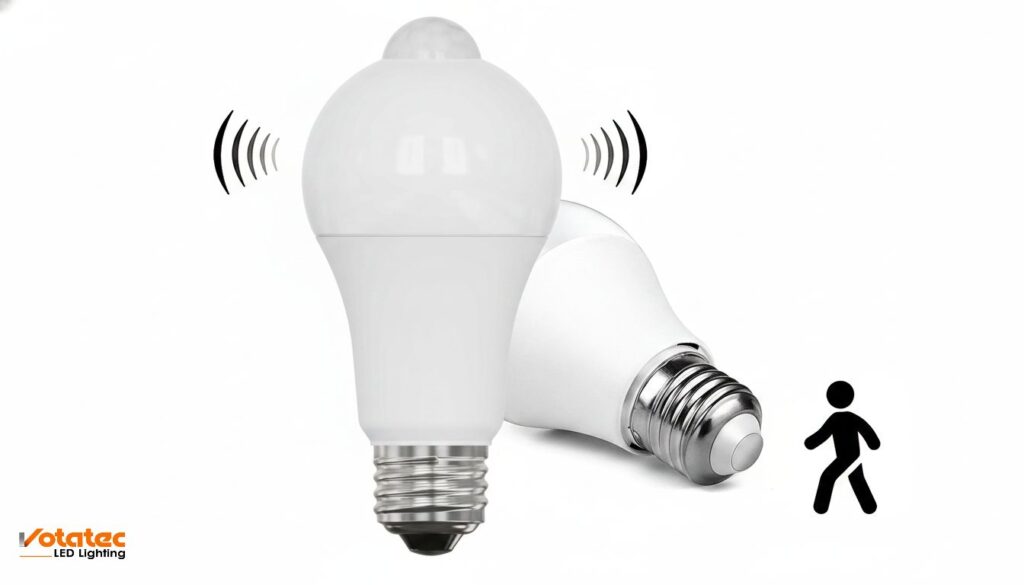
What Types of Motion Sensors Are Used in Light Bulbs?
PIR is the most common. By far. But it’s not the only technology out there. Here’s how they compare.
| Feature | PIR (Passive Infrared) | Microwave (Radar) | Dual-Technology | Ultrasonic |
| How it works | Detects infrared heat changes | Sends radio waves, detects Doppler shift | Combines PIR + microwave | Emits high-frequency sound waves |
| Detection range | 3 to 12 metres | Up to 21 metres | Up to 21 metres | 3 to 8 metres |
| Detection angle | 90 to 120 degrees | Up to 360 degrees | Varies by model | Up to 360 degrees |
| Through walls/glass? | No | Yes | Partial | No |
| False alarms | Low | Higher | Very low | Moderate |
| Power draw | Low | Higher | Moderate | Moderate |
| Cost | $ | $$ | $$$ | $$$ |
| Common form | Screw-in bulbs | Commercial fixtures | Commercial fixtures | Ceiling-mounted sensors |
| Best for | Residential, indoor | Large commercial spaces | Warehouses, parking garages | Open office layouts |
PIR (Passive Infrared)
This is what’s inside almost every motion sensor light bulb sold in Canada.
Pros: Cheap, low power, reliable, very few false alarms.
Cons: Can’t see through glass or walls. Misses stationary people.
For a hallway, garage, closet, or porch? PIR is all you need.
Microwave (Radar)
More common in commercial fixtures than consumer bulbs. These send out low-power radio waves and listen for frequency shifts when something moves. Think of it like a miniature radar system.
Pros: Bigger coverage, works through walls and glass.
Cons: More false triggers, uses more power, costs more.
You’ll see these in warehouse lighting and parking garage fixtures. Overkill for a bedroom closet. If you’re shopping for a basic motion sensor light bulb for home use, stick with PIR.
Dual-Technology
Combines PIR and microwave. Both sensors have to agree that something moved before the light turns on. This cuts false alarms way down.
Best for: Commercial spaces where accuracy matters. Loading docks, stairwells, secure areas.
Availability: Mostly hardwired fixtures. You won’t find these in a screw-in bulb.
Ultrasonic
Uses high-frequency sound waves above human hearing to detect movement. Rare in consumer products. You’ll see these in commercial building occupancy systems, but almost never in a standard light bulb.
Motion Sensor Bulb vs Motion Sensor Fixture: Which Do You Need?
This trips people up. Also called a motion activated light bulb, these units come in a few different forms. There are actually three ways to get motion-activated lighting, and they’re quite different.
Screw-In Motion Sensor Bulbs
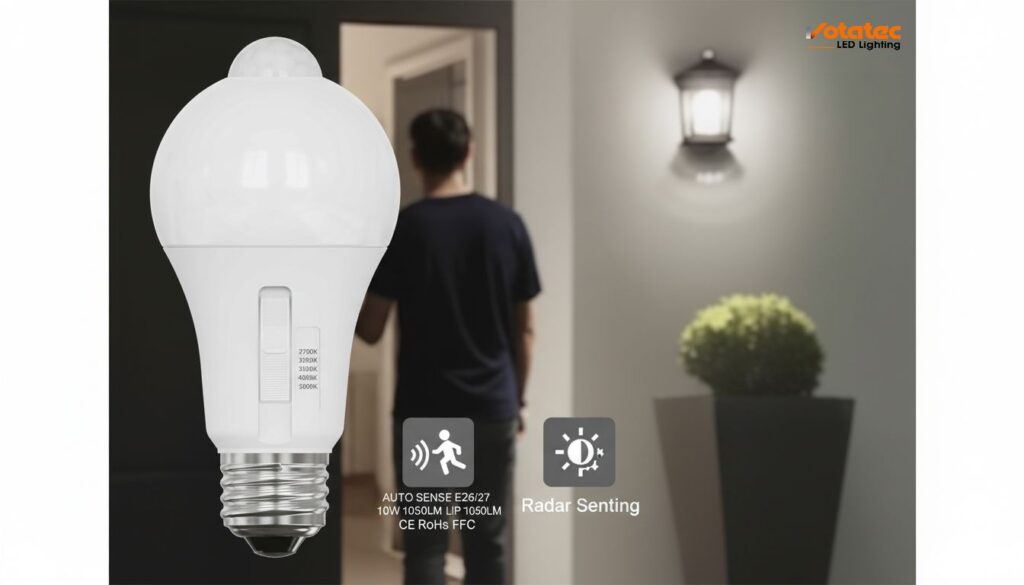
Self-contained units. The LED, the PIR sensor, the photocell, the timer, all built into one bulb with a standard E26 base. Unscrew the old bulb, screw this one in. Done. No wiring, no electrician.
Price: $10 to $30 CAD.
Detection range: 3 to 8 metres.
Best for: Hallways, closets, garages, basements, laundry rooms.
Available at: Canadian Tire, Home Depot, Amazon.ca.
Hardwired Motion Sensor Fixtures
Dedicated light fixtures with a separate, more powerful sensor. These need electrical installation. Votatec’s motion security lights are a good example of what this looks like in a commercial-grade product.
Price: $30 to $300 CAD.
Detection range: Up to 21 metres or more.
Best for: Outdoor security, driveways, commercial properties, loading docks.
Requires: Electrical wiring. Possibly a licensed electrician depending on your province.
Socket Adapters
Here’s an option people forget about. Motion sensor socket adapters screw into an existing socket, and then your regular bulb screws into the adapter. Turns any standard bulb into a motion-activated one.
Price: $8 to $15 CAD.
Pros: Works with any bulb you already own.
Cons: Adds length, so it might not fit in some enclosed fixtures.
Honestly, these are underrated. If you’ve got a bulb you like and just want to add motion sensing, this is the cheapest way to do it.
How Much Energy Do Motion Sensor Light Bulbs Save?
The numbers are solid on this one.
A study by Lawrence Berkeley National Laboratory that analyzed 88 research papers and 240 energy estimates found that occupancy sensors reduce lighting energy use by an average of 24% in commercial buildings (LBNL/ACEEE).
For residential use, the savings are often higher. Motion sensor lights can cut energy use by 35% to 50% compared to leaving lights on all the time (House Digest, SaveOnEnergy).
Let’s do some quick math. Say you’ve got a 60W equivalent LED motion sensor bulb (actual draw around 9W) in your garage. Without the sensor, it’s on 8 hours a day. With the sensor, maybe 2 hours of actual use. At Ontario’s average rate of about $0.13/kWh (Ontario Energy Board), that’s roughly $3 to $4 saved per bulb per year.
One bulb? Not a game changer. But 10 or 20 motion sensor LED bulbs in a commercial building? Now you’re looking at real savings. Especially combined with LED efficiency.
And here’s the thing. If you’re running a commercial facility in Ontario, programs like Save on Energy’s Retrofit Program offer up to $0.35 per kWh saved for advanced lighting controls. Motion sensors count.
What Should You Look for When Buying One?
Not all motion sensor light bulbs are created equal. Here’s what actually matters when you’re picking one out.
Detection Range
For indoor use like hallways, closets, or garages, 3 to 8 metres is plenty. For outdoor or commercial spots, look for 10+ metres. More range means more coverage, but also more chance of false triggers.
Detection Angle
Built-in bulbs usually cover 90 to 120 degrees. Fine for a hallway or entryway. But if you need full room coverage, look for ceiling-mounted options with 360-degree detection.
Delay Timer
Controls how long the light stays on after motion stops. Budget bulbs have a fixed timer, usually 45 to 60 seconds. Better models let you adjust from 10 seconds to 30 minutes. Worth the upgrade if the fixed timer annoys you.
Sensitivity Adjustment
Got pets? This matters. Adjustable sensitivity lets you tune the sensor to ignore smaller heat signatures. Otherwise, every time your cat walks through the hallway at midnight, the light flips on. Every. Single. Time.
Colour Temperature
Pick based on where the bulb is going:
- 2700K (warm white): Cozy, residential. Good for hallways, bedrooms, porches.
- 3000K (soft white): Bit brighter. Good all-around choice.
- 4000K (cool white): Better visibility. Garages, workshops, commercial.
- 5000K (daylight): Maximum brightness. Security, loading docks, parking lots.
IP Rating
Going outside? Check the IP rating. IP44 is the minimum for a covered porch. IP65 or higher for fully exposed locations. Most screw-in motion sensor bulbs are designed for indoor use, so double-check before sticking one outside in a Canadian winter.
Base Type
Standard in Canada is E26 (medium screw base). Fits about 90% of residential sockets. For floodlight-style setups, look for PAR38 base bulbs.
Do Motion Sensor Light Bulbs Work in Canadian Winters?
Good question. And one that barely anyone talks about.
Short answer: yes. And in some ways, they actually work better in cold weather.
PIR sensors detect the difference between body heat and ambient temperature. In a Canadian winter where outdoor temperatures drop to -20 or -30 degrees C, the contrast between your body (37 degrees C) and the surrounding air is massive. That makes detection more reliable, not less.
But there are a couple of catches.
Battery-powered models lose capacity in extreme cold. Lithium batteries handle cold better than alkaline, but if you’re in Alberta or Manitoba and dealing with -40 stretches, a hardwired fixture is the safer bet. No batteries to worry about.
Plastic housings can become brittle. Cheap bulbs with thin plastic may crack after repeated freeze-thaw cycles. Look for outdoor-rated models with an IP65 rating and a temperature range that covers Canadian conditions. Anything rated to -30 degrees C or lower should be fine.
Snow and ice on the sensor lens. If the PIR dome gets covered in ice, detection drops. Mounting the bulb under an eave or overhang helps. So does a downward-facing orientation.
Bottom line: motion sensor light bulbs handle Canadian cold just fine. Just pick the right product and install it smart.
Can You Use Motion Sensor Bulbs in Commercial Buildings?
Absolutely. And in many cases, building codes now require some form of occupancy-based lighting control.
A motion sensor light bulb or fixture makes sense in a lot of commercial spots:
- Stairwells and corridors. Lights running 24/7 in a stairwell nobody uses most of the day? That’s wasted energy. Plain and simple.
- Washrooms. Hands-free operation and energy savings.
- Storage rooms. Light only when someone’s actually in there.
- Parking garages. Security plus big energy savings across dozens of fixtures. If you’re upgrading parking lot lighting, LED parking lot lights paired with motion sensors are the standard now.
- Warehouses. Especially aisles with intermittent traffic.
For these applications, hardwired fixtures with microwave or dual-technology sensors work better than screw-in bulbs. More range, more reliability, and easier to integrate with building management systems.
Something worth knowing: as of January 1, 2026, Canada has banned the import and manufacture of certain fluorescent lamp types (PEC). High-pressure sodium and metal halide bans follow in 2029. If your commercial building still runs legacy lighting, now’s the time to upgrade to LED. Adding motion sensors to the upgrade just makes the ROI even better.
How to Install a Motion Sensor Light Bulb
For screw-in bulbs, this is about as simple as it gets.
- Turn off the light switch. Safety first.
- Remove the old bulb.
- Screw in the motion sensor bulb. Standard E26 base. Same as any regular bulb.
- Turn the switch back on and leave it on. This is the part people miss. The wall switch has to stay in the ON position permanently. The bulb handles its own on/off.
- Aim the sensor. Point the PIR lens toward the area where you expect foot traffic.
- Wait 30 to 60 seconds. Most bulbs need a warm-up period after first power-on.
That’s it. Six steps.
Switch Compatibility Warning
Motion sensor light bulbs need a standard on/off toggle switch. They won’t work properly with:
- Dimmer switches
- Three-way switches (unless wired to bypass the three-way function)
- Smart switches that cut power intermittently
If your bulb keeps flickering or won’t shut off, the switch is almost always the culprit.
Where Should You NOT Place a Motion Sensor Light Bulb?
Just as important as knowing where to put them is knowing where they don’t work well.
Behind glass. PIR sensors can’t detect infrared through glass. If the bulb sits inside a glass-enclosed fixture or behind a window, it won’t see anything.
Near HVAC vents. Hot air blowing across the sensor mimics body heat. This causes false triggers, especially in commercial spaces with ceiling-mounted vents.
Facing direct sunlight. Rapid changes in sunlight intensity (like cloud shadows passing) can trigger the sensor.
In an enclosed fixture without ventilation. Some motion sensor bulbs are rated for enclosed fixtures. Many aren’t. Heat buildup can damage the sensor and shorten the LED’s life. Check the box.
Above a dimmer switch. This deserves repeating. Dimmer switches and motion sensor bulbs don’t mix.
Why Does My Motion Sensor Light Keep Turning On by Itself?
This is the number one complaint about motion sensor light bulbs. And it’s usually one of these five things:
- Sensitivity too high. Pets, passing cars, wind-blown branches near a heat source. Lower the sensitivity if your model allows it.
- Heat sources nearby. HVAC vents, radiators, even a dryer exhaust vent can fool the sensor.
- Insects. Bugs flying close to the sensor lens trigger activation, especially during summer evenings outdoors.
- Sensor facing a window. PIR can’t see through glass, but it can detect heat changes on the glass surface itself.
- Electrical interference. Faulty wiring or power surges can cause random flickers.
Try repositioning the bulb so the sensor faces away from windows, vents, and heat sources. If that doesn’t fix it, an adjustable-sensitivity model is worth the few extra dollars. For a more detailed walkthrough, see our guide on how to turn off a motion detector light for reset and troubleshooting steps.
Smart Home Integration: Where Things Are Heading
The motion sensor LED bulb market is evolving fast. A few trends worth watching.
In 2025, Philips Hue announced MotionAware technology that uses Zigbee radio wave fluctuations to detect human presence through existing smart bulb hardware. No separate sensor needed (Hackaday). That’s a big deal. It means your regular smart bulb could gain motion detection overnight through a firmware update.
The global outdoor motion sensor light market hit USD $3.04 billion in 2025 and is growing at 8.5% to 9.4% annually (360 Research Reports). Over 45% of residential exterior lighting now uses some form of motion sensing.
The Matter protocol is pushing cross-brand compatibility, with over 180 certified smart bulb models working across Apple HomeKit, Google Home, and Amazon Alexa. That number keeps climbing.
For now, though, a simple $15 PIR motion sensor light bulb still does the job for most Canadians. You don’t need a smart home setup to benefit from a motion sensor light bulb. Smart integration is a bonus, not a requirement.
Canadian Rebates for Motion Sensor Lighting
If you’re upgrading commercial or industrial lighting in Canada, provincial rebate programmes can cover a big chunk of the cost.
| Province | Programme | What You Get |
| Ontario | Save on Energy – Retrofit | Up to $0.35/kWh saved for lighting controls |
| British Columbia | BC Hydro | Up to 75% coverage on commercial LED upgrades |
| Quebec | Hydro Quebec | $5 to $40 per fixture for DLC-certified products |
| Manitoba | Efficiency Manitoba | Standard rebates plus 50% bonus (before March 31, 2026) |
| Saskatchewan | SaskPower | Up to $200,000 total; $0.06/kWh saved |
| Nova Scotia | Efficiency Nova Scotia | Up to 75%+ of product cost |
| New Brunswick | SaveEnergy NB | 25% cash back on eligible upgrades |
| PEI | efficiencyPEI | Up to $75,000/year in rebates |
Motion sensor LED bulbs qualify under general LED upgrade programmes in most provinces. You don’t need a motion-sensor-specific rebate.
FAQ
Can you put a motion sensor light bulb in a regular socket?
Yes. Most use a standard E26 base, which fits any regular lamp socket in Canada. No special wiring needed.
Do motion sensor light bulbs work during the day?
Most have a built-in photocell that blocks daytime activation. Some models let you switch to 24/7 mode if you need it.
Do motion sensor light bulbs work through glass?
No. PIR sensors detect infrared heat radiation, and glass blocks it. A bulb behind a glass enclosure won’t detect movement on the other side.
How long do motion sensor light bulbs last?
The LED lasts 25,000 to 50,000 hours. That’s 10 to 20 years at average residential usage. The PIR sensor typically outlasts the LED itself.
Can you use a motion sensor bulb with a dimmer switch?
No. Motion sensor bulbs need a standard on/off toggle switch. Dimmers interfere with the internal electronics and cause flickering.
Are motion sensor light bulbs worth it?
At $10 to $20 CAD per bulb with 35% to 50% energy savings, most pay for themselves in months. Add convenience and security, and yes. Worth it.
What’s the difference between a motion sensor and an occupancy sensor?
Motion sensors detect initial movement and turn the light on. Occupancy sensors also detect subtle ongoing motion (like someone sitting at a desk) to keep the light on. For screw-in bulbs, the distinction is mostly marketing. For commercial fixtures, it actually matters.
Why does my motion sensor light stay on all the time?
Usually a stuck relay, an override mode, or a power surge that reset the timer. Turn the wall switch off for 30 seconds, then back on. That resets most models.
What are the three settings on a motion sensor light?
Most adjustable models have three controls: sensitivity (how easily it triggers), time delay (how long it stays on), and lux level (the ambient light threshold for activation). Budget bulbs often have these fixed.
Do motion sensor light bulbs work in extreme cold?
Yes. PIR sensors actually perform better in cold weather because the temperature difference between your body and the surrounding air is larger. But battery-powered models lose capacity in extreme cold. Hardwired or standard socket models are better for Canadian winters.
Bottom Line
A motion sensor light bulb is one of the simplest upgrades you can make. Screw one in, leave the switch on, and you’ve got hands-free lighting that saves energy and adds a layer of security.
For residential use, a basic PIR screw-in bulb from Canadian Tire or Home Depot will do the job. For commercial buildings, hardwired fixtures with microwave or dual-technology sensors are the better call, and provincial rebate programmes can help offset the cost.
The technology isn’t complicated. A heat sensor, a lens, and a timer circuit. But the convenience? Hard to beat.









B doyle 1 month ago
I plugged in motion activated lightbulb on my outside deck and the electrical outlet and my patio door and my switch is on. I just walked by it and it will not come on how come.
B doyle 1 month ago
I purchased a motion activated at Kent bldg supplies 60 watt. I removed my old 60 watt. Regular lightbulb from the socket outside and I installed my new motion lightbulb I turned it on the switch inside it lit up for about 10 seconds today at 1 o’clock the switch is on inside my home. I just went outside to check and walked by the light fixture that is enclose and the lightbulb did not come onHOW COME