










 (+1) 905 597 5955



Canadian businesses spend around $2.8 billion a year on commercial lighting. About 30% of that energy goes straight to heat instead of light.
Kind of ridiculous when you think about it.
Here’s the thing. If you’re a facility manager, building owner, or procurement officer still running fluorescent or metal halide fixtures, you’re overpaying. A lot. And with Canada’s fluorescent ban now in effect as of January 2026, those old tubes are on borrowed time anyway. The shift to commercial LED lighting in Canada is accelerating, driven by new regulations and rebate programmes that cover up to 90% of upgrade costs.
This guide covers everything you need to know about commercial LED light fixtures for Canadian projects. Fixture types, certifications that actually matter, rebate programmes by province, real ROI numbers, and how to pick the right product for your space. No fluff. Just the stuff that helps you make a smart decision.
What Makes LED Different for Commercial Spaces?
LED isn’t just a better light bulb. It’s a completely different technology.
Fluorescent tubes and metal halide lamps create light by heating gas or metal vapour. Most of that energy becomes heat, not light. LEDs pass current through a semiconductor. Way more efficient. Way less waste.
The numbers tell the story:
- LED vs fluorescent: 50-60% less energy (Source: University of Michigan / U.S. DOE)
- LED vs metal halide: 62-75% less energy
- LED lifespan: 50,000 to 100,000 hours, while fluorescent T8 gets maybe 25,000 and metal halide around 15,000 (learn more about how long LED lights actually last)
So you’re cutting your energy bill in half while replacing lamps 3-5x less often. Pretty good deal.
But here’s what really matters for commercial buyers. LED fixtures now come with selectable wattage and selectable colour temperature built right in. One fixture, multiple settings. You adjust in the field after installation with LED dimmer switches. That means fewer SKUs to stock, fewer ordering mistakes, and more flexibility if the space changes use later.
Want to see what’s available? Browse Votatec’s full range of commercial LED fixtures – all CSA-certified and DLC-listed.
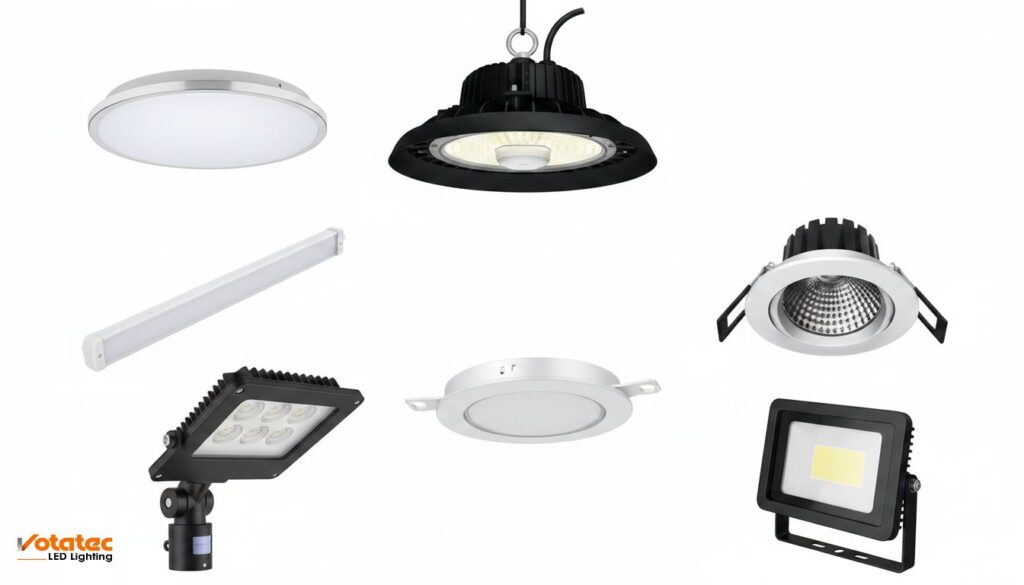
Types of Commercial LED Fixtures (and Where to Use Them)
Not all LED fixtures do the same job. LED lighting for commercial buildings comes in a range of form factors, each designed for specific mounting conditions and use cases. Here’s a breakdown of the main types of LED ceiling lights you’ll run into for commercial projects.
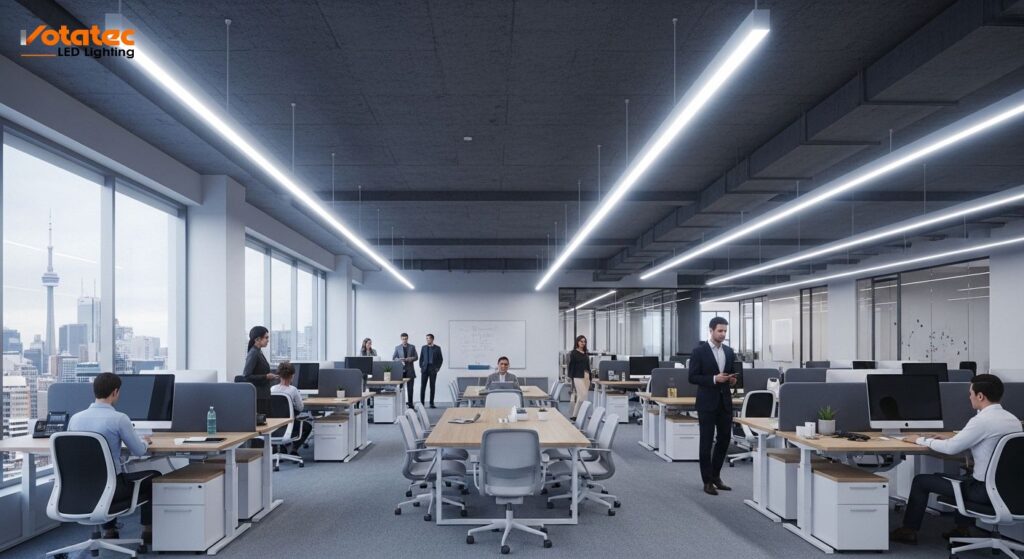
LED Troffers
Drop-in replacements for fluorescent 2×4 and 2×2 ceiling panels. You see these everywhere, offices, schools, hospitals, government buildings. Modern LED troffer lights hit 150 lumens per watt and come in selectable wattage options (like 30/40/50W in one fixture).
For spaces without drop ceilings, surface mount LED lights work as an alternative.
Good for: offices, classrooms, healthcare facilities, any space with drop ceilings.
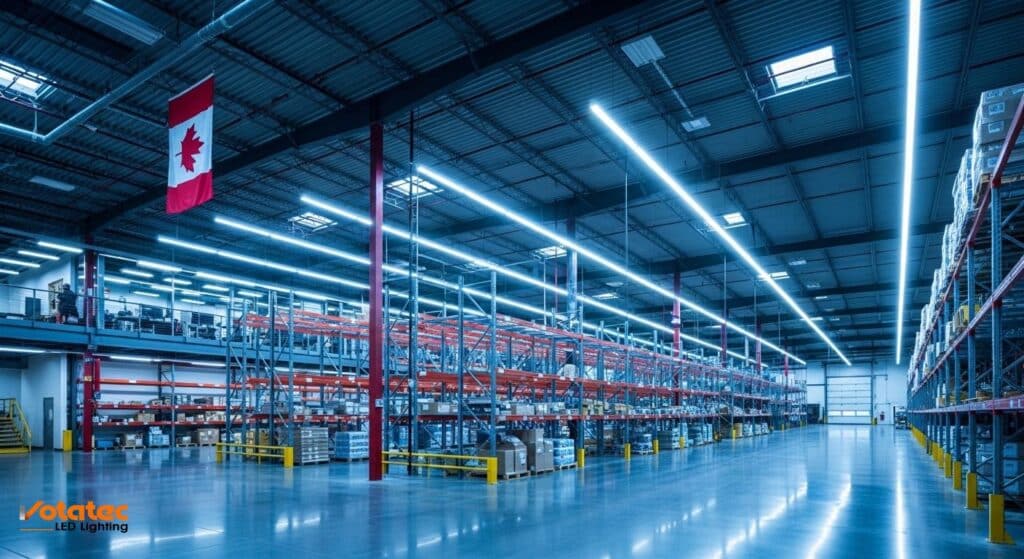
LED High Bays (UFO and Linear)
The workhorses of warehouses and factories. UFO high bay LED fixtures are compact and round, great for open floor plans. Linear high bay LED lights work better for aisles and racking because they spread light in a wider pattern and reduce shadows between shelves.
Wattage range: 100W to 400W. Lumens: 12,000 to 60,000+. Mounting height matters here. A 20-foot ceiling needs around 16,000-20,000 lumens per fixture. Go higher, and you need more.
Good for: warehouses, manufacturing, gyms, distribution centres.
LED Downlights
Recessed downlights sit flush in the ceiling for a clean, finished look. Come in 4-inch, 6-inch, and 8-inch sizes with selectable CCT (2700K through 5000K). Most commercial projects use 4000K for a neutral look. Make sure you know which light bulb base size you need when ordering.
Good for: lobbies, corridors, retail, restaurants, offices.
LED Wall Packs
Exterior fixtures mounted on building walls. They handle perimeter lighting, doorways, loading docks, and walkways. Look for ones with photocell sensors and motion detectors so they only run when needed. If you’re debating between these and floods, check out the wall pack vs flood light comparison.
Good for: building exteriors, loading docks, walkways, parking areas.
LED Vapour Tight Fixtures
IP65 or IP66 rated for wet, dusty, or harsh environments. These replace fluorescent strip lights in places where moisture and debris are a problem.
Good for: car washes, food processing, cold storage, parking garages.
LED Flood Lights
High-output fixtures for large outdoor areas. Stadiums, parking lots, building facades, and security perimeters. Modern LED floods come with adjustable aiming brackets and slip-fitter mounts.
Good for: parking lots, athletic fields, building facades, security.
See outdoor LED flood lights →
Canadian Certifications for Commercial LED Lights
This part trips up a lot of buyers. When purchasing commercial LED lights in Canada, there are dozens of certifications out there, but only a few actually matter for safety and rebate eligibility.
CSA or cETL: Safety (Mandatory)
Every electrical product sold in Canada needs safety certification from CSA (Canadian Standards Association) or cETL (Intertek). The “c” in cETL means it’s certified for Canada specifically. Without one of these marks, the product can’t legally be installed.
Not negotiable. If a fixture doesn’t have CSA or cETL, walk away.
Source: CSA Group – Lighting Certification
DLC: Performance (Needed for Rebates)
Here’s where it gets interesting. DLC (DesignLights Consortium) isn’t a safety certification. It’s a performance standard. It verifies lumen output, efficacy, colour accuracy, and lumen maintenance over time.
Why does this matter? Because about 70% of North American energy efficiency programmes – nearly 700 programmes total – require DLC listing for rebate eligibility (Source: DesignLights Consortium). No DLC, no rebate money. Simple as that.
And here’s a heads up. DLC released Version 6.0 in November 2025 with efficacy thresholds about 14% higher on average. Products that don’t meet V6.0 get delisted by December 2026. So when you’re buying fixtures today, make sure they meet V6.0 standards. Otherwise you might miss the rebate window.
ENERGY STAR: Optional but Helpful
Mostly relevant for residential and light commercial. Some provincial programmes use ENERGY STAR as a qualifying criterion. Worth having, but DLC matters more for commercial projects.
How Much Does Commercial LED Lighting Cost?
Let’s talk real numbers. This is what facility managers and procurement officers actually want to know.
| Fixture Type | Price Range (per unit) | Replaces |
| LED Troffer (2×4) | $40 to $120 | Fluorescent troffer |
| LED High Bay (UFO) | $80 to $250 | Metal halide / HPS high bay |
| LED High Bay (Linear) | $100 to $350 | Fluorescent high bay |
| LED Downlight (6 inch) | $15 to $50 | Incandescent / CFL pot light |
| LED Wall Pack | $50 to $250 | HPS / MH wall pack |
| LED Vapour Tight (4ft) | $40 to $90 | Fluorescent strip |
| LED Tube Light (4ft) | $8 to $20 | T8 fluorescent tube |
These are fixture-only prices. Installation adds $50 to $150 per fixture depending on height, access, and whether you need new wiring. For LED tube lights, direct wire (Type B) installation is usually cheaper than replacing the ballast.
But here’s what Tom, a facility manager at a 200,000 sq ft distribution centre in Mississauga, figured out last year. He was spending $4,200 a month just on replacement lamps and ballasts for his 300 metal halide high bays. The labour to bring in a scissor lift every time one burned out? That alone was killing his maintenance budget. He switched to LED high bays over three months. Lamp replacement cost dropped to basically zero. His energy bill went from $8,400 to $2,900 per month. Total project cost was $67,000 after Ontario Save on Energy rebates covered about 40%.
Payback? Under 14 months.
Commercial LED Lighting Rebates Across Canada
This is the part most buyers underestimate. Commercial lighting rebates across Canada can knock 20-50% off your total project cost. Some even higher.
Ontario: Save on Energy
The biggest programme in Canada for commercial lighting.
- Retrofit Programme: Up to $1,800 per kW saved or $0.20/kWh, whichever is higher. Maximum 50% of eligible project costs
- Small Business Programme: Up to $3,000 in lighting incentives for businesses with 50 or fewer employees. Includes free site assessment and direct installation. Runs until March 31, 2027
- Instant Discounts: Up to $14 per integrated LED troffer, up to $30 per occupancy sensor
- Regional bonuses (new in 2026): Parts of the GTA, Niagara, and Southwestern Ontario get bonus incentives that can potentially double the standard rebate
Combined, these rebates can cover close to 50% of a lighting upgrade. Not a typo.
Source: Save on Energy – Retrofit Programme
British Columbia: BC Hydro
- Up to 75% coverage on LED lighting upgrades
- 30% bonus incentive for eligible projects (check current availability, earlier deadline was February 2026)
- Must use under 500 MWh annually to qualify
- Project completion deadline: March 14, 2027
Quebec: Hydro-Quebec
- Standard DLC fixtures: $5 per fixture
- Premium DLC fixtures: $40 per fixture
- Small businesses: up to 90% of conversion cost covered – the highest rate in Canada
Source: Hydro-Quebec – Efficient Solutions Programme
Other Provinces
| Province | Programme | Key Benefit |
| Manitoba | Efficiency Manitoba | 50% bonus on incentives if submitted before March 31, 2026 |
| Saskatchewan | SaskPower CEOP | $0.06/kWh saved, up to $200,000 |
| Nova Scotia | Efficiency Nova Scotia | $325 per fixture for horticultural LEDs under 650W |
| New Brunswick | SaveEnergy NB | 25% back on eligible upgrades |
| PEI | Business Energy Rebate | Up to $75,000/year for large operations |
| Newfoundland | takeCHARGE Business | Up to $3/tube for LED T8/T5 retrofits |
The catch? Almost all of these require DLC-listed fixtures. See why that certification matters now?
Need help figuring out which rebates apply to your project? Get a commercial LED lighting quote and we’ll walk through rebate eligibility for your province.
How to Calculate Your Commercial LED Lighting ROI
Here’s some quick math for a typical 50,000 sq ft office with 500 fixtures.
Scenario: Replace T8 fluorescent troffers with LED troffers
| Item | Old (Fluorescent) | New (LED) |
| Watts per fixture | 128W (4-lamp T8) | 40W (LED troffer) |
| Total wattage | 64,000W | 20,000W |
| Annual hours | 3,000 | 3,000 |
| Annual kWh | 192,000 | 60,000 |
| Electricity cost ($0.14/kWh) | $26,880/yr | $8,400/yr |
| Annual energy savings | $18,480 |
Project cost: 500 fixtures x $85 = $42,500
Less Ontario rebate (est. 35%): -$14,875
Net cost: $27,625
Payback: 1.5 years. After that, it’s pure savings. Over 10 years, that’s roughly $157,000 in energy savings alone. Plus you’re not replacing tubes and ballasts every 2-3 years.
And those are conservative numbers. Warehouse LED lighting and office LED lighting projects running 24/7 see even faster payback because the fixtures log more hours. Adding occupancy sensors and dimming controls can push savings another 30-50% beyond the fixture swap alone (Source: U.S. DOE).
Source: WattMath – LED Retrofit ROI Analysis
Want to run the numbers for your warehouse? Try Votatec’s high bay lighting calculator.
LED Colour Temperature and CRI for Commercial Spaces
This is where a lot of commercial projects go sideways. You pick the right fixture but the wrong colour temperature, and the space feels off. People complain. Productivity drops. Nobody can explain why.
Colour temperature is measured in Kelvin (K). Lower numbers are warm (yellowish). Higher numbers are cool (bluish-white). Here’s what works for different spaces:
| Space | Recommended CCT | Why |
| Office | 3500K-4000K | Balanced, supports focus without feeling clinical |
| Warehouse / Industrial | 4000K-5000K | Maximises visual clarity for labels, barcodes, safety |
| Retail | 3000K-4000K | Enhances product appearance (see retail lighting guide) |
| Healthcare | 3500K-5000K | Clarity and alertness for medical settings |
| Hospitality | 2700K-3000K | Warm, inviting atmosphere |
| Parking / Security | 4000K-5000K | Maximum visibility |
CRI (Colour Rendering Index) measures how accurately colours appear under the light. Think of it like colour fidelity. A CRI of 80 is the minimum for most commercial spaces. But if you’re lighting a retail store, healthcare facility, or any space where colour accuracy matters, aim for CRI 90+.
Here’s a quick example. Jennifer runs a boutique clothing store in downtown Vancouver. She upgraded to LED track lights but picked fixtures with CRI 70 because they were cheaper. Within two weeks, customers started asking why everything looked “washed out.” Reds looked brownish. Blues looked grey. She ended up re-buying CRI 90+ fixtures and eating the cost of the first batch.
The thing is, $15 more per fixture would have saved her $2,000.
Lesson: don’t cheap out on CRI for retail.
The 2026 Fluorescent Ban: Why Commercial LED Retrofit Is Urgent
Canada banned the manufacture and import of most fluorescent lamps as of January 1, 2026. This isn’t future tense anymore. It’s happening now.
Here’s the timeline:
| Date | What Happens |
| January 1, 2026 | Ban on manufacturing/importing CFLs, T5, T8, T12 fluorescent tubes |
| 2026-2027 | Replacement lamps still available (exemption period) |
| December 31, 2028 | Ban on metal halide and high-pressure sodium lamps |
| 2029 | Retailers clear remaining fluorescent stock |
| January 1, 2030 | Complete ban on retail sales of all remaining fluorescent lamps |
The government projects $3.86 billion in energy savings and a 4.6-megatonne reduction in greenhouse gas emissions over the next 10 years from this regulation alone (Source: Government of Canada).
So if you’re still running fluorescent, you can buy replacement tubes through 2027. But prices are climbing as supply drops. And by 2030, they’re gone completely.
And here’s what caught Paul off guard. He manages a 12-storey office tower in downtown Toronto. About 4,000 T8 tubes across all floors. He figured he’d wait until 2028 to retrofit, ride out the exemption period, and “let the technology mature a bit more.” Then his lamp distributor called in February 2026 to let him know that T8 pricing had jumped 35% since the ban took effect. Every building in his portfolio was competing for the same shrinking supply. He moved up his timeline by 18 months and still ended up paying more for replacement tubes during the transition than he budgeted.
The smart move? Start your commercial LED retrofit now while rebate programmes are still funded and contractors aren’t booked solid. By late 2027, every building in Canada will be scrambling to retrofit. Getting ahead of the rush saves you money and headaches. If your fixtures are flickering already, that’s one more reason not to wait.
How to Choose the Right Commercial LED Fixtures
Alright, let’s pull this together. Here’s a step-by-step approach for your next commercial lighting project.
Step 1: Figure Out What You’re Replacing
Walk the facility. Count fixtures by type. Note mounting heights, ceiling types, and any special conditions (wet areas, high ceilings, hazardous locations). This gives you your fixture list.
Step 2: Check Certifications
Every fixture needs CSA or cETL (safety) and DLC listing (rebate eligibility). If you want rebate money, and you do, DLC is non-negotiable.
Step 3: Match Colour Temperature to the Space
Use the CCT table above. And if you’re not sure, go with 4000K. It works in almost every commercial application. Many modern fixtures let you switch CCT in the field, so you don’t have to commit at the time of purchase.
Step 4: Calculate Your Savings
Use real numbers. Your current wattage, your electricity rate, your operating hours. Votatec’s high bay lighting calculator can help with the math for warehouse spaces.
Step 5: Apply for Rebates Before You Buy
Most programmes require pre-approval. Don’t install first and apply later. Talk to your utility or a lighting supplier who knows the rebate process. This is where a lot of money gets left on the table.
Step 6: Plan the Installation
Decide if you’re doing a full replacement or phased rollout. Phased works well for facilities that can’t shut down. Start with the highest-energy areas first (warehouses, parking, exterior) for the fastest ROI. If you’re adding dimmers, check out how to install a dimmer switch for the basics.
Smart Controls for Commercial LED Lighting
Worth mentioning because this is where the market is heading. The global smart LED lighting market hit $9.86 billion in 2025 and is projected to reach $17.38 billion by 2030 (Source: MarketsandMarkets).
For commercial LED lighting installations, smart controls mean:
- Occupancy sensors that dim or turn off lights in empty rooms – now required by ASHRAE 90.1 in most interior spaces
- Daylight harvesting that adjusts output based on natural light – required within 15 feet of windows
- Scheduling for exterior lighting – mandatory for all outdoor fixtures under current energy codes
- Human-centric lighting that shifts colour temperature throughout the day to support circadian rhythms, boosting productivity by up to 6% (Source: Human Spaces research)
You don’t need to go full smart building on day one. But wiring for controls during a retrofit costs almost nothing compared to adding it later. Something to think about.
Commercial LED Lighting and Green Building Credits
If your building is pursuing LEED, WELL, or BOMA BEST certification, commercial LED lighting can contribute points across multiple categories. This matters especially for B2G projects and institutional buildings where green building certification is often a procurement requirement.
LEED v4.1 credits that LED lighting supports:
- Energy and Atmosphere (EA): LED retrofits reduce energy use intensity (EUI), which is the single largest factor in LEED EA credits
- Indoor Environmental Quality (IEQ): High-CRI LED fixtures with tunable CCT meet IEQ Credit 6 (Interior Lighting) requirements for quality and controllability
- Materials and Resources: LED’s 50,000+ hour lifespan reduces waste from frequent lamp replacements
WELL Building Standard v2:
- Feature L03 (Circadian Lighting Design) requires tunable white fixtures that adjust colour temperature, something modern commercial LED lights do out of the box
- Feature L06 (Visual Acuity) requires CRI 80+ for workspaces and CRI 90+ for certain tasks
And on the ESG reporting side, every kWh saved from an LED upgrade translates directly to Scope 2 emissions reductions. For a 500-fixture office retrofit saving 132,000 kWh per year, that’s roughly 13 tonnes of CO2 avoided annually (using Ontario’s 2025 grid emission factor).
Frequently Asked Questions
How much does commercial LED lighting cost per fixture?
Depends on the fixture type. LED troffers run $40 to $120 each. High bays cost $80 to $350. Downlights are $15 to $50. Installation adds $50 to $150 per fixture. But with provincial rebates covering 20-50% of project costs (up to 90% in Quebec), the net cost is significantly lower.
Are LED lights really worth it for commercial buildings?
Yes. A typical 500-fixture office retrofit saves $18,000+ per year in energy costs alone, with payback under two years. Add maintenance savings (no more relamping every 2-3 years) and you’re looking at $150,000+ in savings over 10 years. The math works for almost every commercial building.
What certifications do I need for commercial LED lights in Canada?
Two are non-negotiable. CSA or cETL for safety (legally required for all electrical products sold in Canada). And DLC listing for rebate eligibility, since about 70% of North American utility programmes require it. ENERGY STAR is optional but helpful for some provincial programmes.
How long do commercial LED lights last?
Most commercial grade LED fixtures are rated for 50,000 to 100,000 hours. At 12 hours per day, that’s 11 to 23 years. Compare that to fluorescent T8 tubes (25,000 hours) or metal halide lamps (15,000 hours). LED lasts 3-5x longer.
What LED colour temperature is best for offices?
4000K (neutral white) is the most popular choice for Canadian offices. It’s bright enough for focus without feeling harsh. Some newer commercial LED lighting systems offer selectable CCT (3500K/4000K/5000K) so you can adjust after installation.
Can I get rebates for LED lighting upgrades in Canada?
Yes. Every major province has an active rebate programme. Ontario’s Save on Energy covers up to 50% of project costs. Quebec’s Hydro-Quebec programme covers up to 90% for small businesses. BC Hydro offers up to 75%. Almost all require DLC-listed fixtures.
What’s the difference between DLC Standard and DLC Premium?
DLC Standard meets baseline efficacy requirements. DLC Premium exceeds them, typically by 20-30%. Premium products qualify for higher rebate amounts in most provinces. Like Hydro-Quebec, which offers $5 per Standard fixture but $40 per Premium fixture. Big difference.
Is the fluorescent ban really happening in Canada?
Already in effect. As of January 1, 2026, the manufacture and import of most fluorescent lamps (T5, T8, T12, CFLs) is banned in Canada. Replacement tubes are available through 2027 under an exemption, but supply is shrinking and prices are rising. Metal halide and HPS lamps get banned December 31, 2028.
Bottom Line on Commercial LED Lighting in Canada
Canada’s commercial LED market is worth $2.21 billion and growing at 9.2% per year (Source: Grand View Research). The fluorescent ban is in effect. Rebate programmes are covering 20-90% of project costs depending on your province. And the ROI on a typical commercial LED retrofit is under two years.
If you’re still running fluorescent or metal halide, now is the time to switch to energy efficient lighting. Not because it’s trendy. Because the math works.
The fixtures are better. The savings are real. And the old technology is literally being banned.
Ready to start your commercial LED upgrade? Browse Votatec’s full range of CSA-certified, DLC-listed commercial LED fixtures or request a project quote to get specific pricing for your facility.