













 (+1) 905 597 5955




Here’s the short answer: multiply your space’s area by the lumens-per-square-foot target for that room type. A 100 sq ft bedroom at 10-20 lumens/sq ft needs 1,000-2,000 lumens. A 4,000 sq ft warehouse aisle at 30-50 foot-candles needs 120,000-200,000 lumens spread across the fixtures.
LED lumens measure how much light a fixture puts out. Watts measure how much energy it draws. Since LED draws far less power than old incandescent or fluorescent gear (ENERGY STAR rates quality LED bulbs at up to 90% less energy), you can’t shop by watts any more. You shop by lumens.
This guide gives you the formula, a room-by-room chart, the commercial foot-candle levels used to spec offices, retail floors, warehouses, and parking structures across Canada, plus the colour temperature, outdoor, and running-cost details most guides skip.
What is a lumen?
A lumen is the unit that measures total visible light from a source. One lumen is roughly the light of a single birthday candle at one foot. A modern LED bulb puts out 800-1,600 lumens. A commercial high bay puts out 20,000-40,000.
Four terms get mixed up. Here’s the difference:
- Lumens measure total light output from the fixture.
- Watts measure energy the fixture draws. More watts no longer means more light.
- Lux measures how much light lands on a surface. 1 lux = 1 lumen per square metre.
- Foot-candles are the imperial version of lux. 1 foot-candle = 1 lumen per square foot = 10.76 lux.
You buy fixtures by lumens. You design a space by lux or foot-candles, because what matters is how much light reaches the desk, the floor, or the shelf, not just what leaves the fixture.
The lumen formula (the quick answer)
To work out total lumens for any space, use one calculation:
Total lumens = floor area × foot-candles required.
A foot-candle is one lumen falling on one square foot. So “foot-candles required” and “lumens per square foot” are the same number for a flat surface.
Two quick conversions you’ll want:
- 1 foot-candle = 1 lumen per square foot = 10.76 lux
- 1 lux = 1 lumen per square metre
If you work in metres, use lux instead. A 40 m² office at 400 lux needs about 16,000 lumens total.
Here’s the four-step version electrical contractors use on site:
- Measure the area. Length × width in square feet (or square metres).
- Pick the target. Use the room or task tables below.
- Multiply. Area × target = total lumens needed.
- Divide by fixture output. Total lumens ÷ lumens per fixture = number of fixtures.
Lumens, watts, and the old bulb equivalents
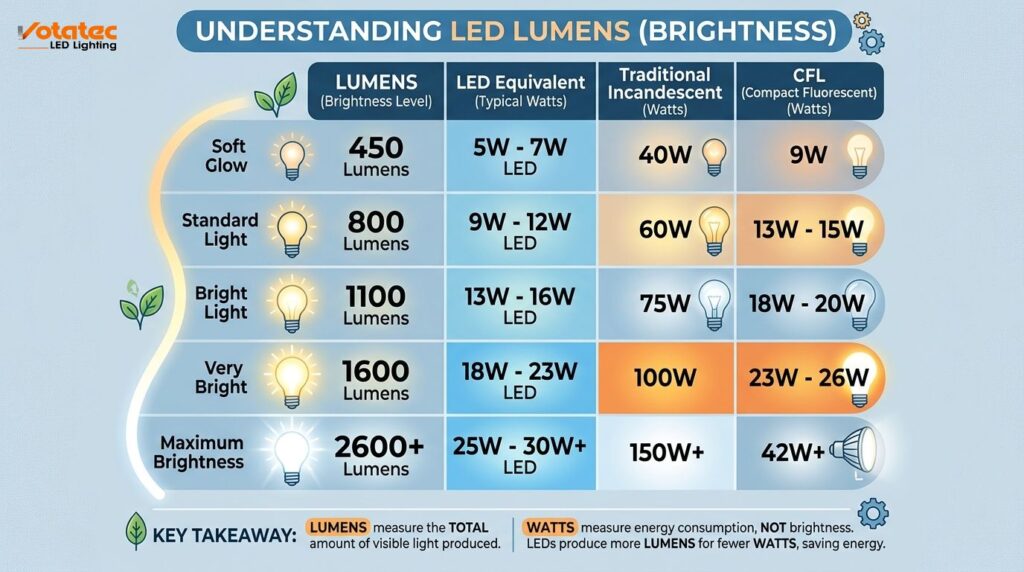
Buyers still think in watts because that’s how bulbs were sold for a century. Use this table to translate old wattage into the LED lumens you actually need.
| Old incandescent | LED lumens (approx.) | Typical LED draw |
|---|---|---|
| 40 W | 450 lumens | 4-6 W |
| 60 W | 800 lumens | 7-9 W |
| 75 W | 1,100 lumens | 10-12 W |
| 100 W | 1,600 lumens | 14-18 W |
| 150 W | 2,600 lumens | 22-28 W |
Source: U.S. Federal Trade Commission bulb-shopping guidance, which lists a 60 W incandescent at about 800 lumens.
One number tells you how good an LED is at turning power into light: efficacy, measured in lumens per watt (lm/W). Good commercial LED runs 120-160 lm/W. Higher efficacy means fewer watts for the same brightness, which is where the energy savings come from.
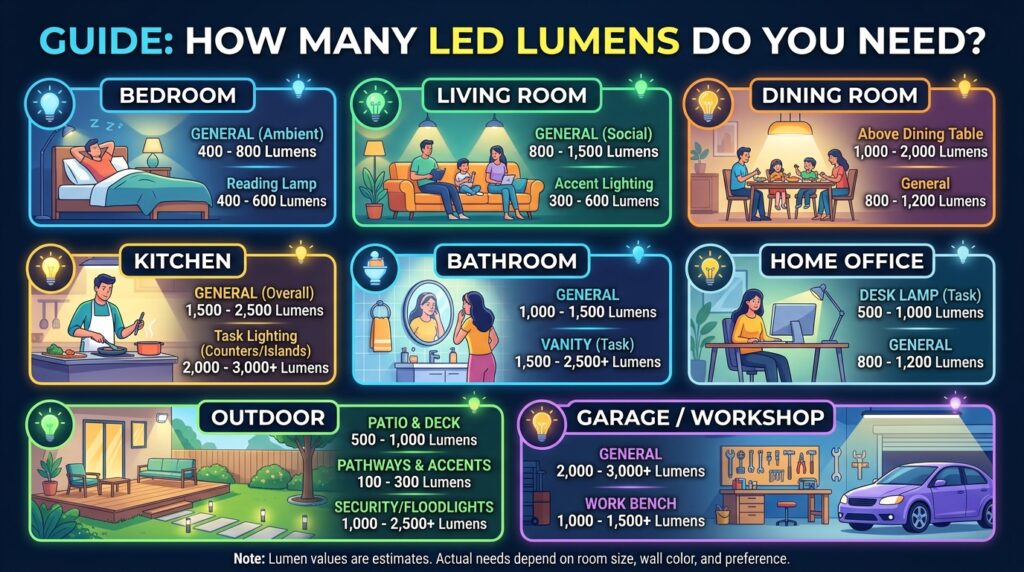
How many lumens do you need room by room?
For homes and light-commercial rooms, use these lumens-per-square-foot targets, then multiply by your floor area.
| Space | Lumens per sq ft | Example: 150 sq ft room |
|---|---|---|
| Living room (ambient) | 10-20 | 1,500-3,000 lumens |
| Bedroom (ambient) | 10-20 | 1,500-3,000 lumens |
| Hallway / stairwell | 5-10 | 750-1,500 lumens |
| Closet | 5-10 | 750-1,500 lumens |
| Laundry room | 30-40 | 4,500-6,000 lumens |
| Dining room | 30-40 | 4,500-6,000 lumens |
| Home office / desk task | 50-70 | 7,500-10,500 lumens |
| Kitchen (general) | 30-40 | 4,500-6,000 lumens |
| Kitchen counter (task) | 70-80 | 10,500-12,000 lumens |
| Bathroom vanity | 70-80 | 10,500-12,000 lumens |
| Garage / workshop | 50-70 | 7,500-10,500 lumens |
| Covered patio | 20-30 | 3,000-4,500 lumens |
These are total targets for the room. Split them across several fixtures rather than one bright source, and put the higher task numbers only over work zones like counters, desks, and benches.
Is 1,000 lumens bright enough for a room?
For a small bedroom or a hallway, yes. For a kitchen or bathroom, no. 1,000 lumens covers a 50-100 sq ft room at ambient levels. A kitchen the same size needs 3,000-4,000 lumens because cooking is task work. Match the number to the job, not just the square footage.
Is 3,000 lumens too bright for a bedroom?
In one fixture, usually yes for a standard bedroom. A 150 sq ft bedroom wants 1,500-3,000 lumens spread across lamps and ceiling lights, with dimming. 3,000 lumens from a single overhead fixture feels harsh. Spread the output and add a dimmer so you can drop it for evenings.
How many lumens for commercial spaces?
Commercial and institutional buildings are specified in foot-candles, following the Illuminating Engineering Society (IES) recommended light levels, including RP-7 for industrial facilities. These are the targets Canadian facility managers, contractors, and procurement teams design to.
| Space type | Foot-candles | Lux (approx.) | Notes |
|---|---|---|---|
| General office | 30-50 fc | 300-500 lux | ~40 fc is the common design target |
| Open workstations | 30-40 fc | 300-430 lux | Task lighting adds local boost |
| Conference room | 30-50 fc | 300-500 lux | Add dimming for AV use |
| Retail sales floor | 50-100 fc | 500-1,000 lux | Higher on feature displays |
| Grocery / big box | 50-75 fc | 500-800 lux | Uniformity matters |
| Warehouse (bulk storage) | 10-30 fc | 100-300 lux | Large-item, low-traffic zones |
| Warehouse aisles | 20-30 fc | 200-300 lux | Vertical light on racks counts |
| E-commerce picking | 50-70 fc | 500-750 lux | Fine detail, fast work |
| Receiving / loading dock | 20 fc (10-40) | 200-430 lux | Safety-driven range |
| Manufacturing (fine work) | 50-100 fc | 500-1,000 lux | Higher for precision assembly |
| Classroom | 30-50 fc | 300-500 lux | Up to 75 fc for lab/detail tasks |
| Gymnasium | 30-50 fc | 300-500 lux | Higher for competition play |
| Parking garage (interior) | 1-2 fc | 10-20 lux | ~1.5 fc average, uniformity is key |
| Building exterior / entry | 5 fc | 50 lux | Security and wayfinding |
Sources: IES recommended lighting levels and RP-7 industrial guidance, as summarised across lighting-industry references.
Offices
Aim for about 40 foot-candles (roughly 400 lux) on the work plane in general office areas. Layer in task lighting at desks so you can keep ambient levels moderate and cut energy. LED panel lights and recessed LED downlights are the usual pairing for suspended ceilings.
Retail
Retail runs brighter, 50-100 foot-candles, because light drives sales. Push feature displays and end caps to the top of that range with focused LED track lighting, and keep circulation aisles lower for contrast.
Warehouses and industrial
Warehouse targets swing with the work. Bulk storage of large items needs only 10-30 foot-candles; fast e-commerce picking wants 50-70. Mount LED high bay lights at the right spacing and remember that vertical light on the racks matters as much as light on the floor.
Parking garages and exterior
Parking decks are low-lux but demand even coverage: about 1.5 foot-candles average with no dark patches. Uniformity beats raw brightness here. Use LED canopy and garage lights and LED wall packs for entries and perimeters.
Colour temperature: how Kelvin changes the look
Lumens tell you how much light. Colour temperature, measured in Kelvin (K), tells you what that light looks like. Two fixtures at the same lumens can feel completely different. Lower Kelvin reads warm and yellow. Higher Kelvin reads cool and blue-white.
| Kelvin | Appearance | Best for |
|---|---|---|
| 2700K | Warm white (incandescent) | Bedrooms, living rooms, hospitality |
| 3000K | Soft warm white | Kitchens, bathrooms, warm retail |
| 3500K | Neutral warm | Lobbies, boutique retail |
| 4000K | Neutral white | Offices, schools, general retail |
| 5000K | Cool daylight white | Warehouses, garages, task areas |
| 5700K-6500K | Daylight / cool | Industrial, inspection, outdoor security |
For most Canadian commercial jobs, 4000K suits offices and retail, and 5000K suits warehouses, industrial floors, and outdoor. Warm 2700K-3000K stays in homes and hospitality. Keep colour temperature consistent within one space. Mixing 3000K and 5000K fixtures in the same room looks like a mistake, because it is one.
One catch worth knowing: warm light can read slightly dimmer than cool light at the same lumen count, so a 2700K room sometimes wants a small lumen bump.
How many lumens for outdoor and security lighting?
Outdoor lighting is rated per fixture, not per square foot, because you’re covering open ground. Here’s what each job needs.
| Outdoor use | Lumens per fixture | Notes |
|---|---|---|
| Pathway / bollard | 100-200 | Low glare, spaced for even pools |
| Step / accent | 50-100 | Safety marking, not flood |
| Residential security flood | 700-1,300 | Motion sensor recommended |
| Commercial security flood | 2,000-4,000 | Covers entries, yards, docks |
| Wall pack (building perimeter) | 2,000-5,000 | Wide throw along walls |
| Parking lot pole (area light) | 5,000-20,000+ | Depends on pole height and spacing |
Two rules keep outdoor jobs from going wrong. First, aim for even coverage, not one bright spot. A single 20,000-lumen flood leaves dark corners a burglar loves. Several spread fixtures beat one blaster. Second, cut light pollution and glare with proper shielding and warmer or neutral colour temperatures near property lines.
For commercial exterior work, LED flood lights, LED wall packs, and LED area and parking lot lights cover most of what a Canadian site needs.
4 factors that change your lumen target
The tables get you close. These four adjustments get you right.
- Ceiling height. Light spreads and weakens with distance. Add about 20% more lumens for 9-10 ft ceilings, and step up to high bay fixtures above roughly 15 ft.
- Colour temperature (CCT). Warm 2700K light can read dimmer than cool 5000K at the same lumens. Offices and warehouses usually run 4000K-5000K; hospitality leans warmer.
- Colour rendering (CRI). CRI doesn’t change lumens, but low-CRI light makes a space feel flat. Retail and inspection work want CRI 90+.
- Surface reflectance. Dark walls, floors, and racking soak up light. A dark warehouse can need 20-30% more output than a bright, white-painted one.
Mounting height and fixture spacing
Two fixtures with the same lumens light a floor very differently depending on how high they hang and how far apart they sit. Higher mounting spreads light wider but drops the lux at floor level. That’s why a 10 ft office and a 25 ft warehouse use different fixtures for the same foot-candle target.
| Mounting height | Fixture type | Typical use |
|---|---|---|
| 8-10 ft | Panels, downlights, troffers | Offices, retail, classrooms |
| 10-15 ft | Linear high bay, strip | Small warehouses, gyms |
| 15-25 ft | Round / linear high bay | Warehouses, manufacturing |
| 25-40 ft | High-output high bay, sports | Distribution centres, arenas |
A rough field rule for even coverage: space fixtures about 1 to 1.5 times the mounting height apart. Fixtures 20 ft up sit roughly 20-30 ft apart. Bunch them closer and you waste fixtures. Spread them wider and you get dark aisles. A proper photometric layout replaces the guesswork.
How to spec fixtures from a lumen target
Here’s a worked example a facility manager might run for a 10,000 sq ft warehouse aisle zone.
- Target: 30 foot-candles for mixed picking.
- Total lumens: 10,000 sq ft × 30 = 300,000 lumens.
- Fixture output: 24,000-lumen LED high bays.
- Count: 300,000 ÷ 24,000 = 13 fixtures, then adjust spacing for even coverage.
Run the same math for a 2,000 sq ft office at 40 foot-candles: 80,000 lumens total, divided by 4,000-lumen panels, gives 20 panels on a grid.
That last step matters. Thirteen high bays bunched together leave dark aisles. A lighting layout spaces them on a grid so lux stays even across the floor. If you’d rather skip the math, our team builds free photometric layouts from your floor plan.
LED lumen maintenance: why brightness fades and what L70 means
LEDs don’t burn out like old bulbs. They fade. The L70 rating is the number of hours before a fixture drops to 70% of its original lumens, and it’s the industry-standard way to measure real LED life.
- L70: output has fallen to 70% of new. The point most people first notice dimming.
- L80: output still at 80% of new. A tighter, higher-quality benchmark.
- L90: output still at 90%. Premium spec for retail and inspection.
- B10: the “B” value is the share of units expected to fail. L80/B10 at 50,000 hours means after 50,000 hours (about 16 years at commercial use), 80% output holds and only 10% of units have failed.
Two lessons for buyers. Compare lumen maintenance, not just rated life. A fixture rated “50,000 hours” tells you little without its L and B values. And design with a maintenance factor of about 0.8, so the space still hits target foot-candles years in, not just on day one.
What LED lumens cost to run in Canada
Lumens cost money to produce. The cheaper the lumens per watt, the lower your hydro bill. As of late 2025, the average Canadian business pays about 16 cents per kWh, though it runs lower in Quebec (near 7-10 cents) and higher in parts of Ontario and the Maritimes (GlobalPetrolPrices data).
Here’s what a warehouse retrofit looks like. Swap 30 old 250 W metal halide high bays (about 290 W each with the ballast) for 30 100 W LED high bays, running 12 hours a day.
| Metal halide | LED | |
|---|---|---|
| Draw per fixture | 290 W | 100 W |
| Annual kWh (30 fixtures, 12 h/day) | ~38,100 kWh | ~13,100 kWh |
| Annual cost at 16 cents | ~$6,100 | ~$2,100 |
That’s roughly $4,000 a year saved on 30 fixtures, before you count fewer replacements and no ballast failures. Payback on a commercial LED retrofit usually lands in the 12-36 month range.
Provincial incentive programs have historically cut that payback further. Save on Energy in Ontario, BC Hydro, and Efficiency Manitoba have all run commercial lighting rebates. Programs change often, so confirm current terms with your utility before you budget for them.
Common mistakes when calculating lumens
- Buying by watts. Old habit, wrong metric. Read the lumen rating on the box.
- Using one big fixture. Total lumens in a single source creates glare and shadows. Spread the output.
- Ignoring ceiling height. The same fixture that lights a 9 ft office won’t cut it at 20 ft.
- Forgetting light loss. Lumens drop over the fixture’s life and with dirt build-up. Design with a maintenance factor of about 0.8.
- Mixing colour temperatures. 3000K beside 5000K in one room looks broken. Keep CCT consistent.
- Skipping uniformity. Average foot-candles can hit target while corners sit in the dark. Check min-to-average ratios, especially in garages and warehouses.
Frequently asked questions
How many lumens is a good LED light?
It depends on the fixture’s job. A standard LED bulb for a room lamp runs 800-1,100 lumens (the 60-75 W incandescent range). A commercial high bay runs 20,000-40,000 lumens. “Good” means matching the lumen output to your area and foot-candle target, not just picking the brightest option.
How many lumens equal a 60-watt bulb?
About 800 lumens. That’s the figure the FTC uses for a traditional 60 W incandescent. A modern LED hits 800 lumens on roughly 8-9 watts.
How do I convert lumens to watts for LED?
You don’t convert directly, because watts depend on the LED’s efficacy. Divide lumens by efficacy (lumens per watt) to estimate draw. At 130 lm/W, an 800-lumen LED uses about 6 watts. Higher efficacy means fewer watts for the same lumens.
How bright is 4,000 lumens?
4,000 lumens is roughly the light of two-and-a-half 100 W incandescent bulbs. It’s enough for a small kitchen, a 200 sq ft general area, or a mid-size garage. In a bedroom it’s too much for one fixture, but for a work zone it’s about right.
How many lumens do I need for a garage?
For a standard two-car garage used as a workshop, aim for 50-70 lumens per square foot. A 400 sq ft garage needs about 20,000-28,000 lumens total, usually two to four LED shop lights or a couple of low-mount high bays at 5000K.
How many lumens per square foot for a commercial space?
Offices need about 40, retail 50-100, warehouses 10-50 depending on the task, and parking garages 1-2. These come from IES recommended light levels. Multiply the target by your floor area for the total lumens.
Do LED lumens fade over time?
Yes, slowly. LEDs lose brightness gradually rather than burning out. The L70 rating tells you how many hours until output drops to 70% of new. Quality commercial fixtures hold their lumens for 50,000 hours or more.
Is more lumens always better?
No. Over-lighting wastes energy, creates glare, and can breach IES guidance for a space. The goal is the right level for the task, delivered evenly, with dimming where the use changes through the day.
What’s the difference between lumens and lux?
Lumens is the total light a fixture produces. Lux is how much of that light reaches a surface (1 lux = 1 lumen per square metre). A high-lumen fixture mounted high can still give low lux at floor level, which is why mounting height and spacing matter.
Get the lumen count right the first time
Quick recap:
- Lumens, not watts, tell you how bright a light is.
- Total lumens = area × foot-candles. Learn the one formula and every space becomes simple.
- Homes run 5-80 lumens/sq ft by room; commercial spaces run 1-100 foot-candles by task.
- Colour temperature sets the look: 2700K-3000K warm for homes, 4000K-5000K for work.
- Adjust for ceiling height, mounting height, CRI, and surface reflectance.
- Spread the output across fixtures for even, glare-free coverage, and buy on lumen maintenance.
Votatec supplies commercial and industrial LED fixtures to contractors, facility managers, and government buyers across Canada, with free lighting layouts built from your floor plan. Request a quote or a photometric layout and we’ll match the fixtures to your lumen targets.