













 (+1) 905 597 5955




A contractor called us last spring about a 40,000 sq ft warehouse in Mississauga. The plan? Forty Wi-Fi smart dimmers, one per zone, controlled from a phone. Cheap, fast, no control wiring.
It would have failed in about three ways at once.
Here’s the deal, and we’ll give you the answer before the details. Wi-Fi based wireless lighting works well in a single room, a private office, a small retail suite or a tenant fit-out, on 120V circuits, in heated space, under roughly 150W of LED load per switch. It stops working the moment you scale it across a building, hit a 347V circuit, put it in an unheated warehouse, or need the project to earn utility rebate money.
That’s not a knock on the technology. It’s a knock on using a room-sized tool for a building-sized job. This guide walks through exactly where the line sits, using published spec data rather than marketing claims, so you can spec wireless lighting controls with your eyes open.
The short answer: where Wi-Fi wireless lighting works and where it fails
| Situation | Wi-Fi wireless lighting? | Why |
|---|---|---|
| Single private office, meeting room, washroom | Yes | One device, one network and easy scheduling |
| Small retail suite or clinic under 10 zones | Yes | Load and device count stay well inside limits |
| Tenant fit-out in leased space | Yes | Nothing permanent, moves out with the tenant |
| Renovation with no path for control wiring | Yes | This is the strongest case for going wireless |
| Warehouse or distribution centre | No | Cold, 347V, and too many devices per network |
| Whole-building code compliance documentation | No | Needs commissioned, documented control sequences |
| Any project chasing networked control rebates | No | Not a qualifying networked lighting control system |
| Unheated garage, cold storage, exterior | No | Below the rated operating temperature |
| 277V or 347V lighting circuits | No | These devices are 120V only |
Notice the pattern? Wireless lighting controls fail on physics and paperwork, not on the wireless part. The radio works fine. It’s the voltage, the temperature, the load rating and the rebate paperwork that stop the job.
What “wireless lighting” actually means, and the three things people mix up
Ask ten people what wireless lighting is and you’ll get four different answers. Worth sorting out, because the confusion is where bad specs come from.
Wireless control is not wireless power
Every wireless control device in a commercial building still gets hard-wired to line voltage. The “wireless” part is the signal, not the electricity. A Wi-Fi dimmer sits in a standard switch box, wired to line, load, neutral and ground, exactly like the dimmer it replaced. It just also talks to a router.
Battery-powered puck lights and stick-on strips are a different product class entirely. Those are consumer goods. They don’t belong in a commercial spec.
Standalone wireless lighting controls vs networked lighting controls
This is the big one. A standalone wireless device controls the fixtures on its own circuit and nothing else. Each one is an island with its own app entry.
A networked lighting control system, usually shortened to NLC, is a different animal. The DesignLights Consortium defines these as the combination of sensors, network interfaces and controllers that together change what luminaires do. Zoning, daylight response, occupancy sensing, energy reporting and commissioning all live in one system. The DLC publishes technical requirements that a system has to meet to get listed, and version 5.2 took effect on 2026-08-03 with tighter rules on cybersecurity, interoperability and energy monitoring.
Forty Wi-Fi dimmers in one building is not an NLC. It’s forty islands. That distinction decides whether a project earns rebate dollars, and we’ll come back to it.
Commercial-grade vs consumer-grade wireless lighting
Read the spec sheet, not the box. Look at how the manufacturer describes its own product.
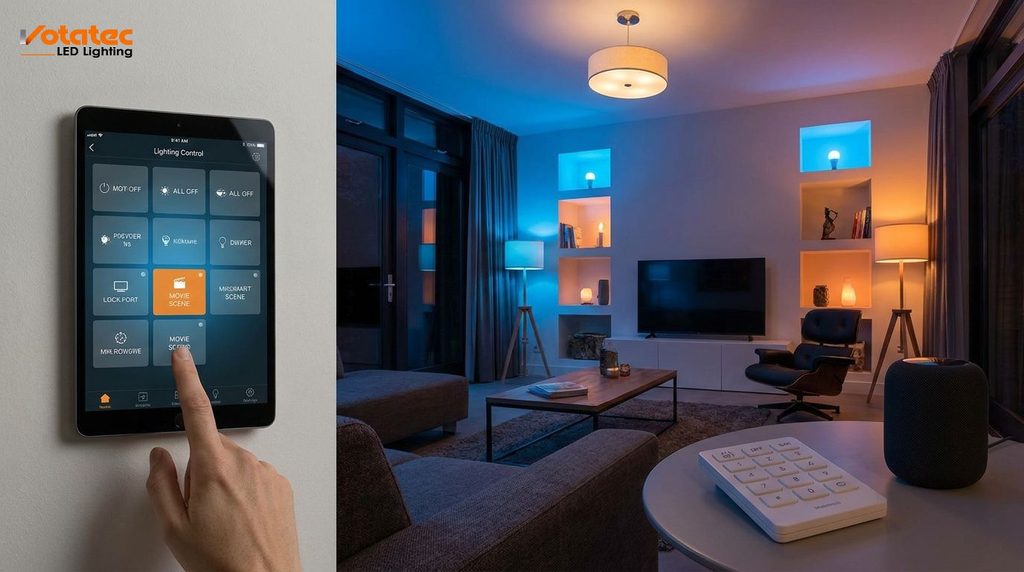
Votatec’s WiFi Smart Dimmer Switch is honest about this on its own data sheet. It “connects directly to 2.4 GHz home Wi-Fi without the need for special hubs.” Home. The word appears three times on that sheet. It’s a genuinely good device inside its design envelope, and the envelope is a room.
That’s not a criticism. Most smart switches sold in Canada are built to the same brief. The mistake is reading a home-scale spec as a building-scale one.
Where Wi-Fi wireless lighting controls work well
Let’s be fair to the technology. There are jobs where wireless lighting beats wired control outright, and cost isn’t even the main reason.
Renovations with no path for control wiring
Say you’re relighting a heritage building in Ottawa with plaster walls and no accessible ceiling void. Fishing 0-10V control wire means opening walls. A wireless lighting control device installs in the existing switch box in about fifteen minutes.
Do the math on that one. The wireless device might cost more than a basic dimmer, and you’ve still saved thousands in patch-and-paint.
Tenant fit-outs and leased space
Landlords hate permanent changes. Tenants hate paying for improvements they can’t take with them. Wireless controls sit neatly in between, because they swap back out at end of lease.
Small offices, meeting rooms and clinics
Under about ten zones, one Wi-Fi device per zone is completely manageable. Scheduling works. Voice control genuinely helps in a boardroom. And you get dimming from 1% to 100% on the Votatec unit, which is a wider range than a lot of basic wired dimmers manage.
Where scheduling alone solves the problem
Not every space needs occupancy sensing. A dental office open 8 to 5, Monday to Friday? A schedule handles it. Wireless lighting with app-based scheduling covers that job for very little money.
Honestly, this one’s underrated. Plenty of small commercial buildings waste more energy on lights left on overnight than they’d ever save from fancy daylight harvesting.
Where Wi-Fi wireless lighting controls fall apart
Now the part that spec sheets bury. Six hard limits, each one taken from published data.
The 120V ceiling, and why 347V kills the whole plan
Canadian commercial buildings frequently run lighting at 277V or 347V. That’s normal here. Warehouses, big-box retail, arenas, schools.
Wi-Fi smart dimmers of the type sold for wireless lighting control are 120V/60Hz devices. The Votatec unit is rated 120V/60Hz, full stop. Put it on a 347V circuit and you don’t get poor performance. You get a destroyed device and a possible fire.
This single fact eliminates wireless lighting controls from most Canadian industrial retrofits before any other consideration. If the lighting circuit is 347V, the conversation about wireless is over. You’re looking at line-voltage sensors rated for that circuit, or a proper NLC system with drivers that accept the voltage.
Check the panel schedule first. Always.
Cold spaces: the 0°C problem
Here’s a limit almost nobody reads. That Wi-Fi dimmer is rated for 0°C to 40°C operating temperature.
Think about what that rules out in Canada:
- Unheated warehouses and storage buildings
- Loading docks and vestibules
- Parking garages
- Cold storage, obviously
- Any exterior location, anywhere in the country, in January
- Uninsulated mechanical rooms
An unheated Winnipeg warehouse hits -25°C. A Toronto parking garage sits near freezing for months. The device isn’t rated to run there, and a controls failure in an unheated space in February is a service call nobody wants.
For those spaces you want the sensor built into a fixture designed for the environment. A vapor tight fixture with an integrated sensor, or a UFO high bay with a sensor rated for the ambient, solves it properly.
The neutral wire question
These devices need constant power to keep their radio alive. That means a neutral in the switch box.
The Votatec installation sheet is blunt about it. Its wiring instructions say that if you don’t have the incoming neutral, “this smart dimmer switch is not compatible.” No workaround. No adapter.
Older Canadian buildings, especially anything pre-1980s with switch loops, often have no neutral at the switch. So before you order forty devices, open three or four boxes and look. Basically a ten-minute job that saves a return shipment.
Our guide on how to install a dimmer switch walks through identifying what’s actually in the box.
LED load limits: 150W is not 500W
This one catches people constantly, and it’s a real trap in wireless lighting specs.
Dimmer ratings get published two ways. The Votatec WiFi Smart Dimmer is rated 150W max for dimmable LED and 500W max for incandescent and halogen. Same device, two very different numbers.
Guess which number gets quoted in listings? The big one.
If you size an LED load against 500W you can overload the dimmer by more than three times. What you’ll see is flickering, buzzing, premature failure, or the over-temperature protection cutting in and out. We wrote about the causes of LED flicker separately, and overloaded dimmers are near the top of the list.
Do the arithmetic before you buy. Ten 15W downlights is 150W, and you’re already at the ceiling. That’s maybe one modest office. A warehouse aisle of high bays? Nowhere close.
2.4GHz congestion and the shared-network problem
These devices join 2.4GHz Wi-Fi only, not 5GHz. And 2.4GHz in a commercial building is crowded already. Staff phones, laptops, payment terminals, barcode scanners, HVAC controls, the guest network.
Add forty lighting devices to that and you’re competing for the same airtime. Symptoms show up as devices dropping off the app, slow response, or schedules that quietly don’t fire.
There’s a second problem that’s less about radio and more about ownership. Your lighting now depends on the building’s IT network. Who owns that? What happens when IT rotates the Wi-Fi password, or replaces the router, or segments the network? Every wireless lighting device needs re-provisioning, one at a time, in the app.
Sound like fun across forty devices? It isn’t.
Cloud dependency and tenant turnover
App-based controls usually tie to a cloud account. Someone’s cloud account. Often the installer’s, or an employee who’s since left.
When that person goes, control of the lighting goes with them. Factory reset, re-pair every device, rebuild every schedule. We’ve seen buildings where nobody could adjust the lights because the account holder had quit two years earlier.
Wired controls don’t do this. A 0-10V dimmer or a PIR sensor dimmer switch keeps working regardless of who has which password.
Wireless lighting controls and Canadian energy code
Short version: Canadian energy code cares about what the control does, not how the signal travels.
The National Energy Code of Canada for Buildings sets out automatic control requirements for lighting in new construction and larger renovations. Interior lighting generally needs automatic shut-off through scheduling, occupancy sensing, or a building automation signal. Exterior lighting needs automatic control plus the ability to reduce power.
Nothing in there says wired or wireless. So in principle, wireless lighting controls can comply.
In practice, three things trip up wireless on code jobs:
- Documentation. A building official wants control sequences and cut sheets. Forty app-configured devices with settings living in someone’s phone is a hard sell.
- Commissioning. Codes increasingly expect controls to be verified and documented as working. App screenshots aren’t a commissioning report.
- Jurisdiction. Ontario Part 3 buildings work through the Building Code’s supplementary standard SB-10, which references NECB. What applies to your project depends on building size, occupancy classification and the scope of work.
Two honest cautions here. Retrofit scope matters a lot, and a straight lamp-for-lamp swap often doesn’t trigger control requirements that a full renovation would. And this is genuinely a question for your electrical engineer and the authority having jurisdiction, not a blog post. We’re flagging where the questions are, not answering them for your specific permit.
If code compliance is driving the project, get the control strategy stamped before you pick hardware.
The rebate problem: why Wi-Fi wireless lighting rarely earns incentive dollars
Money talks, so let’s talk money. This is where the wireless lighting decision gets expensive in a way that surprises people.
Ontario’s Save on Energy Retrofit Program pays incentives on networked lighting controls. As of 2026-06-30 that rate moved from $0.35/kWh down to $0.30/kWh. Applications completed before that date keep the old rate.
Here’s the catch. Across the majority of North American jurisdictions offering networked control incentives, including three Canadian provinces, the incentive only pays if the system appears on the DLC’s networked lighting controls qualified products list.
A standalone Wi-Fi dimmer isn’t a networked lighting control system. It isn’t on that list, and it can’t be, because it doesn’t do the things the listing requires: central commissioning, zoning across devices, energy monitoring, documented interoperability.
So the arithmetic goes like this. Wireless lighting devices look cheaper per point. But if choosing them forfeits an incentive that would have covered a real slice of the project, the cheap option cost more. On a large retrofit, quite a lot more.
Worth checking before you spec. Our Canadian LED rebate guide covers what’s available by province, and our explainer on DLC certification covers how the listings work.
Wired vs wireless lighting controls: a straight comparison
| Factor | Wi-Fi wireless lighting | Wired controls (0-10V, line voltage sensors) |
|---|---|---|
| Install labour | Low, no new wiring | Higher, control wire needed |
| Hardware cost per point | Moderate | Low to moderate |
| Voltage options | 120V typically | 120V through 347V available |
| Temperature range | Around 0°C to 40°C | Wide, depends on device |
| Neutral required | Yes | Often not |
| Scales past 10 zones | Poorly | Yes |
| Network dependency | Yes, and it’s someone else’s network | None |
| Rebate eligibility as NLC | No | Depends on system |
| Commissioning record | App settings only | Documented sequences |
| Survives staff turnover | Only with account handover | Yes |
Neither column wins outright. That’s the point. The right answer depends on the building.
How to choose: six questions before you spec wireless lighting
Run these in order. The first “no” usually settles it.
- What’s the circuit voltage? Anything above 120V rules out standard Wi-Fi dimmers immediately. Check the panel schedule, don’t assume.
- Will the space stay above freezing, year round? If not, put the control in the fixture instead.
- Is there a neutral in the switch box? Open a few and look before ordering.
- What’s the actual LED load per switch? Add up the fixture wattage. Compare it against the LED rating, not the incandescent one.
- How many zones total? Under ten, wireless lighting is fine. Over twenty, you want a real system.
- Is anyone claiming a controls rebate? If yes, the hardware has to be listed, and a standalone wireless device won’t be.
Answer those six honestly and the spec writes itself.
Common mistakes with wireless lighting controls
- Sizing LED load off the incandescent rating. The single most common error. 500W on the listing, 150W for LED in the fine print.
- Assuming wireless means no electrician. These are line-voltage devices in Canada. That’s licensed work, and in Ontario it needs the appropriate permit and inspection.
- Putting the device where the sensor should be. A switch by the door doesn’t see the back of a warehouse aisle. Coverage geometry beats convenience.
- Ignoring who owns the network. Lighting that depends on the tenant’s Wi-Fi becomes the tenant’s problem, then yours.
- Skipping the panel schedule. Two minutes of reading prevents a 347V mistake.
- Buying consumer gear for a 24/7 space. A device rated for over 40,000 switch cycles sounds like a lot. On a washroom sensor cycling 60 times a day it’s under two years.
- Mixing dimming protocols on one circuit. Not all LED drivers respond the same way. Our guide on choosing dimmable LED bulbs covers driver compatibility.
What to use instead when Wi-Fi doesn’t fit
Wireless lighting getting ruled out doesn’t mean going back to a plain toggle switch. Options, roughly in order of project size:
- Line-voltage occupancy sensors. A motion sensor switch handles automatic shut-off in a single space with no network at all. Simple and it stays working.
- PIR sensor dimmer switches. Occupancy plus dimming in one device, wired, no app.
- Timer switches. A timer switch covers scheduled spaces cheaply. Washrooms, storage rooms, exterior signage.
- Photocells for exterior. Dusk-to-dawn control that doesn’t care about your Wi-Fi password. See the photoelectric sensor range.
- Fixtures with integrated sensors. For high bays, troffers and vapor tights, buying the sensor inside the fixture puts it where it can actually see the space and survive the ambient.
- 0-10V dimming with a proper controller. The workhorse of commercial dimming. Scales, documents cleanly, and works at commercial voltages.
Browse the full wiring devices range or the LED dimmer switch category to compare. If you’re planning a larger project, our commercial LED retrofit guide covers sequencing the work.
Frequently asked questions about wireless lighting
Does wireless lighting control meet Canadian energy code requirements?
It can. Canadian energy code sets out what the control has to accomplish, mainly automatic shut-off for interior lighting and automatic control with power reduction for exterior, and it doesn’t specify wired or wireless signalling. What trips up wireless lighting on code projects is documentation and commissioning, since app-stored settings are hard to hand a building official. Confirm the requirement for your building size, occupancy class and scope of work with your engineer and the authority having jurisdiction.
Do wireless lighting controls need a neutral wire?
Almost always yes. Smart switches keep their radio powered constantly, so they need a neutral in the switch box. Votatec’s WiFi Smart Dimmer states plainly in its wiring instructions that without the incoming neutral the device isn’t compatible. Older Canadian buildings with switch-loop wiring often lack one, so open a few boxes and check before ordering.
Can wireless lighting controls work on 347V commercial circuits?
No, not the standard Wi-Fi smart dimmer type. Those are 120V/60Hz devices. Canadian commercial and industrial lighting often runs at 277V or 347V, and connecting a 120V device to a 347V circuit will destroy it and create a safety hazard. For higher-voltage circuits use sensors and controls rated for that voltage, or a networked system with drivers that accept it. Check the panel schedule before specifying anything.
How many Wi-Fi lighting devices can one network handle?
There’s no single number, because it depends on the router, the existing traffic and the building’s construction. Practically, under ten devices is comfortable, ten to twenty needs planning, and beyond twenty you’re better served by a purpose-built networked lighting control system. These devices use 2.4GHz only, which is the crowded band in most commercial buildings.
Do Wi-Fi wireless lighting controls qualify for Ontario rebates?
Generally not as networked lighting controls. Ontario’s Save on Energy Retrofit Program pays an NLC incentive, $0.30/kWh as of 2026-06-30, and most North American programs including three Canadian provinces require the system to appear on the DLC qualified products list. A standalone Wi-Fi dimmer isn’t a networked system and isn’t listed. Confirm current eligibility with the program before you build it into a budget.
Bottom line
Wireless lighting isn’t a cheap version of commercial controls. It’s a different product for a different size of job.
- Use it for single rooms, small suites, tenant fit-outs, and renovations where running control wire means opening walls
- Skip it on 347V circuits, in unheated space, past about ten zones, and on any project claiming a networked controls rebate
- Check four numbers first: circuit voltage, ambient temperature, LED load against the LED rating, and whether there’s a neutral in the box
- Remember the load trap. 500W is the incandescent number. For LED it’s often 150W
Spec it inside its envelope and Wi-Fi wireless lighting is a genuinely useful tool. Spec it outside, and you get callbacks.
Not sure which side of the line your project sits on? Send us the panel schedule and a fixture count. Votatec supplies both wireless lighting controls and the wired sensors, photocells and dimmers that cover the jobs Wi-Fi can’t, to contractors and distributors across Canada. We’d rather tell you the cheap option won’t work than sell you forty devices you’ll be pulling back out in March.