










 (+1) 905 597 5955


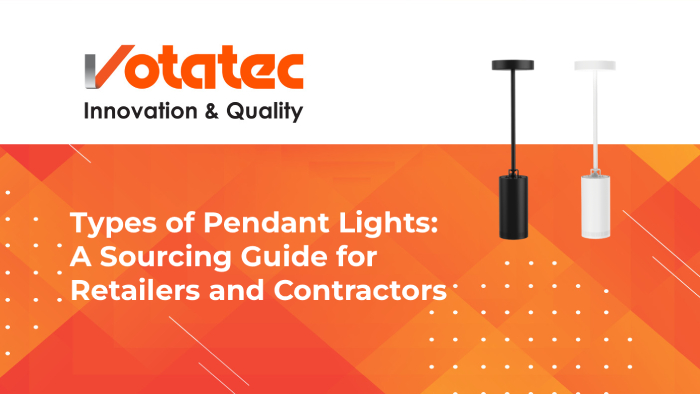

There are nine core types of pendant lights: mini, multi-light cluster, linear, drum, globe, bowl, dome or industrial, lantern or cage, and abstract or sculptural. Each type is defined by its shape and how it delivers light: downward for task work, upward for ambient fill, or diffused for soft general light. For commercial projects, three more categories matter: track-mounted, canopy, and suspended linear pendants.
That’s the answer most guides give. This guide adds the part that decides profit for the trade: certification, driver quality, dimming, and wholesale sourcing in Canada.
Key takeaways
- 9 core pendant shapes cover almost every residential and light-commercial request.
- Every line-voltage pendant sold in Canada must carry a cUL, CSA, or cETL mark under the Canadian Electrical Code (CAN/CSA C22.1).
- ENERGY STAR certified LEDs use at least 75% less energy and last up to 25 times longer than incandescent fixtures.
- Hang island pendants 30 to 36 inches (76 to 91 cm) above the countertop.
- For real output (warehouses, canopies, long runs), use high-bay or suspended linear, not decorative pendants.
What is a pendant light?
A pendant light is a single luminaire suspended from the ceiling by a cord, chain, or rod, with the light source hanging below. It differs from a chandelier, which spreads multiple arms from one central frame, and from flush fixtures that sit tight against the ceiling. In electrical terms, a pendant is a complete lighting unit that connects a lamp or LED module to the circuit.
Pendant lights do three jobs: task lighting over a work surface, ambient lighting for a room, or accent lighting as a design feature. Buyers focus on the design job. Contractors spec for the task and ambient jobs. A good pendant does at least two of the three well.
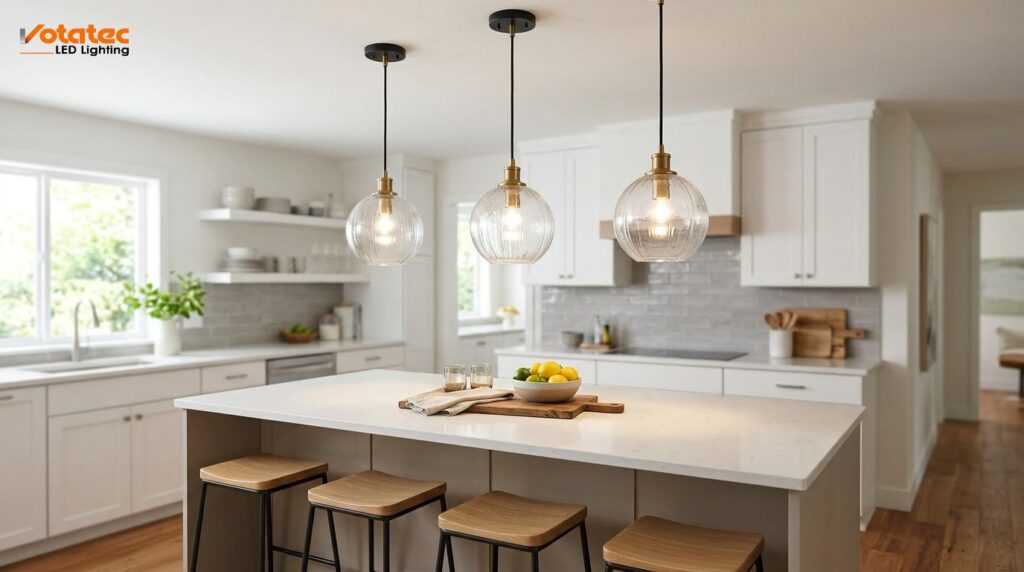
What are the main types of pendant lights?
The main types of pendant lights, grouped by shape and use, are shown below. This taxonomy covers the fixtures a Canadian retailer or contractor handles most often, with the trade note that decides whether each is worth stocking.
| Type | Best-fit application | Trade note |
|---|---|---|
| Mini pendant | Islands, counters, retail displays | Sold in clusters, so attach rate is high |
| Multi-light / cluster | Dining, lobbies, feature walls | One SKU, high perceived value |
| Linear / island | Kitchen islands, boardrooms, reception | Fastest-growing commercial shape |
| Drum / shade | Bedrooms, hospitality, offices | Soft, diffuse light; forgiving to install |
| Globe / orb | Modern residential, cafes | Bare-bulb looks need high-CRI lamps |
| Bowl / inverted | General ambient light | Uplight; hides the source |
| Dome / industrial | Warehouses, kitchens, breweries | Overlaps with high-bay at scale |
| Lantern / cage | Entryways, farmhouse, patios | Check for damp or wet rating |
| Abstract / sculptural | Hospitality, high-end retail | Higher ticket, longer lead time |
Mini pendants
Mini pendants are small, slim fixtures hung in a row, most often three over a kitchen island or a run along a retail counter. Each fixture is modest in price, so buyers purchase several at once, which gives retailers a high attach rate on every sale. Because many mini pendants ship with a visible decorative bulb, pair them with a high-CRI LED filament lamp so the display doesn’t look cheap.
Multi-light and cluster pendants
A cluster pendant is one canopy with several drops hung at staggered heights. It reads as a statement piece but ships as a single SKU, which keeps a catalogue tidy while holding perceived value high. Cluster pendants suit dining rooms, hotel lobbies, and stairwells. They can get heavy, so confirm the canopy and ceiling box can carry the load before spec’ing one for a contractor.
Linear and island pendants
A linear pendant is an elongated fixture built to light a rectangle, such as an island, boardroom table, or reception desk. This is the fastest-growing shape on the commercial side, and it’s where LED integration pays off most. Modern linear pendants use an integrated LED module instead of replaceable lamps, giving even light with no socket shadows. For continuous runs, architectural linear LED lighting can be suspended pendant-style across long spans.
Trade tip: Run the linear fixture along the long axis of the island and centre it on the countertop, not the cabinets. This is the pendant mistake contractors get called back over most.
Drum and shade pendants
A drum pendant wraps the light source in a fabric or metal shade that pushes soft, diffuse light down and out. It’s forgiving to install and popular in hospitality and offices where glare control matters. Because the shade hides the lamp, a plainer LED module still looks premium, which gives drum pendants a strong appearance-to-cost ratio for resellers.
Globe and orb pendants
A globe pendant uses a round diffuser, often glass, sometimes left open. It reads clean and modern, but light quality shows when the bulb is visible. Spec a high-CRI, low-glare lamp in a warm colour temperature, or the fixture photographs poorly and sits on the shelf.
Bowl and inverted pendants
A bowl pendant opens upward, bouncing light off the ceiling for soft ambient fill and hiding the source completely. This makes it a safe pick for dining and lounge areas where people sit and look up. Bowl pendants deliver comfort over punch, so pair them with task lighting elsewhere in the room.
Dome and industrial pendants
An industrial pendant is a metal, utilitarian fixture with a wide reflector, common in warehouses, commercial kitchens, and breweries. At larger sizes and higher lumen counts, industrial pendants overlap with high-bay lighting. When the real job is lighting a warehouse or shop floor, point the buyer at linear high-bay LED lights or UFO high-bay fixtures built for that mounting height and output.
Lantern and cage pendants
A lantern or cage pendant is an enclosed or caged fixture with a traditional or farmhouse feel, common at entryways and covered patios. The one check that matters every time: any pendant used outdoors or in a covered exterior spot needs a damp or wet location rating. Selling an indoor-rated lantern for a porch sets up a warranty claim.
Abstract and sculptural pendants
An abstract pendant is a design-led fixture built to be looked at, such as angled linear bars, organic shapes, or oversized statement pieces. These carry a higher ticket and lower volume, mostly in hospitality and premium retail. Most are special-order for trade buyers, so build the lead time into any quote before you promise a completion date.
What commercial pendant types do design guides miss?
Consumer guides stop at the nine decorative shapes, but three commercial categories carry most of the trade volume: track-mounted, canopy, and suspended linear pendants. These serve the same “suspended from above” role with spec sheets built for real buildings.
- Track-mounted pendants hang off a track system, so heads reposition along a run without rewiring. Ideal for retail floors and galleries where displays move. See track lighting for systems that accept pendant adapters.
- Canopy and continuous-row pendants light gas stations, parking structures, and covered walkways in a wet-rated, vandal-resistant body. Canopy lighting does the pendant job where weather and impact are factors.
- Suspended linear replaces a row of decorative pendants in offices and schools, delivering uniform light with higher efficacy and a cleaner ceiling. When a client asks for “pendants” over a long desk, suspended linear is usually the smarter spec.
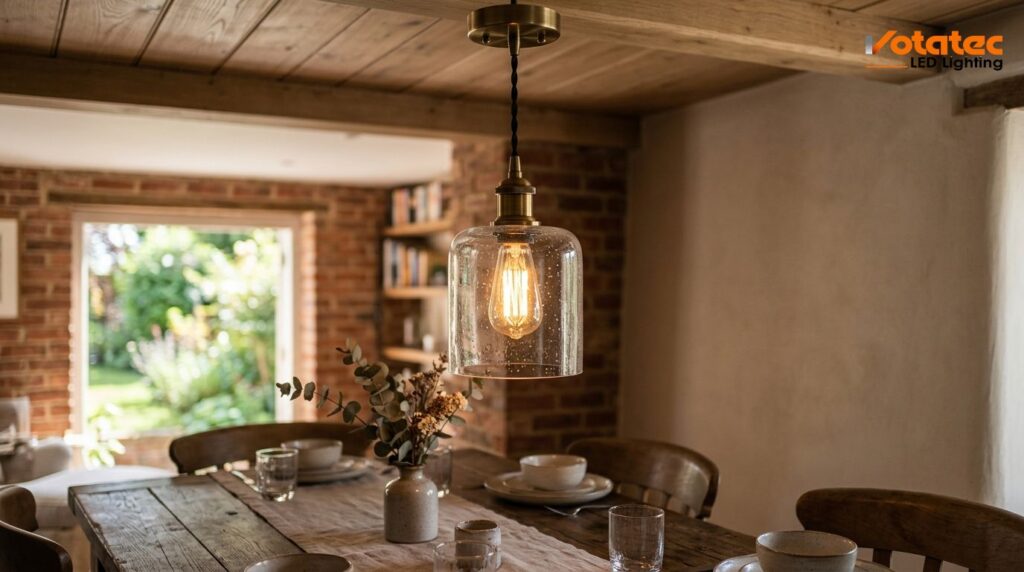
How do you source pendant lights in Canada?
To source pendant lights in Canada, run every fixture through six checks before stocking or spec’ing it: certification, driver quality, colour temperature, dimming, mounting, and lead time. Certification comes first, because an uncertified fixture cannot be sold legally.
- Certification. Every line-voltage fixture sold in Canada must carry a cUL, CSA, or cETL mark and comply with the Canadian Electrical Code (CAN/CSA C22.1), per the Electrical Safety Authority. ESA can pull non-compliant fixtures from a retail floor, so confirm the mark before anything else.
- Driver and LED quality. In integrated fixtures, the driver fails first. Ask for the driver brand, warranty term, and whether it’s field-replaceable. A weak driver turns a 50,000-hour LED into a two-year problem.
- Colour temperature and CRI. Commercial work usually wants 3000K to 4000K. Retail and hospitality often want CRI 90+ so product and food look right. Selectable-CCT fixtures cut the number of SKUs you carry.
- Dimming compatibility. Confirm the fixture dims, and with which protocol (TRIAC, 0-10V, or DALI). Mismatched dimmers cause the flicker and buzz that top the LED-pendant complaint list. Stock a tested LED dimmer switch alongside the fixture.
- Mounting and adjustability. Check maximum drop length, canopy size, and whether the cord or rod shortens on site. Sloped ceilings need a sloped-ceiling adapter, which not every pendant offers.
- Lead time and stock depth. Decorative pendants often come from small production runs. Confirm the supplier can deliver the full project quantity, not just a sample, before you quote a date.
Retailer priorities vs contractor priorities
Retailers and contractors buy pendant lights for different reasons, and the winning fixture differs for each. Retailers optimize for margin and shelf appeal. Contractors optimize for certification and fast, inspection-ready installation. Stocking for both covers the full demand curve.
| Factor | Retailer priority | Contractor priority |
|---|---|---|
| Top concern | Margin and shelf appeal | Certification and install time |
| Volume pattern | Many small orders | Fewer large orders |
| Colour temp | Warm, cozy for display | Spec-driven (3000K to 4000K) |
| Dimming | Nice to have | Must match building controls |
| Packaging | Retail-ready, clear photos | Bulk, project-labelled |
| Deciding factor | Does it sell itself? | Does it pass inspection? |
Buying from a full LED fixture catalogue instead of a single-style importer lets one supplier serve both the retail shelf and the jobsite.
How high should pendant lights hang over an island?
Pendant lights should hang 30 to 36 inches (76 to 91 cm) above the countertop over a kitchen island, measured from the surface to the bottom of the fixture. This range keeps task light on the workspace while holding fixtures out of sightlines across the island, according to guidance from Visual Comfort and lighting designers. For ceilings above 8 feet, raise the fixture about 3 inches for every extra foot of ceiling height.
For quantity, use two to three pendants over a standard island, or a single linear pendant sized to roughly two-thirds of the island length. Centre the fixtures over the countertop, not the cabinet line.
Are LED pendant lights worth it for commercial projects?
LED pendant lights are worth it for commercial projects because they cut energy use and maintenance sharply versus older sources. ENERGY STAR certified LEDs use at least 75% less energy and last up to 25 times longer than traditional incandescent lighting, per ENERGY STAR. Quality LEDs run 25,000 to 50,000 hours, and current models reach efficacies of 150 to 210 lumens per watt.
For a commercial buyer, that math shows up as fewer relamping trips and lower operating cost over the fixture’s life. Natural Resources Canada notes lighting has held at about 3.5% of the energy used in the average Canadian home even as fixture counts rose, largely because LEDs replaced less efficient sources. Integrated LED pendants extend that efficiency to feature lighting, not just downlights and tubes.
What are the most common pendant sourcing mistakes?
The most common pendant sourcing mistakes are skipping the certification check, forgetting the matching dimmer, and ignoring the location rating. Each one turns a sale into a return or a callback.
- Ignoring the certification mark. The fastest way to get a shipment refused or a display pulled by ESA. Check for cUL, CSA, or cETL every time.
- Forgetting the dimmer. Selling a dimmable pendant without a compatible dimmer sets up a flicker complaint.
- Wrong location rating. Damp and wet locations need rated fixtures. A pretty indoor lantern on a covered porch is a warranty claim.
- Underestimating weight. Cluster and oversized pendants can overload a standard ceiling box. Flag it in the quote.
- Spec’ing decorative where you need output. A dome pendant will not light a warehouse. Match the fixture class to the lumen job.
Frequently asked questions
What are the different styles of pendant lights?
The main pendant light styles are mini, multi-light cluster, linear, drum, globe, bowl, dome or industrial, lantern or cage, and abstract or sculptural. Styles are grouped by shape and by how light is delivered: down for task, up for ambient, or diffused for soft general light. Commercial projects add track-mounted, canopy, and suspended linear fixtures.
Are pendant lights out of style in 2026?
No. Pendant lights remain a core lighting category in 2026, and linear and integrated-LED pendants are gaining share in both commercial and residential projects. What’s changing is the technology inside them, shifting from replaceable lamps toward integrated LED modules with selectable colour temperature, not the fixture category itself.
What’s the difference between a pendant light and a chandelier?
A pendant light is a single fixture suspended from one point, with one light source or a tight cluster hanging below. A chandelier spreads multiple arms or branches from a central frame. Pendants suit task and accent lighting over a defined area, while chandeliers usually serve as a room’s central decorative feature.
How many pendant lights do I need over an island?
Use two to three pendants over a standard kitchen island, or one linear pendant sized to about two-thirds of the island length. Centre them over the countertop and hang the bottom of the fixture 30 to 36 inches (76 to 91 cm) above the surface. Confirm the exact drop against the client’s ceiling height.
Do pendant lights sold in Canada need certification?
Yes. Any line-voltage pendant sold or installed in Canada must carry a cUL, CSA, or cETL mark and meet the Canadian Electrical Code (CAN/CSA C22.1). Fixtures without an accepted mark can be refused at inspection or removed from sale by provincial authorities such as Ontario’s Electrical Safety Authority (ESA).
Can commercial pendant lights be dimmed?
Most integrated LED pendants can be dimmed, but only with a compatible dimmer. Match the fixture’s dimming protocol (TRIAC, 0-10V, or DALI) to the building’s controls. Mismatched dimmers are the leading cause of flicker and buzz complaints on LED pendants.
Bottom line for trade buyers
Pick pendant lights by the job, not just the look. Nine core shapes (mini, cluster, linear, drum, globe, bowl, dome, lantern, abstract) cover almost every residential and light-commercial request. For real output, reach for high-bay, canopy, or suspended linear. Certification is non-negotiable: cUL, CSA, or cETL, every time. Sell the dimmer with the fixture to cut callbacks and add margin.
Votatec supplies commercial and architectural LED fixtures to contractors, resellers, and procurement teams across Canada, with wholesale pricing and CSA-certified product. Browse the LED light fixtures catalogue or request a quote for project volumes.