















Canadian homeowners and businesses spend over $3.5 billion on lighting energy every year. And roughly 30% of that gets wasted on lights running at full power when half brightness would do.
Kind of ridiculous when you think about it.
The biggest advantage of dimming switches is simple: they let you control exactly how much light you use. Less light means less energy. Less energy means lower bills. And that’s just the start.
Dimmers also extend the lifespan of your LED fixtures, improve room comfort, reduce eye strain, and even increase your property value. For something that costs maybe $20 to $50 per switch, the return is hard to beat.
Let’s get into the full list.
Why Use Dimmer Switches? The Case for Every Room
Most people think of dimmers as a living room luxury. Something for mood lighting or dinner parties. But that’s a pretty narrow view of what they actually do.
Every room in your home or commercial space has different lighting needs at different times of day. Your kitchen needs full brightness when you’re prepping food, but maybe 40% when you’re just grabbing a glass of water at midnight. Your office conference room needs 100% for presentations and 60% for casual meetings.
A standard on/off switch gives you two options. All or nothing. A dimmer gives you everything in between.
How Do Dimmer Switches Actually Work?
How Do Dimmer Switches Work? Modern dimmers don’t just reduce voltage like the old rotary dimmers from the 1960s. Those wasted energy as heat and buzzed like angry bees.
Today’s LED-compatible dimmers use a method called phase-cut dimming. They rapidly switch the electrical current on and off, many times per second, to reduce the amount of power reaching the fixture. The result is smooth, flicker-free dimming from 100% down to as low as 5% on good systems.
There are two main types:
- Leading-edge (TRIAC) dimmers. The older standard. Works fine with many LEDs but can cause flickering with some fixtures. Still the most common in Canadian homes.
- Trailing-edge (ELV) dimmers. Designed specifically for LED. Smoother dimming, less flicker, quieter operation. Costs a bit more but worth it.
The key thing? Your dimmer must be compatible with your LED fixtures. Not all combinations work. We’ll cover that in more detail below.
Benefits of Dimmer Switches: The Complete List
Here are the 10 advantages that make dimming switches one of the smartest upgrades for any property.
Energy Saving Light Switches: How Dimmers Cut Your Power Bill
Advantage #1: Reduce Energy Consumption by Up to 40%
This is the big one. When you dim a light to 50%, you don’t just cut perceived brightness in half. You actually reduce energy consumption by roughly 40%. Dim to 25% and you’re saving close to 60%.
According to (NRCan), lighting accounts for about 10% to 15% of a typical Canadian home’s electricity bill. Dimming your lights by even 25% across the house adds up fast. For a commercial building where lighting can be 25% to 30% of total energy use, the savings are even bigger.
Energy saving light switches like dimmers are one of the lowest-cost, highest-impact upgrades you can make. No renovation needed. Just swap the switch.
Advantage #2: Extend LED Lifespan
LEDs are rated for 50,000+ hours at full power. But here’s something most people don’t know. Running LEDs at lower output reduces thermal stress on the driver and the diodes. Less heat means slower degradation.
Dim your LEDs by 25% consistently and you can push that lifespan well beyond the rated hours. Some studies suggest 30% to 50% longer life. That means fewer replacements, less maintenance, and lower long-term costs. Pretty good deal.
Advantage #3: Lower Electricity Bills
This one follows directly from advantage #1, but it’s worth spelling out. A household running 20 light fixtures at an average of 15 watts each, dimmed 30% for 4 hours daily, saves roughly $50 to $80 per year. Doesn’t sound like much? Over 10 years, that’s $500 to $800. And that’s just one home.
For a commercial office with 200 fixtures, the same 30% reduction can save $2,000 to $4,000 annually. Payback on the dimmer switches themselves? Usually under a year.
Advantage #4: Create the Perfect Ambiance
Lighting sets the mood. That’s not just interior design talk. It’s how our brains work. Bright, cool light makes us alert. Warm, dim light makes us relax.
With dimming switches, you control the atmosphere without changing fixtures or bulbs. Full brightness for morning routines. A soft glow for movie night. Something in between for dinner. One switch, infinite settings.
Restaurants, hotels, and retail stores have used this for decades. There’s no reason your home or office shouldn’t have the same control.
Advantage #5: Reduce Eye Strain and Improve Comfort
Ever walked into a room where the overhead lights felt like an interrogation lamp? That’s what happens when you can’t adjust brightness.
The Illuminating Engineering Society (IES) recommends different light levels for different tasks. Reading needs 300 to 500 lux. Casual conversation needs 100 to 200 lux. Watching TV? Maybe 50 to 75 lux.
Dimmers let you match the light level to the activity. Less squinting. Less fatigue. More comfort. Your eyes will thank you.
Advantage #6: Increase Property Value
Here’s one that building owners and homeowners care about. Dimmer switches are considered a premium feature in real estate. They signal a modern, well-thought-out home.
While it’s hard to put an exact dollar figure on it, real estate professionals consistently list dimming controls as a selling point. It’s a low-cost upgrade that makes your property feel more finished and more desirable. For maybe $200 to $400 in total switch costs, you’re adding perceived value that can influence a buyer’s impression of the whole house.
Advantage #7: Minimize Light Pollution
Light pollution isn’t just an astronomical problem. It affects your neighbours, your sleep, and local wildlife.
Dimming exterior lights, porch lights, and landscape lighting during late hours reduces unnecessary light spill. You maintain security and visibility without blasting full-power floodlights all night. For rural Canadian properties, this matters even more.
Some municipalities are starting to include outdoor lighting controls in their building codes. Dimmers make compliance easy.
Advantage #8: Support Wellness and Circadian Health
Your body’s internal clock, the circadian rhythm, is heavily influenced by light. Bright light during the day keeps you alert. Dim, warm light in the evening signals your brain to produce melatonin and prepare for sleep.
When your home lighting is stuck at 100% all evening, it disrupts this cycle. That can affect sleep quality, mood, and long-term health. Dimmers let you gradually reduce light levels as the evening progresses. Simple change. Real impact on how well you sleep.
Healthcare facilities and senior care homes are increasingly adopting tunable and dimmable lighting for this exact reason.
Advantage #9: Simple to Install and Retrofit
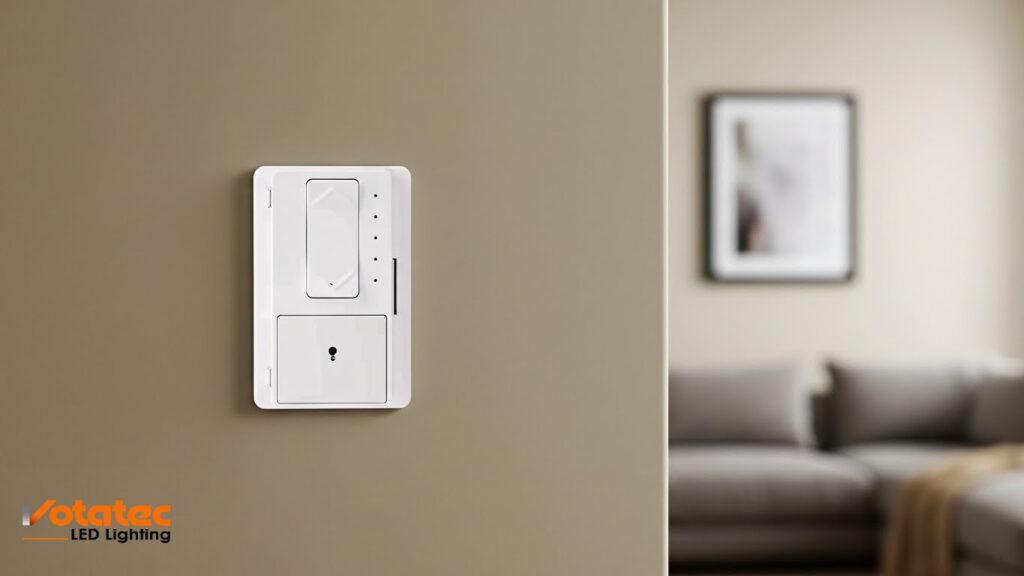
Replacing a standard toggle switch with a dimmer takes about 15 to 20 minutes. You don’t need to rewire anything. The dimmer connects to the same wires in the same switch box.
Basic steps:
- Turn off the breaker
- Remove the old switch
- Connect the dimmer wires (black to black, ground to ground)
- Secure in the switch box and attach the cover plate
- Restore power and test
That’s it. Most homeowners can handle this as a weekend project. For 120V circuits, always make sure you’re comfortable with basic wiring, and if not, hire a licensed electrician. The Electrical Safety Authority (ESA) recommends using CSA-certified dimmer switches for all Canadian installations.
Read more: How to Install a Dimmer Switch
Advantage #10: Compatible with Smart Home Systems
Modern dimmers integrate with smart home platforms like Google Home, Amazon Alexa, and Apple HomeKit. You can dim lights by voice, schedule them to change throughout the day, or control them remotely from your phone.
Smart dimmers also enable features like:
- Automatic dimming based on time of day
- Occupancy-based brightness adjustment
- Scene presets (movie mode, cooking mode, relax mode)
- Energy monitoring and usage reports
For new construction or renovation projects, smart dimmers are a natural fit. And for existing homes, Wi-Fi-enabled smart dimmers retrofit into standard switch boxes without extra wiring.
Dimmer Switch Advantages for Commercial and Institutional Spaces
The advantage of dimming switches doesn’t stop at residential. In commercial settings, dimmers deliver measurable ROI.
Office, Retail, and Healthcare Applications
Offices: Dimming controls help meet the National Energy Code of Canada for Buildings (NECB), which requires automatic lighting controls in commercial spaces. Dimmers combined with occupancy sensors can reduce office lighting energy by 40% to 60%. Employees get adjustable light at their workstations. The building owner gets lower operating costs. Everybody wins.
Retail: Lighting influences buying behaviour. Bright light for product displays, softer light for fitting rooms, and dimmed ambient lighting for luxury sections. Dimmers give retail designers full control without rewiring or swapping fixtures.
Healthcare: Patient rooms benefit from dimmable lighting during rest periods. Nursing stations need full brightness for documentation but lower levels during overnight shifts. According to CSA Group standards, healthcare lighting must be controllable for patient comfort and staff functionality.
Education: Classrooms need bright light for reading and writing but dimmer settings for projector presentations. A single dimmer switch replaces the need for separate lighting circuits.
How to Choose the Right Dimmer Switch
Not every dimmer works with every LED fixture. This is the most common mistake people make, and it leads to flickering, buzzing, and limited dimming range.
Compatibility with LED Fixtures
Here’s what to check before buying:
| Dimmer Type | Best For | LED Compatible? | Price Range |
| Leading-edge (TRIAC) | Incandescent, some LED | Varies by fixture | $15 – $30 |
| Trailing-edge (ELV) | LED and CFL | Yes, best option | $25 – $50 |
| 0-10V | Commercial LED panels | Yes | $30 – $60 |
| Smart dimmer (Wi-Fi) | LED, smart home integration | Check compatibility list | $40 – $80 |
Tips for getting it right:
- Always check the LED fixture’s compatibility list. Most manufacturers publish a list of approved dimmers.
- Match the dimmer’s wattage rating to your total fixture load. A dimmer rated for 600W can’t handle 10 fixtures at 100W each.
- For LED, trailing-edge dimmers almost always perform better. Less flicker, smoother dimming curve, quieter operation.
- If you’re dimming multiple fixtures on one circuit, make sure all fixtures are the same model. Mixing brands or wattages on one dimmer can cause uneven dimming.
One more thing. Cheap dimmers and cheap LEDs don’t play well together. Invest in CSA-certified dimmers and quality LED fixtures. The $10 you save on a bargain dimmer will cost you in frustration.
Frequently Asked Questions About the Advantage of Dimming Switches
Do Dimmer Switches Actually Save Energy?
Yes. And it’s not a small amount. Dimming a light to 75% reduces energy consumption by about 20%. Dimming to 50% saves around 40%. The savings scale proportionally. Over a year, even modest dimming across your home can reduce your lighting energy bill by 10% to 30%. For commercial buildings, the percentage savings are often even higher because lighting represents a larger share of total energy use.
Can You Use a Dimmer Switch with Any LED Light?
No. The LED fixture must be rated as “dimmable.” Non-dimmable LEDs will flicker, buzz, or fail prematurely when connected to a dimmer. Even with dimmable LEDs, you need a compatible dimmer type. Trailing-edge dimmers work best with most LED fixtures. Always check the manufacturer’s compatibility list before buying.
Do Dimmer Switches Work with Smart Home Systems?
Yes. Smart dimmers are available from most major brands and integrate with Google Home, Alexa, Apple HomeKit, and other platforms. They connect via Wi-Fi or Zigbee and allow voice control, scheduling, and remote access. Smart dimmers fit into standard switch boxes, so retrofitting is straightforward. No extra wiring needed.
Are Dimmer Switches Safe?
Absolutely, as long as you use CSA-certified products and install them correctly. Modern dimmers are designed with thermal protection that automatically reduces output if the switch overheats. The main safety concern is using a dimmer rated for a higher wattage than your fixture load, and making sure all connections are secure. Never use an incandescent-only dimmer with LED fixtures, as this can cause overheating in the dimmer.
Bottom Line
The advantage of dimming switches goes way beyond mood lighting. Energy savings, longer LED life, lower bills, better comfort, increased property value, and smart home integration. Ten solid reasons, and honestly, any one of them justifies the upgrade.
For a $20 to $50 investment per switch, the payback is fast and the benefits last for years. Whether you’re upgrading a single room or outfitting an entire commercial building, dimmers are one of the smartest lighting decisions you can make.
Votatec offers a full range of CSA-certified dimmable LED fixtures designed to work with leading-edge, trailing-edge, and 0-10V dimming systems. Every product ships from our Canadian warehouse and comes with a 5-year warranty.


