












Lighting eats up roughly 25% to 30% of a warehouse’s total energy bill. That’s a big number. And if you’re still running fluorescent tubes or metal halides, about a third of that energy is turning into heat instead of light. Kind of ridiculous when you think about it.
Linear lights fix this. Specifically, LED linear light fixtures designed for high-ceiling, large-footprint spaces like warehouses, distribution centres, and manufacturing floors. They deliver more lumens per watt, last 5 to 10 times longer than fluorescent, and spread light evenly across wide floor areas without dark spots or shadows.
The payoff is real. A typical warehouse switching from fluorescent to LED linear lights cuts lighting energy costs by 60% to 75%. Payback in 12 to 24 months. Sometimes faster with provincial rebates.
This guide covers everything facility managers need to know about choosing, mounting, and getting the most out of linear lights in warehouse environments across Canada.
Quick Spec Box: Warehouse Linear Lights at a Glance
| Specification | Recommended Range |
| Lumens per fixture | 4,000 – 12,000 lm |
| Wattage | 30W – 80W (replaces 100W – 250W fluorescent) |
| Colour Temperature | 4000K – 5000K (neutral to cool white) |
| CRI | 80+ (90+ for quality inspection areas) |
| Mounting Height | 3 – 9 metres (10 – 30 feet) |
| Lifespan | 50,000 – 100,000 hours |
| Certifications | CSA, DLC listed, Energy Star |
| IP Rating | IP20 (dry), IP65 (wet/dusty environments) |
Why Warehouse Linear Lighting Outperforms Traditional Fixtures
Warehouses have always relied on long, linear light fixture designs. Makes sense. The floor layout is linear: long aisles, parallel racking, loading docks that stretch from one end to the other. You need light that follows that geometry.
But older fluorescent and HID warehouse lighting has serious problems that warehouse linear lighting with LED technology solves.
Common Problems with Fluorescent and HID Warehouse Lights
Flickering and warm-up delays. Fluorescent tubes flicker as they age. Metal halides take 10 to 15 minutes to reach full brightness. In a warehouse running two or three shifts, that warm-up time adds up. LED linear lights hit full output instantly. No warm-up. No flicker.
Uneven light distribution. Older fixtures create bright spots directly below and dark zones between rows. Workers strain their eyes. Barcode scanners misread labels. Forklifts navigate shadows. Not safe. Not productive.
Constant maintenance. Fluorescent tubes last maybe 20,000 hours on a good day. In a warehouse with 200 fixtures, you’re replacing tubes constantly. And every replacement means a maintenance crew, a lift, and downtime in that aisle. LED linear lights last 50,000 to 100,000 hours. Do the math.
Read more: ELD Lighting vs Fluorescent Tubes
Mercury content. Every fluorescent tube contains mercury. That means special disposal procedures under Canadian environmental regulations. LED has zero mercury. One less headache.
Energy waste. A 4-foot T8 fluorescent tube runs at 32 watts and delivers about 2,800 lumens. A comparable LED linear fixture runs at 18 to 22 watts and delivers 3,200 to 4,000 lumens. More light, less power. Pretty simple.
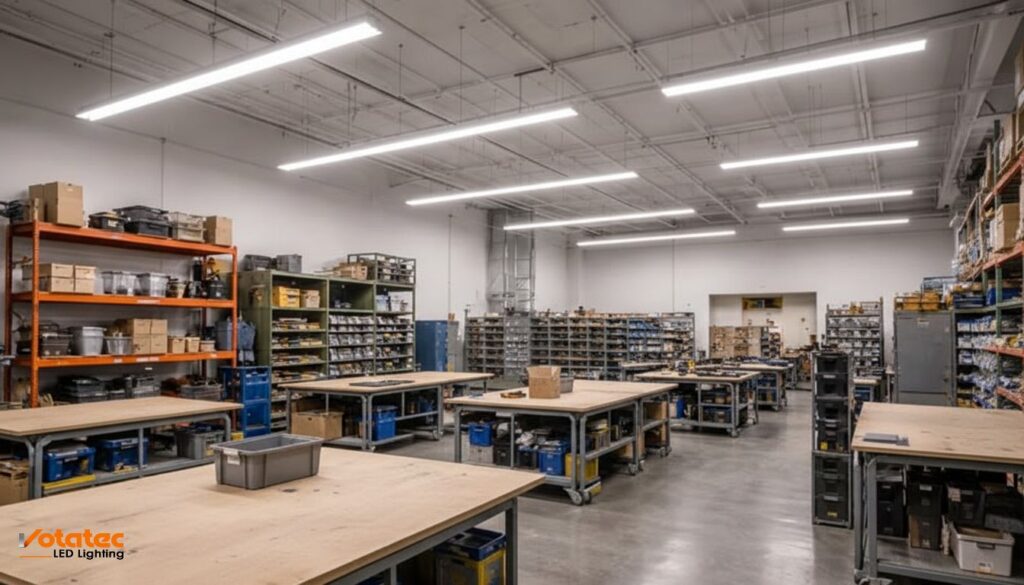
LED Linear Light Fixtures: Key Specs for Warehouses
Not all LED linear light fixtures are built the same. For warehouse applications, you need fixtures that handle height, dust, vibration, and long operating hours. Here’s what to look for.
Lumens per foot. For aisles with racking, target 500 to 700 lumens per foot of fixture length. Open floor areas can go lower, around 400 lumens per foot. Quality inspection zones need 800+ lumens per foot.
Colour temperature. Stick with 4000K to 5000K for warehouses. This range provides high visibility and keeps workers alert. Warmer temperatures like 3000K look nice in offices but reduce contrast in industrial settings.
Efficacy. Look for fixtures rated at 130+ lumens per watt. That’s the sweet spot for warehouse-grade efficiency. Anything under 100 lm/W is outdated.
IP rating. Standard dry warehouses need IP20 minimum. Cold storage, food processing, or wash-down areas need IP65 or higher.
Now, the mounting type matters just as much as the specs. You’ve got three main options.
Recessed Linear Lighting: When to Use It
Recessed linear lighting sits inside the ceiling, flush with the surface. Clean look. Zero protrusion below the ceiling plane.
But here’s the thing. Most warehouses don’t have drop ceilings. And even if they do, the ceiling height makes recessed fixtures less practical for broad illumination.
Where recessed linear works in warehouses:
- Office areas within the warehouse (shipping offices, control rooms)
- Break rooms and meeting spaces
- Mezzanine levels with drop ceilings
For the main warehouse floor? Recessed isn’t your best option. You need the light closer to the work plane, and recessed fixtures stay locked at ceiling height.
Suspended Linear Lights: Best for High Ceilings
Suspended linear lights hang from the ceiling on cables, chains, or rigid stems. This brings the light source lower, closer to the floor where you need it.
For warehouses with ceilings above 6 metres (20 feet), suspended mounting is often the smartest choice. You can drop the fixtures to an optimal height, typically 4.5 to 6 metres above the floor, and get better light levels without maxing out the wattage.
Benefits of suspended linear lights in warehouses:
- Adjustable mounting height for different zones
- Better light delivery to narrow aisles between tall racking
- Easier maintenance access compared to ceiling-hugging fixtures
- Can be configured in continuous rows for uniform coverage
Most suspended linear fixtures use aircraft cables with adjustable lengths. Installation is straightforward for any commercial electrician.
Surface-Mounted Linear Lights: The Versatile Option
Surface-mounted linear lights attach directly to the ceiling. The housing sits below the ceiling surface, fully exposed. No suspension hardware. No recessed cavity needed.
This is the go-to for warehouses with moderate ceiling heights (3 to 6 metres) or exposed structure ceilings like metal deck or open joists. Surface-mounted linear lights are also the easiest to install since you’re just bolting or clipping them to the existing ceiling.
Where surface mount works best:
- Standard height warehouses (under 6 metres)
- Parking structures and loading docks
- Retrofit projects where you’re replacing fluorescent troffers one-for-one
- Concrete or metal deck ceilings that can’t accept recessed fixtures
Continuous Row Lighting for Large-Scale Warehouse Floors
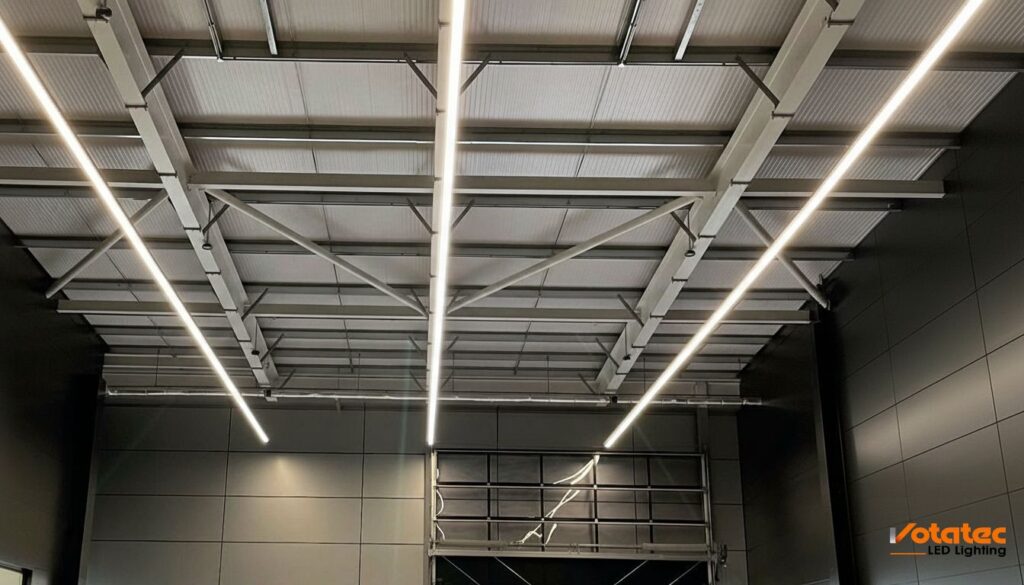
Here’s where linear lights really shine in warehouse applications. Instead of individual fixtures spaced apart, continuous row lighting links fixtures end-to-end in unbroken lines that run the full length of the aisle.
How Continuous Rows Eliminate Dark Spots
Individual fixtures create a light-dark-light pattern on the floor. You get bright pools under each fixture and dim zones in between. For general storage, that might be acceptable. For pick-and-pack operations, quality inspection, or forklift traffic, it’s not.
Continuous row lighting solves this by eliminating gaps. The fixtures connect seamlessly, lens to lens, creating a uniform ribbon of light along the entire aisle. No dark spots. No shadows between fixtures. Just consistent illumination from one end to the other.
The result? Better barcode readability, fewer picking errors, and improved safety for forklift operators who need to see floor markings and pedestrian zones clearly.
Most continuous row systems use a modular approach. You buy individual sections (typically 1.2-metre or 2.4-metre modules) and connect them with linking hardware. This lets you build runs of any length and configure them to match your racking layout exactly.
How Linear LED Lighting Cuts Warehouse Energy Costs
Let’s talk numbers. Because for most facility managers, the energy savings argument is what gets the project approved.
A typical 10,000 square metre warehouse running 200 four-foot fluorescent fixtures at 32W each consumes about 25,000 kWh per year on lighting alone (assuming 12-hour days). At $0.12/kWh, that’s roughly $3,000 per year.
Replace those with linear LED lighting at 18W each and you’re down to about 14,000 kWh. Annual cost: roughly $1,680. That’s a $1,320 annual saving from the fixture swap alone.
Now add occupancy sensors and dimming controls. Warehouses have zones that sit empty for hours at a time. Dimming lights in unoccupied aisles to 20% and bringing them back to full when sensors detect motion can cut another 30% to 40% off that already-reduced number.
Total savings? Somewhere around 60% to 75% of your original lighting energy bill. Payback in 12 to 24 months depending on fixture costs and utility rates.
Energy-Efficient Linear Lights and Canadian Rebate Programs
Provincial rebate programs can accelerate your payback significantly. Here’s what’s available:
DLC Qualification. The DesignLights Consortium (DLC) maintains a list of qualified commercial LED products. Many Canadian utility rebate programs require DLC listing as a condition of eligibility. Make sure your energy-efficient linear lights are on the DLC QPL before purchasing.
Ontario – SaveOnEnergy. Offers incentives for commercial and industrial LED retrofits. Rebates are calculated per fixture or per watt saved, depending on the program stream.
BC Hydro. Commercial lighting upgrade incentives for businesses in British Columbia. Covers a portion of fixture and installation costs.
Hydro-Quebec. Energy efficiency programs for commercial properties including warehouse lighting upgrades.
According to NRCan, commercial lighting upgrades to LED are one of the highest-ROI energy efficiency measures available to Canadian businesses. The federal government encourages these upgrades through programs and tax incentives aimed at reducing commercial building energy consumption.
Dimmable Linear LED Fixtures: Smart Controls for Warehouses
Dimmable linear LED fixtures paired with smart controls take energy savings to the next level. Here’s what’s available:
- Occupancy sensors. Detect motion in each aisle or zone. Lights dim to 10-20% when empty and ramp back to 100% when someone enters. Saves 30-40% on top of the LED conversion savings.
- Daylight harvesting. Sensors near skylights or dock doors measure ambient daylight and adjust fixture output to maintain a consistent lux level. On bright days, fixtures might run at 50% output.
- Scheduled dimming. Program fixtures to reduce output during off-peak hours. If your second shift only uses half the warehouse, dim the unused zones automatically.
- 0-10V and DALI dimming. The two most common control protocols for commercial LED. 0-10V is simpler and cheaper. DALI offers individual fixture addressing and more granular control.
The combination of LED efficiency plus smart controls is where the real savings stack up. Some warehouses report 80%+ energy reduction compared to their old fluorescent systems. Worth the investment.
Commercial Linear Lighting: Beyond the Warehouse
While this guide focuses on warehouses, commercial linear lighting serves a much wider range of spaces. The same fixture technology that lights a distribution centre aisle works beautifully in other environments.
Applications in Retail, Office, and Institutional Spaces
Retail. Architectural linear lighting creates clean, modern sightlines in retail stores. Suspended linear fixtures over product displays draw the eye and highlight merchandise. Surface-mounted rows in back-of-house areas keep stockrooms well-lit.
Offices. Modern linear lighting design has transformed office spaces. Suspended linear fixtures over workstations provide glare-free task lighting with high CRI for accurate colour rendering on screens and documents. Open-plan offices love the clean aesthetic of continuous linear runs.
Healthcare. Hospitals use linear LED fixtures in corridors, patient rooms, and surgical prep areas. High CRI (90+) is critical for accurate skin tone and colour assessment.
Education. Schools and universities use surface-mounted linear lights in classrooms, gymnasiums, and corridors. Durable, low-maintenance, and flicker-free, they’re ideal for learning environments.
Parking structures. Vapor-tight linear fixtures handle the moisture, temperature swings, and dust that parking garages throw at them. IP65-rated models are the standard here.
All of these applications benefit from the same core advantages: energy efficiency, long lifespan, even light distribution, and low maintenance. The mounting type and spec details change, but the linear LED platform is the same.
Frequently Asked Questions About Linear Lights for Warehouses
How Many Linear Light Fixtures Do I Need for My Warehouse?
It depends on ceiling height, aisle width, and target lux level. A general guideline: for standard pallet racking aisles at 6-metre ceiling height, plan one row of continuous linear fixtures per aisle, centred above the aisle. For open floor areas, space rows 2.4 to 3 metres apart. A photometric layout from your lighting supplier gives you exact fixture counts and spacing. Votatec offers free photometric plans for commercial projects.
Can I Replace Fluorescent Tubes with LED Linear Lights Directly?
Yes, but you have two options. You can retrofit existing fluorescent housings with LED tube replacements (T8 LED tubes), or you can replace the entire fixture with a new LED linear unit. Full fixture replacement is the better long-term choice because you get improved optics, integrated drivers, better thermal management, and a full warranty. Tube retrofits are cheaper upfront but leave you with old housings and ballast compatibility issues.
What’s the Best Colour Temperature for Warehouse Linear Lights?
4000K to 5000K is the recommended range for warehouses. This neutral-to-cool white range provides high contrast, good colour rendering, and keeps workers alert during long shifts. Avoid anything below 3500K for industrial spaces. It reduces visibility and can make workers drowsy. For quality inspection zones where colour accuracy matters, choose fixtures with 90+ CRI at 4000K.
How Long Do LED Linear Light Fixtures Last in a Warehouse?
Quality LED linear fixtures are rated for 50,000 to 100,000 hours. At 12 hours per day, 365 days per year, a 50,000-hour fixture lasts about 11 years. A 100,000-hour fixture lasts over 22 years. Compare that to fluorescent tubes at 20,000 hours (about 4.5 years at the same usage). The reduced replacement frequency alone justifies the upgrade for most warehouse operators.
Do LED Linear Lights Work in Cold Storage Warehouses?
Absolutely. In fact, LED performs better in cold environments than fluorescent. Fluorescent tubes struggle to start and maintain brightness in temperatures below 0°C. LED linear fixtures rated for -40°C to +50°C operate at full output regardless of ambient temperature. For cold storage and freezer applications, look for fixtures with an IP65 rating to handle moisture from temperature cycling. CSA-certified fixtures designed for Canadian conditions handle this without issue.
Bottom Line
Linear lights are the most practical lighting solution for Canadian warehouses. They follow the natural geometry of aisles and racking, deliver uniform illumination without dark spots, and cut energy costs by 60% to 75% compared to fluorescent or HID systems.
Choose suspended mounting for high ceilings, surface mount for standard heights, and continuous row configurations for maximum uniformity. Add dimmable controls and occupancy sensors to push savings even further.
Need a photometric layout for your facility? Contact our commercial lighting team. We’ll design a custom plan that maximizes visibility and minimizes energy costs.


