









 (+1) 905 597 5955


Here’s some quick math: 100 fixtures x 250W savings x 4,000 hours per year x $0.12/kWh = $12,000 in annual savings. Payback in under two years. Sometimes less if you’re in Ontario with SaveOnEnergy covering up to 50% of the project.
That’s the short answer on why Canadian businesses are switching to high bay LED lights. The longer answer, covering the full range of high bay LED lights benefits, includes better light quality, less maintenance, cooler buildings, and a bunch of other advantages that add up fast.
But let’s start with the basics.
What Are High Bay LED Lights?
High bay LED lights are fixtures built for spaces with tall ceilings, generally anything above 12 feet. You’ll see them in warehouses, distribution centres, manufacturing plants, gymnasiums, big box retail stores, and auto shops. Pretty much any large indoor space where you need bright, even light from a height.
They come in two main styles: UFO (round, compact) and linear (long, rectangular). More on that in a second.
What makes high bay LED lights different from regular commercial fixtures? A few things. They’re designed to throw light down from 12 to 45+ feet without losing intensity. They run cooler than traditional fixtures. And they don’t need the warm-up time that old metal halide or HPS lamps require.
The Canadian LED market has hit $8.2 billion, according to Natural Resources Canada. That’s not a trend. It’s a shift.
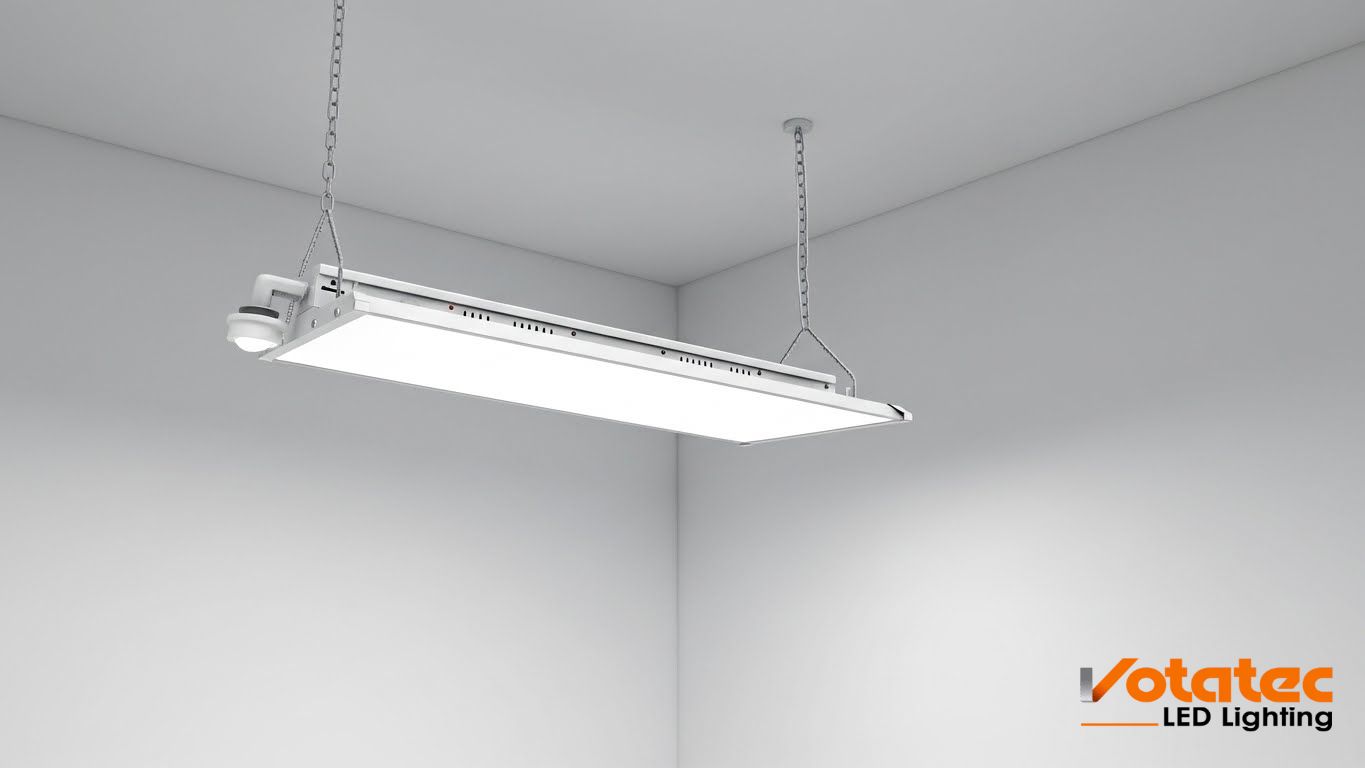
UFO vs Linear High Bay LEDs: Which One Fits Your Space?
This is one of the most common questions facility managers ask. And the answer depends on your layout.
UFO High Bay LEDs
UFO models are round, compact fixtures. Think of a flying saucer shape. They work well in open spaces where you need concentrated light from a single point. Warehouses with tall racking, open manufacturing floors, and gymnasiums are the sweet spot.
Votatec’s UFO LED high bay lights come in adjustable wattage options from 80W all the way up to 300W, with CCT and beam angle adjustments built in. So one fixture can adapt to different ceiling heights and tasks.
Linear High Bay LEDs
Linear models are rectangular fixtures, usually 2 or 4 feet long. They spread light over a wider area, which makes them better for spaces with rows of aisles, assembly lines, or inspection zones where you need consistent coverage without harsh shadows. For a deeper look at layout options, see our guide on linear lights for warehouses.
Votatec’s linear high bay fixtures range from 80W to 300W adjustable, with emergency backup options available for spaces that need code-compliant egress lighting.
Quick Comparison
| Feature | UFO High Bay | Linear High Bay |
| Shape | Round, compact | Rectangular, 2ft or 4ft |
| Best for | Open floors, high ceilings | Aisles, assembly lines |
| Light spread | Focused, directional | Wide, even distribution |
| Mounting | Hook or pendant | Chain, pendant, or surface |
| Typical wattage | 80W to 300W | 80W to 300W |
So which one? If your ceiling is open with no obstructions and you need light dropped straight down, go with UFO LED high bay fixtures. If you’ve got rows, aisles, or areas that need wider coverage, linear is the better call. Some facilities use both.
7 Benefits of Switching to High Bay LED Lights
1. Energy Savings of 75% or More
Commercial buildings spend around 25 to 30 percent of their total energy budget on lighting, per NRCan’s commercial building energy benchmarks. That’s a big number. And if you’re still running metal halide or fluorescent high bays, most of that energy is turning into heat instead of useful light.
High bay LED lights use around 75% less electricity for the same light output. A 400W metal halide fixture gets replaced by a 150W LED that actually puts out more lumens. Do that across 100 fixtures and you’re looking at $12,000 or more in annual savings.
Plus, dimmable high bay lights with occupancy sensors can push savings even further, anywhere from 20 to 40 percent on top of the base LED savings. Depends on the space, but the numbers are real.
2. 50,000+ Hour Lifespan, Way Less Maintenance
Here’s where the math really works in your favour. A metal halide lamp lasts maybe 10,000 to 15,000 hours. An LED high bay? 50,000 to 100,000 hours depending on the model. That’s 5 to 10 times longer.
And it’s not just about bulb replacements. Think about what maintenance actually costs in a high-ceiling space. You need a scissor lift or boom lift. That’s $200 to $400 per visit just for the equipment rental. Add labour, downtime, and the safety risk of working at height. It adds up fast.
With LED high bay lights, you might not touch a fixture for 10 to 15 years. No ballasts to fail. No lamps to burn out every few months. That’s less disruption and lower operating costs. Want the full breakdown on LED lifespan? Check out our guide on how long LED bulbs really last.
3. Better Light Quality for Safer Workspaces
This one’s underrated, honestly. Better lighting doesn’t just look nice. It directly affects safety and productivity.
High bay LED lights deliver high colour rendering (CRI 80+), which means colours appear accurate under the light. That matters in quality inspection areas, auto body shops, and anywhere workers need to spot defects or read labels clearly.
No flicker. No warm-up delay. Full brightness the instant you flip the switch. In a warehouse, that means clearer aisles, fewer picking errors, and safer forklift operations. In a gym, it means better visibility for athletes and fewer accidents.
The colour temperature matters too. Here’s a rough guide:
- 3000K to 4000K (warm to neutral): Retail, showrooms, gyms
- 4000K to 5000K (neutral to cool): Warehouses, manufacturing, distribution
- 5000K+ (daylight): Inspection areas, detail work, food processing
4. Lower Heat Output, Lower Cooling Costs
Old metal halide fixtures run extremely hot. Like, burn-your-hand hot. That heat radiates into your space, and your HVAC system has to work harder to compensate. Especially in summer.
High bay LED lights produce a fraction of that heat. Your building stays cooler. Your cooling costs drop. Your workers are more comfortable. And in temperature-sensitive environments like food storage or pharmaceutical facilities, less radiant heat from lighting is a genuine operational advantage.
5. Smart Controls and Dimming Compatibility
Smart lighting in commercial spaces is growing at around 22% per year, based on global market research from IES. There’s a good reason for that.
Modern commercial high bay LED lights integrate with motion sensors, daylight harvesting systems, programmable schedules, and building automation platforms. Votatec’s adjustable models support 0-10V dimming right out of the box, so you can pair them with sensors without extra hardware. Learn more about the advantages of dimming switches for commercial spaces.
What does that look like in practice? Lights dim to 30% in empty aisles and ramp up when someone walks in. Lights near skylights adjust based on how much natural daylight is available. Lights in a gym go full brightness during events and drop to 50% during off-hours.
That’s another 20 to 40 percent in energy savings on top of the LED efficiency gains. Not bad.
6. Smaller Environmental Footprint
LEDs contain no mercury. That’s a direct advantage over fluorescent and some HID lamps, which require special disposal procedures in most Canadian provinces.
They also last longer, so fewer fixtures end up in landfills. And because they use 75% less electricity, they reduce your building’s carbon output significantly. If your facility is working toward LEED certification or CaGBC green building standards, high bay LED upgrades are one of the fastest ways to earn points.
7. Faster ROI Than Most Building Upgrades
Most businesses recover the cost of a commercial high bay LED lights upgrade within 12 to 36 months. That’s faster than HVAC upgrades, building envelope improvements, or solar installations.
Here’s a realistic example:
- Facility: 50,000 sq ft warehouse
- Existing fixtures: 80 x 400W metal halide
- LED replacement: 80 x 150W high bay LED
- Annual energy savings: 80 x 250W x 4,000 hrs x $0.12/kWh = $9,600/year
- Maintenance savings: Around $3,000 to $5,000/year (lift rentals, labour, lamps)
- Total annual savings: $12,600 to $14,600
- Rebate potential: Up to 50% of project cost through provincial utility programs
What about upfront cost? You’re looking at maybe $80 to $250 per fixture for high bay LED lights for warehouse and industrial use. Depends on wattage, features, and whether you go UFO or linear. Higher-end adjustable models with built-in sensors sit at the top of that range.
With rebates, some facilities see payback in under 12 months. That’s about as close to a guaranteed return as you’ll find in building upgrades.
Real-World Example
A 60,000 sq ft distribution centre in the GTA replaced 120 metal halide high bays with Votatec UFO LED fixtures. Energy costs dropped 72% in the first year. Maintenance calls went from monthly to almost none. The project paid for itself in 14 months, including installation labour. The facility manager said the biggest surprise wasn’t the savings, it was how much brighter and more comfortable the space felt for workers on the floor.
LED High Bay vs Traditional Lighting: Side-by-Side

UFO high bay LEDs (round) vs linear high bay LEDs (rectangular) serve different facility layouts.
| Feature | LED High Bay Lights | Metal Halide / HPS / Fluorescent |
| Energy use | 75% less | Baseline (high) |
| Lifespan | 50,000 to 100,000 hours | 8,000 to 15,000 hours |
| Heat output | Low | Very high |
| Maintenance | Rarely needed | Frequent lamp and ballast replacements |
| Start time | Instant on | 5 to 15 minute warm-up |
| Smart controls | Dimming, sensors, IoT ready | Limited or none |
| Light quality | Stable, high CRI, no flicker | Fades over time, flickers with age |
| Mercury content | None | Yes (fluorescent and some HID) |
How to Choose the Right High Bay LED Lights
Key Specs to Compare
Lumens per watt (efficacy): Look for fixtures hitting 140 to 160 lm/W or higher. That’s the 2026 benchmark for commercial-grade high bays. Anything below 120 lm/W is outdated.
Wattage: Match wattage to your ceiling height and spacing. Here’s a rough guide:
| Ceiling Height | Recommended Wattage | Typical Application |
| 12 to 20 ft | 80W to 150W | Retail, light assembly, gyms |
| 20 to 30 ft | 150W to 200W | Warehouses, distribution centres |
| 30 to 40 ft | 200W to 300W | Manufacturing, large industrial |
| 40 ft+ | 300W+ or multi-fixture | Aircraft hangars, arena ceilings |
Votatec’s adjustable wattage models (like the 240W/210W/180W UFO) let you dial in the right output without buying different fixtures for different zones.
Colour temperature (CCT): Pick based on your application. See the guide above. Adjustable CCT fixtures give you more flexibility if the space serves multiple purposes.
Beam angle: Wide angles (90 to 120 degrees) for open areas. Narrower angles (60 to 90 degrees) for aisled warehouses where you need light directed between racks.
How to Calculate How Many Fixtures You Need
Here’s a basic lux calculation you can use for a quick estimate:
Number of fixtures = (Area in m² x Required lux) / (Lumens per fixture x Utilization factor)
Say you have a 2,000 m² distribution centre that needs 300 lux (standard for warehouse work). Your LED fixture outputs 30,000 lumens with a utilization factor of 0.7:
(2,000 x 300) / (30,000 x 0.7) = 29 fixtures (round up to 30)
That’s a rough number. Actual fixture counts depend on room geometry, reflectance values, and fixture photometric data. For an accurate layout, you’ll want a professional photometric plan. Votatec provides these for commercial projects, just get in touch and the team will run the numbers for your space.
Quick note on foot-candles vs lux: If you’re working with US-based specs, 1 foot-candle equals about 10.76 lux. So a 30 foot-candle warehouse requirement translates to roughly 300 lux.
IP and IK Ratings: Do They Matter?
Yes, if your environment has dust, moisture, or physical hazards.
- IP65: Dust-tight and protected against water jets. Good for most warehouses and manufacturing.
- IP66/IP67: Higher water protection. Use in wash-down areas or food processing.
- IK08 to IK10: Impact resistance. Important in spaces where forklifts, overhead cranes, or moving equipment could strike fixtures.
For a standard dry warehouse, IP65 is usually enough. For harsher environments, ask about higher-rated options.
Canadian Rebates, Standards and Certifications
Utility Rebates
Provincial utility programs can cover a significant portion of your high bay LED lights upgrade cost. Some examples:
- Ontario (Enbridge/SaveOnEnergy): Custom retrofit incentives based on verified energy savings
- BC Hydro: Commercial lighting rebates for qualifying LED upgrades
- Hydro-Québec: Energy efficiency programs for commercial and institutional buildings
- Alberta (Emissions Reduction Alberta): Clean technology funding for energy efficiency projects
Rebate amounts vary by province, utility, and project size. Some programs cover up to 50% of the total project cost. Votatec’s team can help you identify which programs apply to your project.
Certifications to Look For
- CSA (Canadian Standards Association): Required for electrical equipment sold in Canada
- DLC (DesignLights Consortium): DLC listed or DLC Premium qualification is often required to access utility rebates. The current standard is DLC SSL V5.1+
- Energy Star: An additional efficiency benchmark, though DLC is more common for commercial high bays
- cULus: Indicates testing and certification for both Canadian and US markets
Workplace Lighting Requirements
The Ontario Occupational Health and Safety Act (OHSA) and CSA Z1004 require minimum lighting levels in workplaces. The IES (Illuminating Engineering Society) publishes recommended lux levels by application:
- General warehouse: 200 to 300 lux
- Picking and packing: 300 to 500 lux
- Detailed inspection: 500 to 750 lux
- Manufacturing (general): 300 to 500 lux
Make sure your new LED layout meets or exceeds these levels. A photometric plan helps confirm this before installation.
Installation and Retrofit Tips
New Installation vs Retrofit
If you’re replacing existing high bay fixtures, you have two paths:
Direct replacement: Remove old fixtures entirely and mount new LED high bays. Cleaner result, but more labour.
Retrofit kits: Keep the existing housing and swap in LED components. Faster installation, lower cost, and less waste. Votatec offers LED fixtures designed for both approaches.
Ballast Bypass
If your current fixtures run on magnetic or electronic ballasts, those need to come out during an LED retrofit. LEDs run on direct line voltage, so the ballast becomes dead weight that wastes a small amount of energy and adds a potential failure point. Any qualified electrician can handle the bypass.
Maintenance Best Practices
LED high bays are low maintenance, but not zero maintenance. Here’s what to keep on your schedule:
- Clean fixture lenses once a year. Dust buildup can reduce light output by 10 to 15% after 12 months
- Check mounting hardware annually, especially in spaces with vibration from heavy equipment
- Inspect wiring connections during routine electrical maintenance
- Make sure all installations meet CSA requirements and local building codes
Why Canadian Businesses Choose Votatec
Votatec focuses on commercial and industrial LED lighting for the Canadian market. That means fixtures designed for Canadian electrical standards, rated for our climate conditions, and backed by local support.
What you get:
- UFO high bay LEDs and linear high bay fixtures with adjustable wattage and CCT
- CSA certified components
- DLC listed products eligible for utility rebates
- Photometric layout services for your specific space
- Help navigating rebate applications
- Industrial-grade housings built for warehouses, factories, and commercial facilities
Need help figuring out what fits your space? Reach out to the Votatec team for a recommendation based on your ceiling height, layout, and lighting requirements.
Frequently Asked Questions
What does “high bay” mean in lighting?
High bay refers to fixtures designed for spaces with ceilings starting around 12 feet and going up to 45 feet or more. The name comes from the mounting height. If your ceiling is below 12 feet, you’d typically use low bay fixtures instead.
How much energy can high bay LED lights save?
Most businesses see around 75% energy savings compared to metal halide or HPS systems. Add occupancy sensors and daylight harvesting, and total savings can reach 80 to 90% in some facilities.
How long do LED high bay lights last?
Commercial-grade LED high bays typically last 50,000 to 100,000 hours. At 4,000 hours of annual use (typical for a single-shift warehouse), that’s 12 to 25 years before replacement.
Do high bay LED lights get hot?
They produce some heat, but far less than traditional fixtures. Metal halide lamps convert around 65 to 70% of their energy into heat. LEDs convert around 20 to 30%. You’ll notice the difference in ambient temperature, especially during summer months.
How many high bay lights do I need for my warehouse?
It depends on your floor area, ceiling height, required lux levels, and fixture output. For high bay LED lights for warehouse use, the formula above gives a rough starting point. Or contact Votatec for a free photometric layout that gives you exact fixture count and placement.
Are LED high bay lights suitable for gymnasiums?
Yes. Gyms benefit from high CRI, instant-on capability, and even light distribution. Look for fixtures rated at 4000K to 5000K colour temperature and make sure they meet the minimum 300 lux requirement for recreational sports, or 500+ lux for competitive play.
What’s the difference between DLC and DLC Premium?
DLC Standard listing means the fixture meets minimum efficacy requirements. DLC Premium indicates higher efficacy, usually 20% or more above the standard threshold. Many utility rebate programs offer higher incentives for DLC Premium products.
Can I retrofit existing fixtures instead of replacing them entirely?
Yes. Retrofit kits let you keep the existing housing and swap in LED components. It’s faster and cheaper than full replacement. But if your existing housings are corroded or damaged, full replacement is the better long-term choice.
Is the upfront investment worth it?
Most businesses recover costs within 12 to 36 months through energy and maintenance savings. With provincial rebates covering up to 50%, the payback period gets even shorter. After that, it’s pure savings for the remaining 10 to 20+ years of fixture life.
What colour temperature is best for warehouse lighting?
For general warehouse work, 4000K to 5000K is the standard range. It provides bright, neutral to cool white light that supports visibility without causing eye fatigue. Inspection areas may benefit from 5000K or higher for more accurate colour rendering.
Bottom Line
Switching to high bay LED lights isn’t just about lower electricity bills, though that’s a big part of it. It’s about better light quality, safer workspaces, lower maintenance costs, cooler buildings, and a faster return on investment than most facility upgrades offer.
Canadian businesses have access to strong rebate programs that make the switch even more affordable. And with adjustable fixtures from Votatec, you don’t need to guess at specs. Pick the right wattage, colour temperature, and beam angle for your space, and you’re set for the next decade or more.
Ready to upgrade? Contact Votatec for product recommendations, photometric layouts, and help with rebate applications. Or browse the full range of high bay LED lights to see what fits your facility.