










 (+1) 905 597 5955



Dark parking lot. Unlit walkway. A tenant trips on a raised paver and breaks their wrist. Now you’re dealing with a liability claim, an insurance headache, and a problem that could’ve been solved for a few hundred dollars.
Sound familiar?
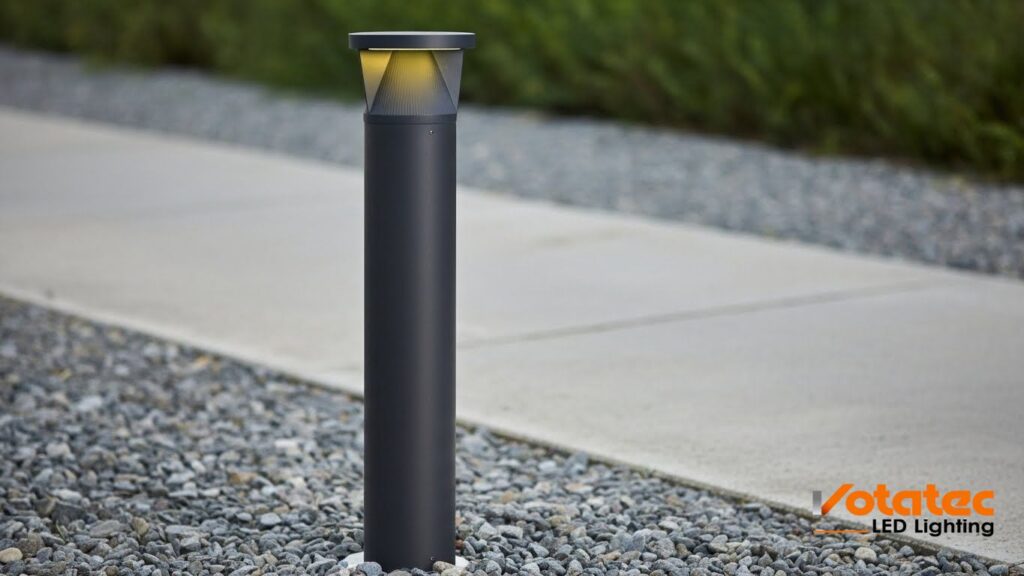
Bollard lights fix this. They’re short, ground-level fixtures designed to illuminate pathways, parking areas, building perimeters, and landscape lighting features without the glare of overhead pole lights. And they do it while looking good.
Here’s the quick version. A bollard light is a vertical post-mounted fixture, typically 30 to 42 inches tall, that casts light downward and outward at ground level. LED bollard lights use 10-30 watts each, last 50,000+ hours, and cost pennies per night to operate. They’re standard equipment for commercial properties, municipal pathways, residential complexes, and institutional campuses across Canada.
But not all bollard lights are the same. The difference between a fixture that performs for 15 years in a Canadian winter and one that fails after two seasons comes down to IP rating, build materials, colour temperature, and optical design.
Let’s break it all down so you pick the right ones the first time
Quick Spec Box: LED Bollard Lights at a Glance
| Specification | Details |
| Typical Height | 30-42 inches (760-1070mm) |
| Wattage Range | 10-30W LED |
| Lumen Output | 800-3,000 lumens |
| Colour Temperature | 3000K (warm) to 5000K (cool white) |
| CRI | 80+ standard |
| IP Rating | IP65 minimum for outdoor use |
| Lifespan | 50,000-60,000 hours |
| Operating Temp | -40°C to +50°C (quality units) |
| Certifications | CSA, cUL, DLC (for rebate eligibility) |
| Material | Die-cast aluminum, stainless steel, or powder-coated steel |
What Are Bollard Lights and Why Do They Matter?
So what are bollard lights exactly? They’re short, sturdy lighting fixtures installed at ground level to illuminate walkways, driveways, patios, garden paths, parking areas, and building entrances. The name comes from maritime bollards, those thick posts on docks used to tie ships. Same idea. A strong vertical post, but with a light inside.
Bollard Light Fixtures: Three Main Types
Bollard light fixtures come in three main categories:
1- Fixed illumination bollards. These are purely lighting fixtures. No barrier function. They’re designed to cast light across pathways and landscape areas. Most residential and commercial landscape bollard lights fall into this category.
2- Illuminated security bollards. These combine lighting with physical barrier protection. You’ll see them at storefronts, building entrances, and public spaces where vehicle intrusion prevention matters. They’re heavier, often steel-core or concrete-filled, and the lighting is a secondary function.
3- Solar bollard lights. Self-contained units with integrated solar panels and batteries. No wiring needed. Good for remote paths, parks, and areas where trenching for electrical conduit is impractical or too expensive. The trade-off? Lower light output and battery degradation in Canadian winters when sunlight hours drop.
Read more: Stunning Landscape Lighting Ideas
Why Lighted Bollards Matter for Safety and Security
Why do bollard lights matter? Three reasons.
Safety. Illuminated pathways reduce trip-and-fall incidents by making surface changes, steps, and obstacles visible. For commercial property managers, that’s a direct liability reduction. Insurance companies notice.
Security. Lighted bollards deter unwanted activity in parking lots, building perimeters, and common areas. Dark corners invite problems. Lit corners don’t.
Aesthetics. A well-placed set of outdoor bollard lights transforms a plain walkway into an architectural feature. They add visual depth to landscapes, define boundaries, and create welcoming entry sequences for buildings. Property value goes up. Tenant satisfaction goes up. Pretty straightforward.
Commercial LED Bollard Lights: Applications and Benefits
Commercial properties are where bollard lights really earn their keep. And commercial LED bollard lights have become the default choice for new construction and retrofit projects across Canada. Here’s why.
LED Bollard Light Savings: Energy, Maintenance, and Quality
- Energy consumption is minimal. A typical LED bollard light draws 15-20 watts. Compare that to a traditional 100W HPS (high-pressure sodium) bollard or a 70W metal halide unit. You’re looking at 75-85% energy savings per fixture. Across a commercial property with 40-60 bollards running dusk-to-dawn, that adds up to $1,500-3,000 in annual savings.
- Maintenance virtually disappears. HPS and metal halide bollards need lamp replacements every 2-3 years. The ballasts fail. The lenses yellow. LED bollard lights? Set them and forget them for 10-15 years. For property managers responsible for dozens or hundreds of bollards spread across a campus, that’s a massive reduction in work orders and contractor callouts.
- Light quality is better. Old sodium bollards cast that ugly orange glow that makes everything look the same colour. LED delivers white light with CRI values above 80, which means faces are recognizable on security cameras, landscape colours look natural, and wayfinding signage is actually readable at night.
Commercial bollard lights show up everywhere in Canadian properties. Office campus walkways. Condo and apartment common areas. Hotel entrance paths. Shopping centre parking lots. Hospital and university grounds. Transit station platforms. Municipal parks. Pretty much any outdoor space where people walk after dark.
Commercial Bollard Lights ROI for Canadian Properties
The ROI math is simple. If you’re replacing 50 old HPS bollards with LED, you’ll save around $2,000-4,000 per year in energy and another $1,500-2,500 in maintenance. Total project cost for 50 commercial LED bollard lights might run $15,000-25,000 installed. Payback in 3-4 years, sometimes faster with provincial rebates.
Landscape Bollard Lights for Gardens and Green Spaces
Garden and landscape applications need a different approach than parking lot bollards. Here, the goal isn’t maximum light output. It’s atmosphere.
Landscape bollard lights work best at 3000K warm white colour temperature. That warm tone complements natural greenery, stone pathways, and wood features without the clinical feel of 5000K cool white. Think soft pools of light along a garden path rather than a floodlit sidewalk.
Height matters in landscape settings. Shorter bollards, around 24-30 inches, keep the light close to the ground and reduce glare for anyone sitting on nearby benches or patios. Taller 36-42 inch units work better for wider paths and open lawn areas where light needs to spread further.
Garden bollard lighting also benefits from shielded or louvred optics that direct light downward. This does two things. It eliminates upward light pollution, which matters in residential areas and dark-sky communities. And it keeps glare out of neighbouring windows. Nobody wants a bollard light beaming into their bedroom at 2am.
For plant beds and feature gardens, consider bollards with asymmetric light distribution. These cast light to one side, letting you illuminate a garden bed from the path edge without wasting light on the walkway itself.
Spacing for landscape applications is typically 8-12 feet between fixtures, depending on output and desired ambiance. Closer spacing creates a dramatic runway effect. Wider spacing feels more relaxed and natural.
Pathway Bollard Lights: Spacing, Height, and Placement Tips
Getting pathway bollard lights right is about more than just dropping fixtures every 10 feet. There’s a method to it.
Spacing guidelines by path width:
| Path Width | Recommended Spacing | Layout Pattern |
| 4-6 ft (residential) | 8-10 ft apart | Single side |
| 6-8 ft (commercial) | 10-12 ft apart | Single side or staggered |
| 8-12 ft (wide commercial) | 10-14 ft apart | Staggered both sides |
| 12 ft+ (plaza/campus) | 12-16 ft apart | Both sides, aligned or staggered |
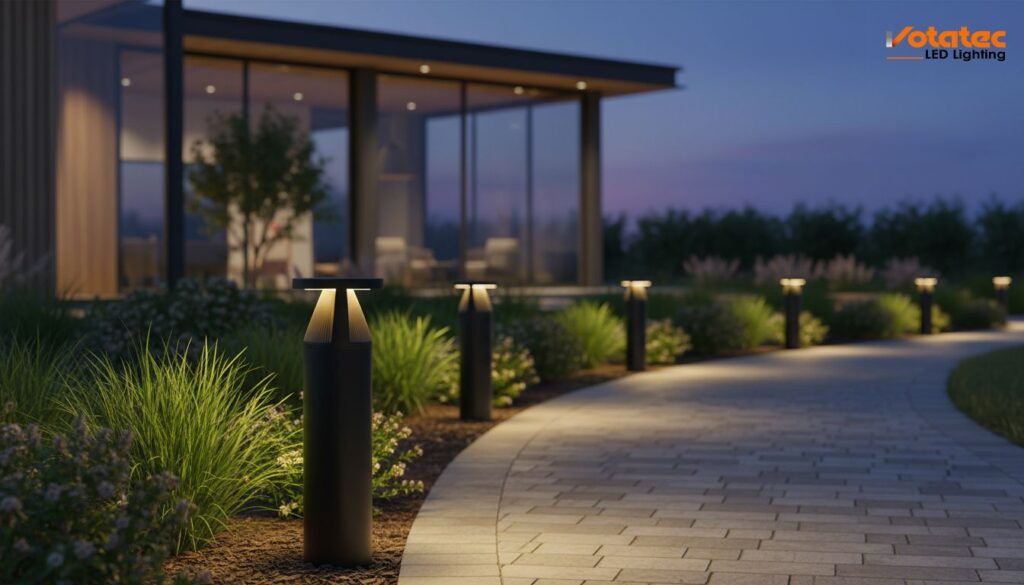
Single-side vs. staggered placement. For narrow residential paths, bollards along one side are usually enough. For wider commercial walkways, staggering bollards on alternating sides creates more uniform coverage and looks more balanced.
Height selection. Path bollard lights should cast light at a height that illuminates the walking surface without blinding pedestrians. The sweet spot is 30-36 inches for most applications. Anything taller than 42 inches starts acting more like a short pole light and loses the intimate ground-level effect that makes bollards appealing.
Key placement points. Beyond regular spacing along straight paths, add bollards at every intersection and decision point. Path curves. T-junctions. Stairway tops and bottoms. Building entrances. Parking lot crosswalks. These are the spots where people need light most, and where trip-and-fall risk is highest.
One more tip. Don’t line up bollards in a perfectly rigid grid on organic, curving pathways. Follow the path’s natural curve. It looks better and distributes light more evenly along the actual walking route.
Bollard Lights Outdoor: What to Look for in Canadian Weather
This is where cheap bollard lights die. Canadian outdoor conditions are brutal on lighting fixtures, and bollard lights outdoor face every challenge at once. Snow load. Ice. Salt spray. Temperature swings from -35°C to +35°C. UV exposure. Rain. Lawn sprinkler overspray. Rodents chewing wires. Snow plows bumping fixtures.
If your bollard isn’t built for this, it won’t last.
Waterproof Outdoor Bollards: IP Ratings Explained
IP Rating: Non-Negotiable
IP65 is the minimum for any outdoor bollard lighting application in Canada. That means complete dust protection and resistance to water jets from any direction. For bollards near roadways, parking lots, or areas subject to pressure washing, IP66 is better.
What does this look like in practice? A properly sealed lens gasket. Waterproof cable entry glands at the base. Drainage channels that prevent water pooling inside the fixture. And waterproof outdoor bollards with sealed driver compartments that keep moisture away from electronics.
Outdoor Bollard Lighting Material Selection
Material Selection
Die-cast aluminum with powder coating is the standard for commercial applications. It resists corrosion, handles temperature cycling without cracking, and powder coat finishes hold up to UV exposure for 10+ years. Stainless steel (316 marine grade) is the premium choice for coastal or high-salt environments like Halifax, St. John’s, or Vancouver’s seawall.
Avoid: plain steel with paint (it rusts within 2-3 seasons), plastic housings (they become brittle in cold and yellow in UV), and thin aluminum extrusions (they bend when hit by snow removal equipment).
Outdoor Bollard Lights Temperature and CSA Requirements
Temperature Range
A quality LED bollard light rated for Canadian conditions should operate from -40°C to +50°C without performance issues. Check the spec sheet. If it says “operating temperature: 0°C to +40°C,” that fixture isn’t designed for a Winnipeg January or a Calgary February. The LED driver is the weak point. Cold temperatures stress capacitors and reduce driver efficiency. Quality drivers from name-brand manufacturers handle this. Cheap imports often don’t.
CSA Certification
Every outdoor light fixture installed in Canada must be CSA certified or cUL listed. This isn’t optional. It’s a Canadian Electrical Code requirement. Non-certified fixtures can void your insurance, fail inspection, and create serious liability exposure. Always confirm the CSA or cUL mark before purchasing outdoor bollard lights for any Canadian project.
Modern Bollard Lights: Styles and Design Trends for 2026
The days of clunky mushroom-top bollards are fading. Modern bollard lights in 2026 lean toward clean lines, minimal profiles, and architectural integration.
Current trends:
Cylinder and column shapes dominate commercial projects. Simple round or square profiles in dark bronze, black, or graphite finishes that complement modern architecture without competing with the building design.
Integrated louvres and shields that hide the light source completely. You see the glow on the ground but not the LED itself. This eliminates glare and creates a more sophisticated look. Architects and landscape designers prefer this approach for high-end projects.
Slim profiles are getting popular. Instead of 6-8 inch diameter bollards, newer designs run 3-4 inches across. They’re less visually intrusive in garden settings and look cleaner along narrow pathways.
Dark-sky compliant designs with zero uplight. Municipalities across Canada are adopting dark-sky bylaws, particularly in areas near observatories and national parks. Modern bollard lights with full-cutoff optics meet these requirements while still delivering adequate path illumination.
Colour-tuneable bollards are emerging in smart city applications. These let facility managers adjust colour temperature from warm 2700K in the evening to neutral 4000K during peak pedestrian hours. Still a premium feature, but the technology is maturing.
Energy-Efficient LED Walkway Lighting: Specs That Matter
Not all LED bollards deliver the same efficiency. And when you’re specifying 40, 60, or 100+ units across a property, the spec differences add up fast.
Energy-efficient LED walkway lighting comes down to four numbers.
LED Bollard Lights Lumens Per Watt (Efficacy)
Good LED bollards deliver 100-130 lumens per watt. Great ones push 140+. A 15W fixture at 130 lm/W produces 1,950 lumens. The same 15W at 100 lm/W gives you only 1,500 lumens. You either need more fixtures or you accept less light. Neither is ideal.
Garden Bollard Lighting and BUG Rating (Backlight, Uplight, Glare)
This rating from the IES (Illuminating Engineering Society) tells you how much light goes where it shouldn’t. For bollards, you want low B (minimal backlight behind the fixture), zero U (no uplight), and low G (minimal glare). A B1-U0-G1 rating is excellent for most pathway applications.
Path Bollard Lights Driver Efficiency
The LED driver converts AC power to DC for the LEDs. A cheap driver wastes 10-15% as heat. A quality driver loses only 5-8%. Over 50,000 operating hours across dozens of fixtures, that efficiency gap costs real money.
Bollard Lights LED Photocell and Dimming Compatibility
Bollard lights that integrate with photocells (auto on/off at dusk and dawn) and support dimming schedules save another 20-30% beyond the LED baseline. A fixture running at 50% output from midnight to 5am uses half the energy during those hours. Multiply across your full bollard count, and it’s meaningful.
For Canadian properties pursuing Natural Resources Canada energy targets or applying for provincial rebates, DLC-listed bollard fixtures qualify for incentive programs in Ontario, BC, Quebec, and most other provinces. Always verify DLC listing before specifying.
How to Choose Bollard Lights for Your Project
Alright. You know what bollard lights are, where they go, and what specs matter. Now let’s put it together. Here’s how to choose bollard lights based on your specific project needs.
Step 1: Define your application.
What’s the primary purpose? Pure pathway illumination? Landscape accent? Security perimeter? Architectural feature? The answer drives everything else, including height, output, colour temperature, and style.
Step 2: Determine your light level requirement.
| Application | Recommended Foot-Candles | Suggested Bollard Output |
| Residential pathway | 0.5-1.0 fc | 800-1,200 lumens |
| Commercial walkway | 1.0-2.0 fc | 1,200-2,000 lumens |
| Parking lot pedestrian | 2.0-5.0 fc | 2,000-3,000 lumens |
| Security perimeter | 2.0-5.0 fc | 2,000-3,000 lumens |
| Garden/landscape accent | 0.2-0.5 fc | 500-800 lumens |
| Municipal park path | 0.5-1.5 fc | 1,000-1,800 lumens |
Bollard Lights Commercial Colour Temperature Guide
Step 3: Choose your colour temperature.
- 3000K warm white: Residential, hospitality, gardens, upscale commercial. Warm and welcoming.
- 4000K neutral white: General commercial, institutional, mixed-use. Clean and professional.
- 5000K cool white: Security-focused, parking areas, transit. Maximum visibility.
For most Canadian commercial projects, 4000K is the safe default. It works everywhere without feeling too warm or too clinical.
Step 4: Confirm environmental specs.
- IP65 minimum (IP66 for exposed locations)
- -40°C to +50°C operating range
- CSA or cUL certification
- Impact resistance (IK08 minimum for commercial, IK10 for high-traffic)
Step 5: Plan your layout and spacing.
Use the spacing guidelines from the pathway section above. For larger properties, a photometric layout from your supplier ensures uniform coverage and helps identify any dark spots before installation.
LED Bollard Lights vs Solar vs HPS: What Is a Bollard Light Worth?
Bollard Type Comparison:
| Feature | LED Bollard | Solar Bollard | HPS Bollard (Legacy) |
| Wattage | 10-30W | 3-10W | 50-100W |
| Lumen Output | 800-3,000 | 200-800 | 2,000-4,000 |
| Lifespan | 50,000 hrs | 20,000-30,000 hrs | 15,000-20,000 hrs |
| Maintenance | Very low | Low (battery replacement) | High (lamp + ballast) |
| Winter Performance | Excellent | Reduced | Good |
| Upfront Cost | $$ | $$$ | $ |
| Operating Cost | Very low | Near zero | High |
| Canadian Winter Rating | -40°C capable | Varies widely | -30°C typical |
| Best For | Commercial, institutional | Remote paths, parks | Replacement only |
The honest recommendation? For any wired installation in Canada, LED bollard lights are the clear winner. Solar works in limited applications but struggles with Canadian winter daylight hours and snow-covered panels. HPS is outdated. Don’t install new ones. Just retrofit what’s already there.
Frequently Asked Questions About Bollard Lights
1. What is a bollard light and what is it used for?
A bollard light is a short, vertical post-mounted fixture designed to illuminate pathways, walkways, parking areas, gardens, and building perimeters at ground level. They typically stand 30-42 inches tall and cast light downward and outward. Bollard lights are used in commercial properties, residential complexes, municipal parks, institutional campuses, and anywhere pedestrians need safe, well-lit paths after dark.
2. How far apart should bollard lights be spaced?
Spacing depends on the path width, fixture output, and desired light level. As a general guide, bollard lights are spaced 8-12 feet apart on residential paths and 10-16 feet apart on wider commercial walkways. For staggered layouts on both sides of a wide path, 12-16 feet between fixtures on each side is typical. Always check photometric data for your specific fixture to confirm spacing provides adequate foot-candle levels.
3. Are LED bollard lights worth the extra cost over solar bollards?
For most Canadian installations, yes. LED bollard lights connected to building power deliver consistent, reliable output year-round regardless of weather or season. Solar bollards depend on sunlight to charge, and Canadian winters mean shorter days, snow-covered panels, and reduced battery performance. Solar works well for remote locations where wiring is impractical, but for commercial and residential properties with available power, wired LED bollards are the better long-term investment.
4. What IP rating do I need for outdoor bollard lights in Canada?
IP65 is the minimum for any outdoor bollard light in Canada. This rating means complete dust protection and resistance to water jets. For bollards in exposed locations near roadways, parking lots, or areas subject to snow removal equipment spray, IP66 provides an extra margin of protection. Always combine IP rating with a -40°C minimum operating temperature to handle Canadian winters.
5. How to choose bollard lights that qualify for Canadian utility rebates?
To qualify for provincial rebate programs like Ontario’s SaveOnEnergy or BC Hydro’s commercial incentives, your bollard lights need to be DLC (DesignLights Consortium) listed. DLC listing confirms the fixture meets minimum efficacy and performance standards. You’ll also need CSA or cUL certification for code compliance. Work with your supplier to confirm DLC listing before purchasing, and apply for rebates before installation begins, since most programs require pre-approval.
Bottom Line
Bollard lights do a lot of work for a small fixture. They keep pathways safe, deter unwanted activity, define landscape features, and make properties look professional after dark. And with LED technology, they do all of it for 10-30 watts per fixture with virtually zero maintenance for a decade or more. The key is choosing the right fixture for Canadian conditions. That means IP65 minimum, -40°C rating, CSA certification, and quality aluminum construction that won’t corrode or crack after a few freeze-thaw cycles. Votatec supplies a full range of CSA-certified LED bollard lights built for Canadian weather, from compact pathway bollards to high-output commercial units. Direct importer pricing, DLC-listed options for rebate eligibility, and contractor-friendly support across Canada. Request a free quote for your next project.