










 (+1) 905 597 5955


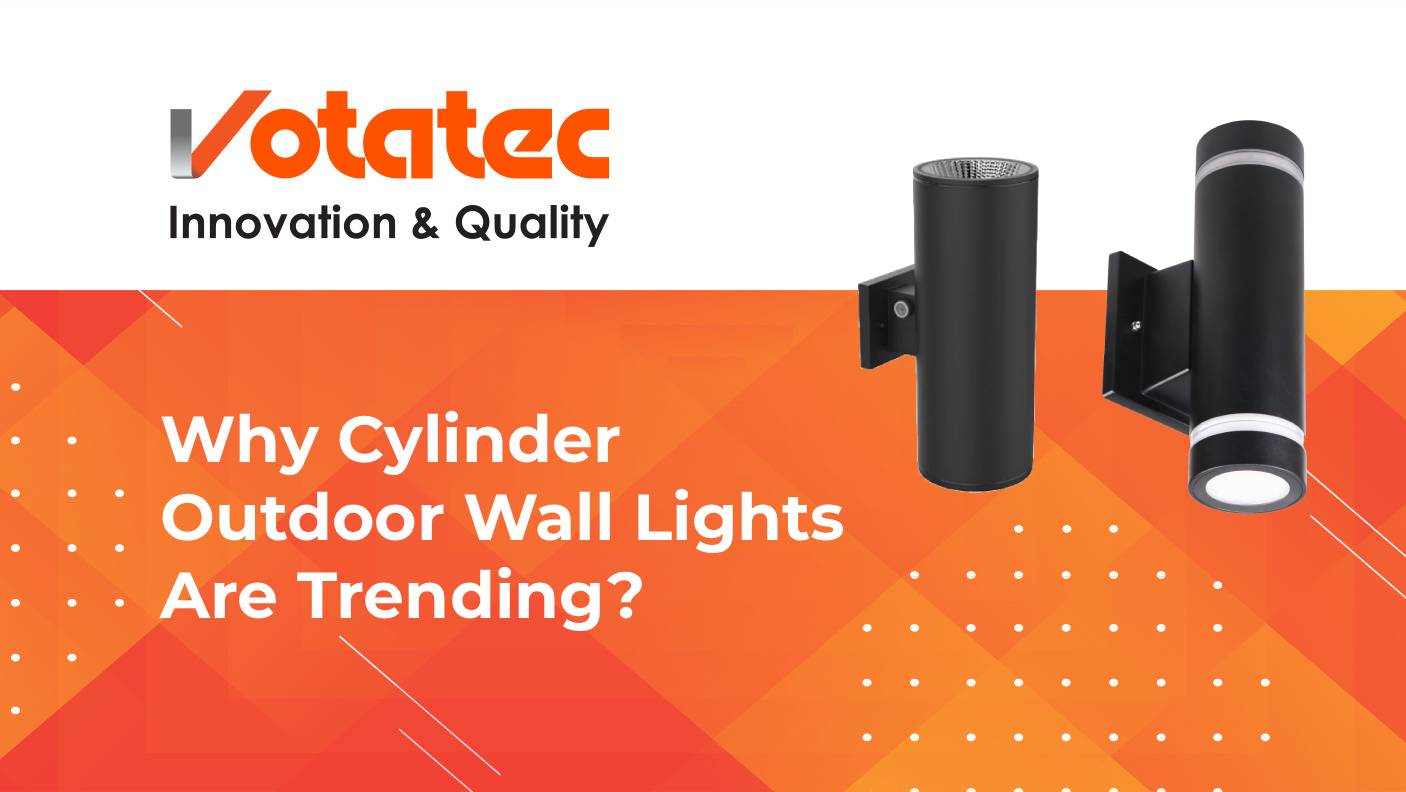

Picture your front entrance at dusk. Two slim cylinders flanking the door, casting clean beams of warm light up and down a textured stone wall. No visible bulb. No ornate scrollwork. No fussy glass panels. Just architecture and light.
That’s the appeal of cylinder outdoor wall lights. And that’s why they’ve become the most popular exterior wall fixture in modern Canadian design.
Here’s the quick version. Cylinder outdoor wall lights are tube-shaped wall-mounted fixtures, usually aluminum, that project light upward, downward, or both. They’re compact, minimal, weather-resistant, and work on pretty much any exterior surface. Most run on 10-20W LED, last 50,000+ hours, and cost almost nothing to operate. Brands like Votatec offer these fixtures in CSA-certified, weather-rated configurations built specifically for Canadian exteriors.
But the real reason they’re everywhere? They look incredible on modern homes, condos, commercial facades, and mixed-use buildings without trying too hard. They let the architecture do the talking. The fixture just provides the light.
Let’s dig into what makes them work and how to pick the right ones for your project.
Why Are Cylinder Outdoor Wall Lights So Popular Right Now?
The minimalist design movement has been building for years. Clean lines, flat roofs, mixed materials, matte finishes. And lighting has followed the same direction. Bulky coach lanterns and ornate carriage lights don’t fit on a modern home with hardie board siding and a flat-roof entryway. They look out of place. Kind of like putting chrome rims on a Tesla.
Cylinder outdoor wall lights solve this. They’re the architectural equivalent of a period at the end of a sentence. Simple. Intentional. Done.
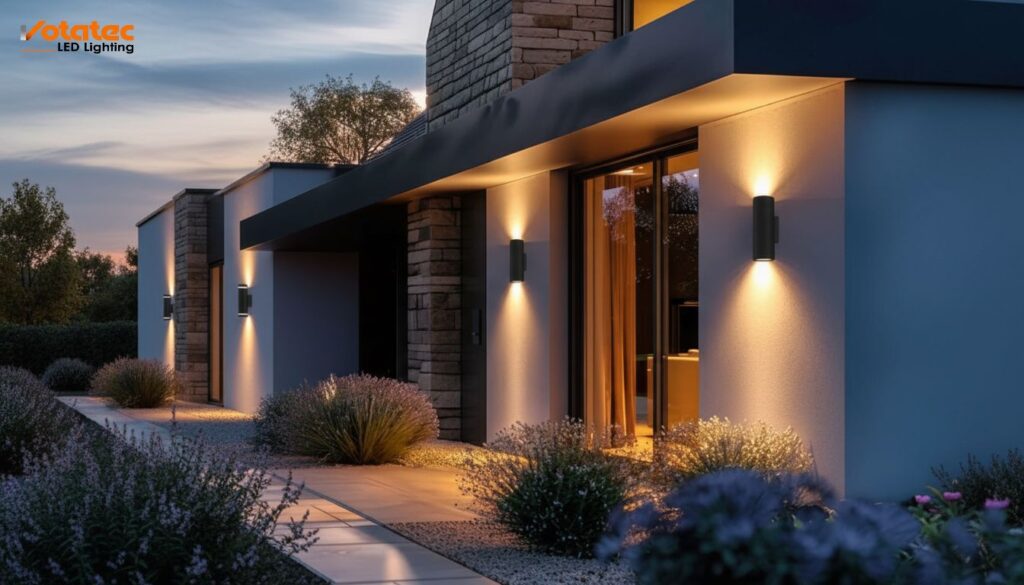
But the trend isn’t just about looks. There are practical reasons too.
Versatility. A cylinder wall light works on brick, stone, stucco, wood siding, concrete, and metal panels. It suits residential front entries, garage flanks, condo corridors, hotel facades, retail storefronts, and office building perimeters. One fixture style that works across dozens of applications. That’s rare.
Low profile. Most cylinder fixtures project only 4-6 inches from the wall. They don’t stick out into walkways, don’t get bumped by passing people or carts, and don’t create visual clutter on a facade. For commercial buildings with tight clearances near doorways, this matters.
Light control. Up/down cylinder lights create dramatic wall-washing effects that highlight texture and create visual depth. Down-only versions provide functional pathway illumination without upward light waste. The beam angle, usually 15-60 degrees, can be tight and dramatic or wide and functional depending on the fixture.
Up/Down vs Down-Only Cylinder Wall Lights: What’s the Difference?
This is the first decision most buyers face. And it depends on whether you want drama or function.
Up/down (bi-directional) cylinder lights cast two beams, one washing up the wall and one washing down. This creates that signature look you see on modern homes and commercial buildings. The upward beam highlights wall texture, soffits, or overhangs. The downward beam illuminates the ground below the fixture. The visual effect is striking, especially on textured surfaces like stone veneer, split-face block, or rough-sawn wood.
Down-only (uni-directional) cylinder lights cast light only downward. These are more functional and less decorative. They’re the better choice for dark-sky compliant applications where upward light isn’t allowed, for locations where you only need ground-level illumination, and for areas near upper-floor windows where an upward beam would be annoying.
Some cylinder fixtures offer adjustable beam angles, letting you control how tight or wide the up and down cones spread. A narrow 15-degree beam creates a dramatic pencil of light on the wall. A wide 60-degree beam provides softer, broader illumination.
Read more: How to Choose the Perfect Modern Outdoor Wall Lighting for Your Patio
Where Do Cylinder Outdoor Wall Lights Work Best?
Pretty much anywhere you’d put an exterior wall light. But some applications show them off better than others.
Front entryways. The classic placement. A pair of cylinder lights flanking a front door, mounted at 66-72 inches from the ground, creates a welcoming and modern entrance. This is the application that put cylinder outdoor wall lights on the map.
Garage doors. One or two cylinders beside a garage door provide functional light for the driveway approach while maintaining clean facade lines. Down-only works best here to avoid lighting the garage door face unevenly.
Commercial building facades. Rows of evenly spaced cylinders along a building perimeter create a unified, professional look. Hotels, office buildings, retail centres, and restaurants use this approach extensively.
Condo and apartment corridors. Where dozens of identical fixtures line a hallway or breezeway, the compact profile and simple design of cylinder lights prevent visual clutter. They provide consistent, even illumination without dominating the corridor aesthetics.
Garden walls and fences. Cylinder lights mounted on garden walls, retaining walls, or fence pillars add depth and drama to outdoor living spaces. Warm 3000K colour temperature works beautifully here.
What Makes the Best Cylinder Outdoor Wall Lights?
Not all cylinder wall lights are created equal. The difference between a fixture that performs for 15 years and one that corrodes in 3 seasons comes down to materials, construction, and LED quality. Here’s what separates the best cylinder outdoor wall lights from the rest.
Die-cast aluminum construction. This is the baseline for any quality exterior fixture. Die-cast aluminum doesn’t rust, handles freeze-thaw cycling, and takes powder coat finishes well. Avoid pressed steel (it rusts), thin aluminum extrusions (they bend), and plastic housings (they crack and yellow in UV).
Quality powder coat finish. Black, dark bronze, graphite, and white are the standard colour options. The finish should be rated to AAMA 2604 or higher, which means it resists UV fading, chalking, and salt spray for 10+ years. Cheap finishes start peeling after 2-3 Canadian winters.
Tempered glass or UV-stabilized polycarbonate lens. The lens protects the LED module from moisture and impact. Tempered glass is more scratch-resistant and maintains clarity longer. Polycarbonate is lighter and more impact-resistant. Both work. Just make sure the material is UV-stabilized for Canadian sun exposure.
Quality LED driver. The driver is the component most likely to fail before the LEDs themselves. Quality drivers from name-brand manufacturers handle temperature extremes, voltage fluctuations, and surge events. Budget drivers fail early, especially in Canadian cold.
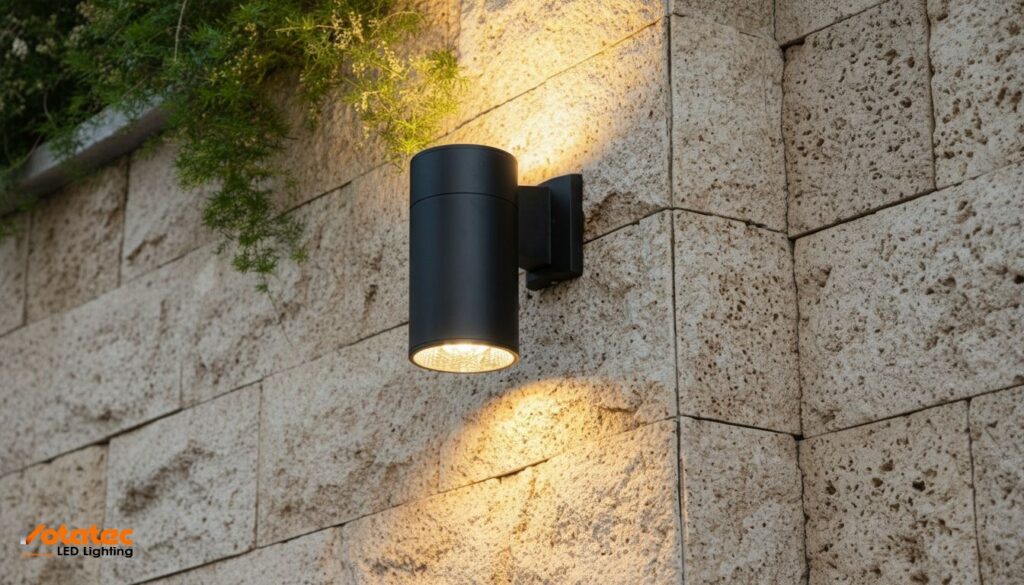
Large Cylinder Outdoor Wall Lights: Where Bigger Makes a Statement
Large cylinder outdoor wall lights, typically 10-14 inches tall and 4-6 inches in diameter, are the choice for making a visual impact. They suit large entryways, tall walls, commercial facades, and any application where the fixture needs to hold its own against a big surface area.
On a two-storey stone facade? Small cylinders get lost. Large cylinders provide visual balance and enough light output (1,000-2,000 lumens) to illuminate the wall and ground effectively.
Best applications for large cylinders:
- Grand residential entries with high ceilings or tall walls
- Commercial building perimeters with 10+ foot wall heights
- Hotel and hospitality facade lighting
- Mixed-use building entries and lobbies
- Parking structure stairwells and entrances
One thing to watch. Large cylinder outdoor wall lights need proportional spacing. If you pack them too close together on a long wall, they look crowded. Generally, space large cylinders 8-12 feet apart for commercial facades and 6-10 feet apart on residential walls.
Small Cylinder Outdoor Wall Lights: Subtle Accent Without the Bulk
Small cylinder outdoor wall lights, usually 6-8 inches tall and 3-4 inches in diameter, are the choice for subtle, understated lighting. They don’t compete with the architecture. They complement it.
Small cylinders work best on:
- Standard residential entries with 8-foot door height
- Narrow pilasters between windows
- Garden walls and fence pillars
- Condo and apartment unit entries
- Covered patios and porches where ceiling height is limited
The trade-off? Lower light output, typically 400-800 lumens. That’s plenty for accent and ambient lighting but may not be enough for primary pathway illumination in large open areas. If you need more functional light from a small fixture, pair it with pathway bollards or step lights.
How to Choose the Right Size Cylinder Wall Light for Your Space
The sizing decision comes down to wall height, fixture spacing, and visual proportion.
Size Selection Guide:
| Wall Height | Recommended Cylinder Size | Lumen Output | Typical Spacing |
| Under 8 ft | Small (6-8 inches) | 400-800 lm | 5-8 ft apart |
| 8-12 ft | Medium (8-10 inches) | 600-1,200 lm | 6-10 ft apart |
| 12-16 ft | Large (10-14 inches) | 1,000-2,000 lm | 8-12 ft apart |
| 16 ft+ | Extra large (14+ inches) | 1,500-2,500 lm | 10-14 ft apart |
The rule of thumb? The fixture height should be roughly 1/6 to 1/8 of the wall height. So an 8-foot wall gets a 12-16 inch fixture. A 16-foot wall gets a 24-30 inch fixture or a large cylinder with enough visual weight to hold the space. Going too small on a tall wall makes the fixtures look like afterthoughts.
Outdoor Cylinder Lights LED: Why LED Is the Only Smart Choice
If you’re buying cylinder outdoor wall lights in 2026, LED is really the only option worth considering. Halogen cylinder fixtures still exist but they consume 5-10 times more energy, burn hot enough to discolour the mounting surface, and need bulb replacements every 1-2 years. Not worth it.
Outdoor cylinder lights LED fixtures deliver 100-150 lumens per watt, last 50,000+ hours, run cool, and dim smoothly. They’re available in every colour temperature from warm 2700K to cool 5000K. And they cost $1-3 per year to operate per fixture. Basically nothing.
What Colour Temperature Works Best for Cylinder Outdoor Wall Lights?
Colour temperature sets the mood. And for exterior wall lights, the choice matters more than most people think.
Colour Temperature Guide for Cylinder Wall Lights:
| Colour Temp | Look | Best For |
| 2700K | Warm amber, cozy | Residential patios, intimate entries |
| 3000K | Warm white, inviting | Most residential, hospitality, restaurants |
| 4000K | Neutral white, clean | Commercial facades, offices, mixed-use |
| 5000K | Cool white, bright | Security, industrial, parking structures |
For most Canadian residential applications, 3000K is the sweet spot. It’s warm enough to feel welcoming without the orange tone of 2700K. For commercial lighting projects, 4000K delivers a professional, clean look that reads well against modern facade materials like concrete, metal panel, and glass.
Avoid mixing colour temperatures on the same facade. Two fixtures at 3000K flanking a door with a 5000K fixture around the corner looks jarring. Pick one temperature and stick with it across the entire building exterior.
IP Ratings and Weather Protection for Canadian Exteriors
Canadian weather destroys cheap exterior fixtures. Rain, snow, ice, salt spray, UV radiation, and temperature swings from -35°C to +35°C test every component.
Cylinder outdoor wall lights need an IP65 rating minimum. That means complete dust protection and resistance to water jets from any direction. For fixtures mounted in exposed locations, like on a building face without a soffit overhang, IP66 is better.
Beyond the IP rating, verify:
- Operating temperature range of -40°C to +50°C. Non-negotiable for Canadian installations. Fixtures rated for 0°C to +40°C will fail during winter.
- CSA certification or cUL listing. Mandatory for every exterior electrical fixture installed in Canada. Required by the Canadian Electrical Code.
- Surge protection. Built-in surge protection rated for 2-4kV protects the LED driver from power fluctuations. Important in areas with unstable grid power.
Dark-Sky Compliant Cylinder Wall Lights
More Canadian municipalities are adopting dark-sky bylaws that restrict upward light from exterior fixtures. If your project is in a dark-sky zone, you need down-only cylinder fixtures with zero upward light emission.
The IES (Illuminating Engineering Society) BUG rating system classifies fixtures by Backlight, Uplight, and Glare output. A U0 rating means zero uplight. For dark-sky compliance, specify U0-rated down-only cylinder fixtures. Many manufacturers offer the same cylinder design in both up/down and down-only versions, so you don’t have to sacrifice aesthetics for compliance.
Even if your municipality doesn’t currently require dark-sky compliance, down-only fixtures are a good choice for homes in residential neighbourhoods where upward light can bother neighbours or create light trespass on adjacent properties.
How to Install Cylinder Outdoor Wall Lights: Height, Spacing, and Placement
Getting the installation right matters as much as choosing the right fixture. A beautiful cylinder light mounted at the wrong height or spaced too far apart defeats the purpose.
What Height Should Outdoor Cylinder Lights Be Mounted?
The standard mounting height for exterior wall lights is 66-72 inches (168-183 cm) from the ground to the centre of the fixture. This places the light at roughly eye level, which provides comfortable illumination without glare.
But cylinder lights are flexible. Here are adjustments by application:
- Flanking a front door: 66-72 inches, centred vertically on the door sidelight or at 2/3 the door height. This is the classic position.
- Along a commercial facade: 72-96 inches, higher mounting to cast light over a wider area and avoid being bumped by pedestrians or carts.
- On garden walls or fence pillars: 36-48 inches, lower mounting for accent lighting that highlights landscape features rather than overhead illumination.
- Stairway walls: 30-36 inches above each landing or tread, angled to illuminate steps for safety.
For up/down fixtures, consider what the upward beam will hit. If there’s a soffit 12 inches above the fixture, that beam creates a beautiful wash on the overhang. If there’s nothing above for 20 feet, the upward beam disappears into the sky. In that case, a down-only fixture makes more sense.
How Far Apart Should Cylinder Wall Lights Be Spaced?
Spacing depends on fixture output, beam angle, and whether you’re lighting for aesthetics or function.
Spacing Guidelines:
| Purpose | Recommended Spacing | Notes |
| Decorative accent | 8-12 ft apart | Light pools don’t need to overlap |
| Functional pathway | 6-8 ft apart | Pools should overlap slightly |
| Commercial facade | 8-14 ft apart | Even spacing, symmetrical layout |
| Security perimeter | 6-10 ft apart | Minimize dark gaps between fixtures |
For residential front entries, the most common layout is two fixtures flanking the door at equal distance from the door frame, usually 6-12 inches to each side. That’s one placement decision that rarely varies.
On long commercial walls, maintain perfectly even spacing. Measure the total wall length, decide on your spacing, and mark fixture locations before drilling. Uneven spacing on a clean facade is immediately noticeable and looks unprofessional.
One more tip. If you’re running wiring for multiple cylinder fixtures along a wall, consider using a shared circuit with a photocell or astronomical timer for automatic dusk-to-dawn operation. Running individual switches for each fixture isn’t practical. A single photocell turns them all on at sunset and off at sunrise automatically. Energy rebate programs supported by Natural Resources Canada often favour projects with automated lighting controls.
Frequently Asked Questions About Cylinder Outdoor Wall Lights
1. Are cylinder outdoor wall lights waterproof?
Quality cylinder outdoor wall lights with an IP65 or IP66 rating are fully protected against rain, snow, and water jets. IP65 is the minimum recommended for Canadian exterior use. Always verify the IP rating on the product spec sheet. Fixtures without a stated IP rating should not be used outdoors, especially in Canadian climates where freeze-thaw cycles, ice, and salt exposure are common.
2. Can I use cylinder wall lights on a covered patio?
Absolutely. Covered patios are actually an easier environment for exterior fixtures because the overhang provides additional weather protection. You can use fixtures rated IP44 or higher in covered locations, though IP65 is still recommended in Canada where wind-driven rain and snow can reach covered areas. Covered patios are a great spot for up/down cylinder lights since the upward beam washes the ceiling beautifully.
3. Do cylinder outdoor wall lights need a special electrical box?
Yes. Exterior wall lights in Canada must be mounted on a weatherproof electrical junction box, typically a standard round or octagonal box with a weatherproof cover plate. The box must be rated for exterior use and properly sealed where the wiring enters the wall. All installations must comply with the Canadian Electrical Code and use CSA-certified components.
4. What’s the difference between up/down and down-only cylinder wall lights?
Up/down (bi-directional) fixtures cast two beams, one upward and one downward, creating dramatic wall-washing effects. Down-only (uni-directional) fixtures cast light only downward for functional illumination without upward light waste. Up/down looks more dramatic and highlights wall textures. Down-only is better for dark-sky compliance, locations near bedroom windows, and applications where you only need ground-level light.
5. How many lumens do I need for cylinder outdoor wall lights?
For residential accent lighting, 400-800 lumens per fixture is typically sufficient. For functional pathway lighting, 800-1,200 lumens provides adequate ground coverage. For commercial facades and security applications, 1,200-2,000 lumens delivers more usable light. The right lumen output depends on your fixture spacing, mounting height, and whether the cylinder lights are your primary light source or supplemental accent lighting.
Bottom Line: Choosing the Right Cylinder Outdoor Wall Lights
Cylinder outdoor wall lights aren’t just a trend. They’re becoming the standard for modern exterior lighting across Canada. Clean lines, low energy use, minimal maintenance, and a form factor that works on everything from a single-family home to a 50-storey condo tower.
Get the basics right and you won’t think about these fixtures again for a decade. Die-cast aluminum body. IP65 or higher. CSA certified. Rated to -40°C. Quality powder coat that won’t peel after two winters. And the right size and beam direction for your wall height and application.
Whether you’re a homeowner refreshing a front entry, a contractor specifying fixtures for a new build, or a property manager upgrading a commercial facade, cylinder outdoor wall lights deliver the look and performance that modern Canadian properties demand.