










 (+1) 905 597 5955


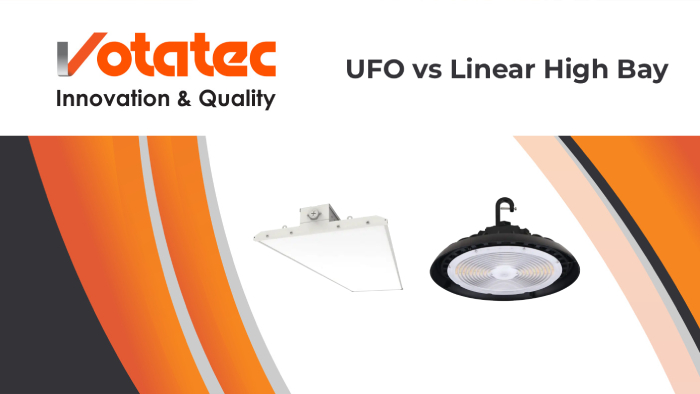

The UFO vs linear high bay decision comes down to your floor plan. UFO high bays win in open, square spaces with no racking. Linear high bays win in aisles, production lines, and anywhere a rectangular light pattern cuts shadows between shelves.
That’s the short version. Below, you’ll find beam angle guidance, mounting height rules, typical applications across Canadian facilities, and a section on current rebate incentives that can cover a significant portion of your project cost.
What Makes UFO and Linear High Bays Different?
Both are LED fixtures built for ceilings above 4.5 metres (15 feet). The difference is how they distribute light.
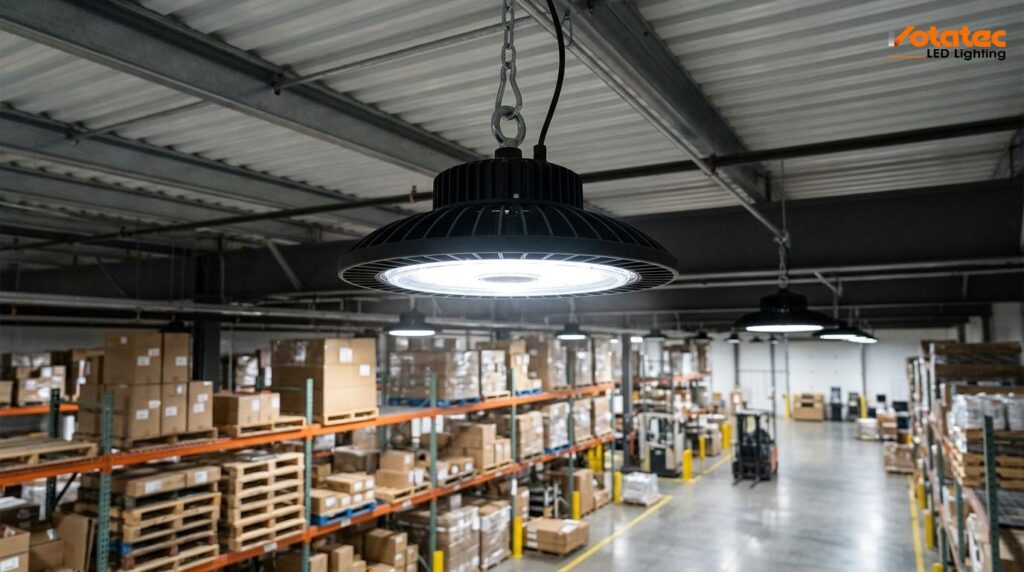
A UFO high bay is a round, disc-shaped unit. It throws light in a wide circular pattern below the fixture. That footprint works well in open, square-shaped spaces where you want even coverage in all directions.
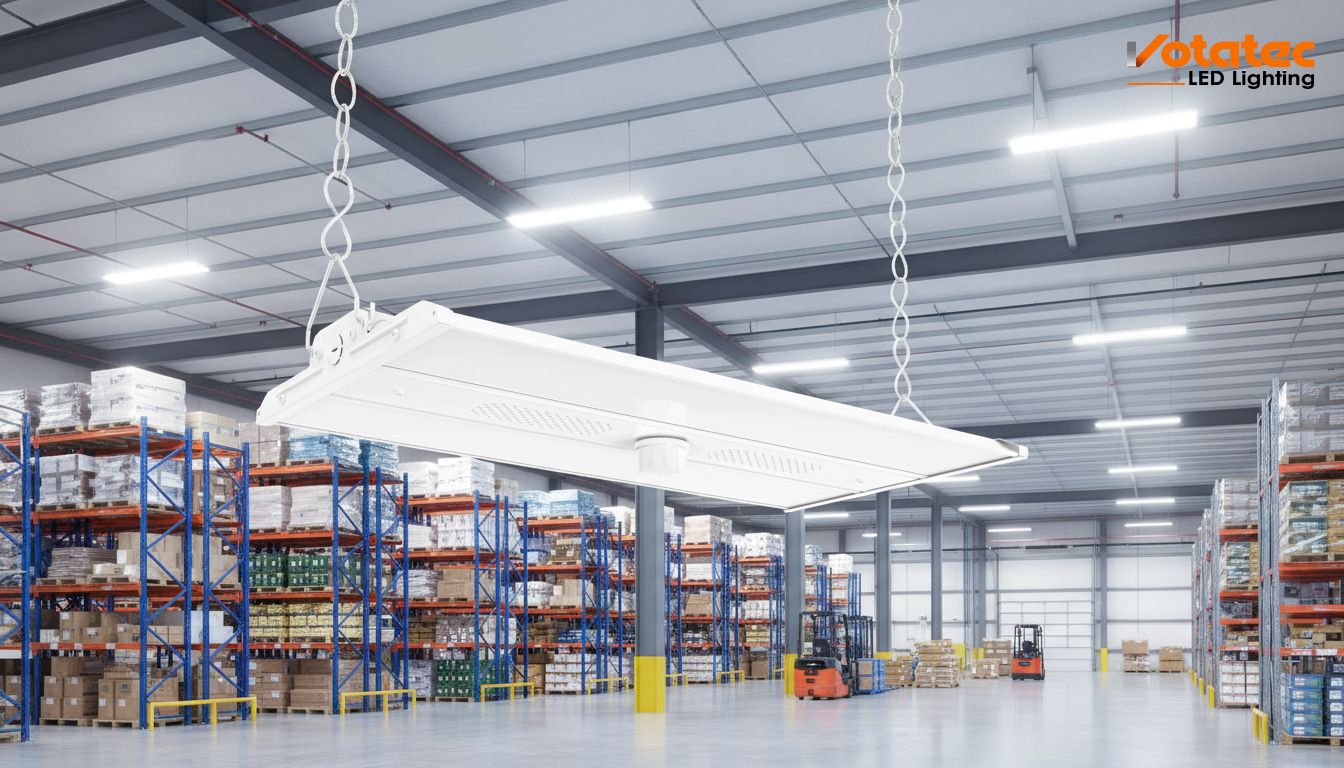
A linear high bay is a rectangular fixture, typically 1.2 metres (4 feet) long. It throws light along the length of the unit, creating an elongated footprint. That shape matches an aisle, a production line, or any space where the floor runs long and narrow.
The core rule: the shape of your light footprint should match the shape of your space.
| UFO High Bay | Linear High Bay | |
|---|---|---|
| Light pattern | Circular / omnidirectional | Elongated / directional |
| IP rating | IP65-IP66 (waterproof) | IP40-IP65 (varies by model) |
| Best space shape | Open or square | Rectangular or aisled |
| Wattage range | 100W-480W | 60W-300W |
| Appearance | Industrial, round | Clean, commercial |
| Typical mount | Hook, chain, or pendant | V-hook, chain, or surface |
When Should You Choose UFO High Bay Fixtures?
Open warehouses with no racking
If your warehouse floor is one open area without shelving or racking, a UFO fixture’s circular light pattern gives you even coverage with fewer units. Without aisles creating shadow zones, the round footprint fills the space naturally and reduces the total fixture count.
Gymnasiums and indoor arenas
UFO high bays are the standard choice for gymnasiums across Canada. The circular distribution covers the court evenly, and most models carry an impact-resistance rating that handles the occasional errant ball. A 150W or 200W UFO at 7-8 metres delivers adequate foot-candles for recreational use. Competitive and varsity-level athletics will typically need 250W+ fixtures with a tighter beam angle.
Manufacturing floors with open layouts
Assembly areas, fabrication floors, and welding bays are natural fits for UFO fixtures. The open layout benefits from omnidirectional distribution, and the IP65 or IP66 rating handles dust, metal shavings, and the occasional water spray-down without issue.
Wash bays and wet environments
Most UFO high bays carry IP65 or IP66 ratings – fully dust-tight and protected against high-pressure water jets. Livestock barns, vehicle wash bays, and food processing areas all benefit from this rating. Linear fixtures often carry lower IP ratings unless specifically specified for wet locations, so check the spec sheet carefully for wet applications.
Parking garages
UFO fixtures mount cleanly to a concrete soffit without requiring a trough or channel. The downward distribution covers driving lanes and stalls without directing glare at approaching drivers. Cold-rated models handle the Canadian climate through winter without lumen degradation.
Cold storage (open format, no racking)
Open cold rooms benefit from UFO fixtures rated for low temperatures. If you’re specifying for walk-in freezers or cold chain storage, confirm the fixture is rated to -40°C. Several models designed for Canadian applications carry this rating as standard.
When Does Linear High Bay Outperform UFO?
Warehouses with racking and narrow aisles
This is linear’s clearest advantage. The elongated footprint of a linear fixture matches the shape of an aisle. One linear high bay mounted directly above a racked lane pushes light straight down the row, onto the face of the shelving, and onto the product label. A UFO fixture in the same position spreads light to the sides – where the rack structure blocks it before it reaches the floor.
For warehouses with racking above 4.5 metres and aisles narrower than 3 metres, linear high bays consistently deliver better uniformity ratios and fewer shadow zones between rack faces.
Production lines and assembly conveyors
Production lines run long and narrow. A row of linear high bays mounted above the conveyor keeps light directly over the work surface. Workers accurately read labels, identify defects, and spot potential hazards with far less eye strain than UFO fixtures positioned off-centre from the task area.
Cold storage with aisled racking
Cold storage with pallet racking needs the same aisle-specific coverage as a standard warehouse. Linear fixtures handle this well and are available in low-temperature ratings for freezer applications.
Retail-style and showroom applications
If you’re lighting a showroom, big-box retail floor, or any customer-facing area, linear high bays present better. The rectangular profile blends into a ceiling grid more naturally than round UFO fixtures. The result is a cleaner visual for spaces where appearance matters alongside function.
Vehicle service and maintenance bays
Vehicle maintenance bays and long service corridors benefit from linear fixtures because the light follows the direction of the work. A technician working under a vehicle gets direct overhead light from a linear bay. With a UFO fixture, the light can fall more to the sides and less directly over the pit or lift.
What Ceiling Height Works Best for UFO vs Linear High Bays?
Both types fall under the high bay category – ceilings above 4.5 metres (15 feet). But ceiling height affects both wattage selection and beam angle, and those decisions change the output at floor level significantly.
UFO beam angle guide
| Ceiling Height | Recommended Beam Angle | Wattage Range |
|---|---|---|
| 4.5m-6m (15-20 ft) | 120° | 100W-150W |
| 6m-9m (20-30 ft) | 90° | 150W-200W |
| 9m-12m (30-40 ft) | 60° | 200W-300W |
| 12m+ (40 ft+) | 60° or narrower | 300W-480W |
The 90° beam angle is the safest starting point for most Canadian industrial facilities. At a 7.5-metre ceiling, a 90° fixture delivers approximately 28-32 foot-candles at the floor – nearly 40% more than a 120° beam from the same wattage unit. A wider beam spreads out before reaching the floor; a tighter beam concentrates it where it counts.
What colour temperature should you choose?
Both UFO high bay lights and linear fixtures are available in 4000K (neutral white) and 5000K (cool daylight). For most Canadian warehouses and manufacturing facilities, 5000K is the standard – it’s close to daylight, makes it easier for workers to read labels, spot colour differences in materials, and stay alert on long shifts.
Gymnasiums and arenas sometimes prefer 4000K for a slightly warmer appearance under broadcast or recreational lighting. Cold storage applications benefit from fixtures rated for low ambient temperatures regardless of colour temperature choice. If you’re unsure, 5000K is the safe default for industrial applications.
Linear fixture spacing rule
A reliable starting point is the 1:1 ratio: space your fixtures no farther apart than your mounting height. At a 6-metre ceiling, fixtures spaced beyond 6 metres apart will produce noticeable dark zones. Never exceed a 1.5:1 spacing-to-height ratio or uniformity drops off quickly.
Wattage by ceiling height (both fixture types)
- 4.5m-6m (15-20 ft): 100W-150W
- 6m-9m (20-30 ft): 150W-200W
- 9m-12m (30-40 ft): 200W-300W
- 12m+ (40 ft+): 300W+
Can You Mix UFO and Linear in the Same Building?
Yes, and for many distribution centres and mixed-use warehouses, mixing is the right approach. Whether you go with UFO vs linear high bay or a combination of both, the decision starts with a floor plan sketch that maps open zones against aisled zones.
A practical example: a 6,000 sq. metre distribution centre might use 80 UFO fixtures at 200W covering the open receiving, picking, and staging areas, and 60 linear high bay lights running above 20 racked aisles, each 30 metres long. The UFO fixtures handle open areas where forklifts move freely; the linear fixtures cover the narrow lanes where order pickers work close to the shelving. This approach keeps the total fixture count lower than trying to cover the entire building with one type.
For large projects or full retrofits, a photometric layout – a lighting simulation showing foot-candles across the entire floor – confirms fixture spacing, identifies dark zones before installation, and gives your facilities or finance team a clear picture of the outcome before you place the order. Votatec provides free photometric layouts for qualifying projects.
Frequently Asked Questions
Is a UFO high bay brighter than a linear high bay at the same wattage?
Neither type is inherently brighter. At the same wattage, both produce similar lumen output. The difference is distribution – UFO spreads it in a circular pattern, linear concentrates it along the fixture’s length. Choose based on your space shape, not raw lumen numbers.
What’s the minimum ceiling height for a high bay fixture?
High bay fixtures are designed for ceilings of 4.5 metres (15 feet) and above. Below that, a low bay fixture or commercial troffer will give you better uniformity without the risk of overlighting or glare at eye level.
Do linear high bays work in gymnasiums?
They can, but UFO fixtures are the stronger choice for gymnasium applications. The circular distribution covers a court more evenly, and UFO units are generally more impact-resistant for spaces where balls or equipment could make contact with the fixture.
Which fixture type is easier to retrofit from metal halide?
Both are straightforward retrofits. UFO fixtures typically use a hook or pendant mount that replaces existing metal halide pendants directly. Linear fixtures may need a V-hook or chain system. In most facilities, a retrofit from metal halide to LED takes under 30 minutes per fixture with no structural changes required.
What Are the Rebate Incentives for High Bay Upgrades in Canada?
High bay LED upgrades typically qualify for provincial utility rebate programs. Current programs to know:
Ontario: Save on Energy’s Instant Discounts Program offers up to $90 per fixture for qualifying LED high bay replacements. Businesses in high-demand grid zones in the GTA, Niagara Region, and parts of Southwestern Ontario may qualify for Regional Adder bonuses. These can push total incentive coverage close to 50% of project cost in designated areas.
British Columbia: BC Hydro’s commercial lighting program offers coverage up to 75% of project cost on LED lighting upgrades for commercial and industrial customers.
Quebec and other provinces: Similar programs exist through Hydro-Québec, Enmax, and regional utilities. Rebate amounts and qualifying criteria change year to year, so confirm current programs before finalising your budget.
A 200-fixture warehouse switching from 400W metal halide to 150W LED high bay lights could see $18K or more in rebates through Ontario programs alone – before factoring in the 50-70% reduction in energy costs typical of metal halide to LED conversions.
Votatec works with electrical contractors and facility managers to identify rebate eligibility during the quoting process.