









 (+1) 905 597 5955



A Greater Sudbury salon, A Touch of Class, cut $1.3K off its annual power bill by swapping to LED. The upgrade cost $2.7K, $1.5K came back as a Save on Energy rebate. The fixtures paid for themselves inside one year. That’s the Canadian reality of a properly specced salon lighting upgrade.
Done right, salon lighting does four jobs at once: renders hair colour accurately, flatters skin in the mirror, kills glare for stylists working 8-hour shifts, and cuts energy bills 60% or more. This guide gives you the full spec sheet to hit all four. Colour temperature by zone. CRI 90+ with the R9 metric most guides skip. UGR glare limits. Tunable white for 2026 builds. Canadian rebate programs that cover 25% to 90% of the cost.
Quick Answer: The Salon Lighting Spec Sheet
Short on time? Copy this table straight to your electrician.
| Zone | Colour Temp | CRI | R9 | UGR | Fixture Type |
|---|---|---|---|---|---|
| Styling chair | 3500K-4000K | 90+ | 50+ | ≤19 | Track spots + vanity LEDs |
| Colour mixing bar | 5000K | 95+ | 80+ | ≤16 | High-CRI LED panel |
| Shampoo / wash | 2700K-3000K, dimmable | 90+ | 50+ | ≤19 | Recessed downlights |
| Reception / retail | 3500K-4000K | 90+ | 50+ | ≤19 | Track + accent spots |
| Waiting / lounge | 2700K-3000K | 90+ | 50+ | ≤22 | Warm downlights, sconces |
| General ambient | 3500K-4000K | 90+ | 50+ | ≤19 | LED panels or recessed |
Four rules run through the whole spec:
- CRI 90 or higher at every spot where colour gets evaluated
- Layer your light (ambient + task + accent)
- Keep colour temperature consistent within each room
- Specify UGR ≤19 to stop glare headaches for stylists
Need fixtures that hit every line of that spec, DLC-listed for rebate eligibility? Get a wholesale quote from Votatec.
Why Salon Lighting Is a Different Beast
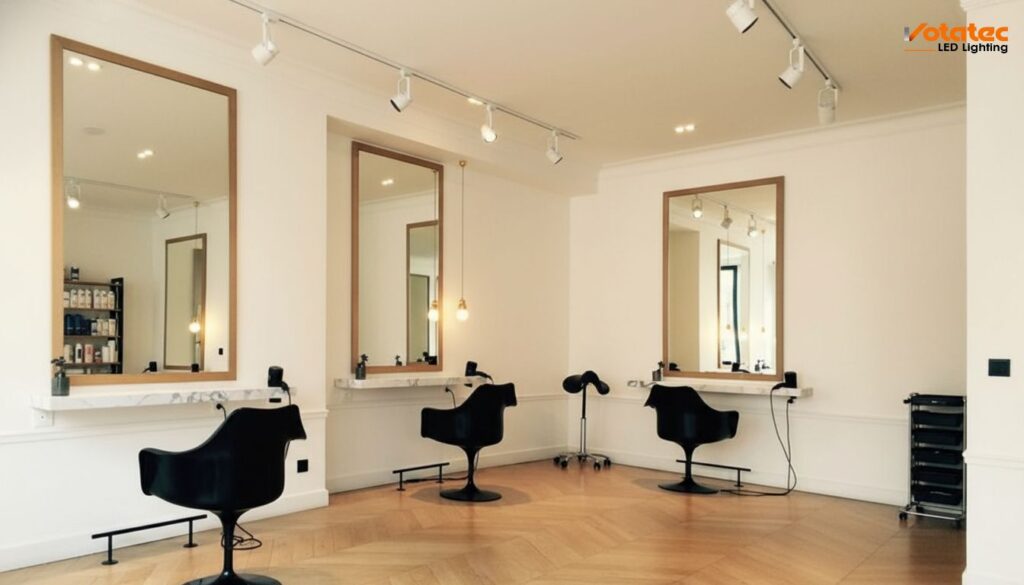
Office lighting has one job: can people read. Salon lighting has four, and they fight each other.
- Colour accuracy on hair. Toner, balayage, root smudge, copper reds. Get the light wrong and every tone reads off.
- Skin flattery at the mirror. Clients stare at their own face for 60 to 90 minutes. Bad light greys them out. They stop rebooking.
- Glare and eye fatigue. Colourists make micro-judgements all day. Glare above UGR 19 causes headaches and colour errors by hour 5.
- Zone-specific mood. The shampoo chair is spa. The retail wall is shop. One room, two jobs, one electrical plan.
A generic office LED troffer fails on all four. A salon-grade fixture package handles them together. That’s the gap this guide fills.
Colour Temperature: The First Decision
Colour temperature (measured in Kelvin, K) describes whether light looks warm (yellow), neutral (white), or cool (blue-white). For the full breakdown across all commercial applications, see our LED colour temperature guide.
2700K to 3000K: Warm white
Candlelight range. Use it in the shampoo area, lounge, and waiting seats. It signals “relax.” It hides detail, so don’t run colour work under it.
3500K to 4000K: Neutral white
Sunrise range. Safest default for the main salon floor. Skin reads even. Makeup looks close to true. Cuts and blow-dries read cleanly. Most stylists prefer 4000K at the chair.
5000K: Daylight
Noon sun. This is the colour-critical light. Reserve it for the mixing bar, and optionally one dedicated check station. At 5000K, hair dye reads the way it will read outside the door.
What to avoid
6500K “ice white” retail lamps. Too blue. Skin reads sallow, hair reads flat.
Also avoid mixing 3000K and 5000K lamps in the same sightline. A client walking from chair to reception sees her colour shift twice. She’ll blame the colourist, not the lamps.
CRI and R9: The Numbers That Actually Matter
Colour Rendering Index (CRI) scores how accurately a light shows colour vs. daylight. The scale runs 0 to 100. Office lighting sits at CRI 80. That’s fine for spreadsheets. It’s bad for hair.
Salons need CRI 90 minimum. CRI 95 or higher at colour mixing.
The hidden metric: R9
CRI 90 sounds great until you learn it’s an average of 8 colour samples (R1 to R8). Red (R9) isn’t in the average. A lamp can score CRI 92 while rendering red so weakly that copper and auburn look muddy.
Ask your supplier for the R9 value. You want R9 above 50, ideally 80 or more. A lamp with CRI 95 and R9 80+ shows warm tones the way a client will see them in daylight.
Why it bites stylists
Under CRI 80, a level 6 natural red reads as muted brown. Client books a touch-up. Drives home. The red pops in her driveway. She thinks the colourist messed up. She didn’t. The light did.
Votatec’s salon-spec LED track heads and panels ship at CRI 90+ with published R9 values. Request a spec sheet with R9 data.
Glare Control: The Missing Metric Most Guides Skip
Unified Glare Rating (UGR) scores how uncomfortable a fixture array feels to look at. The scale runs roughly 10 (invisible) to 30 (painful). Developed by the CIE in 1995, it’s now part of DLC Premium requirements.
For salons:
- UGR ≤19 at styling stations and the mixing bar (office standard)
- UGR ≤16 for colour-critical work (drafting room standard)
- UGR ≤22 acceptable in circulation areas and lounges
UGR isn’t a fixture property. It’s a calculation that depends on the fixture, its optics, and the room. Ask your lighting designer for the UGR calc before ordering. If that’s not in scope, specify fixtures with:
- Deep-cell louvers or diffuse lenses (no bare LED diodes visible)
- Beam angles that throw light on the work, not into eyes
- Recessed troffers with UGR <19 printed on the cut sheet
High glare kills your colourists by hour 5. Ignore it at your peril.
The Three-Layer Salon Lighting Formula
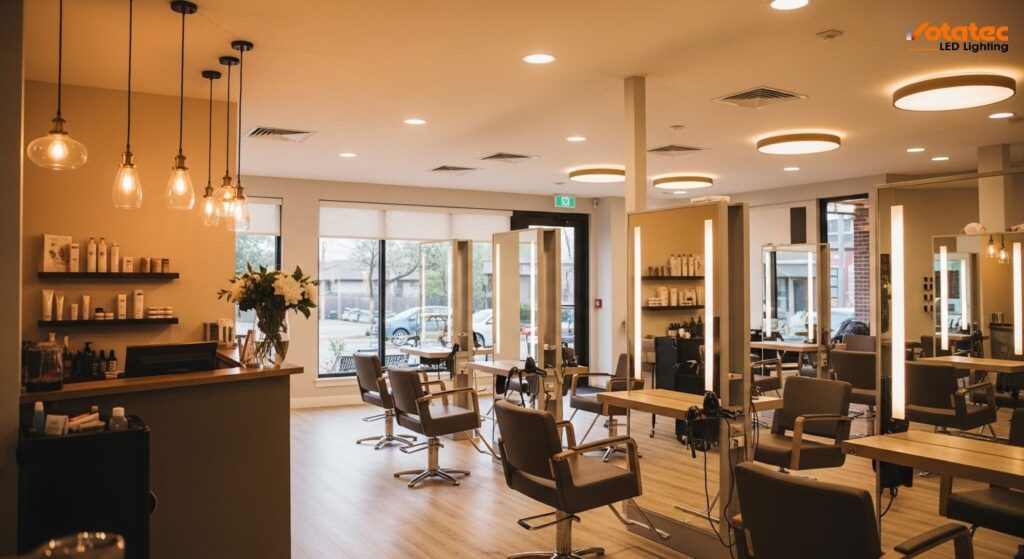
A pro salon build is never one fixture type. It’s three layers working together.
Layer 1: Ambient (general fill)
Purpose: no dark corners.
Fixtures: LED panels, recessed downlights, wide-beam track.
Spec: 3500K-4000K, CRI 90+, UGR ≤19, 400 to 500 lux at work height.
Coverage: start at 30 to 40 lumens per square foot. A 1,000-sq-ft salon needs roughly 30K to 40K lumens of ambient output.
Layer 2: Task (directional at workstations)
Purpose: kill shadows at the chair and mixing bar.
Fixtures: adjustable track heads, vanity mirror strips, pendant colour-check lamps.
Spec: 4000K at chair, 5000K at mixing, CRI 95+, UGR ≤16, 750 to 1,000 lux at the client’s face.
Placement: two track heads per chair, from both sides at 45 degrees. Erases shadow under the brow, nose, and jaw. Lights the back of the head without blinding the stylist.
Layer 3: Accent (feature light)
Purpose: draw the eye. Sell product. Set mood.
Fixtures: narrow-beam spots, wall sconces, LED strips.
Spec: 3000K for lounge, 3500K for retail, CRI 90+.
Use it on: the retail wall, logo, art, shampoo backbar, product shelves. Accent lighting is the line between salon and clinic.
Salon Layout: Zone by Zone
Walk your floor plan. Each zone needs its own recipe.
Reception and entry
First impression. Energetic but welcoming.
- Temp: 3500K-4000K
- Layers: ambient downlights + one accent spot on the brand wall
- Add: dimmer to drop entry lighting to 60% for late bookings
Waiting area
Relaxed, not sleepy. Phones are out.
- Temp: 3000K
- Layers: warm downlights, wall sconce for texture
- Avoid: direct downlights that glare on phone screens
Styling stations (the chair)
Money zone.
- Temp: 4000K
- CRI: 90+, 95+ preferred
- UGR: ≤19, ≤16 better
- Fixtures: two track heads 24 to 30 inches (60-75 cm) out from the mirror wall, angled at 45°
- Vanity strips: vertical LEDs on each side of the mirror erase under-chin shadow
- Mount height: 2.4 to 2.7 m above floor (8 to 9 ft)
- Avoid: single fixture directly overhead. Casts shadow on nose and jaw.
Colour mixing bar
Most light-critical spot in the salon.
- Temp: 5000K
- CRI: 95+ with R9 above 80
- UGR: ≤16
- Fixtures: high-CRI LED panel directly overhead, plus an optional counter colour-check lamp
- Why: a toner that reads correct at 4000K can read off at 5000K. Mixers catch it now, not at the chair.
Shampoo and wash area
Spa mood. Dim, warm, calm.
- Temp: 2700K-3000K
- Dimmer: mandatory. Drop to 20% during the wash.
- Fixtures: wide-beam recessed downlights or indirect cove lighting
- Avoid: any light shining directly into the client’s face while reclined
Retail display
Move product.
- Temp: 3500K-4000K
- CRI: 90+ (product labels must read correctly)
- Fixtures: narrow-beam track spots at 24° beam angle, 2-3 heads per 4-foot section
- Level: 2x ambient so product pops off the shelf
Back office, break room, storage
Function over form.
- Temp: 4000K
- CRI: 80+ (no colour work happens here)
- Fixtures: 2×2 LED panels, simple, cheap
Tunable White: The 2026 Upgrade Path
Tunable white fixtures change colour temperature on demand, usually across 2700K to 6500K. One fixture handles multiple zones or adapts to time of day. See the US DOE reference on color-tunable LED products for the underlying tech.
Why salons care
- One mixing bar, two modes. Run at 5000K during colour prep. Drop to 3500K for the consultation.
- Client experience. Warm mood at arrival. Neutral for cut. Cool for colour check. Warm again at the shampoo bowl.
- Circadian benefit for staff. Stylists on 10-hour shifts feel more alert under 4500K-5000K midday light and less wired under 3000K before close.
Technology options
- 2-channel standard tunable white. One warm LED chip plus one cool. Blends across 2700K-6500K. Most cost-effective. Accurate enough for salon use.
- 5-channel RGBTW. Adds red, green, blue. Renders full daylight spectrum. Premium option for boutique builds where design language matters.
- Dim-to-warm. Colour temperature drops as you dim. Mimics firelight. Best for lounge and waiting zones, not colour work.
Cost premium
Expect 40-80% higher unit cost for tunable white track heads vs. fixed 4000K. Payback comes from fewer fixture SKUs, lower renovation cost, and client experience lift. Not every salon needs it. The premium salons do.
Votatec stocks DLC-listed tunable white track heads and panels. Request the tunable white fixture catalogue.
LED Fixture Types and When to Use Each
Track lighting
The salon workhorse. Adjustable heads aim exactly where you need them.
- Use for: styling stations, retail, colour mixing
- Pick when: chairs or retail displays get rearranged over time
LED panels (troffers)
Flat, recessed, even wash.
- Use for: general ambient, back office, colour mixing room
- Pick when: you need even coverage with no hot spots
Recessed downlights
Clean ceilings, discreet light.
- Use for: waiting area, shampoo zone, reception fill
- Pick when: architecture matters and you want fixtures to disappear
Vanity LEDs (mirror strips)
Vertical strips framing each mirror.
- Use for: chair stations
- Pick when: zero under-chin shadow matters (high-end colour salons)
Linear suspended
Pendants dropped from the ceiling.
- Use for: reception bars, mixing counters, statement installs
- Pick when: design language matters and you want architectural presence
Flexible LED strips
Continuous tape in tight spots.
- Use for: mirror frames, under-counter retail, cove lighting
- Pick when: you’re hiding the source and just want the glow
Votatec supplies all six fixture types: LED track lighting, LED panels, LED downlights, vanity strips, linear suspended, and LED strips. All in salon-spec colour temperatures with DLC listings. Request wholesale pricing.
Lumens, Lux, and Light Levels
Lumens = total fixture output. Lux = light landing on a surface.
Design in lux at working height.
| Zone | Target Lux |
|---|---|
| Reception desk | 300-500 |
| Waiting area | 150-200 |
| Styling chair (client face) | 750-1,000 |
| Colour mixing bar | 1,000-1,500 |
| Shampoo (dimmed) | 50-100 |
| Retail shelves | 500-750 |
| General ambient | 300-500 |
Rough DIY check: download a lux meter app, hold your phone at client eye level in the chair. Under 500 lux there? You’re under-lit for colour work.
Controls and Dimming: Don’t Skip This
Most salon lighting failures trace back to one missing item. No dimmer.
What to specify
- 0-10V dimming drivers on shampoo and lounge zones (smoothest low-end dim)
- Wall station scene control with presets for Open, Busy, Quiet, Close
- Zone-based switching. Reception, chairs, shampoo, retail each on their own circuit
- DLC listing on drivers, required for most rebate programs
Why it matters
A salon that can’t dim the shampoo zone during a wash loses 10% of its spa feel. A salon that can’t drop retail lights after closing burns 2-3 extra hours of energy daily. Both problems cost money across a year.
What Does a Salon Lighting Upgrade Cost?
Real Canadian number: A Touch of Class in Greater Sudbury spent $2.7K on a full LED retrofit, received $1.5K back via Save on Energy, and cut $1.3K from annual power bills. Payback under one year.
For planning, here’s a rough Canadian range (CAD) for a 6-chair salon (1,200 sq ft).
| Item | Low | High |
|---|---|---|
| Track lighting (chairs + retail) | $3K | $8K |
| LED panels (ambient) | $1.5K | $4K |
| Recessed downlights | $1K | $3K |
| Vanity mirror LEDs (per chair) | $150 | $400 |
| Dimmers and scene controls | $500 | $2K |
| Labour and install | $2K | $6K |
| Project total | $8K | $23K |
Energy payback typically runs 18-36 months before rebates. With Ontario, BC, or Quebec rebate stacking, payback drops to 9-18 months.
Votatec works wholesale for electrical contractors and salon builders. Pricing depends on fixture mix, volume, and timeline. Send your fixture schedule for a line-item quote.
Canadian Rebates for Salon LED Upgrades (2026)
Programs shift yearly. Verify before ordering. Here’s the current lay of the land.
| Province | Program | Typical Coverage |
|---|---|---|
| Ontario | Save on Energy Small Business Lighting | Point-of-sale + retrofit rebates |
| British Columbia | BC Hydro CEM Hub | ~25% of upgrade + 30% bonus for apps submitted by 2026-02-12 |
| Quebec | Hydro-Québec Efficient Solutions | Up to 90% for small business, DLC-listed products only |
| Nova Scotia | Efficiency Nova Scotia Business Rebates | Prescriptive + custom |
| New Brunswick | NB Power Commercial Lighting | Prescriptive + custom |
Every major program requires DLC (DesignLights Consortium) listing. Votatec’s commercial-grade panels and track heads carry DLC listings where required. Ask for the DLC spec sheet when you quote.
How to Read a Salon Lighting Spec Sheet
You’re quoted two fixtures. Both say “LED track head, 4000K.” Prices differ by $40. Which one’s right for a salon?
Here’s what to check on the cut sheet:
- CRI: want 90+, check for Ra and R9 separately
- R9: want 50+, ideally 80+
- UGR: want ≤19, published for typical room
- Colour temperature tolerance: want ±150K (looser = visible variation chair to chair)
- LM-80 / L70 rating: want L70 at 50,000 hours or more
- TM-30 Rf and Rg: newer metric; Rf above 90 and Rg near 100 is excellent
- DLC listing: required for most Canadian rebates
- Dimming compatibility: 0-10V or TRIAC, check against driver
Skip any cut sheet that doesn’t publish these numbers. Legit manufacturers share them.
Common Salon Lighting Mistakes
1. One colour temperature everywhere
Running 4000K in shampoo turns the spa into a kitchen. Zone your temps.
2. Skipping CRI on the spec
Ordering fixtures by wattage and price alone. CRI 80 lamps at the chair turn every blonde brassy.
3. Overhead only, no side fill
Single ceiling fixture over each chair. Shadow under brow, shadow under jaw. Clients look 5 years older. Add side fill or vanity LEDs.
4. Forgetting the dimmer
Shampoo hard-wired at 100%. You can’t drop the mood for the wash. Spec 0-10V drivers on shampoo and lounge.
5. Ignoring UGR / glare
Colourists working under UGR 25+ fixtures get headaches by hour 5 and make more colour errors. Specify UGR ≤19 minimum.
6. Aged fluorescents “because they work”
T8 fluorescents drop CRI as they age. A 2-year-old T8 can render copper tones 15% off true. Retrofit them.
7. No L70 or LM-80 spec
All LEDs dim over life. Spec L70 at 50,000 hours minimum. Means the fixture still gives 70% of original output at 50K hours. Cheap fixtures drop below 70% by year 3.
FAQ
What is the best colour temperature for a hair salon?
4000K at the styling chair and 5000K at the colour mixing bar. Use 2700K to 3000K for the shampoo area and lounge. This three-tier approach gives accurate colour evaluation where stylists need it, and relaxing mood where clients want it.
What CRI do I need for salon lighting?
CRI 90 minimum. CRI 95 or higher at the colour mixing bar. Ask the supplier for the R9 value too. R9 above 50 is required; above 80 is ideal for rendering reds, coppers, and warm tones accurately.
What is UGR and does it matter for salons?
UGR (Unified Glare Rating) scores how uncomfortable a fixture array feels to look at. Specify UGR ≤19 at styling stations and ≤16 at the colour mixing bar. Stylists working under high-glare fixtures report headaches and make more colour errors by hour 5 of their shift.
How many lumens per square foot for a hair salon?
Start at 30 to 40 lumens per square foot of ambient light. Add task lighting at each chair to reach 750 to 1,000 lux at the client’s face. Retail shelves should sit at 2x ambient level.
Are LED track lights better than panels for salons?
They serve different layers. Track lights give directional, adjustable task light at chairs and retail. Panels give even ambient fill overhead. Most salons use both. Track heads solve shadows; panels solve dark corners.
Is tunable white worth it for a salon?
Yes for premium salons. Tunable white lets one fixture handle multiple modes (consultation warm, colour-check cool, shampoo dim-warm). It costs 40-80% more per fixture but cuts total SKU count and boosts client experience. Skip it on budget builds where fixed 4000K and 5000K fixtures work fine.
Can I get a rebate for a salon LED upgrade in Canada?
Yes in most provinces. Save on Energy (Ontario), BC Hydro, Hydro-Québec, Efficiency Nova Scotia, and NB Power all offer commercial lighting rebates. Coverage ranges from 25% (BC) to 90% (Quebec small business). A real example: A Touch of Class salon in Sudbury received $1.5K on a $2.7K upgrade through Save on Energy, with $1.3K annual savings on power.
How long do salon LED fixtures last?
Commercial-grade LED fixtures rated L70 at 50,000 hours give roughly 17 years of life at 8 hours per day. Cheap fixtures drop to 70% output much faster and shift colour over time, which kills salon colour accuracy.
Your Spec-Ready Checklist
Before you buy, check every box:
- Layout drawn, zones marked (reception, chairs, mixing, shampoo, retail)
- Colour temperature assigned per zone
- CRI 90+ everywhere colour gets evaluated, 95+ at mixing
- R9 value requested from supplier
- UGR ≤19 specified, ≤16 at mixing
- Three layers planned (ambient + task + accent)
- Dimmers on shampoo and lounge
- Scene control at reception
- L70 at 50,000 hours minimum
- DLC listing confirmed for rebate eligibility
- Tunable white evaluated (premium builds)
- Quote requested with line-item fixture schedule
Votatec supplies Canadian salon projects with LED panels, track systems, downlights, vanity strips, and accent fixtures at wholesale. We ship from stock across Ontario, British Columbia, and Quebec. DLC-listed options on every core fixture family.
Get a salon lighting quote from Votatec. Send your floor plan and chair count. We’ll return a spec-ready fixture schedule with rebate-eligible SKUs.