










 (+1) 905 597 5955


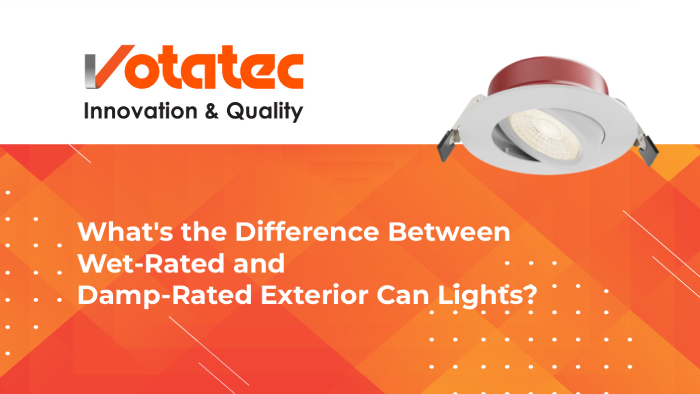

Here’s the short version: wet-rated exterior can lights handle direct water exposure – open soffits, exposed canopies, rain-soaked building entrances. Damp-rated exterior can lights handle ambient moisture only – covered patios, sheltered loading docks, enclosed carports.
Install a damp-rated fixture where a wet-rated one belongs and you’re looking at premature failure, a voided warranty, and a Canadian Electrical Code violation.
This distinction matters more in Canada than most buyers realise. Wide temperature swings, freeze-thaw cycles, and heavy snowmelt expose every gap in a fixture’s rating. Getting it wrong costs far more than getting it right the first time.
What Do These Ratings Actually Mean?
The terms “wet-rated” and “damp-rated” come from the National Electrical Code (NEC) and Canada’s counterpart, the Canadian Electrical Code (CEC), Section 30, Rules 30-316 to 30-322, which define permitted luminaire types for each location type.
Damp location: An area protected from direct water contact but subject to humidity, condensation, or occasional light splashes. Covered porches, sheltered soffits, and enclosed parking structures all qualify.
Wet location: Any area subject to direct water exposure – rain, snow, sprinklers, or water jets. This is where you need wet-rated LED exterior can lights. No exceptions.
A wet-rated fixture can go anywhere a damp-rated one can. The reverse is not true. A damp-rated fixture in a wet location will corrode, fail, and in some cases create a safety hazard.
The rule is simple. Know your location type before you spec the fixture.
Where Do You Need Exterior Can Lights? Wet vs Damp Locations Explained
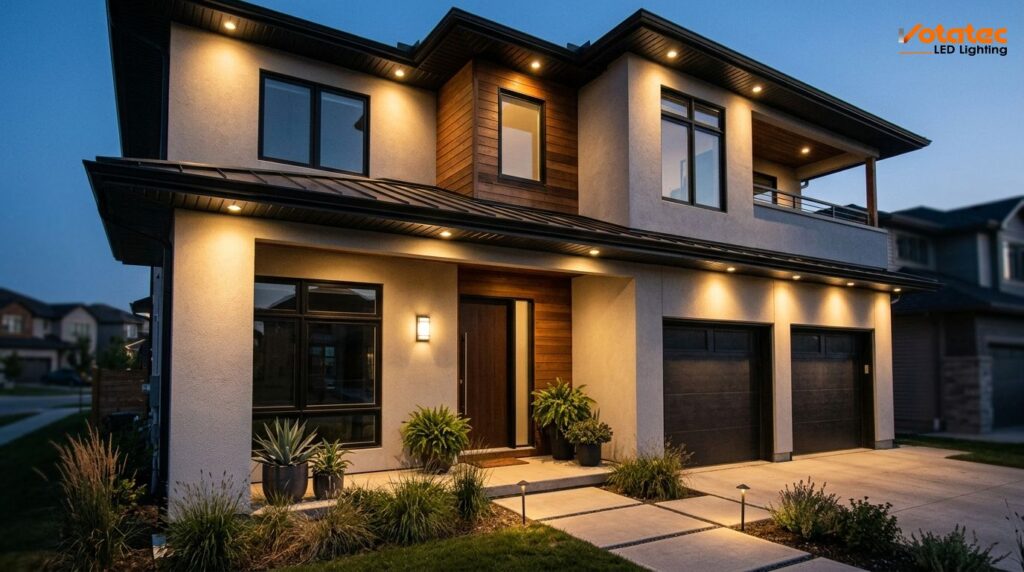
Matching the rating to the location is where most facilities teams trip up. Here’s a practical breakdown for exterior can lighting projects across commercial and institutional buildings.
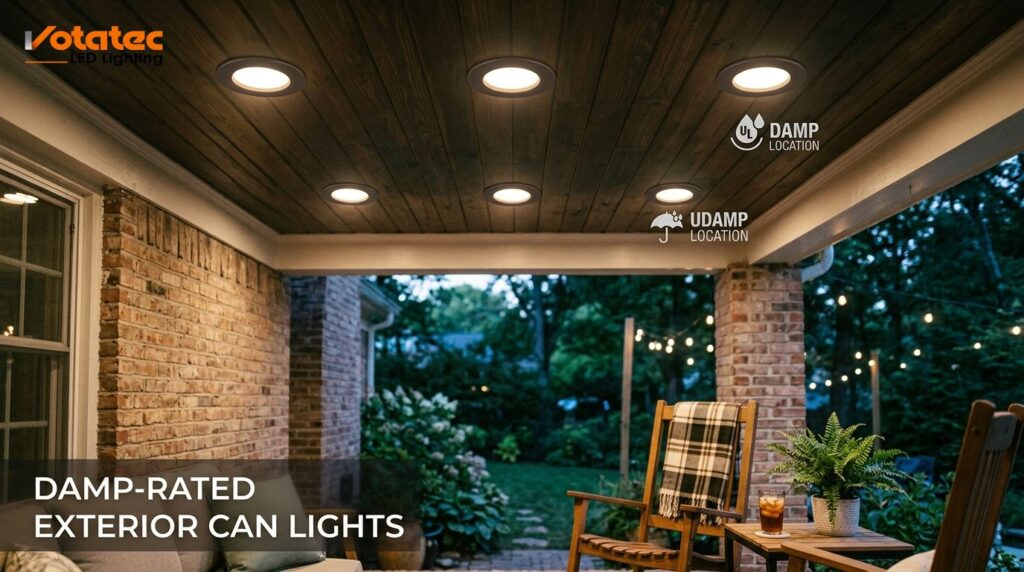
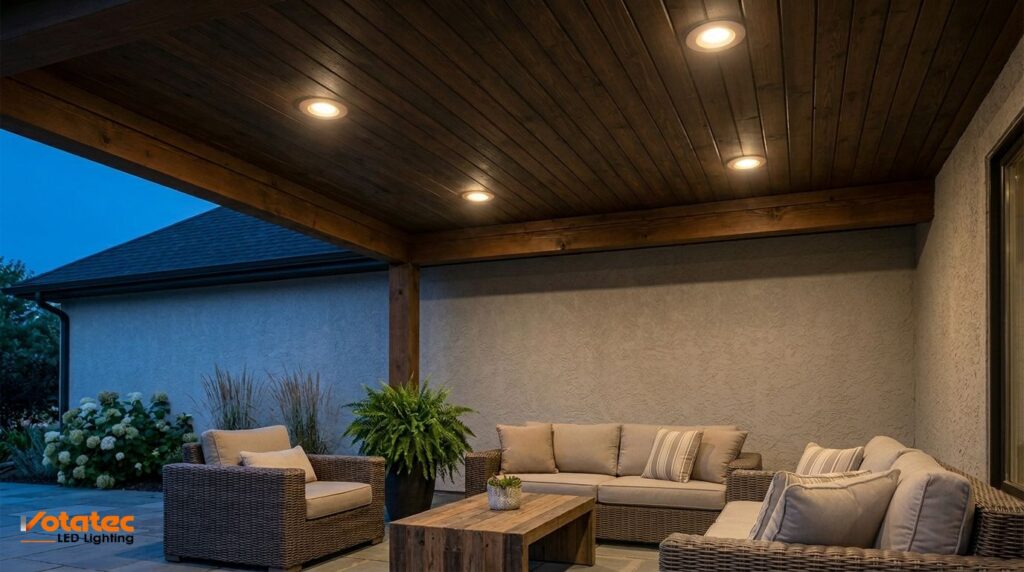
Damp-Rated Exterior Can Lights Are Right For:
- Covered parking garage soffits where the ceiling is enclosed and rain doesn’t reach the fixture directly
- Loading dock ceilings with a full roof overhead and walls on at least two sides
- Enclosed carports and porte-cocheres where the fixture sits well back from the open edge
- Colonnade or covered walkway ceilings where the fixture is shielded from lateral rain
- Recessed soffit lights under a generous overhang – typically at least 60 cm of protection from the drip line
Wet-Rated Exterior Can Lights Are Required For:
- Open soffits on building exteriors where rain or blowing snow can reach the fixture
- Gas station and commercial entry canopies with no walls – wind-driven rain counts as direct exposure
- Partially sheltered soffits near the edge of an overhang where splash or wind can reach the fixture
- Outdoor ceiling fixtures under open pergolas or uncovered structures
- Any location where sprinklers, pressure washing, or water runoff can contact the fixture
When in doubt, go wet-rated. The cost difference between damp and wet-rated exterior can lights is minimal compared to a warranty dispute or a failed inspection.
What Are IP Ratings and How Do They Relate?
The wet/damp classification is a North American code-based label. IP (Ingress Protection) ratings follow the international IEC 60529 standard and give you a more precise picture of what a fixture can handle. You’ll see both on spec sheets for outdoor recessed lights Canada-wide, and knowing how they map together saves you from spec errors.
| IP Rating | Dust Protection | Water Protection | Typical Application |
|---|---|---|---|
| IP44 | Protected from objects >1 mm | Protected from water splashes from any direction | Damp-rated minimum |
| IP54 | Dust partial protection | Splash-resistant from any direction | Covered canopies near traffic |
| IP65 | Fully dust-tight | Protected from low-pressure water jets | Wet-rated standard for exterior soffits |
| IP67 | Fully dust-tight | Protected from temporary immersion (1 m / 30 min) | High-pressure wash areas |
For Canadian commercial projects:
- IP44 minimum for damp-rated applications in enclosed or well-covered locations
- IP65 minimum for wet-rated exterior can lighting – the standard for building soffits, canopies, and entrances exposed to weather
- IP67 for locations subject to pressure washing, heavy snowmelt drainage, or standing water
Canadian winters add a factor most spec sheets don’t mention: freeze-thaw cycling. Water that seeps into a sub-rated fixture during a warm spell can freeze, expand, and crack the housing. An IP65-rated aluminium housing with a sealed gasket survives this. An IP44 fixture in the same location often doesn’t last two winters.
What’s the Most Common Mistake Facilities Teams Make With Exterior Can Lighting?
Installing damp-rated can lights in a location that technically qualifies as wet. It’s more common than you’d think, and the pattern usually looks like this:
- The architect spec calls for exterior recessed fixtures
- The purchasing team sources the lowest-cost option that ships quickly
- Nobody checks whether the listed fixture is wet-rated or damp-rated
- The fixtures fail within 18-24 months – discolouration, flickering, water ingress into the driver
- The manufacturer won’t cover it because the fixture was installed outside its rated location
The fix isn’t complicated. Before ordering any exterior can lights, confirm two things on the spec sheet:
- The location rating (wet or damp) – often listed under “installation” or “certifications”
- The IP rating – match it to the table above for your specific application
If the spec sheet doesn’t list an IP rating or location type, don’t buy it for any exterior application.
One other situation catches facilities teams off guard: a covered soffit that sits right at the drip line of a roof. Even with overhead protection, wind-driven rain in Vancouver or blowing snow in Calgary can hit that fixture at a near-horizontal angle. Damp-rated won’t cut it. Treat anything within 60 cm of the drip line as a wet location, and spec accordingly.
Does the Canadian Electrical Code Require Wet-Rated Fixtures?
Yes. CEC Part I, Section 30, Rules 30-316 through 30-322 specify that fixtures installed in damp or wet locations must be listed and marked for those locations. “Listed” means certified by a recognised Canadian testing organisation – typically CSA Group or ETL Listed with a Canadian mark (cETL or cUL).
Key compliance points for facility managers and contractors procuring exterior can lighting:
- The fixture must carry a cUL, cETLus, or CSA mark for the correct location type
- “Wet-rated” or “suitable for wet locations” must appear on the fixture label or in the certification documentation
- A US-only UL listing (without the “c” prefix) is not sufficient for CEC compliance in Canada
- Inspectors in Ontario, BC, and Quebec have been increasingly rigorous about this distinction on commercial and institutional projects
When sourcing LED exterior can lights for a commercial retrofit or new build, ask your supplier for the Canadian certification documentation. A reputable supplier provides this as a standard part of the product package. If they can’t produce it quickly, that’s a signal to look elsewhere.
How Does the Rating Affect LED Rebate Eligibility in Canada?
Most provincial rebate programs require that exterior LED can lights meet specific performance standards. Getting the location rating wrong can disqualify your project, even if the fixture itself is DLC-listed.
Ontario’s Save on Energy Retrofit Program and Instant Discounts Program require fixtures to be DLC (DesignLights Consortium) Premium or Energy Star certified. DLC listings specify the installation environment – an exterior LED can light listed under DLC for “outdoor” use must match the wet or damp classification required for its installation location.
What this means in practice:
- A damp-rated fixture installed in a wet location may not be eligible for the rebate even if it carries a DLC listing
- The rebate application requires proof that the fixture is installed as intended – inspectors can flag a location mismatch
- BC’s FortisBC commercial lighting rebate and Hydro-Québec’s Efficient Solutions program follow similar standards
The right approach: specify the correct wet or damp rating at the start of the project, confirm the DLC or Energy Star certification, and keep all documentation. Ontario rebates can cover up to 50% of eligible project costs – it’s worth getting the paperwork right from day one.
How to Choose the Right Exterior LED Can Lights for Your Project
A five-step process that works for both new installations and retrofits.
Step 1: Classify each fixture location
Walk the site. For every proposed exterior can light location, ask: “Can rain, snow, or water from any direction reach this fixture?” If yes, it’s a wet location. If it’s truly sheltered on all sides, it’s damp.
Step 2: Apply the 60 cm overhang rule
A rule of thumb used by lighting engineers: if the fixture is within 60 cm of the drip line of the roof or overhang, treat it as a wet location. This catches the partial-shelter edge cases that cause most failures.
Step 3: Match IP rating to environment
Use IP65 for standard exterior wet locations. Upgrade to IP67 for loading docks where pressure washing is routine, or areas with heavy freeze-thaw water drainage.
Step 4: Confirm the Canadian certification mark
Look for cUL, cETLus, or CSA with the correct location type on the product label. This is non-negotiable for CEC compliance and rebate eligibility.
Step 5: Verify DLC or Energy Star listing
If you’re targeting provincial rebates, confirm the LED exterior can lights appear on the current DLC Qualified Products List or carry the Energy Star Canada mark. Check the DLC Qualified Products List at designlights.org using the exact model number before ordering.
Frequently Asked Questions
Can I use a wet-rated exterior can light in a damp location?
Yes. A wet-rated fixture exceeds the requirements for a damp location and is always a safe substitution. The reverse – using a damp-rated fixture in a wet location – is a code violation and a reliability risk.
What IP rating do I need for exterior can lighting under a building soffit in Canada?
IP65 is the standard minimum for exterior soffits that may be exposed to wind-driven rain or blowing snow. For soffits that are fully enclosed and protected on all sides, IP44 may be sufficient, but most Canadian lighting specifiers default to IP65 for all exterior can lighting to account for climate variability across the country.
Do exterior LED can lights need to be IC-rated as well as wet-rated?
IC (insulation contact) rating applies when the fixture is installed in a ceiling that has insulation above it. Exterior soffits often have insulation in the roof assembly above them. If your installation contacts insulation, you need a fixture rated both IC and wet (or damp) for the location. Confirm this with your electrical contractor before ordering.
Will using the wrong rating void my lighting warranty?
In almost every case, yes. Manufacturers specify the permitted installation environments in their warranty terms. A damp-rated fixture installed in a wet location is typically excluded from warranty coverage for moisture-related failures – and that’s before you factor in any CEC compliance issues.
How do I know if my existing exterior can lights are correctly rated?
Check the fixture label or the original product specification sheet. Look for the words “wet location” or “damp location” and the IP rating. If neither appears on the label, treat the fixture as dry-location only – it’s not suitable for any exterior application. A licensed electrician can verify compliance during a site inspection.
Are there rebates for upgrading to LED exterior can lights in Ontario and BC?
Yes. Ontario’s Save on Energy Retrofit Program covers exterior lighting upgrades with rebates that can reach 50% of eligible project costs. FortisBC in BC offers commercial lighting rebates for qualifying LED products. Both programs require DLC Premium or Energy Star certification. Contact Votatec for a list of qualifying LED exterior can lights with current Canadian certification documentation.
The Bottom Line
Wet-rated and damp-rated aren’t just labels. They’re a safety classification, a code requirement, and a rebate eligibility factor rolled into one.
For most Canadian commercial and institutional applications, IP65 wet-rated exterior LED can lights are the right choice. They handle our climate, satisfy the CEC, and qualify for the provincial rebates that make LED retrofits cost-effective.
If you’re planning an exterior can lighting project and want to confirm the right fixture type for your specific locations, Votatec’s team works with facility managers and contractors across Canada. We’ll match you with the right wet or damp-rated LED exterior can lights, provide full Canadian certification documentation, and identify available rebates in your province.