










 (+1) 905 597 5955



The right stair wall light depends on four things: the building type, expected foot traffic, Canadian code requirements, and the aesthetic standard you need to maintain. Get any one of those wrong and you’re either replacing fixtures in two years or fielding complaints from a condo board.
This guide covers everything you need to know before specifying wall mounted stair lights for a multi-storey commercial or residential building, including stair wall lighting ideas by building type and a plain-language overview of installation requirements.
Why Stair Wall Lights Do More Work Than Any Other Fixture
Stairwells are among the highest-risk areas in any building. Slips and falls on stairs account for a significant share of building liability claims across Canada. Poor lighting is one of the leading contributing factors.
But a stair wall light isn’t only a safety issue. In a condo or hotel, the stairwell is part of the first impression. Guests and residents notice it. A dim, flickering fluorescent signals neglect. A well-chosen wall mounted stair light signals quality and care.
In an office tower, stairwells double as evacuation routes. The fixtures you choose need to perform under normal conditions and when the power goes out.
That’s a lot to ask from one fixture. Here’s how to choose it correctly.
Condos, Hotels, and Office Towers: What Each Building Needs
These three building types share a need for wall-mounted stair lighting, but the priorities are different.
| Factor | Condo | Hotel | Office Tower |
|---|---|---|---|
| Aesthetic priority | High – residents see it daily | Very high – brand impression | Moderate – functional, professional |
| Foot traffic | Low to moderate | Moderate to high (events) | High (shift changes, fire drills) |
| Colour temperature | 2700K-3000K (warm, residential feel) | 2700K-3000K (welcoming) | 3500K-4000K (neutral, alert) |
| Emergency backup | Required | Required | Required |
| Finish priority | Matches lobby and corridor palette | Matches hotel brand standard | Durable, clean, consistent |
| Sensor priority | Moderate – saves on hydro | Low to moderate | High – high traffic justifies dimming |
The overlap is that all three building types need DLC-listed LED fixtures, emergency battery backup in the stairwell, and a minimum 50 lux average at tread level per the National Building Code of Canada.
Stair Wall Lighting Ideas by Building Type
Before you pick a fixture, it helps to know what approach other buildings in your category are using. These stair wall lighting ideas aren’t just about aesthetics. Each one also addresses a functional requirement.
Condos: Warm Layered Light
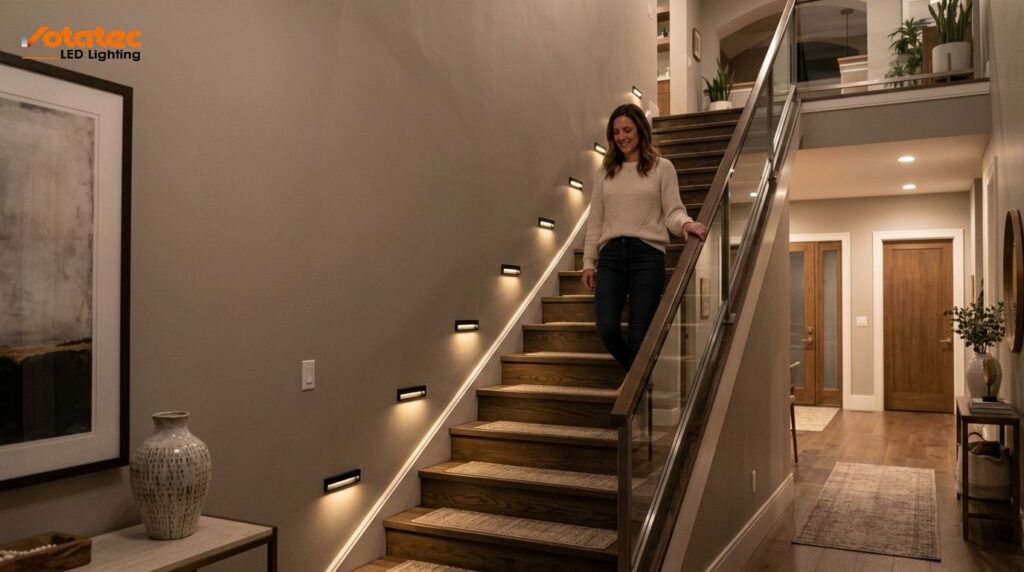
For condo stairwells, the goal is a warm, continuous glow that feels like an extension of the corridor, not a utility space. A common approach is combining upper wall sconces on each landing with low-level step lights recessed into the wall at tread height. The sconces handle code compliance at 50 lux average. The step lights add depth and reduce shadowing at the nosing edge, where most slip-and-fall incidents happen.
Finish the fixtures in the same material as your corridor hardware, brushed nickel if your building is modern, warm bronze if it’s heritage or transitional.
Hotels: Consistent Signature Look
Hotels typically run one fixture model across the entire property to maintain visual consistency. For stairwells, a slim wall-mounted sconce in a finish that matches the corridor wall brackets is the standard approach. Mid-scale hotel brands use matte black with a 3000K warm white lamp. Luxury properties often specify CRI 90+ to ensure skin tones and finishes look their best even in egress areas.
Don’t underestimate the stairwell. For a guest using the stairs instead of the lift, that’s the experience they carry with them.
Office Towers: Clean and Code-Forward
Office tower stairwells are functional spaces. The priority is reliable illumination at 4000K neutral white, occupancy sensors with a 15-minute timeout, and integrated emergency battery backup in every fixture. Wall-wrap LED units with wattage-selectable drivers are common here because they let the facilities team adjust light output if future building reconfigurations change the stairwell dimensions.
Some newer Class A towers are specifying architectural sconces even in service stairwells as part of tenant attraction strategy. If your building competes on design, that’s worth considering.
What Types of Wall Mounted Stair Light Are Available?
Not all wall mounted stair lights are the same. You’ve got four main categories.
1. Wall Sconces (Decorative or Architectural)
A wall sconce sits flush or semi-flush on the wall and provides up-light, down-light, or both. It’s the standard stair wall light for any building where aesthetics matter. These come in a wide range of finishes and can be matched to corridor fixtures, making them the most versatile category for condos and hotels.
2. Wall-Wrap LED Fixtures (Commercial Utility)
A wall-wrap is a simple rectangular LED fixture that mounts directly to the wall. It’s not a design statement, but it’s extremely effective in utilitarian stairwells. Most wall-wrap units are available with integrated emergency battery backup, and many are CCT-selectable and wattage-selectable, giving facilities teams flexibility on a single SKU.
Best for office towers, industrial buildings, and service stairwells.
3. Recessed Step Lights (Tread-Level)
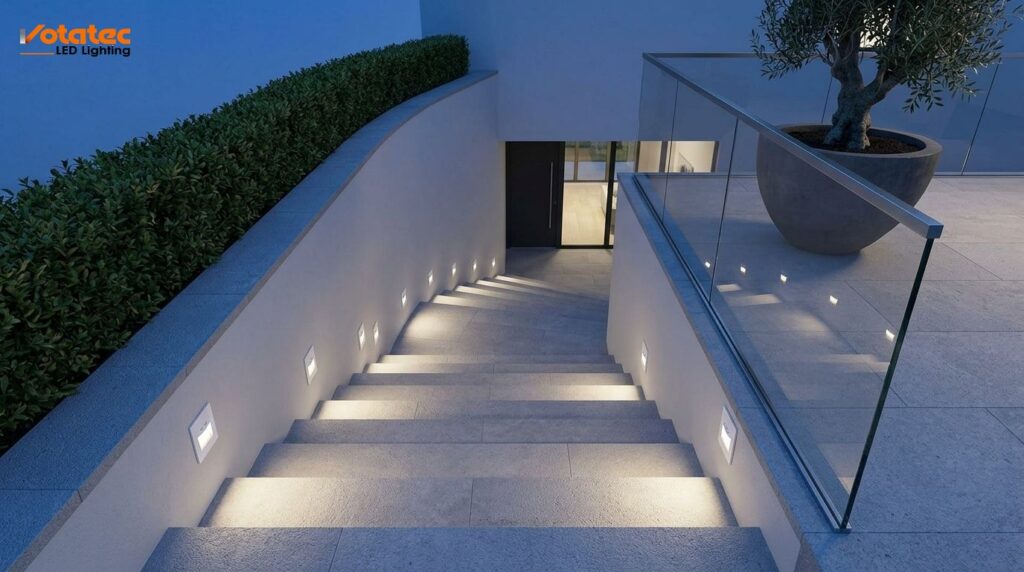
Small, low-profile fixtures installed into the wall at tread level. They cast light directly onto each step rather than illuminating the overall space. They don’t replace upper-wall or ceiling fixtures but supplement them for a layered look.
Best for high-end condos and hotels as a design element. Not appropriate as a primary light source.
4. Emergency Combo Units
These are dual-purpose: they function as a normal LED fixture during daily operation and switch to battery-powered emergency mode during a power outage. They’re the most practical choice for any code-compliant stairwell and can be found in both wall-wrap and sconce styles.
Any multi-storey commercial stairwell in Canada should have emergency combo units.
What Specs Actually Matter When Buying Stair Wall Lights?
These are the numbers that determine whether a stair wall light is right for your stairwell.
Lumen Output and Lux Levels
Under the National Building Code of Canada and the Ontario Building Code, stairwells must provide:
- Average 50 lux at floor and tread level
- Minimum 10 lux at any single point (lower bound)
For a typical stairwell with a 2.5-metre ceiling height, a single 1,000-lumen wall-mounted fixture per landing is usually enough. Wider or taller stairwells need more. Measure the square footage of your landings, not just the treads, when calculating fixture placement.
Colour Temperature (CCT)
- 2700K-3000K: Warm white. Right for condos and hotels.
- 3500K: Neutral warm. A good middle ground for mixed-use buildings.
- 4000K: Neutral white. Standard for office towers and institutional buildings.
Many commercial LED stair wall lights now come CCT-selectable, meaning you can set the colour temperature in the field. That’s a smart buy if you’re specifying across multiple properties.
Colour Rendering Index (CRI)
CRI measures how accurately a fixture renders colour compared to natural light. The scale runs from 0 to 100.
- Minimum acceptable for commercial stairwells: CRI 70
- Recommended for condos and hotels: CRI 80+
- Premium hotel lobbies and high-end condos: CRI 90+
Higher CRI means occupants can see step edges, hazards, and signage more clearly. It’s a direct safety factor.
IP Rating
For indoor stairwells, IP20 or IP44 is standard. For stairwells that connect to parkades or exterior doors where humidity and condensation are factors, specify IP44 or IP65.
Voltage Range
Specify fixtures rated for 120V-277V where possible. This gives you flexibility across building electrical systems without needing transformers.
DLC Listing
DesignLights Consortium (DLC) listing is required for rebate eligibility under most Canadian utility programmes, including Ontario’s SaveOnEnergy programme. Always confirm DLC Premium status if rebates are part of your ROI calculation.
Do Your Stair Wall Lights Have to Meet Code in Canada?
Yes. And the requirements aren’t optional.
Under the National Building Code of Canada and provincial codes including the Ontario Building Code:
- Stairwells must be lit to an average of 50 lux at floor level
- Minimum illumination at any point must not fall below 10 lux
- If stairs span more than six treads, light switches are required at both the top and bottom landing (except where remote, central, or automatic controls are provided)
- Emergency lighting must activate within 10 seconds of a power failure
- Emergency backup must maintain at least 1 foot-candle (10.8 lux) for a minimum of 90 minutes
For building permit compliance and insurance purposes, use fixtures that are CSA-certified or cUL-listed for Canada. That’s non-negotiable.
Accessibility note: Accessibility Standards Canada recommends 50 lux as the minimum for accessible design, which aligns with the NBC floor average requirement. If you’re targeting AODA compliance in Ontario, that’s already built into the base code requirement.
How to Install Stair Wall Lighting?
Installing wall mounted stair lights in a commercial building is a licensed electrician job in every Canadian province. That said, knowing the installation requirements helps you specify the right product and brief your contractor properly.
Here’s what a standard installation involves.
Confirm mounting height
Wall mounted stair lights are typically installed at 1.5 to 1.8 metres above the tread on the landing wall. Too low and they create glare in people’s eyes. Too high and they lose effectiveness at tread level. For sloped stairwells, confirm the fixture’s beam angle to verify coverage before finalising the mounting point.Check the rough-in box
Most stair wall lights require a standard electrical box, either a 4-inch octagon box or a single-gang. If you’re retrofitting older fluorescent fixtures, check whether the existing rough-in is compatible with the new LED unit’s mounting bracket before ordering.Wire for the right voltage
Most commercial wall mounted stair light fixtures are rated for 120V-277V and will accept either voltage. Confirm with your electrical team whether the stairwell circuit is 120V or 277V so they can select the correct driver tap.Connect emergency backup where required
If your fixture includes an integrated emergency battery, the backup unit will have a separate testing function, usually a test button or a remote test port. Your electrician will need to wire this and confirm the battery holds charge during commissioning. Emergency units must be tested at installation and at regular intervals per the Ontario Fire Code and local authority requirements.Set CCT and wattage (if selectable)
Many modern stair wall lights include a small selector switch inside the fixture housing before the lens is installed. Set the colour temperature and wattage before closing up. This is the one step that gets skipped most often during busy retrofit jobs and it’s much harder to fix after the fact.Test and document
After installation, test every fixture under normal operating conditions. Then simulate a power failure and confirm emergency mode activates within 10 seconds and maintains the required lux level. Log the test date for your building records.
Should Your Stair Wall Lighting Include Occupancy Sensors?
In most office towers, yes. In condos and hotels, it depends.
Occupancy sensors can cut stairwell lighting energy consumption by 50-70% by dimming to 10-20% when unoccupied and ramping to full output when motion is detected.
There are two caveats for stairwells used as egress routes:
- The sensor controller must be set for fail-safe operation, meaning if the sensor fails, the light stays on, not off.
- Timer duration must be set for a minimum of 15 minutes to prevent lights from going out while someone is still in the stairwell.
PIR (passive infrared) sensors work well in straight stairwells. For multi-flight stairs where line of sight is blocked between floors, microwave sensors are more reliable because they can detect motion through walls and floors.
For condos: sensors are less common but increasingly popular as part of green building certifications like LEED and BOMA Best.
Finishes, Aesthetics, and Getting the Details Right
In condos and hotels, the wrong finish is as bad as the wrong fixture. Your stair wall light should tie into the broader interior palette, not fight it.
Common finishes and where they work:
| Finish | Best Fit |
|---|---|
| Matte black | Modern condo, boutique hotel, contemporary office |
| Brushed nickel / satin nickel | Mid-range condo, business hotel, corporate office |
| Warm bronze / antique brass | Heritage building, luxury hotel, traditional condo |
| White powder coat | Institutional, healthcare, municipal stairwells |
| Satin aluminium | Contemporary office tower, new construction |
5 Common Mistakes When Choosing Stair Wall Lights
1. Choosing decorative fixtures without checking for emergency battery backup
A beautiful wall sconce that doesn’t have an emergency function is not code-compliant for a stairwell. Check the spec sheet before specifying.
2. Under-specifying lumens for tall stairwells
A 1,000-lumen fixture is fine at 2.5 metres. At 4 metres, you’ll fall short of the 50-lux average. Use a photometric calculation for anything above standard floor-to-ceiling height.
3. Specifying residential fixtures in commercial stairwells
Residential fixtures aren’t rated for the duty cycle of a commercial building. They’ll fail faster and void your warranty. Always specify commercial-grade.
4. Ignoring IP rating in parkade-connected stairwells
If your stairwell has any connection to underground parking or exterior access, humidity is a factor. IP20 is not enough. Go to IP44 minimum.
5. Forgetting to confirm DLC listing before purchasing
If there’s a utility rebate available and your fixture isn’t DLC-listed, you’ve left money on the table. In Ontario, SaveOnEnergy rebates can cover a meaningful portion of a stairwell retrofit project cost.
Frequently Asked Questions
What is the minimum light level required in a stairwell in Canada?
The National Building Code of Canada requires an average of 50 lux at floor and tread level in stairwells, with a minimum floor value of 10 lux. Emergency backup lighting must maintain at least 10.8 lux for 90 minutes after a power failure. Ontario’s Building Code aligns with these requirements.
Do stair wall lights need emergency battery backup in Canadian commercial buildings?
Yes. Any stairwell that is part of a building’s means of egress must have emergency lighting. Emergency backup must activate within 10 seconds of a power outage and remain operational for at least 90 minutes. Integrated emergency battery units are the most common solution for wall-mounted stair fixtures.
What colour temperature is best for condo and hotel stairwells?
2700K to 3000K is the standard for condos and hotels. This warm white range feels residential and welcoming. Office towers typically use 4000K for better visual alertness during work hours.
Can I use occupancy sensors in a stairwell that’s a fire exit?
Yes, but with conditions. The sensor controller must be fail-safe (defaults to on, not off), and the timer must be set to a minimum of 15 minutes per the National Building Code. Microwave sensors are recommended for multi-flight stairwells where line of sight is blocked between levels.
How long do LED stair wall lights last?
Commercial-grade LED stair wall lights are typically rated at 50,000+ hours. At 8 hours per day of operation, that’s over 17 years. Most commercial buildings see a payback period of 12 to 36 months on LED stairwell retrofits when factoring in energy savings and maintenance cost reductions.
What IP rating do I need for an indoor stairwell?
For a standard heated indoor stairwell, IP20 is sufficient. For stairwells adjacent to parkades, exterior entry points, or areas with elevated humidity, IP44 is the appropriate minimum. Outdoor stair lighting or fixtures exposed to direct moisture require IP65 or higher.
Choosing the Right Stair Wall Lights: Quick Summary
Stair wall lights are one of the most overlooked fixtures in a commercial or multi-residential building, and one of the most consequential. They affect liability, first impressions, energy costs, and code compliance at the same time.
For condos and hotels: prioritise aesthetics, CRI 80+, warm CCT (2700-3000K), and a finish that matches your corridor palette. Don’t forget emergency backup.
For office towers: prioritise neutral CCT (3500-4000K), occupancy sensors with fail-safe controllers, commercial-grade durability, and DLC listing for rebate eligibility.
If you’re specifying wall mounted stair lights for a Canadian multi-storey building and want to make sure you get the fixture selection right before placing an order, contact Votatec for a project consultation.