










 (+1) 905 597 5955


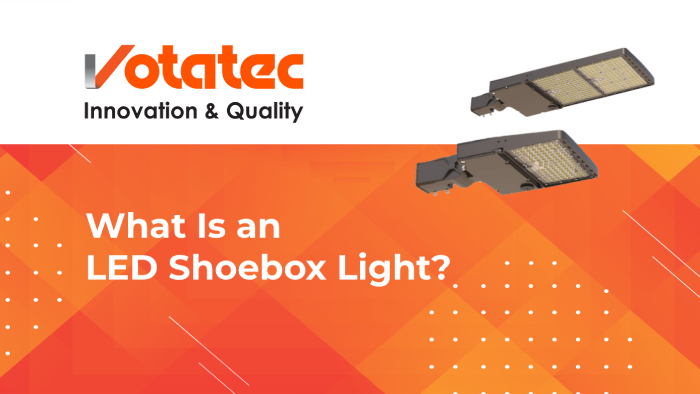

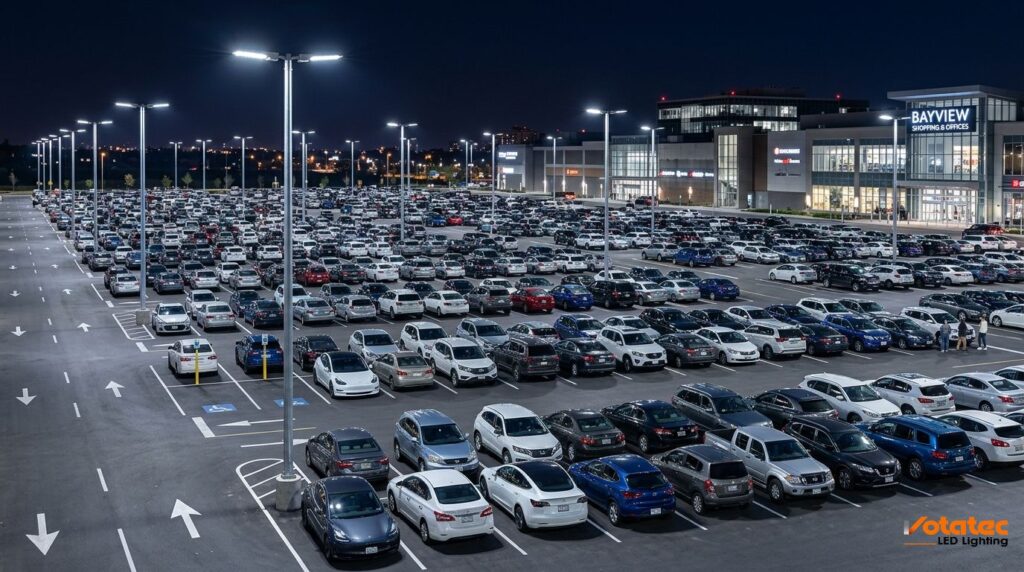
An LED shoebox light is a flat, rectangular outdoor fixture that mounts on a pole or a wall and pushes light down over a wide area. Parking lots, mostly. It gets the name from its shape. Looks like a shoebox.
You’ve seen thousands of them. Every plaza, every big-box lot, every car dealership uses them. They replaced the old metal halide and high-pressure sodium fixtures that buzzed, flickered, and turned everything orange.
Here’s the short version. A shoebox light covers a lot of ground from up high, uses about 75% less energy than the HID gear it replaces, and lasts 50,000+ hours. That’s the whole pitch. The rest of this guide covers wattages, real uses, and how to pick the right one for your site.
What Does a Shoebox Light Actually Do?
It lights big horizontal spaces from a pole. That’s the job.
Think about the geometry of a parking lot. You’ve got a wide, flat surface and a handful of poles spaced across it. Each fixture needs to throw light sideways and down, evenly, so there are no dark gaps between poles. A shoebox does that with a directional optic that spreads light in a controlled pattern.
Compare that to a flood light, which aims a tight beam at a wall or sign. Different tool, different job. Shoebox lights are built for area coverage, not spotlighting.
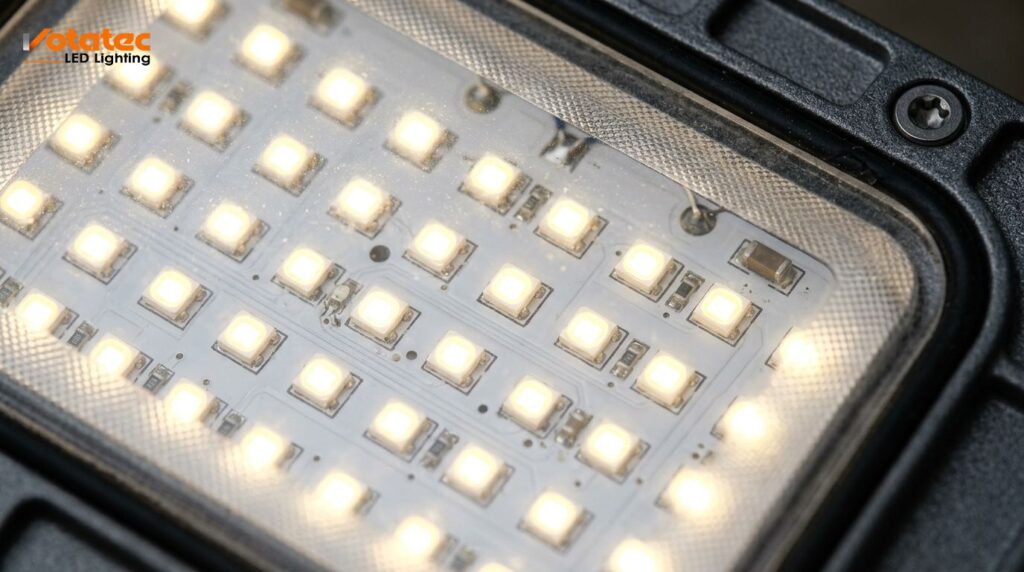
Most quality fixtures today run 140 to 170 lumens per watt. Anything under 130 is older LED tech, and you’ll pay for it on the hydro bill. The minimum efficacy for a DLC-qualified parking lot luminaire is 85 lumens per watt, so the good fixtures clear that bar by a wide margin (DesignLights Consortium).
Where Do Shoebox Lights Fit?
Anywhere you need even light over a wide outdoor space. Here’s where they show up most:
- Parking lots – the classic use, rows of poles across the lot
- Car dealerships – high light levels to show inventory at night
- Distribution and logistics yards – trailer staging, loading areas
- Service yards and depots – municipal fleet, transit, utility yards
- Campuses and recreation complexes – walkways, sports parking, public lots
- Roadways and access lanes – with the right optic distribution
Notice the pattern. Big, open, horizontal. If you’re lighting a wall or a building face instead, you’d look at flood lights or canopy fixtures. For an indoor warehouse or shop ceiling, that’s high bay territory.
So the question isn’t just “which shoebox.” It’s “is a shoebox even the right fixture.” For outdoor area lighting on poles? Almost always yes.
LED Shoebox Light Wattages: A Quick Map
This is where most people get stuck. They see 60W next to 1200W and freeze. Don’t.
The wattage you need depends on pole height, pole spacing, and how bright the surface has to be. Higher poles and wider spacing need more output. A 15-foot pole over a small lot is a different animal than a 30-foot pole over a big-box lot.
Here’s a rough map of where each range lands:
| LED Wattage | Replaces (Metal Halide) | Typical Pole Height | Common Use |
|---|---|---|---|
| 40W to 100W | 175W to 320W MH | 10 to 15 ft | Small lots, side parking, walkways |
| 100W to 200W | 320W to 400W MH | 15 to 25 ft | Medium lots, dealerships, yards |
| 200W to 400W | 750W to 1000W MH | 25 ft and up | Large lots, logistics, wide spacing |
A few real anchors from the field: a 100W LED is a solid swap for a 250 to 320W metal halide and puts out around 14,000 lumens. A 150W LED handles most 400W MH jobs. A 300W LED hits roughly 39,000 to 45,000 lumens and replaces a 1000W metal halide on a tall pole.
Votatec stocks area light wattages from 60W up to 1200W, so the full range is covered for small retail strips through to large industrial yards.
One Mistake to Avoid
Don’t match old wattage to new wattage. Ever.
A 1000W metal halide does not need a 1000W LED. It needs maybe 300W of LED to do the same job, often better. Matching wattage one-to-one is the most expensive error in a retrofit. You’d be paying for light you don’t need and blowing the energy savings that justify the project.
Pick by delivered lumens, mounting height, pole spacing, optic distribution, voltage, and your target foot-candle level. Not by the number printed on the old fixture.
How Do You Choose the Right Shoebox Light?
Five things decide it. Run through these and the spec falls out on its own.
- Mounting height – how tall is the pole? Taller poles need more lumens to reach the ground.
- Pole spacing – how far apart are the poles? Wider gaps need wider optics or more output.
- Optic distribution (Type II, III, IV, V) – this shapes where the light lands. Type III is the parking lot workhorse. Type V throws light in all directions for open areas.
- Voltage – most fixtures run 100V to 277V or 277V to 480V. Match your site’s supply.
- Colour temperature (CCT) – 4000K is warm-neutral and easy on the eyes. 5000K is crisp and bright, popular for security. 3000K is warmer, used where light pollution rules apply.
Get those five right and the fixture practically picks itself. Get them wrong and you end up with dark spots, glare complaints, or a re-order. Worth slowing down for.
Not sure about distribution type or pole spacing? That’s normal. Send us your site layout and pole heights, and we’ll spec the fixtures and wattages for you before you buy.
How Do Shoebox Lights Mount?
The fixture is only half the order. How it attaches to the pole or wall matters just as much, and it’s where a lot of jobs get tripped up.
Four mounts cover almost every install:
- Slip fitter – slides over a standard 2 3/8-inch pole tenon and tilts to aim. The go-to for most parking lot poles because it adjusts both horizontally and vertically. If you’re not sure, this is usually the one.
- Arm mount (direct) – bolts straight to the side of a pole or wall with a clean, fixed look. Rigid, so no aiming after it’s up.
- Trunnion / yoke – a U-bracket on the bottom of the fixture that bolts to a flat surface or pole. The most flexible for odd angles, but it needs a solid pole or facade behind it.
- Wall bracket – mounts the fixture flat against a building. Handy when you want shoebox-level output near an entrance or loading dock without a pole.
Then there’s the control side. Most fixtures take a photocell for automatic dusk-to-dawn switching, and many support a motion sensor so the light dims down when the lot’s empty and ramps up when a vehicle pulls in. Both cut run-time energy on top of the LED savings.
One tip: confirm your existing poles use the standard 2 3/8-inch tenon before you order slip-fit fixtures. Older poles vary. A quick check now saves a return later.
Why Switch From Metal Halide or HPS?
Because the old gear costs you money every single night. Here’s the math.
Metal halide and high-pressure sodium fixtures waste roughly a third of their energy as heat instead of light. LED cuts the energy draw by about 75% for the same brightness, sometimes more (Natural Resources Canada). On a yard with 40 fixtures running every night, that adds up fast.
Then there’s maintenance. Metal halide lamps fade and die around 15,000 hours, and replacing one means a bucket truck, a lift fee, and labour. LED shoebox lights run 50,000+ hours. Set them and forget them for years.
And the light is just better. No warm-up. No flicker. No orange tint that makes your security cameras useless. LED hits full brightness the instant it’s switched on, with a colour quality that actually shows detail.
Bottom line: lower bills, fewer truck rolls, better light. The payback usually lands inside two to three years.
Are There Rebates in Canada?
Often, yes. And they can cover a real chunk of the project.
Most Canadian utility programs require the fixture to be DLC-listed to qualify. Over 90% of DLC member utilities make DLC listing a condition for rebate eligibility (DesignLights Consortium). So before you buy, check that the shoebox you’re spec’ing is on the DLC Qualified Products List.
In Ontario, the Save on Energy programs offer incentives for commercial LED upgrades, including parking and lot lighting (Save on Energy). BC, Quebec, and Alberta run their own programs through their utilities. The amounts and rules change year to year, so always check the current program before you commit.
The takeaway for buyers: DLC-qualified fixtures aren’t just a quality signal. They’re your ticket to the rebate. Votatec’s area lights are spec’d with this in mind.
Shoebox Light vs Other Outdoor Fixtures
People mix these up all the time. Quick clear-up:
- Shoebox vs flood light – shoebox spreads light over a wide area from a pole; a flood light aims a beam at a target like a wall or sign.
- Shoebox vs wall pack – a shoebox sits on a pole over open ground; a wall-mounted fixture lights the area right around a building entrance or perimeter.
- Shoebox vs high bay – a shoebox is outdoor area lighting; a high bay lights tall indoor ceilings in warehouses and shops.
Same idea throughout: pick the fixture built for the space. A shoebox is the answer for outdoor, pole-mounted, wide-area light. Nothing else does that job as cleanly.
Frequently Asked Questions
What size shoebox light do I need for a parking lot?
It depends on pole height and spacing, not lot size alone. As a rough guide, 100W to 150W LED fits 15 to 25-foot poles on medium lots, and 200W to 400W fits 25-foot-plus poles on large lots. Send your pole heights and a site layout for an exact spec.
What metal halide wattage does an LED shoebox replace?
A 100W LED replaces a 250 to 320W metal halide, a 150W LED replaces a 400W MH, and a 300W LED replaces a 1000W MH. Always confirm by delivered lumens and your target light level, not by matching wattage one-to-one.
What colour temperature is best for a parking lot shoebox light?
5000K is the most common for parking lots and security because it’s crisp and bright. 4000K is a softer neutral white that many sites prefer for comfort. 3000K is used where dark-sky or light-pollution rules apply.
Do LED shoebox lights qualify for Canadian utility rebates?
Most do, as long as they’re DLC-listed. Over 90% of Canadian utility programs require DLC qualification for rebate eligibility. Check the current program in your province and confirm the fixture is on the DLC list before you buy.
How long do LED shoebox lights last?
Quality fixtures are rated for 50,000+ hours. At typical dusk-to-dawn run times, that’s well over a decade before you’d think about replacement, compared to roughly 15,000 hours for metal halide.
The Bottom Line
An LED shoebox light is the standard fixture for lighting outdoor areas from a pole. Parking lots, dealerships, yards, campuses. It cuts energy use by about 75%, lasts 50,000+ hours, and often qualifies for a utility rebate when it’s DLC-listed.
The one thing to get right is the spec. Pick by pole height, spacing, optic distribution, voltage, and colour temperature, not by the wattage on your old metal halide.
Need shoebox lights for a project across Canada? Votatec is a Canadian wholesale supplier serving electrical contractors, facility managers, and procurement teams. Browse the LED area light range, or request a wholesale quote and we’ll spec the right fixtures and wattages for your site.