













 (+1) 905 597 5955



Picking the right LED lighting distributor in Canada comes down to eight things: certifications (CSA and DLC), rebate program support, in-stock product depth, wholesale pricing terms, Canadian warehouse lead times, warranty coverage, real technical support, and a track record you can check. Get those right and the rest of the job gets easier.
Get them wrong? You’re back on site swapping failed fixtures, eating callback labour, and explaining to the client why the utility rebate never showed up.
We work with electrical contractors and facility teams across the country every week. The same buying mistakes come up again and again. So this guide breaks down exactly what to compare when you’re vetting any LED lighting distributor Canada has to offer, whether you order direct or through the electrical wholesale channel
What Makes a Good LED Lighting Distributor in Canada?
A good LED lighting distributor in Canada is a supplier that stocks CSA-certified, DLC-listed fixtures in Canadian warehouses, sells at transparent wholesale pricing, backs products with a real warranty, and helps you win utility rebates. That’s the short version.
The longer version matters more on a bid. Contractors don’t just buy fixtures. You buy delivery dates, spec support, rebate paperwork, and someone who picks up the phone when a shipment is short. A distributor who nails the product but botches the lead time can still blow your schedule.
Here’s the thing about the Canadian market. It’s big and it’s growing. The LED lighting and fixtures segment sits around CAD $4.2 to $4.8 billion for 2026 and keeps climbing at roughly 7 to 9% a year, per market research from Grand View Research. More money means more suppliers chasing your order. More choice is good. It also means more noise, more thin catalogues, and more grey-market product to sort through.
Why Your Choice of LED Light Distributor Matters on the Job
Think about what a bad fixture actually costs you. Not the sticker price. The total cost.
Say you install 80 high bays in a warehouse. Six months later, a handful start flickering. Now you’re renting a lift again, pulling a crew off another site, and driving across the GTA to warranty a product the distributor won’t stand behind. That’s real money. On labour alone, one return trip can run $200 to $400 before you’ve touched a single fixture.
A solid LED light distributor kills that risk three ways:
- Product that lasts. Quality LED fixtures are rated for 50,000+ hours. Cheap ones fade, shift colour, and fail early.
- Rebate money you’d otherwise leave on the table. DLC-listed product unlocks utility incentives worth thousands per project.
- Backup when something goes sideways. A distributor with Canadian stock and a real warranty makes a failed fixture a phone call, not a crisis.
So the distributor decision isn’t a purchasing detail. It’s a risk decision. And it follows you for the life of the install.
The 8 Things Contractors Should Compare
Here’s the core of it. When you line up two or three LED lighting distributors side by side, score them on these eight factors. Weight them for your own business. A rebate-heavy retrofit shop cares more about incentive support than a new-construction crew does.
1. Certifications and Compliance (CSA, DLC, Energy Star)
Start here. In Canada, electrical product needs a recognised safety certification to be legal to install. CSA Group certification is the one most inspectors expect, though other accredited marks (cUL, cETL) are accepted too. No mark, no install. Simple.
Then there’s performance certification. The DesignLights Consortium runs the Qualified Products List (QPL) that most utility rebate programs check against. If a fixture isn’t DLC-listed, it usually can’t earn a rebate.
Watch the version. DLC’s SSL V6.0 became the active standard on January 5, 2026, and V5.1 product is scheduled to delist on December 15, 2026. Translation for contractors: a fixture that qualifies for a rebate today might not next year. Ask your LED lighting distributor which DLC version their stock is listed under. It’s a fair question, and a good distributor answers it without hesitating.
For general-service bulbs, there’s also federal efficacy law. Under Natural Resources Canada’s energy efficiency regulations, most A-shape LED bulbs sold in Canada now have to hit at least 100 lumens per watt. You can read the current rules straight from Natural Resources Canada. Any legitimate led light bulb distributor already meets this. If they can’t confirm it, walk.
2. Rebate Program Support
This is where distributors quietly separate themselves. Anyone can sell you a box. Fewer will help you claim the incentive.
Provincial programs like Ontario’s Save on Energy and BC Hydro’s Power Smart hand out real money for qualifying LED retrofits, sometimes covering a big chunk of project cost. But the paperwork trips people up. You need DLC listing numbers, spec sheets, and sometimes pre-approval before the work starts.
A strong LED lighting distributor Canada contractors actually trust will give you the QPL numbers up front, flag which products qualify, and sometimes help package the application. Ask directly: “Can you give me the DLC IDs and spec sheets for the rebate?” The answer tells you a lot.
3. Product Range and Availability
A deep catalogue matters, but in-stock matters more. A distributor can list 4,000 SKUs and still leave you waiting six weeks for the one you need.
Ask what they actually keep on the shelf in Canada versus what they drop-ship from overseas. For most jobs you want a supplier who carries the workhorses in stock:
- Troffers and panels
- UFO and linear high bay fixtures
- Wall packs and area lights
- Downlights and pot lights
- Retrofit bulbs and tubes
- Controls and drivers
If you run greenhouse or indoor-ag work, you’ll also want to know whether they act as an led grow light distributor, since horticultural fixtures are a different spec class entirely. More on specialty categories below.
4. Pricing and Wholesale Terms
Wholesale means wholesale. You want tiered pricing that rewards volume, clear account terms, and quotes that don’t expire before you can bid the job.
Be careful with prices that look too good. In LED, cheap usually means one of a few things: no real warranty, no DLC listing, overstated lumen output, or grey-market stock with no Canadian support. The led light wholesale distributors worth using are transparent about what’s driving the number.
Good questions to ask:
- Are these prices before or after rebate?
- What are the volume break points?
- How long is a quote valid?
- Are there account terms, or is it pay-on-order?
5. Lead Times and Canadian Warehousing
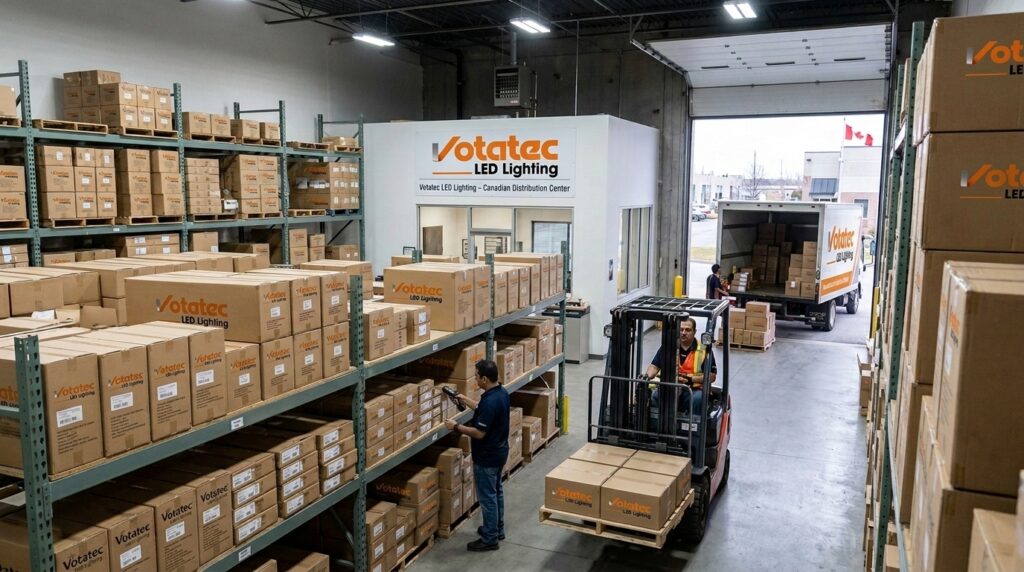
Warehouse location is everything for schedule. A distributor shipping from a Toronto, Vancouver, or Montreal facility can get product to your site in days. One shipping from overseas measures lead time in weeks, plus customs risk.
Ask where their Canadian warehouses are and what “in stock” really means. Also ask about backorder policy. When a popular SKU runs dry, does the distributor tell you straight, or do you find out when the shipment doesn’t arrive?
6. Warranty and Returns
Read the warranty. Actually read it. A “5-year warranty” is only as good as the company standing behind it and the process for claiming it.
Look for:
- Length: 5 years is common for commercial LED; some quality lines go longer.
- Coverage: Does it include the driver? Drivers fail more often than the LEDs themselves.
- Process: Advance replacement, or do you ship the dead unit back and wait?
- Who honours it: A Canadian distributor, or a factory on another continent?
A distributor with local stock can usually cross-ship a replacement fast. That’s the difference between a five-minute fix and a stalled project.
7. Technical Support and Spec Help
On a tricky job, spec support is worth as much as the product. Photometric layouts, lumen calculations, colour temperature matching, dimming compatibility. This is where an experienced distributor earns their keep.
Test it before you commit. Send a real question. Ask for a photometric layout on a sample space, or ask which driver pairs with a specific 0-10V dimmer. How fast and how sharp the answer comes back tells you whether there’s an actual lighting person on the other end or just an order-taker.
8. Reputation and Track Record
Last, do the homework. Google the distributor. Check reviews. Ask other contractors in your network who they buy from and who burned them.
Look for signs of a company that’s been around: consistent product lines, real project references, industry association membership, and a physical Canadian presence. Fly-by-night led lights distributors show up cheap and vanish when the warranty claims start. A stable supplier is boring in the best way.
Direct Distributor vs Electrical Wholesale Channel
Not every distributor sells the same way. Some sell direct to contractors. Others sell only through electrical wholesale counters. Both models work. They just fit different businesses.
| Factor | Direct-to-contractor distributor | Electrical wholesale channel |
|---|---|---|
| Account setup | Usually fast; open an account and order | Needs an established wholesale account |
| Pricing | Factory-direct, often tighter margins | Marked up through the counter |
| Product range | Focused catalogue, deep stock | Broad, brand-mixed inventory |
| Spec support | Direct from the source | Depends on the counter staff |
| Best for | Retrofit shops, volume buyers, spec jobs | Contractors already tied to a supply house |
If you don’t have a wholesale account set up yet, direct sellers are usually faster to onboard. If you already run everything through one supply house, adding a direct LED lighting distributor for specialty product can still save real money on the bigger fixture orders.
Want a head start on shortlisting suppliers? Our team keeps a running rundown of the best Canadian LED lighting wholesalers for contractors that’s worth a look before you start calling around.
Specialty Categories to Ask About
General fixtures are the bulk of most orders. But the specialty stuff is where a lot of contractors get stuck, because not every distributor really stocks it. Ask up front.
UFO LED High Bay Light Distributor
Warehouses, gyms, arenas, big-box retail. These spaces run on high bays, and the round “UFO” style dominates for good reason: compact, efficient, easy to mount. A proper ufo led high bay light distributor carries a full range of UFO high bay fixtures (say 100W through 240W), multiple mounting options, and DLC-listed models so the retrofit qualifies for rebates. If a supplier only offers one or two SKUs here, they’re not really in the high bay business.
LED Grow Light Distributors
Indoor agriculture is booming in Canada, and horticultural lighting is its own world. Spectrum, PPFD, and photoperiod control matter more than plain lumens. If you’re bidding greenhouse or vertical-farm work, confirm the supplier actually functions as an led grow light distributor with purpose-built horticultural fixtures. General commercial led grow lights distributor claims don’t always hold up. Ask for the spectrum charts. A serious led grow lights distributor will have them ready.
LED Light Bulbs Wholesale Distributors
Sometimes you just need volume on the basics. Retrofit lamps, tubes, and screw-in replacements by the case. The led light bulbs wholesale distributors worth keeping on speed dial stock CSA-certified, NRCan-compliant wholesale LED bulbs in bulk with pricing that scales. Whether you call them led light bulb distributors or led light wholesale distributors, the test is the same: real stock, real certification, real wholesale pricing.
Red Flags to Watch For
A few warning signs come up over and over when contractors get burned. Watch for these when comparing LED lighting distributors:
- No CSA or accredited safety mark. Non-negotiable. Don’t install uncertified product.
- Vague on DLC version. If they can’t tell you whether stock is V5.1 or V6.0 listed, your rebate is at risk.
- Prices way below everyone else. Usually hides a missing warranty or grey-market stock.
- No Canadian warehouse. Long lead times and customs headaches follow.
- Warranty that lives offshore. A claim process across an ocean is a claim process you’ll never finish.
- No spec support. If nobody there can read a photometric layout, you’re on your own when a job gets complicated.
Honestly, the DLC one catches even experienced buyers. With the V5.1 delisting deadline hitting in December 2026, older stock can look like a bargain right up until the rebate gets denied.
A Simple Checklist for Vetting an LED Lighting Distributor in Canada
Run any supplier through this before you place a big order. Copy it, print it, whatever works.
- Certification: CSA (or cUL/cETL) marked? DLC-listed, and on which version?
- Rebate: Will they hand over DLC IDs and spec sheets for the utility application?
- Stock: What’s actually in a Canadian warehouse right now?
- Pricing: Tiered wholesale terms? Quote valid long enough to bid?
- Lead time: Shipping from where, and how fast to your site?
- Warranty: How many years, does it cover the driver, and who honours it?
- Support: Can they produce a photometric layout on request?
- Reputation: Reviews, references, and years in business check out?
Score each supplier out of 8. The one that clears the most, wins. If two tie, go with whoever answered your spec question fastest. That’s usually the one who’ll still pick up the phone in year three.
What We’ve Learned Comparing LED Lighting Distributors
After years of shipping product to contractors across the country, a few patterns hold up no matter the province or the project.
The first: the cheapest LED lighting distributor in Canada almost never wins the total-cost math. We’ve watched contractors save 15% on the purchase order and lose it three times over on callbacks, denied rebates, and lift rentals. Price is one line on a longer bill.
The second: certification questions separate the pros from the pretenders fast. When a buyer opens with “which DLC version is this listed under,” we know they’ve been burned before. And they’ve learned. The best LED lighting distributors expect that question and answer it in seconds, with the QPL number ready.
The third pattern is about stock honesty. Plenty of led light distributor websites show a green “in stock” badge that means “in stock at the factory overseas.” The distributors worth keeping tell you the truth about lead times, even when the truth is inconvenient. That candour is rare, and it’s worth more than a slightly lower quote.
One more thing we see constantly: contractors who build a short bench of two or three trusted LED lighting distributors sleep better than the ones chasing the lowest price every job. When your main supplier runs short on a Friday, having a backup you’ve already vetted turns a schedule crisis into a quick call.
So when you compare LED lighting distributors in Canada, think past the current order. You’re not buying fixtures for one job. You’re picking a supplier you’ll lean on for the next dozen. The certification, the rebate help, the Canadian stock, the warranty someone actually honours: those are the things that still matter when the invoice is long forgotten.
Frequently Asked Questions
How do I choose the best LED lighting distributor in Canada?
Compare distributors on eight points: safety certification (CSA), DLC listing for rebates, in-stock product depth, transparent wholesale pricing, Canadian warehouse lead times, warranty terms, technical support, and reputation. Score two or three suppliers against those factors and weight them for your type of work. A retrofit shop should prioritise rebate support; a new-construction crew should prioritise stock and lead time.
What certifications should a Canadian LED light distributor have?
At minimum, products need a recognised safety mark such as CSA (cUL and cETL are also accepted) to be legal to install in Canada. For utility rebates, fixtures should be DLC-listed on the current Qualified Products List. General-service bulbs must also meet Natural Resources Canada efficacy rules, now at least 100 lumens per watt for most A-shape lamps.
Do LED lighting distributors help with utility rebates?
The good ones do. Strong distributors provide the DLC listing numbers and spec sheets you need for programs like Ontario’s Save on Energy or BC Hydro Power Smart, and some help package the application. Always ask up front, because not every led light wholesale distributor offers this, and a missed rebate can cost thousands on a single project.
Should contractors buy direct or through an electrical wholesaler?
It depends on your setup. Direct-to-contractor distributors are usually faster to onboard and offer tighter, factory-direct pricing, which suits retrofit shops and volume buyers. The electrical wholesale channel makes sense if you already run everything through one supply house. Many contractors use both: the wholesaler for daily materials and a direct LED lighting distributor for bigger or specialty fixture orders.
Where can I find a UFO LED high bay light distributor in Canada?
Look for a distributor that stocks a full wattage range of DLC-listed UFO high bays in a Canadian warehouse, with multiple mounting options. High bays are common enough that any serious commercial supplier should carry deep stock. If a supplier only lists one or two high bay SKUs, keep looking, since that signals a thin catalogue rather than a true ufo led high bay light distributor.
Bottom Line
The right LED lighting distributor in Canada saves you callbacks, wins your clients rebate money, and keeps projects on schedule. The wrong one costs you all three. So don’t shortcut the comparison.
Quick recap of what to weigh:
- Certification first: CSA for safety, DLC for rebates, NRCan compliance for bulbs.
- Rebate and spec support: the two services that separate real distributors from box-movers.
- Canadian stock and warranty: speed and backup when something fails.
- Reputation: years in business and references you can actually call.
Run every supplier through the 8-point checklist above. Then pick the one that scores highest on the factors that matter most to your business.
Comparing LED lighting distributors for an upcoming project? Request a wholesale quote from Votatec and put our certifications, stock, and rebate support to the test.