










 (+1) 905 597 5955



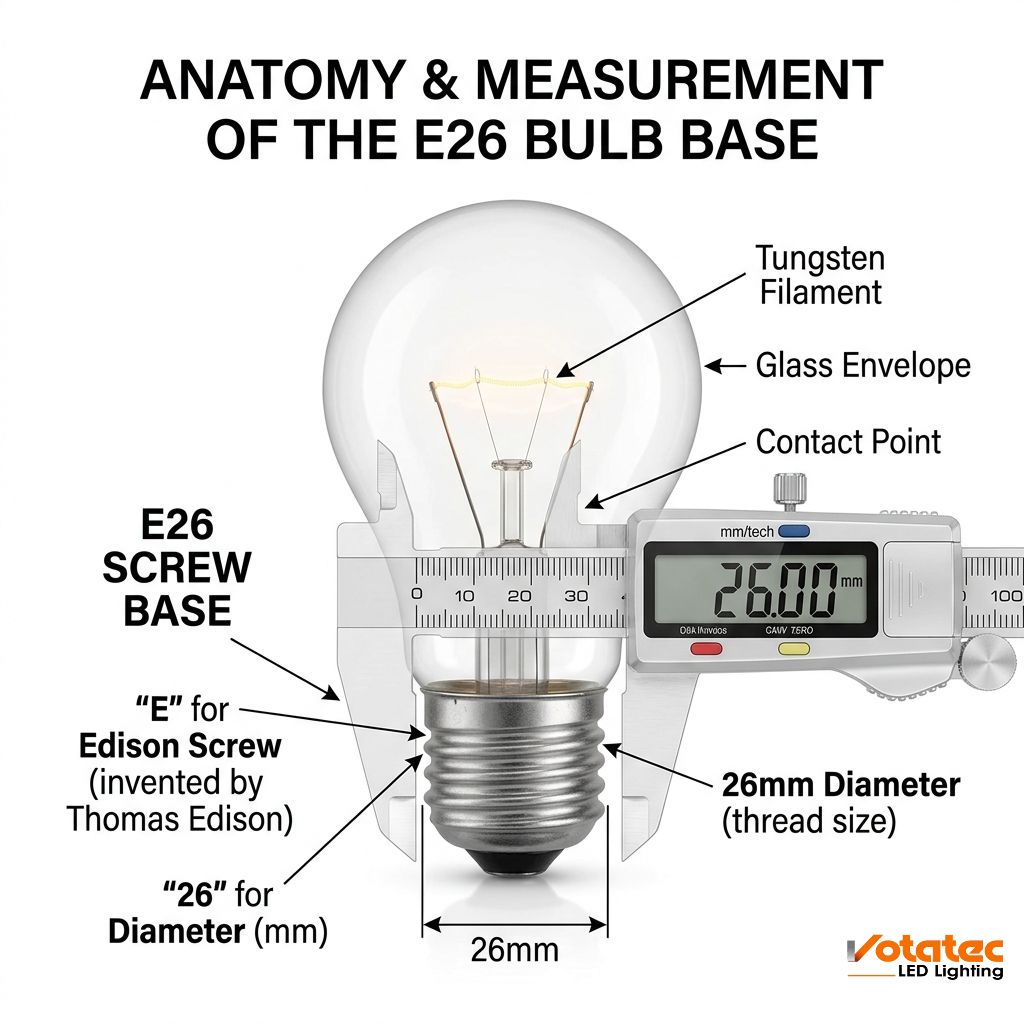
An E26 bulb is any bulb with a 26mm Edison screw base, the standard medium socket used across Canada and North America. The “E” stands for Edison. The “26” is the base diameter in millimetres. That’s it. It describes the part that screws into the socket, not the shape of the bulb itself.
So when someone hands you a fixture and says “it takes an E26,” they’re talking about the threads, not the glass.
Here’s why that distinction matters. You can buy an E26 bulb shaped like a classic pear, a round globe, a flood, or a vintage filament. Same base, totally different bulbs. Get the base right and it screws in. Get the lumens and colour right and it actually works for the space.
This guide covers the base spec, how E26 compares to E27 and A19, wattage-to-LED swaps, and where E26 fits in commercial and institutional buildings. Let’s get into it.
What does E26 actually mean?
Break the code apart and it’s simple.
- E = Edison screw. The screw-in threaded base Thomas Edison’s design made standard.
- 26 = 26 millimetres. The outside diameter of the base, roughly 1 inch.
You’ll also see it called the Medium Edison Screw, or MES. Same thing. It runs on 120 volts, which is exactly what Canadian and US buildings supply at the wall.
The base handles two jobs at once. It holds the bulb in place mechanically, and it carries the electrical contact. Screw it in, and you’ve got both a physical grip and a live circuit. Pretty clever for a design that’s over a century old.
One thing to keep straight: E26 says nothing about brightness, colour, or shape. A 5W LED and a 100W-equivalent flood can both wear an E26 base. The base just tells you it’ll fit the socket.
E26 vs A19: base versus shape
This trips up a lot of buyers. People treat E26 and A19 like they’re competing options. They’re not.
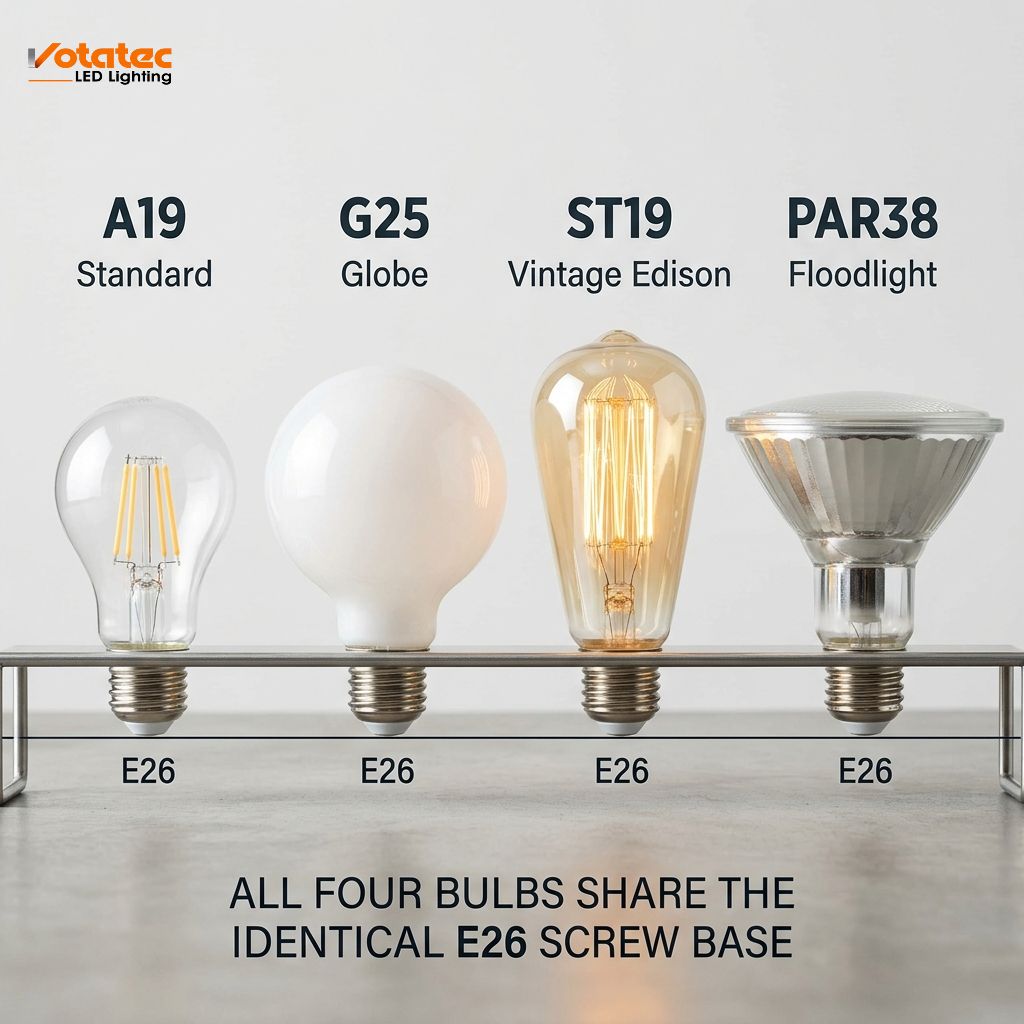
E26 is the base. A19 is the shape. Most A19 bulbs happen to have an E26 base, which is why the two terms get jumbled together. The A19 is that familiar pear shape, about 2.4 inches across at the widest point. Screw an E26 base onto it and you’ve got the bulb sitting in most table lamps and ceiling fixtures across the country.
But A19 isn’t the only shape that uses E26. Here are common ones:
| Bulb shape | What it looks like | Typical use |
|---|---|---|
| A19 / A21 | Classic pear | Lamps, general room lighting |
| G25 / G30 | Round globe | Vanities, bathroom bars, decorative |
| BR30 / BR40 | Wide reflector flood | Recessed pot lights, ceilings |
| PAR20 / PAR38 | Focused spotlight | Track lighting, accent, outdoor flood |
| ST19 / Edison | Vintage filament | Restaurants, lobbies, hospitality |
All of these can carry an E26 base. So the base gets you into the socket. The shape decides how the light spreads. Both matter.
E26 vs E27: the one millimetre that’s about voltage
E26 and E27 look almost identical. One millimetre apart in diameter. You can often thread one into the other. So what’s the catch?
Voltage.
E26 is the 120V North American standard. E27 is the 220-240V European and international standard. That single millimetre is mostly a side effect of two different electrical systems evolving on two continents.
For a Canadian building, you want E26. Full stop. An E27 bulb rated for 240V will usually run on a 120V circuit, just dimmer than intended. The riskier direction is putting a 120V-rated bulb on a 240V system, which can overheat or fail. In Canada that’s rarely the scenario, but if you’re sourcing internationally or speccing for export, check the voltage rating on the bulb, not just the base size.
Bottom line for most readers here: Canadian sockets are E26 at 120V. Match it and move on.
Can E26 bulbs be LED?
Yes. And honestly, they should be.
The E26 base started life on incandescent bulbs. Then CFLs adopted it. Now LED has taken over the base almost entirely. Walk into any supplier and the E26 shelf is mostly LED, with a shrinking corner of legacy stock.
Why the switch matters for a building owner: an LED in an E26 socket draws a fraction of the power for the same light. We’re talking around 75% less energy than the incandescent it replaces, in line with Natural Resources Canada efficiency figures. Same socket. Same fixture. No rewiring. You just swap the bulb.
That makes E26 LED retrofits one of the easiest lighting upgrades going. No electrician needed for a basic lamp swap. For a building with hundreds of medium-base sockets, that adds up fast.
E26 LED wattage equivalents
Here’s the part buyers actually need. When you replace an old incandescent with an E26 LED, you’re not matching watts. You’re matching lumens, the real measure of brightness. Watts just tell you energy draw.
Use this chart as your starting point:
| Old incandescent | Brightness | E26 LED equivalent |
|---|---|---|
| 40 W | ~450 lumens | 5-6 W |
| 60 W | ~800 lumens | 8-9 W |
| 75 W | ~1,100 lumens | 11-13 W |
| 100 W | ~1,600 lumens | 14-16 W |
A 9W LED putting out 800 lumens replaces a 60W incandescent. Same brightness, roughly 85% less power. That’s the whole pitch in one line.
One caution. Efficiency varies between manufacturers, so two “60W equivalent” bulbs might not be identical. Always check the lumen figure on the Lighting Facts label rather than trusting the “equivalent” claim alone. Match lumens, not marketing.
For colour, most commercial spaces want 3500K to 4000K (neutral to cool white). Warmer 2700K-3000K suits hospitality and lobbies. Daylight 5000K works for workshops and detail work.
Where E26 fits in commercial and institutional buildings
E26 has a reputation as a residential base. Fair enough, that’s where most of them live. But it shows up across commercial and government buildings more than people expect.
Think about it:
- Office lobbies and corridors running A19 or A21 LED bulbs in surface fixtures
- Recessed pot lights across drop ceilings using BR30 or BR40 LED floods
- Vanity and washroom bars in schools, clinics, and offices with G25 globes
- Track and accent lighting in retail, museums, and reception areas with PAR LED spotlights
- Hospitality and food service running vintage Edison-style LED filament bulbs
For a facility manager standardising on one base across a building, E26 covers a huge slice of general-purpose lighting. One base type, dozens of bulb shapes, simpler inventory.
When E26 isn’t enough: the E39 mogul base
Here’s where commercial buyers need to pay attention. E26 has limits.
For high-output industrial fixtures, the bigger E39 mogul base (39mm) takes over. It’s built for higher current, more contact area, and better mechanical support. You’ll find E39 in:
- High bay warehouse lighting
- Street and roadway lighting
- Parking lot poles and shoeboxes
- Legacy HID retrofits
A medium E26 base pushed near its upper wattage limit can degrade over time, leading to socket heating and intermittent failures that often get blamed on the bulb. So for demanding, high-wattage, long-hour service, spec E39.
Many LED corn-style retrofit bulbs ship with an E26 base plus an E39 mogul adapter, so they drop into either socket. Handy for mixed-fixture buildings. Just match the base to the electrical load and thermal conditions, not to whatever adapter happens to be in the box.
How to choose the right E26 light bulb
Quick checklist before you order, especially at volume:
- Confirm the base. Is the socket truly E26? Measure if unsure. 26mm across the threads.
- Match the shape. A19 for general, BR for recessed, PAR for spot, G for decorative.
- Match the lumens, not the watts. Use the chart above. Brightness is lumens.
- Pick the colour temperature. 3500K-4000K for most commercial spaces.
- Check dimmability. Not every LED dims. If the fixture’s on a dimmer, the bulb must say “dimmable.”
- Look for certification. A DesignLights Consortium (DLC) or ENERGY STAR Canada listing matters for quality and for rebate eligibility.
- Confirm enclosed-rating if the fixture is sealed. Trapped heat kills non-rated LEDs early.
That last point on rebates is worth a second look. Several provincial utility programs offer incentives on qualifying LED products, and DLC listing is often the gate to claim them. For a large E26 retrofit, that can shave real money off the project.
Quick takeaway: E26 is the standard 26mm screw base. It’s not a bulb shape. Match the base to your socket, the shape to your fixture, and the lumens to the brightness you need. Then go LED for the energy savings.
Buying E26 Light bulbs in bulk
For a single lamp, you grab one off a shelf. For a building, it’s a different game.
Volume buyers care about consistent colour batch to batch, reliable lumen output, warranty terms, and DLC listing for rebates. A pallet of mismatched “warm white” bulbs that range from yellow to nearly blue is a callback waiting to happen. Consistency is the whole point of buying wholesale.
Votatec stocks E26 LED bulbs across the common commercial shapes, A-line, BR reflectors, PAR floods, and decorative options, built for Canadian 120V systems and contractor-grade reliability. If you’re speccing a retrofit or standardising a building’s lighting, request a wholesale quote and we’ll match the right bulbs to your fixtures and your rebate eligibility.
Frequently asked questions about E26 Light bulbs
Is a regular light bulb an E26?
In Canada and the US, yes, most standard household and general-purpose bulbs use the E26 base. It’s the default medium screw size at 120V. If you’ve grabbed a typical bulb off a shelf, odds are it’s E26 unless the fixture calls for a smaller candelabra (E12) or larger mogul (E39) base.
Is an E26 bulb the same as A19?
No, but they’re often paired. E26 is the base, the 26mm screw part. A19 is the bulb’s pear shape. Most A19 bulbs come with an E26 base, which is why people use the terms interchangeably. But other shapes like globes, floods, and spotlights also use E26.
Can I use an LED bulb in an E26 socket?
Absolutely. LED bulbs are now the most common type sold with E26 bases. Just confirm the bulb is rated for your fixture, dimmable if you’re on a dimmer, and enclosed-rated if the fixture is sealed. No rewiring needed for a basic swap.
What’s the difference between E26 and E27?
About one millimetre and a lot of voltage. E26 is 26mm and built for 120V North American systems. E27 is 27mm and built for 220-240V European systems. They can physically thread together in many cases, but for Canadian buildings you want E26 rated at 120V.
What wattage LED replaces a 60W bulb in an E26 socket?
Around 8-9 watts. A 9W E26 LED produces roughly 800 lumens, the same brightness as a 60W incandescent, while using about 85% less power. Match lumens rather than watts to get the brightness you expect.
Are E26 bulbs good for commercial use?
For general lighting, yes. E26 covers lobbies, corridors, recessed pot lights, washrooms, and accent lighting in commercial and institutional buildings. For high-output industrial fixtures like high bays and parking lot lights, step up to the E39 mogul base instead.
Bottom line
E26 is the standard 26mm Edison screw base in Canadian sockets. It describes the threads, not the bulb. Match the base to your socket, the shape to your fixture, the lumens to your brightness target, and go LED for the energy savings. For commercial buildings, E26 handles most general lighting, with E39 stepping in for heavy industrial loads.
Sorting out a building’s lighting? Votatec can help you spec the right E26 LED bulbs and check what qualifies for provincial rebates.