










 (+1) 905 597 5955



Most closet lighting fails inspection for one reason: the wrong fixture, too close to the shelf. In Canada, a closet light has to use a fully enclosed light source and sit a set distance away from where clothes and boxes get stored. That’s the whole game. Pick an enclosed LED fixture, keep the clearance, and you pass.
This guide gives you the seven LED closet lighting solutions that meet the Canadian Electrical Code, the exact clearances they need, and what to spec when the “closet” is a hotel suite, a server room cabinet, or 200 units in a new build. No open bulbs. No guesswork.
Quick answer: Canadian closets allow surface-mounted or recessed LED luminaires with a completely enclosed light source. Surface fixtures need 300 mm (12 in.) of clearance to storage. Recessed enclosed fixtures need 150 mm (6 in.). Open lamps and pendants aren’t allowed. (CSA Group, CEC Part I)
Why closet lighting has its own rule?
Closets pack heat sources next to fuel. A hot lamp, a stack of folded sweaters, a cardboard box pushed up against the bulb. That combination is exactly how storage-space fires start, which is why both the Canadian Electrical Code and the US National Electrical Code carve out a dedicated rule for closet luminaires.
In Canada, that rule is CEC Rule 30-204 (Section 30, Installation of Lighting Equipment). It does two things: it limits which fixture types you can install, and it sets minimum clearances between the fixture and the closet’s storage space. (Guide to the Canadian Electrical Code, Section 30)
A note on scope before you spec. The exact wording, clearance values, and fixture definitions live in the current edition of CSA C22.1 and any provincial amendments (Ontario, Alberta, B.C. and others publish their own). The figures below reflect the widely applied national values, but you should always confirm against the edition your authority having jurisdiction (AHJ) enforces before you finalize a drawing or a purchase order. Codes get revised on a three-year cycle.
What CEC Rule 30-204 permits?
| Allowed in a Canadian closet | Why |
|---|---|
| Surface-mounted LED or incandescent with a completely enclosed light source | Enclosure keeps the hot element away from fabric and dust |
| Recessed LED or incandescent with a completely enclosed light source | Recessing plus enclosure adds two layers of separation |
| Surface-mounted or recessed fluorescent luminaires | Lower surface temperature than open incandescent |
| LED or fluorescent fixtures identified as suitable for the closet storage space | Listed for the location, so clearance rules ease |
What CEC Rule 30-204 prohibits?
- Incandescent luminaires with open or partially enclosed lamps
- Pendant luminaires or lamp-holders that hang into the space
- Any bare lamp a stored item could touch
The takeaway is simple. If you can see the bulb, it doesn’t belong in a closet.
Source basis for the clearances and fixture list: CSA C22.1 Canadian Electrical Code, Part I and the Electrical Industry guide to Section 30. The US equivalent, NEC 410.16, uses the same 12 in. / 6 in. structure, so cross-border product spec sheets line up.
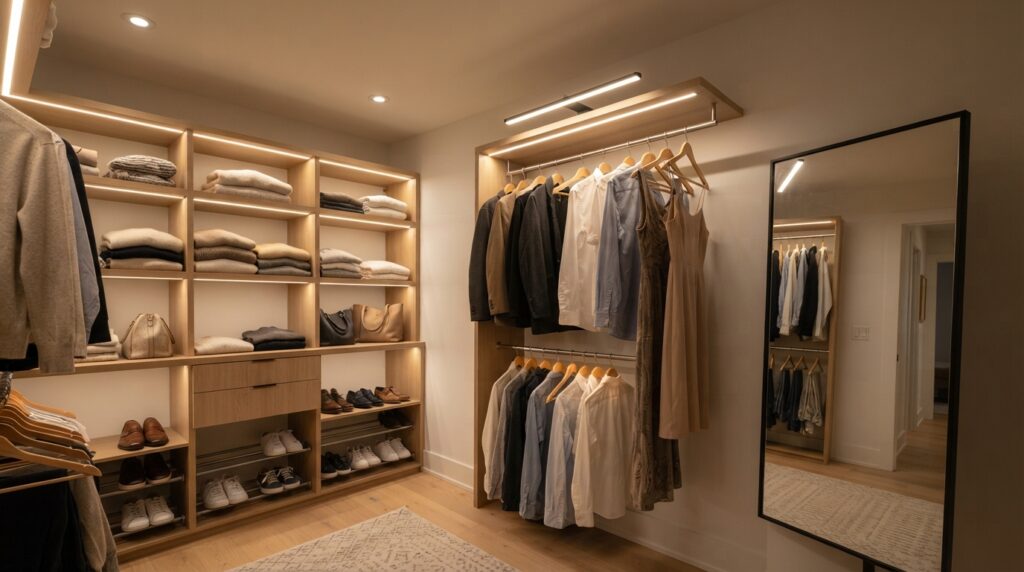
Closet clearance cheat sheet
Print this. It’s the part inspectors actually check.
| Fixture type | Mounting | Minimum clearance to storage |
|---|---|---|
| LED / incandescent, completely enclosed | Surface (wall above door or ceiling) | 300 mm (12 in.) |
| LED / incandescent, completely enclosed | Recessed in wall or ceiling | 150 mm (6 in.) |
| Fluorescent | Surface | 150 mm (6 in.) |
| Fluorescent | Recessed | 150 mm (6 in.) |
| Fixture listed as suitable for closet storage space | Surface or recessed | Per the product listing |
“Storage space” means the nearest point goods can sit: the top shelf, the hanging rod, the back wall where boxes lean. Measure from the fixture to that point, not to the floor.
What closet lighting is allowed under Canadian electrical code, and what LED fixtures should I use?
Under the Canadian Electrical Code, a closet light has to use a completely enclosed light source, and CEC Rule 30-204 limits you to surface-mounted or recessed LED, incandescent, or fluorescent luminaires that meet that bar, plus any fixture specifically listed as suitable for a closet storage space. Open and partially enclosed incandescent lamps, pendants, and hanging lamp-holders are out. So the real question isn’t whether LED is allowed; it’s which enclosed LED fixture fits the space. For a finished reach-in, a sealed recessed downlight at 150 mm clearance is the tidiest choice. For drywall ceilings you can’t cut into, a low-profile surface-mount LED disk above the door at 300 mm clearance does the job and retrofits an old open socket in minutes. For walk-ins and commercial store rooms, reach for an enclosed LED wrap or a strip light run inside an aluminum channel so the source stays sealed. Whatever you pick, buy it CSA-marked and enclosed-rated, and you’ve answered both halves of the question at once: it’s allowed, and it’ll pass.
The 7 code-compliant LED closet lighting solutions
Each option below uses an enclosed LED source, so it starts compliant. The difference is fit: a bedroom reach-in needs something different than a 40-unit condo or a commercial supply room.
1. Recessed enclosed LED downlights
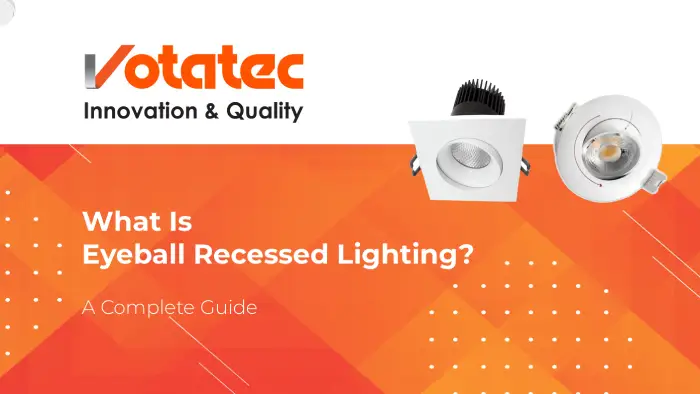
The cleanest look and the easiest clearance to hit. A recessed enclosed LED downlight needs only 150 mm to storage, so it fits closets where ceiling space is tight. Pick a fixture with a sealed lens and no exposed lamp. For walk-ins and reach-ins alike, a 3-inch or 4-inch downlight at 600 to 900 lumens lights the space without glare.
Spec it from: LED downlights
Best for: finished residential closets, hotel suites, condo reach-ins.
2. Surface-mount LED disk and wrap fixtures
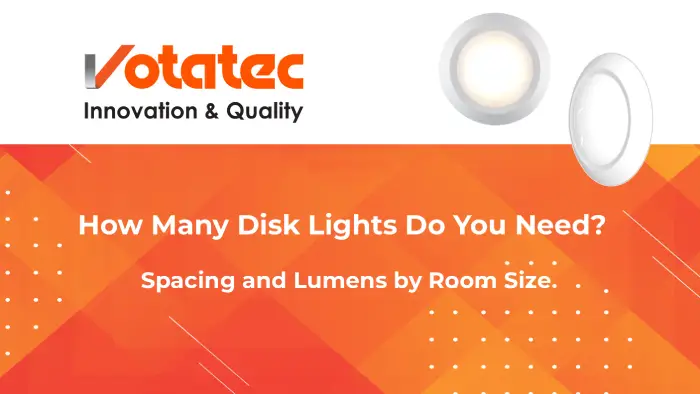
When you can’t recess, surface-mount is the workhorse. A low-profile LED disk or wrap with a fully enclosed diffuser mounts on the ceiling or the wall above the door. Remember the trade-off: surface fixtures need the full 300 mm of clearance because the body sits in the room, closer to stored goods.
These also retrofit beautifully. Pull an old open-bulb keyless lampholder, drop in a sealed LED disk, and a non-compliant closet becomes compliant in minutes.
Spec it from: surface-mount LED lights and LED wrap lights
Best for: retrofits, drywall ceilings with no plenum, older housing stock.
3. Enclosed LED strip in an aluminum channel
Bare LED tape stuck to a shelf is not code-compliant, full stop. To use strip lighting in a closet, the strip has to sit inside a protective housing, usually an aluminum mounting channel with a lens and end caps, so the source is enclosed. (aspectLED on enclosed strip)
Done right, channel-mounted strip is the best under-shelf and rod lighting there is. It throws even light across hanging items with zero hot spots, and the channel doubles as a heat sink that extends LED life.
Spec it from: LED strip lights plus strip light fixtures and channels
Best for: walk-ins, custom millwork, retail stockrooms, display closets.
4. LED wrap and linear fixtures for walk-ins
A walk-in closet or a commercial storage room behaves more like a small room than a cupboard. Here a sealed LED wrap or linear fixture gives broad, shadow-free coverage. The enclosed lens keeps it compliant while the wider output covers deep shelving on both walls.
For aisles of stored inventory, run linear fixtures down the centre and keep the 300 mm clearance to the top shelf.
Spec it from: LED wrap lights
Best for: walk-in closets, janitorial and supply rooms, light commercial storage.
5. Motion-sensor and occupancy-controlled LED closet lights
Nobody remembers to switch off a closet light. An occupancy sensor fixes that and pays for itself. Pair an enclosed LED fixture with an occupancy sensor or a photoelectric control so the light comes on when the door opens and shuts off on a timer.
For B2B projects this is more than convenience. Automatic controls support energy-code targets and trim operating cost across hundreds of units. The fixture still has to be an enclosed type at the right clearance; the sensor just decides when it runs.
Spec it from: enclosed surface-mount LED lights paired with photoelectric sensors
Best for: multi-unit residential, hotels, offices, any project chasing energy savings.
6. LED-retrofit of an enclosed ceiling fixture
Plenty of older Canadian closets still run an open keyless socket or a partially enclosed globe. Both are now prohibited. The compliant fix is a sealed LED ceiling fixture, or an enclosed-rated fixture fitted with an LED lamp that’s listed for enclosed use.
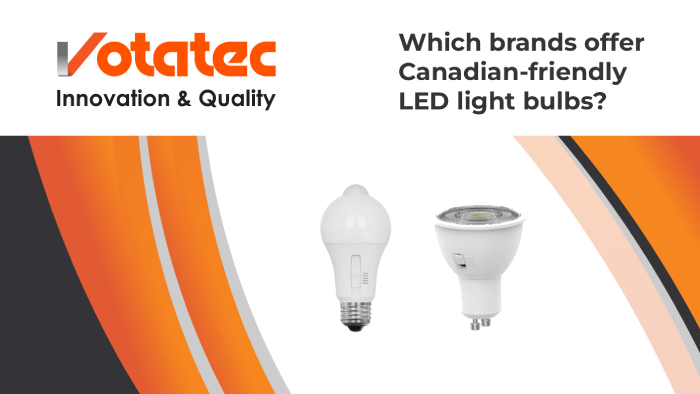
If you reuse a fixture, check the lamp. A standard LED bulb in a sealed fixture can overheat unless it’s marked suitable for enclosed luminaires. Spec the right lamp and the retrofit holds up.
Spec it from: surface-mount LED lights and enclosed-rated LED light bulbs
Best for: renovation work, heritage buildings, landlord upgrade programs.
7. Emergency and egress-rated LED for large storage closets
Large walk-in storage rooms and back-of-house closets in commercial buildings can fall under egress lighting rules. When a storage room is big enough to walk into and work in, the design may need emergency illumination on the path out. An enclosed LED fixture with an integral battery or an emergency LED unit covers both the closet rule and the egress requirement.
Spec it from: LED emergency lights
Best for: commercial supply rooms, institutional storage, B2G facilities.
Common closet lighting mistakes that fail inspection
These are the misses that send an electrician back to the truck.
- Open or partially enclosed bulbs. The single most common failure. A bare lamp in a closet is a no.
- Surface fixture too close to the shelf. It’s enclosed, but it sits inside the 300 mm zone. Move it above the door.
- Bare LED tape on a shelf edge. Pretty, and non-compliant. The strip must be in an enclosed channel.
- Pendants or hanging cords. A swag light or a dangling lampholder is prohibited in a closet.
- Wrong lamp in a sealed fixture. A non-enclosed-rated LED bulb in an airtight fixture overheats and shortens life. Spec the enclosed-rated lamp.
- Measuring clearance from the floor. The clearance is to the nearest storage point, often the top shelf or rod, not the ground.
Spec’ing closet lighting for commercial and multi-unit projects
A single closet light is easy. Two hundred of them, on a delivery schedule, with one bill of materials, is a different job. That’s where buying through a Canadian wholesaler changes the math.
Standardize the fixture. Pick one enclosed LED model that clears 30-204 and repeat it across every closet in the project. One SKU means one submittal, one spare-parts line, and no field surprises.
Match the controls to the energy code. Occupancy sensors on closet circuits help hit the lighting-power and automatic-shutoff targets in the National Energy Code of Canada for Buildings and provincial equivalents.
Lock the colour temperature. A 3500K or 4000K LED reads clean and neutral, so tenants can match colours when they get dressed and staff can read labels in a supply room. Mixing CCTs across a building looks cheap and draws complaints.
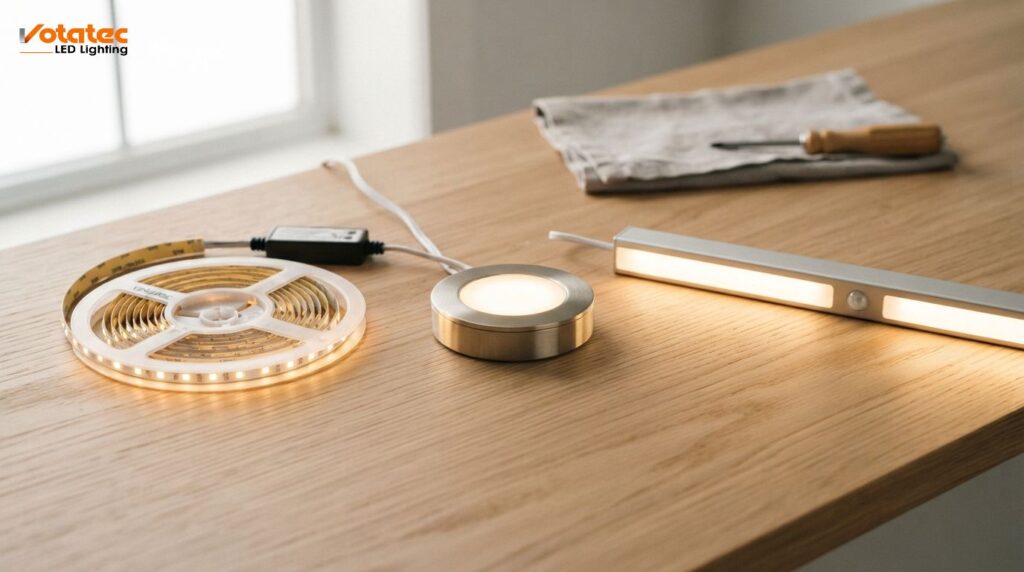
Buy commercial grade, not big-box. Battery puck lights and stick-on bars dominate the consumer aisle, but they aren’t hard-wired, they aren’t always enclosed-rated, and they don’t carry the warranty a property manager needs. Hard-wired, enclosed, CSA-marked fixtures are what pass inspection and last.
LED itself carries the project. Compared with the incandescent and fluorescent fixtures it replaces, LED closet lighting cuts energy use by roughly 75% and runs for 50,000+ hours, which across a portfolio of closets means far fewer relamping truck rolls. (Natural Resources Canada)
How to choose the right closet light
Run through these five questions and the fixture picks itself.
- Can you recess? Yes, use a downlight at 150 mm clearance. No, use a surface disk or wrap at 300 mm.
- Reach-in or walk-in? Reach-in: one disk or downlight. Walk-in: linear, wrap, or channel strip for even coverage.
- New build or retrofit? Retrofit usually means pulling an open lampholder for a sealed surface fixture.
- One closet or many? Multi-unit work wants one standardized, enclosed, controls-ready SKU.
- Does anyone walk in to work there? If it’s a large commercial store room, check whether egress and emergency lighting apply.
How do I install LED closet lights and make sure the motion sensor works with my current wiring?
Installing an enclosed LED closet fixture is straightforward, but the motion sensor is where most jobs go sideways, and the cause is almost always the wiring at the switch box. Kill the breaker, confirm it’s dead, and mount the fixture above the door or in the ceiling at the correct clearance (300 mm surface, 150 mm recessed). The wiring choice comes down to one question: is there a neutral wire in the switch box? Many older Canadian homes were wired with a switch loop that carries only the hot and switched legs, no neutral. A standard occupancy-sensor switch needs that neutral to power its electronics, so check before you buy.
If the box has a neutral, use a neutral-required occupancy sensor. It’s the cleaner setup for LED because it doesn’t depend on a minimum load, so it won’t flicker your low-wattage closet light. If the box has no neutral, you’ve got two routes: a sensor model rated for no-neutral operation, or a fixture with the motion sensor built in (the sensor and driver live together, so the wiring question disappears). The catch with no-neutral switches is leakage current. They trickle a little power through the load while off, and an LED driver can react to that with a faint glow or flicker. If that happens, fit an LED-rated sensor, confirm the LED’s wattage clears the sensor’s minimum load, and in stubborn cases add a bypass capacitor across the load.
Two more things save callbacks. First, match dimming: a non-dimmable LED on a dimming sensor will hum or flicker, so pair dimmable LEDs with dimming controls and non-dimmable LEDs with simple on/off sensors. Second, set the timer short. A closet doesn’t need a 15-minute hold; 1 to 5 minutes is plenty and squeezes the most energy savings out of the control. For a clean parts list, an enclosed surface-mount LED fixture paired with an LED-rated photoelectric sensor covers most closets, and any wiring you’re unsure of belongs with a licensed electrician.
Frequently asked questions
What kind of light is allowed in a closet in Canada?
Canadian closets allow surface-mounted or recessed LED, incandescent, or fluorescent luminaires with a completely enclosed light source, under CEC Rule 30-204. Open or partially enclosed incandescent lamps and pendant fixtures aren’t permitted. In practice, an enclosed LED downlight or sealed surface fixture is the standard choice.
How far does a closet light have to be from the shelf?
A surface-mounted enclosed LED fixture needs at least 300 mm (12 in.) of clearance to the nearest storage space. A recessed enclosed fixture needs 150 mm (6 in.). Measure to the closest point goods can sit, usually the top shelf or hanging rod. Always confirm against the current CSA C22.1 edition and your local AHJ.
Can I put LED strip lights in a closet?
Yes, but the strip has to be enclosed. Bare LED tape stuck to a shelf or wall is not code-compliant. Mount the strip inside an aluminum channel with a lens and end caps so the light source is fully enclosed, then it meets the closet rule and lasts longer.
Are battery-powered puck lights code-compliant?
For a permanent installation, no. Stick-on battery puck lights and motion bars aren’t hard-wired and often aren’t enclosed-rated, so they don’t satisfy CEC Rule 30-204 as a building’s closet lighting. They’re fine as a temporary renter add-on, but a compliant closet uses a hard-wired enclosed fixture.
What’s the difference between Canadian and US closet lighting code?
The structure is nearly identical. Canada uses CEC Rule 30-204; the US uses NEC 410.16. Both require enclosed sources and use the same 300 mm / 12 in. surface and 150 mm / 6 in. recessed clearances. Product spec sheets sold across both markets generally list both, so a CSA-marked fixture works on either side.
What colour temperature is best for a closet?
For most closets, 3500K to 4000K (neutral white) is the sweet spot. It renders clothing colours accurately and keeps storage rooms easy to read. Warmer 2700K to 3000K suits residential closets that should feel cosy, while cooler tones can wash out fabric colour.
The bottom line
Code-compliant closet lighting in Canada comes down to two rules: enclosed source, correct clearance. Every option in this guide starts there, then fits a different space, from a condo reach-in to a commercial store room.
- Enclosed LED only. No open or partially enclosed lamps, no pendants.
- 300 mm clearance for surface fixtures, 150 mm for recessed enclosed.
- Strip lighting needs an enclosed channel.
- Standardize one fixture for multi-unit and commercial projects.
- Confirm the current CSA C22.1 edition and your local AHJ before you spec.
Planning closet lighting for a build, a retrofit, or a portfolio of units? Browse Votatec’s LED light fixtures for enclosed, CSA-marked closet-ready options, or contact our team for a project bill of materials and a wholesale quote.