









 (+1) 905 597 5955



Short answer: a headboard LED is safe if two things are true. The whole LED headboard assembly carries a certification mark that Canada actually recognises, and the low-voltage supply feeding it is an approved Class 2 unit. Miss either one and you’ve got a fire risk sitting eight inches from your pillow.
The light itself isn’t the problem. Diodes running at 12 or 24 volts don’t shock people. What burns bedrooms down is the little black power brick, the wire staples driven through insulation, and the fact that nobody tested the LED headboard assembly before it shipped from a marketplace warehouse.
Here’s the part most buying guides skip. In Ontario, the Electrical Safety Authority publishes a list of products exempt from approval when they’re fed by a Class 2 supply. LED lighting is specifically carved out of that exemption. So the reassurance you keep reading online, that low voltage means you don’t need to worry about certification, is wrong for exactly this product category, and a headboard LED is the clearest example of it.
Let’s go through what to actually check on an LED headboard.
What Counts as a Headboard LED?
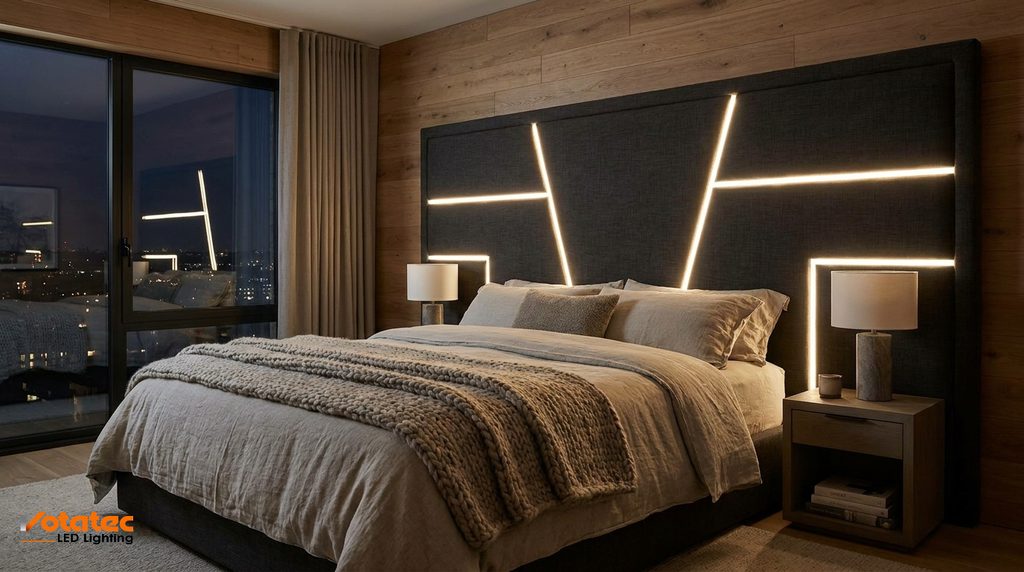
Four different LED headboard builds get sold under the same search term, and they don’t carry the same risk.
- Factory-integrated LED headboard. Strip or module built into the headboard panel at the plant, wired to a captive driver, single plug at the wall. Most of the Amazon and Wayfair listings.
- Backlit headboard, wall-washing type. Strip hidden on the rear edge, aimed at the wall behind. The glow you see is bounced light. Often called a backlit bed when the frame is lit too, and it’s the most common backlit headboard style in Canadian bedrooms.
- Floating bed frame with LED lights. Perimeter strip under the base, making the frame look like it hovers. Same electrical questions as a headboard LED, more exposure to feet, vacuums, and pets.
- Retrofit strip you add yourself. Adhesive tape plus a plug-in adapter, stuck behind an existing headboard. Cheapest route to an LED headboard, and the one where installation quality is entirely on you.
The retrofit and the factory-integrated headboard LED fail in different ways. A factory unit fails because of a cheap driver nobody certified. A retrofit fails because of how it was mounted. Worth knowing which one you’re dealing with before you start checking things.
The Real Risks, Ranked Honestly
Most articles on LED headboard safety either shrug and say it’s fine, or scare you about blue light. Neither is useful. Here’s the actual order of concern, based on how LED headboard products actually fail in the field.
1. The Driver or Adapter (Highest Risk)
This is where nearly every incident starts. The power supply converts 120V line voltage down to 12V or 24V DC. A properly built headboard LED driver has thermal protection, overcurrent protection, and a real enclosure. A $4 unbranded one has a transformer, a couple of capacitors, and optimism.
Health Canada’s recall database is instructive here. It carries repeated LED and power-supply recalls for exactly this failure mode: ANNQUAN power strips recalled in January 2026 for lacking overcurrent protection, Uberhaus PAR20 LED bulbs pulled in April 2025 after overheating reports, and a set of “Justice” light-up bed canopies recalled after the canopy lights overheated and burned. That last one is the closest analogue to a lit headboard, and it produced two Canadian overheating reports plus sixteen in the US.
Same lesson every time. The diode didn’t fail. The thing powering it did.
2. Wiring Pinched Under Upholstery
An upholstered LED headboard hides its wiring behind fabric and foam. That’s a thermal blanket over a conductor. If the wiring is stapled, pinched by a mounting bracket, or crushed where the panel meets the wall, you get a hot spot with no airflow and no way to see it.
Foam and fabric are also fuel. A copper conductor running warm inside a sealed upholstered cavity is a materially worse situation than the same conductor stapled to a bare wooden rail.
3. Overheating From Blocked Heat Sinking
LED strip needs somewhere to dump heat. Aluminium channel, a metal rail, something. Stick a high-density headboard LED strip directly onto fabric, MDF, or foam and the diodes cook themselves. Lumen output drops, the adhesive lets go, and the solder joints eventually crack.
You’ll usually see this as colour shift or dead segments long before anything dangerous happens. Still a defect, and it tells you the LED headboard was built badly everywhere else too.
4. Shock Risk (Genuinely Low)
At 12V or 24V DC, a headboard LED isn’t a shock hazard to a healthy adult. Class 2 limits exist precisely because voltages under 30V aren’t considered a shock risk. The exception is the 120V side: the plug, the cord, and anything you hardwired into a wall box without a permit.
So the risk profile isn’t “LEDs are dangerous.” It’s “cheap power conversion and hidden wiring are dangerous, and an LED headboard hides both.”
The Certification Mark Check (Do This First)
Before you look at anything else, find the mark. Not the CSA logo printed on a box in marketing copy. The actual moulded or labelled mark on the driver and on the LED headboard itself.
In Ontario, Rule 2-022 of the Ontario Electrical Safety Code requires approval for electrical products sold or used in the province. ESA maintains a list of over forty recognised agencies. The marks you want to see include:
- cCSAus or CSA (CSA Group)
- cULus or cUL (UL Solutions)
- cETLus or ETL (Intertek)
- cTUVus (TÜV Rheinland or TÜV SÜD)
- ESAFE (an ESA field evaluation, applied after the fact)
The small “c” prefix matters. It means the mark covers Canada, not just the US. A bare “UL” on a driver is a US-only listing.
The CE Mark Trap
Here’s the one that catches people. A CE mark is a manufacturer’s self-declaration used in Europe. It’s not a third-party certification and Canada does not recognise it. Plenty of imported headboard LED units carry a CE mark and nothing else, and the listing photographs make it look like a safety credential.
It isn’t. If CE is the only mark on your driver, that headboard LED is unapproved equipment in Ontario. ESA’s language on that is blunt: installing and connecting unapproved electrical equipment is against the law and can lead to prosecution.
Does anyone get charged over a bedroom LED headboard? Realistically, no. But your insurer reads the same code after a fire, and “unapproved equipment” is a phrase you don’t want in a claim file.
Class 2, and the LED Exception Nobody Mentions
This is the section that separates a real answer from a copied one.
A Class 2 power supply is a low-energy source. Under the Canadian Electrical Code, the reasoning is that under 30 volts isn’t a shock hazard and under 100 volt-amps isn’t a fire hazard. ESA states the numbers precisely: the output may not exceed 100 VA, with operating voltage no more than 30 V rms, 42.4 V peak, or 60 V DC, certified to CAN/CSA-C22.2 No. 223.
Now the part that gets misread everywhere. Equipment connected to the output of an approved Class 2 supply is generally exempt from needing its own approval. That’s true. And it’s why forum advice says low-voltage strip doesn’t need certification.
But ESA lists specific things that still need approval even on a Class 2 output:
- Luminaires
- Decorative lighting strings, signs, or displays
- Medical electrical equipment
- Equipment for hazardous locations
- Equipment that incorporates heating elements
- Lighting equipment that incorporates LEDs
Read that last line again. A headboard LED is lighting equipment incorporating LEDs. It does not get the Class 2 exemption. The supply needs approval and so does the lit LED headboard assembly.
That single line invalidates most of what currently ranks for headboard LED safety. If a page tells you low voltage means certification doesn’t apply, it hasn’t read the exception list.
What to Check Before You Plug One In
Ten minutes with a phone light. Work through the LED headboard in this order.
- Find the mark on the driver. cCSAus, cULus, cETLus, cTUVus. Photograph the label. If it’s CE-only or bare, stop here.
- Find a mark on the LED headboard assembly itself. Per the LED carve-out above, the lit product needs approval too, not just the brick.
- Read the output rating. Should say 12V DC or 24V DC, with a wattage. Confirm it’s a Class 2 or LPS unit.
- Add up the load. Strip wattage per metre times length. Keep total draw at 80% of the driver’s rating or less. Our LED strip power supply sizing guide walks the arithmetic.
- Check the cord and plug. No nicks, no exposed conductor, moulded strain relief where the cord enters the brick.
- Feel the driver after two hours of headboard LED runtime. Warm is normal. Too hot to hold for five seconds is not.
- Look for a heat path. Is the headboard LED strip on aluminium channel or metal rail, or stuck straight to fabric and MDF?
- Trace the wire run. Any staples through insulation, any wire crushed by a bracket or squeezed between panel and wall.
- Confirm nothing is buried in foam. Connectors and splices need air and access, not a stuffed cavity.
- Check the wall outlet. One driver in a properly grounded receptacle. Not a daisy chain of adapters behind the bed.
Failed step 1 or 2? Don’t run that LED headboard. A driver swap for a certified one is cheap. Replacing a bedroom isn’t.
Is Sleeping With a Backlit Headboard Bad for You?
Different question from electrical safety, and the honest answer has two halves.
On eye damage, the science is reassuring. ICNIRP, the international body that sets optical radiation exposure guidelines, published a statement on LEDs concluding they “are safe under reasonably foreseeable usage conditions.” Their assessment of the retinal damage studies is direct: the animal experiments involved dilated pupils and direct viewing for at least four hours, conditions they call “extreme and not typical for humans.” Their finding on general lighting is that warmer LEDs in well-designed fixtures “should pose no more of a hazard than traditional lighting sources of similar colour temperature.”
A headboard LED bouncing off a wall at low output sits about as far from a worst-case optical exposure as you can get. It’s indirect, it’s dim, and you’re not staring at it.
Lamps do get sorted into risk groups RG0 through RG3 under IEC 62471 for photobiological safety. Bedroom-grade indirect LED headboard strip lands at the harmless end. The high-risk groups are for intense, direct-view sources.
The Sleep Half Is Where the Real Issue Is
Bright light at night suppresses melatonin. That’s well established, and short-wavelength light around 460 to 470 nm does it most efficiently. A cool 6000K white backlit bed left on all night is genuinely working against your sleep. Not because it’s an LED headboard, but because it’s blue-rich light hitting your eyes at the wrong time of day.
Fix is straightforward:
- Pick 2700K to 3000K for anything that stays on near bedtime. Our LED colour temperature guide covers where each range belongs.
- Dim it. A headboard LED at 10% output is ambience. At full output it’s a work light. Add a proper LED dimmer switch or use a driver with dimming built in.
- Aim the headboard LED at the wall, not the room. Indirect light is the whole point of a backlit headboard.
- Put the LED headboard on a timer. Off an hour before sleep beats off at 3am.
- Skip RGB colour-cycling overnight. Constant colour shifts keep pulling attention.
Interesting wrinkle: for a bedroom you actually want the opposite of what most spec sheets brag about. Low output, warm CCT, high colour rendering. Our best LED lights for bedroom breakdown gets into the layering.
Plug-In or Hardwired? This Changes Who Can Install It
Plug-in LED headboard units are consumer products. Buy it, check the marks, plug it in. No permit, no electrician.
Hardwired is a different animal. The moment you’re putting a driver in a wall box, running cable through a stud bay, or tying into a switch leg, you’re doing electrical work covered by the code. In Ontario that means a notification to ESA and, unless you’re the homeowner doing your own work within the rules, a licensed electrical contractor.
Where people get this wrong: they buy a plug-in backlit headboard, decide the visible cord is ugly, and cut the plug off to wire it into a nearby outlet box. That converts a certified plug-connected product into an unapproved hardwired installation. The certification covered that LED headboard as shipped, cord included.
Want the cord gone? Add a receptacle behind the headboard properly, and plug in as designed.
If You’re Cutting Strip to Length
Retrofit headboard LED strip usually needs trimming. Cut on the marked copper pads only, and re-terminate with a proper connector or solder joint plus heat-shrink. Bare twisted conductors inside a fabric LED headboard is asking for it. We covered the method in can you cut LED strip lights.
Also worth knowing: not every strip is cuttable. Constant-current segments and some high-voltage rope products aren’t, and cutting them kills whole sections.
Buying Online Is Where This Goes Wrong
Marketplace listings mix certified and uncertified goods in the same search results. A headboard LED can photograph beautifully, arrive well packed, and still carry no mark Canada recognises. The listing won’t tell you. “Safe” in a product title is marketing copy, not a certification, and one of the units currently ranking in Canada literally has the word Safe in its name.
What to do about it:
- Ask the seller for the certification file number before ordering. Real ones answer. Vague ones tell you what you need to know.
- Treat “CE certified” as a red flag, not a green one, for a product sold into Canada.
- Check the driver separately from the LED headboard. Sometimes the brick is certified and the LED headboard assembly isn’t. You need both.
- Search ESA’s approval mark lookup if you’re unsure a mark is real.
- Keep the box and label photos. Insurance and warranty both want them.
And if a headboard LED shows up with no acceptable mark, you have two decent options. Return it, or replace the driver with a certified Class 2 unit and accept that the lit assembly itself is still technically unapproved. Returning is cleaner.
Specifying LED Headboard Lighting for Hotels and Residences
Residential buyers can make their own risk calls on an LED headboard. Commercial specifiers can’t.
If you’re fitting out a hotel, student residence, long-term care facility, or multi-unit residential building, LED headboard details show up constantly in the interior package. The exposure is different: hundreds of rooms, a building inspector, a fire marshal, and an operator carrying the liability for decades.
What changes at that scale:
- Approval isn’t optional or ignorable. An inspector will find one uncertified LED headboard across 200 rooms and you’ll be pulling all 200.
- Spec the driver as a line item, not as whatever the furniture vendor bundles. Furniture suppliers buy furniture well and power supplies badly.
- Demand aluminium extrusion or a metal carrier for the strip. Fabric-mounted tape in a hospitality LED headboard will fail inside two years.
- Match binning and CCT across the order. Nothing looks worse than a corridor of rooms where every headboard LED is a slightly different white.
- Plan for relamping. Sealed upholstered LED headboards with captive strip mean the whole panel gets replaced when a segment dies.
- Ask about certification listings the same way you’d ask on any fixture. If you’re used to checking DLC qualification on commercial fixtures, apply the same rigour here.
For architectural work, purpose-built LED strip lighting with a properly specified driver beats furniture-integrated tape almost every time. It’s serviceable, it’s certified as a lighting product rather than furniture, and it can be detailed into millwork or a wall recess to get the same floating effect with none of the upholstery heat problems.
That’s the honest trade. Integrated headboard LED units are convenient. Separately specified strip and driver are safer, repairable, and easier to get past an inspector.
Warning Signs an Installed Headboard LED Needs Attention
Already living with an LED headboard? Watch for these.
- Flicker, especially at low dim levels
- Any section that has shifted colour or gone dim
- A driver that’s hot rather than warm, or that clicks and buzzes
- Any smell of hot plastic near the bed
- Adhesive lifting, letting strip hang loose behind the panel
- The breaker on that circuit tripping for no obvious reason
- Visible discolouration on fabric near where the wiring runs
Hot plastic smell or breaker trips? Unplug it and stop using it. Those two aren’t wait-and-see items.
Bottom Line
An LED headboard is one of the safer things in a modern bedroom, right up until the moment nobody checked who tested it.
The short version:
- On an LED headboard, the mark is the whole ballgame. cCSAus, cULus, cETLus or cTUVus on both the driver and the assembly. CE alone doesn’t count in Canada.
- LEDs don’t get the Class 2 exemption. ESA carves out lighting equipment incorporating LEDs by name, so low voltage is not a free pass on certification.
- Headboard LED drivers cause fires, diodes don’t. Size the supply properly and give it air.
- Heat needs somewhere to go. Metal carrier, not fabric and foam.
- Warm and dim beats bright and blue if you’d like to sleep.
- Plug-in is a consumer product. Hardwired is electrical work. Don’t blur the two by cutting off a plug.
Ten minutes of checking marks and ratings gets any headboard LED most of the way to safe. Skipping that check is the only part of a backlit bed that should worry you.
Sorting out lighting for a bedroom project, a hospitality fit-out, or a residential build? Our team specs certified LED strip, drivers, and controls for Canadian projects daily. Browse the LED strip lighting range or dig through more lighting guides on the Votatec blog.
Frequently Asked Questions
Are LED headboards safe to leave on all night?
Electrically, yes, if the LED headboard carries a recognised Canadian certification mark and the driver is properly sized. A certified LED headboard drawing 10 to 30 watts is built for continuous duty. The real argument against all-night use is sleep quality, not fire risk. Light at night suppresses melatonin, and cool white light does it most efficiently. Run it warm, dim, and on a timer.
Can an LED headboard cause a fire?
The LEDs themselves almost never do. The power supply can, and that’s where nearly every reported incident starts. Health Canada’s recall database carries repeated LED and power-supply recalls for overheating and missing overcurrent protection, including bed canopy lights that overheated and burned. An uncertified driver, an overloaded driver, or wiring pinched under upholstery are the three things that turn an otherwise safe headboard LED into a hazard.
Do LED headboards need CSA approval in Canada?
Yes. Ontario’s Electrical Safety Code Rule 2-022 requires approval for electrical products sold or used in the province, and CSA is one of more than forty recognised marks alongside cULus, cETLus and cTUVus. People assume low-voltage LED products are exempt because Class 2 equipment usually is. ESA’s exception list specifically states approval is still required for lighting equipment that incorporates LEDs. So the exemption doesn’t apply to a headboard LED.
Is a backlit bed bad for your eyes?
No, not at the output levels these products use. ICNIRP’s statement on LEDs concludes they’re safe under reasonably foreseeable usage conditions, and notes that the animal studies raising retinal concerns used dilated pupils and four-plus hours of direct viewing, which they describe as extreme and not typical for humans. Indirect wall-washing light from an LED headboard is a very low optical exposure. Direct-view, high-intensity sources are the ones that get flagged under IEC 62471 risk groups.
What colour temperature should a headboard LED be?
2700K to 3000K. Warm white supports the wind-down before sleep and keeps blue-light content low. 4000K reads clinical in a bedroom, and anything at 5000K or above is working directly against melatonin production at night. If you want one fixture to do double duty for reading, use a tunable-white LED headboard or add a separate task light rather than pushing the ambient strip cooler.