










 (+1) 905 597 5955




Three specs decide whether your exterior pot lights survive a Canadian winter or fail in eighteen months. IP rating. Beam angle. Wet-location listing.
Get those three right and the rest is preference. Get one wrong and you’re back on a ladder.
Here’s the short version. For soffit and eave work, specify exterior pot lights with an IP65 rating minimum, a wet-location listing (not damp), and a 60-degree beam angle for general soffit wash. Add IC rating if the housing touches insulation. That covers roughly 90% of residential and light commercial jobs in Canada.
Now the reasoning, because the exceptions matter.
The Short Answer: What to Look For in Exterior Pot Lights
Good exterior pot lights have:
- A wet-location listing from a recognised certification body. Damp-rated isn’t enough for most soffits.
- IP65 or better. IP66 for anything facing driven rain or pressure washing.
- A 60-degree beam for soffit wash. 38-degree for tall features. 100-degree-plus for low porch ceilings.
- IC rating if the housing contacts attic or eave insulation.
- Gasketted trim with a sealed lens, not just a sealed driver box.
- A cold-start rating to -30°C or lower for most of the country.
The rest of this guide explains why each line is on that list.
Wet-Location Listing vs IP Rating on Exterior Pot Lights
This is the most common confusion in the category, and it costs contractors real money. The two measure different things under different systems. One is a safety certification, the other an engineering spec. Good exterior pot lights carry both.
What a wet-location listing certifies
A wet-location listing is a safety certification. An accredited agency tested the fixture and confirmed it’s safe where water can drip, splash, or flow against it. In Canada that mark comes from a body like CSA, cULus, or Intertek/ETL.
It isn’t optional. Ontario requires electrical products to be approved by an accredited agency and to carry the mark before they’re sold or installed. Check which marks are legitimate on the Electrical Safety Authority’s list of recognised certification marks. Installing uncertified exterior pot lights is against the law in Ontario, and it will fail inspection.
Two tiers matter:
- Damp location: moisture, humidity, and condensation, but no direct water. Fully sheltered covered porches.
- Wet location: water can drip, splash, or flow against the fixture. Open eaves. Exposed soffits. Anywhere wind drives rain sideways.
Most Canadian soffits are wet locations, not damp ones. Wind-driven rain doesn’t respect the tidy diagram in the catalogue. We’ve broken that decision down further in our guide to wet-rated vs damp-rated exterior can lights, including how the rating affects provincial rebate eligibility.
What an IP rating measures
IP stands for Ingress Protection, defined under IEC 60529. Two digits: the first covers solids and dust, the second water.
An IP rating is a performance spec, not a legal approval. A manufacturer can publish an IP number with no third-party safety listing at all. That’s why cheap imported exterior pot lights often advertise a big IP number and nothing else.
Why exterior pot lights need both
The wet-location listing says “legal and safe to install here.” The IP rating says “here’s how much water it’ll actually keep out.”
Exterior pot lights with a wet-location listing but a low IP rating may be safe yet still let moisture reach the optics, which fogs the lens and dims the output. Exterior pot lights with IP66 and no certification mark can’t legally be installed at all. Specify both, every time.
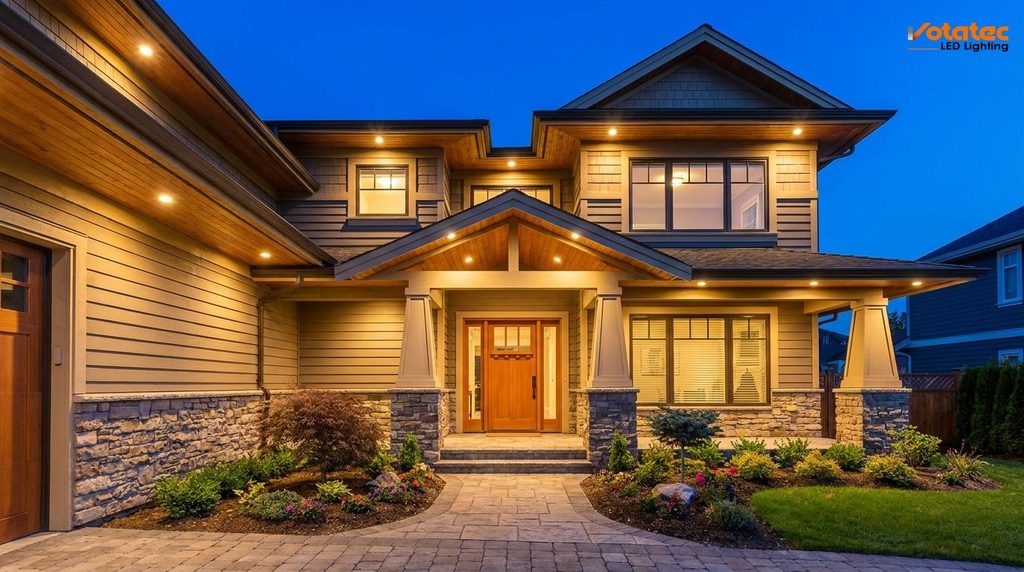
IP Ratings for Exterior Pot Lights, Decoded
First digit: solids and dust
| Digit | Protection |
|---|---|
| 4 | Objects over 1mm, like wire and small tools |
| 5 | Dust-protected. Some ingress, no harmful deposit |
| 6 | Dust-tight. No ingress at all |
For exterior pot lights you want a 6. Soffits collect dust, pollen, insects, and webs. A 5 eventually lets fines settle on the LED board.
Second digit: water
| Digit | Test | Real-world meaning |
|---|---|---|
| 4 | Splashing from any direction | Sheltered, covered areas |
| 5 | Water jets, 6.3mm nozzle, about 12.5 L/min | Rain and hose spray |
| 6 | Powerful jets, 12.5mm nozzle, about 100 L/min | Driven rain, pressure washing |
| 7 | Immersion, 1m for 30 minutes | Temporary flooding |
| 8 | Continuous immersion past 1m | Submerged use |
The jump from 5 to 6 is bigger than it looks. Roughly eight times the water volume, through a nozzle twice the diameter.
IP65 vs IP66 vs IP67 for exterior pot lights
- IP65: the working standard for soffit-mounted exterior pot lights. Dust-tight, handles rain and hose spray from any angle.
- IP66: the step up for exposed elevations, coastal wind, and anywhere a pressure washer gets used.
- IP67: immersion rated. For in-grade and deck fixtures where water pools.
The IP67 trap: higher isn’t automatically better
Here’s a detail most buying guides skip, and it catches experienced people out.
IP67 does not imply IP65 or IP66.
The immersion tests at levels 7 and 8 are separate from the jet tests at 5 and 6. A fixture certified IP67 passed static immersion. It may never have been sprayed with a pressurised jet, and still water behaves nothing like a jet hitting a gasket seam at an angle.
So IP67 exterior pot lights aren’t automatically the safer buy for a soffit catching driven rain. Where a product sees both pooling and spray, look for a dual marking like IP66/IP67, meaning it passed both. Don’t assume the bigger number covers everything beneath it. It doesn’t.
Beam Angle: The Exterior Pot Lights Spec Most Buyers Ignore
Nearly everyone shopping for exterior pot lights checks the IP rating. Almost nobody checks the beam angle. Then they wonder why the front of the house looks blotchy.
Beam angle decides how wide the light spreads: an even wash, or a row of disconnected spotlights with dark gaps between them.
How beam angle works
Beam angle is measured to the point where intensity falls to 50% of centre. The geometry:
Beam diameter = 2 x mounting height x tan(beam angle / 2)
No trigonometry needed on site. Use the multiplier below.
Beam spread by mounting height
Diameter of the lit pool at grade for exterior pot lights, by beam angle and soffit height:
| Beam angle | Multiplier | 8 ft | 9 ft | 10 ft | 12 ft |
|---|---|---|---|---|---|
| 24° (narrow spot) | 0.43 x H | 3.4 ft | 3.8 ft | 4.3 ft | 5.1 ft |
| 38° (spot) | 0.69 x H | 5.5 ft | 6.2 ft | 6.9 ft | 8.3 ft |
| 60° (flood) | 1.16 x H | 9.2 ft | 10.4 ft | 11.5 ft | 13.9 ft |
| 80° (wide flood) | 1.68 x H | 13.4 ft | 15.1 ft | 16.8 ft | 20.1 ft |
| 100° (very wide) | 2.38 x H | 19.1 ft | 21.5 ft | 23.8 ft | 28.6 ft |
| 120° (diffuse) | 3.46 x H | 27.7 ft | 31.2 ft | 34.6 ft | 41.6 ft |
Multiply soffit height by the multiplier. That’s your pool diameter.
Matching beam angle on exterior pot lights to the job
- 24° to 38°: accent work. Uplighting a column, grazing stonework, picking out a gable. Tight and dramatic, and the narrowest exterior pot lights you’ll want.
- 60°: the default for exterior pot lights in soffits at 8 to 10 feet. Pools overlap cleanly without washing out.
- 80° to 100°: low porch and carport ceilings, or broad coverage from few fixtures.
- 120°: diffuse ambient fill. Soft, but weak at distance and glare-prone unless the LED is well regressed.
Two-storey soffits need narrower exterior pot lights
Two-storey soffits usually sit 18 to 22 feet up. At that height a 60-degree beam spreads over 20 feet wide, and the light arriving at grade is thin, because intensity falls with the square of distance.
Go narrower and brighter. A 38-degree beam at 20 feet gives a 13.8-foot pool with far more punch. Regressed or baffled trims matter more too, since a flush lens up there throws glare into bedroom windows across the street.
Worth saying plainly: exterior pot lights aren’t always right for a two-storey facade. LED flood lights or wall pack lights often do it better, as we cover in LED wall pack vs flood light.
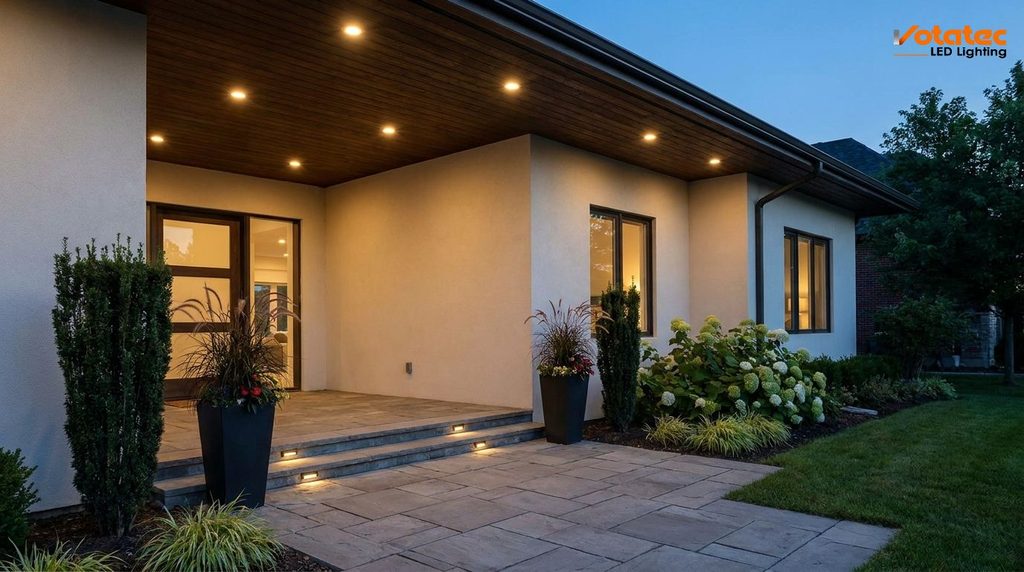
Exterior Pot Lights Spacing for Soffits and Eaves
Beam angle without spacing math is just a number. Here’s how to turn it into an exterior pot lights layout.
The spacing rule
Once you have pool diameter from the table above, pick your look. Space exterior pot lights at:
- 0.75x to 1.0x pool diameter for a continuous wash with no visible gaps. Pools overlap into one even band.
- 1.25x to 1.5x for distinct scalloped pools. You’ll see separate circles. Some architects want this.
- Deliberate overlap for security coverage. Dark gaps are where people hide.
Spacing by soffit height, 60-degree beam
| Soffit height | Pool diameter | Continuous wash | Distinct pools |
|---|---|---|---|
| 8 ft | 9.2 ft | 7 to 9 ft apart | 11 to 14 ft apart |
| 9 ft | 10.4 ft | 8 to 10 ft apart | 13 to 16 ft apart |
| 10 ft | 11.5 ft | 9 to 11 ft apart | 14 to 17 ft apart |
| 12 ft | 13.9 ft | 10 to 14 ft apart | 17 to 21 ft apart |
The common advice to “space them 6 to 8 feet apart” only really holds at 8-foot soffits with a 60-degree beam. Push the soffit higher or the beam wider and that rule falls apart.
Spacing mistakes to avoid
- Centring on the soffit instead of the architecture. Line exterior pot lights up with windows, columns, and garage bays. A light landing between two windows looks like a mistake, because it is one.
- Ignoring the corner. Corners need a fixture within about half the normal spacing, or the building edge goes dark and the massing disappears at night.
- Forgetting soffit depth. Exterior pot lights set too far back light the fascia, not the ground. Keep them in the outer third.
- Equal spacing across unequal runs. A 40-foot run and a 12-foot porch run don’t get the same layout.
For cutout sizing, our trimless recessed downlight sizing guide covers the 2-inch through 4-inch range.
IC Rating for Exterior Pot Lights in a Soffit
IC stands for Insulation Contact. An IC-rated fixture can sit directly against insulation without becoming a fire risk. Non-IC fixtures need clearance, usually 3 inches.
Here’s why this bites on exterior pot lights specifically. Soffits and eaves are exactly where attic insulation gets pushed by wind or sloppy installation. You can plan for clearance and get contact anyway, six months later, when someone tops up the attic. Specify IC-rated exterior pot lights on any soffit connected to an insulated attic. Costs little, removes the variable.
There’s a second reason. In cold climates a non-IC fixture in an eave is a thermal bypass. Warm indoor air leaks past it into the soffit cavity, hits the cold roof deck, and condenses. That’s how you get ice damming and mystery water stains. IC-rated, airtight-gasketted exterior pot lights cut that path off.
Colour Temperature and CRI for Exterior Pot Lights
Colour temperature on exterior pot lights is measured in Kelvin. Lower is warmer.
- 2700K to 3000K: the residential range. Warm, welcoming, and still clean enough to read brick and stone properly. 3000K is the Canadian default.
- 4000K: neutral white, the commercial default. Better perceived brightness and colour accuracy, which matters for security cameras.
- 5000K: daylight. Maximum visibility, but it reads institutional and makes warm brick look grey.
Keep it consistent across the building. Mixed colour temperature on one facade is the most visible lighting error there is.
Many Votatec exterior pot lights ship with 5-way selectable CCT, so you set temperature on site with a switch instead of committing at the order stage. On CRI: 80 is fine generally, 90+ where stone or wood colour matters.
Sizing and Trim Choices for Exterior Pot Lights
Aperture size
- 3-inch: discreet and modern, for narrow soffits and accent runs. Less output, so tighter spacing.
- 4-inch: the workhorse size for exterior pot lights. Best balance of output, cutout, and cost.
- 6-inch: more lumens per fixture, wider spacing, more visible aperture. Common on commercial canopies.
Measure soffit depth before ordering exterior pot lights. Vinyl and aluminum panels sit close to the framing, and some housings won’t fit. Canless or wafer-style exterior pot lights need only about 2 inches of depth.
Trim style
- Baffle: ridged interior, cuts glare. The best default outdoors.
- Regressed: LED set deep behind the aperture. Lowest glare, strong on tall soffits.
- Reflector: maximum output, more glare. Fine for utility areas, less so over a front entry.
- Gimbal: aims up to about 30 degrees off vertical, for grazing a wall. Our gimbal recessed light guide covers aiming angles.
Canadian Code Requirements for Exterior Pot Lights
The Canadian Electrical Code handles lighting in Section 30. Rules 30-316 through 30-322 set requirements for luminaires in damp and wet locations, including totally enclosed gasketted fixtures. Provinces adopt the CE Code with their own amendments, so the governing version is the provincial one. Ontario’s is published by the ESA as the Ontario Electrical Safety Code.
Practical points for exterior pot lights:
- The certification mark is mandatory. No mark, no legal install.
- Wet-location marking must match the application. An inspector can and will fail damp-rated exterior pot lights in an exposed soffit.
- Outdoor receptacles need Class A GFCI protection under current code, relevant if exterior pot lights go in alongside a new outdoor outlet.
- Permits. Hardwired work altering permanent wiring generally needs one.
A note on rebates. ENERGY STAR certification for general-purpose luminaires has changed considerably in recent years, so don’t assume a fixture qualifies because a datasheet says so. Verify current programme status through ENERGY STAR Canada at Natural Resources Canada first.
Cold-Weather Performance of Exterior Pot Lights
Most exterior pot lights spec sheets are written for a mild climate. Ours isn’t one. LEDs actually like cold, and efficacy improves slightly as temperature drops. The failure points sit elsewhere:
- Driver cold-start rating. Many budget drivers stop at -20°C, which an Edmonton winter clears easily. Specify -30°C or lower.
- Gasket material. Cheap rubber hardens and cracks through freeze-thaw cycles. Silicone stays flexible. This is the top cause of water ingress on exterior pot lights that passed their IP test when new.
- Thermal cycling. A fixture that heats up then meets cold rain breathes. Air moves through weak seams and carries moisture in. Look for a potted driver compartment.
- Condensation, not leaks. Fogged lenses are usually internal condensation. Exterior pot lights with a breather membrane handle it properly.
Freeze-thaw cycling is harder on a fixture than steady deep cold. Coastal BC, swinging around zero, is tougher on gaskets than a stable prairie winter.
Voltage: 120V vs 347V Exterior Pot Lights
Residential exterior pot lights run on 120V. Straightforward.
Canadian commercial and institutional buildings are frequently wired 347/600V, a distinctly Canadian standard you won’t meet in the US market. Specifying exterior pot lights for a school, arena, or municipal building? Check the panel voltage first. Native 347V beats step-down transformers: cheaper to install, one less failure point. And note that multi-voltage drivers often span 120-277V, which covers most commercial cases but not 347V. Read the driver spec, not the marketing copy.
Common Mistakes When Buying Exterior Pot Lights
- Buying on IP rating alone. No certification mark means it can’t legally go in.
- Assuming IP67 beats IP65. Different tests, as covered above.
- Reusing indoor fixtures under a covered porch. Usually voids the warranty.
- Skipping beam angle. The most common cause of blotchy, amateur-looking exterior pot lights.
- Mixing colour temperatures. Instantly visible. Order all exterior pot lights at once, from one batch.
- Ignoring soffit depth. Measure before ordering, not after the truck arrives.
- Forgetting the driver’s minimum temperature. A -20°C driver in a -35°C January is a warranty claim.
- No photocell or timer. Manual switching means lights left on all day. A photoelectric sensor fixes that for a few dollars.
- Under-specifying corners. Dark building edges undo the whole layout.
Exterior Pot Lights Spec Checklist
Run this before the purchase order goes out:
- Wet-location listed with a recognised certification mark, confirmed on the fixture label, not just the web page.
- IP65 minimum. IP66 for exposed or pressure-washed elevations.
- Beam angle chosen against actual soffit height, using the multiplier table.
- Spacing laid out to architecture, corners included.
- IC rated if insulation contact is possible.
- Aperture checked against real soffit depth.
- Colour temperature consistent across the building.
- Driver rated for your province’s minimum temperature, with a silicone gasket and sealed driver compartment.
- Voltage confirmed against the panel, 347V checked on commercial work.
- Warranty in writing, with the wet-location application named.
Browse wet-location listed, IC-rated exterior pot lights in the Votatec LED downlight range. For covered commercial entries and drive-throughs, canopy lights often fit better, and for grounds and pathways there’s landscape lighting. More background sits on the Votatec blog.
Frequently Asked Questions
Are there pot lights rated for outdoor use?
Yes. Exterior pot lights are a standard category, listed for damp or wet locations depending on the model. The important part is matching the listing to actual exposure. Open eaves and exposed soffits are wet locations and need a wet-location listing. Fully sheltered porches can sometimes take damp-rated fixtures. Check the label on the fixture itself, because the listing is printed on the product, not just claimed in a catalogue.
What IP rating do I need for exterior pot lights in Canada?
IP65 is the practical minimum for soffit-mounted exterior pot lights. It means dust-tight plus resistance to water jets from any direction, covering rain, wind-driven spray, and hose washing. Step up to IP66 for exposed elevations, coastal locations, or anywhere a pressure washer is used. Choose IP67 only where water actually pools, and remember it doesn’t automatically include jet protection.
Can I use indoor pot lights outside under a covered soffit?
Usually not, and it’s a bad bet. Indoor fixtures are typically dry-location rated, meaning no protection against humidity or condensation, let alone splash. Even a deep covered soffit sees wind-driven rain and heavy seasonal condensation in Canada. A dry-rated fixture there voids the warranty, can fail inspection, and creates a real shock hazard. Wet-rated exterior pot lights remove the argument entirely.
What beam angle is best for exterior pot lights?
A 60-degree beam suits most soffit installs at 8 to 10 feet, giving a pool roughly 1.16 times the mounting height in diameter. Go narrower, 24 to 38 degrees, for accent work or tall two-storey soffits where output must carry further. Go wider, 80 to 100 degrees, for low porch and carport ceilings. Multiply mounting height by the beam multiplier to get pool size, then space accordingly.
How far apart should exterior pot lights be spaced?
Work it from beam angle and mounting height, not a fixed number. For a continuous even wash, space exterior pot lights at 0.75 to 1.0 times the lit pool diameter. For distinct separated pools, use 1.25 to 1.5 times. With a 60-degree beam in a 9-foot soffit that’s roughly 8 to 10 feet apart. Tighten spacing at building corners, and align fixtures with windows and garage bays rather than dividing the run into equal parts.
Bottom Line Exterior Pot Lights Buying Guid
Exterior pot lights aren’t complicated, but they are unforgiving. The three specs in this guide’s title carry almost all the risk.
Wet-location listing keeps the install legal. IP rating decides how long exterior pot lights last outdoors, with IP65 as the floor and the IP67 assumption as the trap to dodge. Beam angle, paired with honest spacing math, separates a facade that looks designed from one that looks guessed.
Measure the soffit. Check the driver’s cold rating. Confirm the certification mark on the fixture label. Then order all your exterior pot lights in one batch so the colour temperature matches.
Need help specifying exterior pot lights for a Canadian project? Votatec supplies contractors, facility managers, and public-sector buyers across Canada with wet-location listed, IC-rated exterior pot lights at wholesale pricing. Request a quote with your soffit heights and elevation lengths, and we’ll work the layout with you.