












 (+1) 905 597 5955


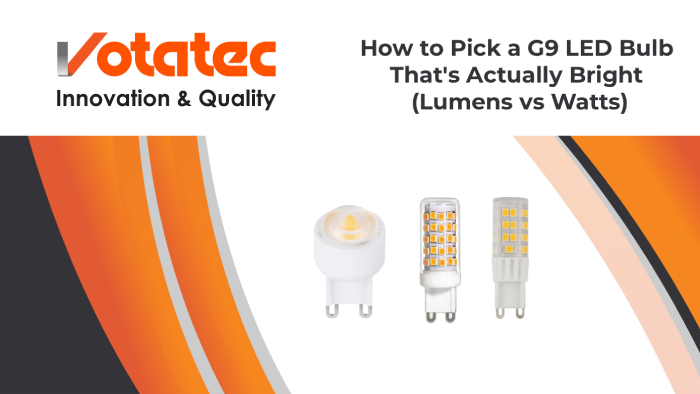

Pick a G9 LED bulb by its lumens, not its wattage. A 40W halogen G9 puts out roughly 400 to 500 lumens, so any LED that hits that lumen range will match the brightness your client expects, while pulling about 80% less power (Engineer Fix). The old habit of matching wattage falls apart with LED. A 4W LED can outshine a 40W halogen. Wattage now tells you energy draw. Lumens tell you light.
That single shift causes most of the callbacks contractors get on G9 swaps. The fixture looks dim, the colour looks off, or the bulb flickers on a dimmer. Below is how to spec the right G9 LED the first time, plus a halogen-to-LED chart you can keep on your phone.
What is a G9 LED bulb?
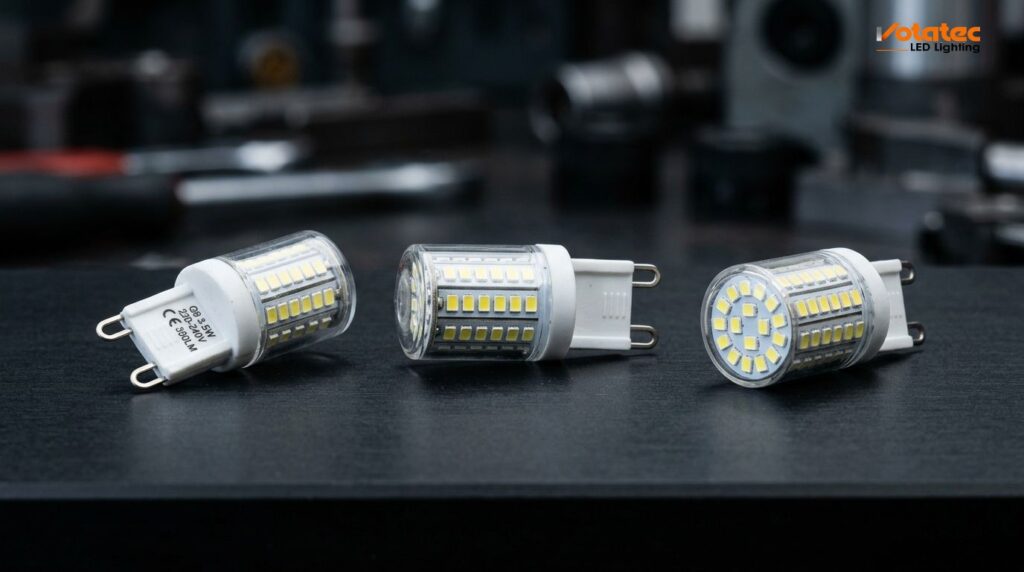
A G9 LED bulb is a compact, bi-pin LED lamp with two looped pins spaced 9mm apart. The “9” in G9 refers to that 9mm pin spacing. It pushes straight into the socket. No screw, no twist.
You’ll see G9 sockets in chandeliers, bathroom vanity bars, wall sconces, pendant clusters, and some landscape fixtures. For decades those fixtures shipped with 25W, 40W, or 60W halogen capsules that ran hot and burned out fast. The G9 LED is the drop-in fix.
Lumens vs watts: the number that actually matters
Here’s the rule. Lumens measure brightness. Watts measure energy use. With halogen, the two tracked together, so people learned to shop by watts. LED broke that link. Now you match the lumen output of the old bulb and ignore the wattage gap.
Use this chart when you’re swapping halogen G9 capsules for LED:
| Old halogen G9 | Approx. lumens to match | Typical LED wattage | Energy saved |
|---|---|---|---|
| 20W halogen | 200 to 250 lm | 2W to 3W LED | ~85% |
| 25W halogen | 250 to 300 lm | 3W LED | ~85% |
| 40W halogen | 400 to 500 lm | 3.5W to 4.5W LED | ~80% |
| 60W halogen | 600 to 700 lm | 5W to 6W LED | ~80% |
Watch the “equivalent” labels on cheap import bulbs. A bulb sold as “40W equivalent” should deliver 400-plus lumens. Many don’t. Always check the lumen figure printed on the box or spec sheet, not the equivalency claim on the front.
How many lumens do you need?
It depends on the fixture and the room. Match the old output as a baseline, then adjust:
- Chandeliers (multi-bulb): 300 to 400 lm per lamp. Six lamps at 350 lm gives plenty of fill.
- Bathroom vanity bars: 400 to 650 lm per lamp for good face lighting at the mirror.
- Wall sconces and accent fixtures: 200 to 350 lm. You want warmth, not glare.
- Landscape and pendant: match the original capsule, usually 300 to 500 lm.
When a client says a room feels dim after a retrofit, the cause is almost always under-spec’d lumens, not a bad bulb.
7 specs to check before you spec a G9 LED
Brightness is step one. These six checks decide whether the job comes back to bite you.
1. Lumen output
Covered above. Get the real number off the spec sheet. For commercial jobs, ask the supplier for the photometric data, not the box claim.
2. Colour temperature (CCT)
Measured in Kelvin. This sets the mood of the light:
- 3000K (warm white): the standard for chandeliers, homes, and hospitality. Closest to old halogen.
- 4000K (neutral): clean and modern, good for vanities and retail.
- 5000K to 6000K (daylight): crisp white for task areas and some commercial spaces.
Match every lamp in a fixture to the same CCT. Mixed Kelvin in one chandelier looks broken. Most decorative G9 work lands at 3000K.
3. Colour rendering index (CRI)
CRI rates how accurately the light shows colour, on a 0 to 100 scale. Aim for CRI 80 or higher for general work, and CRI 90-plus where colour accuracy matters, like retail display or high-end residential (Saco Lighting). Skin tones and finishes look washed out below CRI 80.
4. Dimmable and dimmer compatibility
If the fixture sits on a dimmer, the bulb must say “dimmable” on the spec sheet. That’s only half the job. The dimmer itself has to suit LED loads. Old leading-edge halogen dimmers often buzz or flicker with low-wattage LED. Many G9 retrofits need a trailing-edge or LED-rated dimmer to run smooth from 0 to 100%.
Spec the bulb and check the dimmer together. This is the number one callback on G9 jobs.
5. Base and physical size
The pins are standard at 9mm. The body is not. G9 LEDs vary in length and width, and some are taller than the halogen capsule they replace. In a tight enclosed shade or a small sconce, an oversized bulb won’t seat or the glass won’t close. Check the listed dimensions against the fixture cavity before you order a full case.
6. Flicker
Cheap drivers flicker. You may not see it, but cameras catch it and it causes eye strain over a shift. Look for a “no flicker” or “flicker-free” rating on the spec sheet. For any space where people work or where video gets shot, this is non-negotiable.
7. Enclosed-rating and base material
Many G9 fixtures are sealed or partly enclosed, which traps heat. Heat is what kills LED drivers early. Confirm the bulb is rated for enclosed fixtures, and favour a ceramic base over plastic. Ceramic handles heat better and supports the long rated life (Saco Lighting).
One more North American note. G9 LEDs sell in both 120V and 220 to 240V. Confirm you’re buying 120V for Canadian work. A 230V bulb will look dim or fail on our grid.
Common mistakes contractors make with G9 swaps
We see the same five errors on retrofit jobs:
- Shopping by watts. A 40W habit leads to over- or under-lit rooms. Read lumens.
- Skipping the dimmer check. The bulb dims fine on a modern dimmer and buzzes on a 15-year-old one.
- Mixing colour temperatures across one fixture. The client notices immediately.
- Ignoring fixture size. The bulb won’t seat under the shade, and now you’re driving back.
- Buying no-name import bulbs with inflated equivalency claims and no flicker or CRI data. The savings vanish on the first warranty call.
Spec the full set of numbers up front and the job stays closed.
Votatec’s G9 LED range
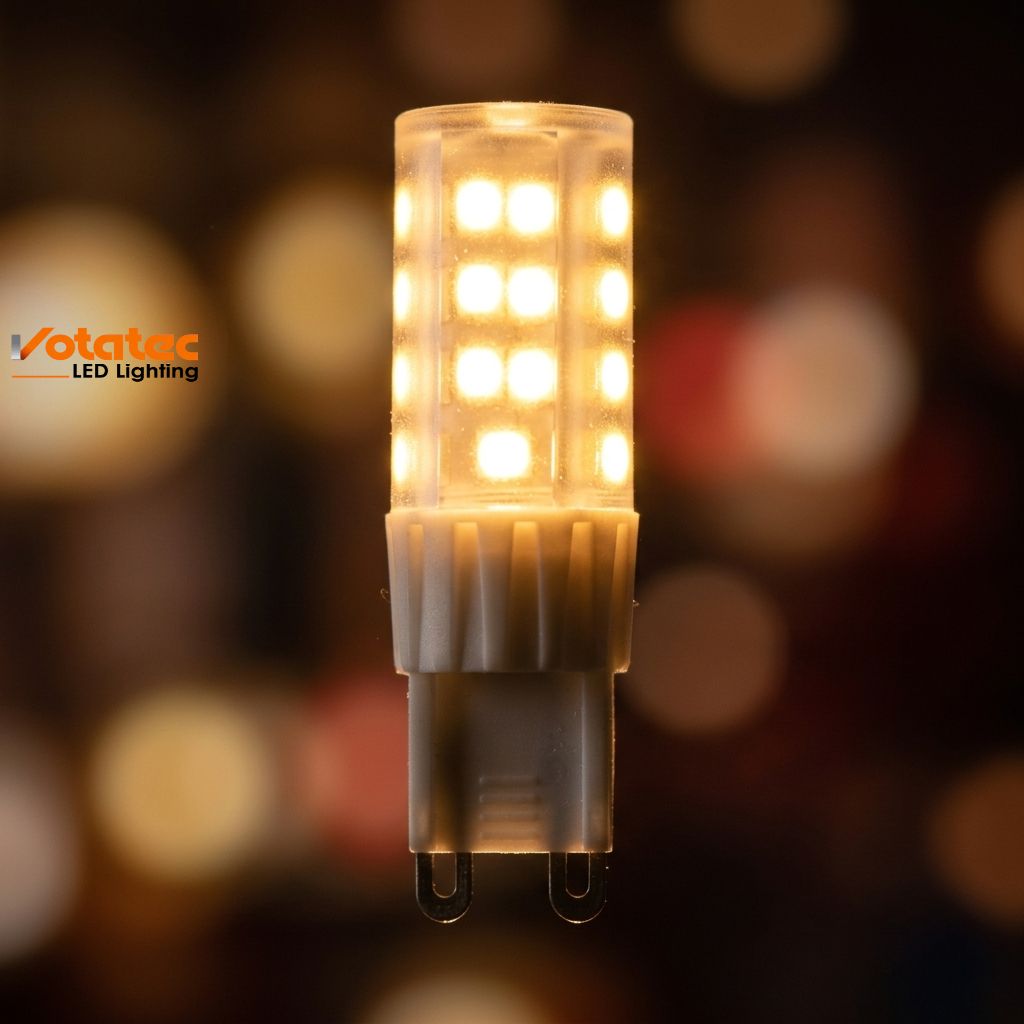
We stock G9 LEDs built for the spec sheet, not the box claim. Every Votatec G9 is dimmable, ETL listed, CRI greater than 80, flicker-free, 120V, and rated 25,000 hours, with colour temperature options from 3000K through 6000K.
| Votatec G9 LED | Brightness | Replaces | Beam angle | CCT options |
|---|---|---|---|---|
| G9 LED – 3W | 270 to 300 lm | 25W halogen | 100° | 3000K to 6000K |
| G9 LED – 3.5W | 400 lm | 40W halogen | 360° | 3000K to 6000K |
| G9 LED – 6W | 650 lm | 60W halogen | 360° | 3000K to 6000K |
See the full G4/G9 range, or browse all LED light bulbs. Pricing is wholesale and quoted per order for business customers.
Spec’ing a project? Request a wholesale quote with your fixture type and quantities. We’ll match the right G9 LED to your lumen, CCT, and dimming needs and send photometric data for your submittal.
Frequently asked questions
How many lumens replace a 40W halogen G9?
About 400 to 500 lumens. A 40W halogen G9 produces roughly that range, so a G9 LED in the 3.5W to 4.5W class with 400-plus lumens will match it while using around 80% less energy (Engineer Fix).
Are G9 LED bulbs dimmable?
Some are, some aren’t. Only buy a bulb that states “dimmable” on its spec sheet, and pair it with an LED-rated or trailing-edge dimmer. Older halogen dimmers often flicker or buzz with low-wattage LED loads. Every Votatec G9 is dimmable.
What colour temperature is best for a G9 chandelier?
3000K warm white. It’s closest to the halogen glow people expect in decorative fixtures and the most popular choice for residential and hospitality work. Keep every lamp in the fixture at the same Kelvin.
Can I put a G9 LED in an enclosed fixture?
Only if the bulb is rated for enclosed fixtures. Sealed shades trap heat, which shortens LED driver life. Look for an enclosed-rating on the spec sheet and a ceramic base, which handles heat better than plastic.
Why does my G9 LED flicker?
Usually a dimmer mismatch or a low-quality driver. Confirm the bulb is flicker-free rated, then check that the dimmer suits LED loads. If both check out and it still flickers, the fixture wiring or transformer may be the cause.
The bottom line
Stop shopping by watts. Match the lumen output of the old halogen, then confirm CCT, CRI, dimming, fixture fit, flicker, and a 120V enclosed rating before you order a case. Get those numbers right and a G9 LED swap is clean, energy-saving, and callback-free.
- Read lumens, not watts to match brightness.
- 40W halogen needs about 400 to 500 lumens of LED.
- Check the dimmer alongside the bulb on every dimmable job.
- Match CCT across the whole fixture, usually 3000K.
- Confirm 120V and an enclosed rating for Canadian work.
Ready to spec a job? Request a wholesale quote from Votatec and we’ll match the right G9 LED to your project.