










 (+1) 905 597 5955



When comparing metal halide vs LED high bays, the answer is clear: LED wins. By a wide margin.
A 400W metal halide fixture and a 150W LED high bay deliver similar light output. The LED uses 67% less electricity, lasts three times longer, and needs zero lamp replacements for a decade. For a 50-fixture warehouse in Ontario, that gap works out to over $22,000 per year in combined energy and maintenance savings (Luma Energy, 2025).
That’s the headline. The rest of this article breaks down exactly how the numbers work so you can put together a solid business case for your facility.
At a glance:
- A 150W LED high bay equals a 400W metal halide in usable light output
- LED uses 67% less electricity per fixture, every hour it runs
- Metal halide loses 40% of its output within 18 months – LED holds 90%+ for 10+ years
- A 50-fixture Ontario warehouse saves $23,000+ per year in energy and maintenance combined
- Average payback period: 1.9 years (WattMath, 2025)
Why Facility Managers Are Moving Away from Metal Halide
Metal halide was the best high-bay option available for decades. It produces bright, white light at reasonable wattages and was a genuine step up from older high-pressure sodium technology.
The problem is what happens over time.
Metal halide lamps start losing output almost immediately after installation. By 8,000 hours – roughly 18 months of two-shift operation – they’ve already shed 40% of their initial lumens (LED Expert, 2024). The fixture is still running. Your electricity bill is still full price. You’re getting significantly less light for the same cost.
A 400W metal halide also has a total system wattage of about 458W once you account for ballast losses, and it converts approximately 70% of its energy into waste heat rather than light (Hylele, 2025). That heat raises ambient temperature in your facility and adds to cooling loads.
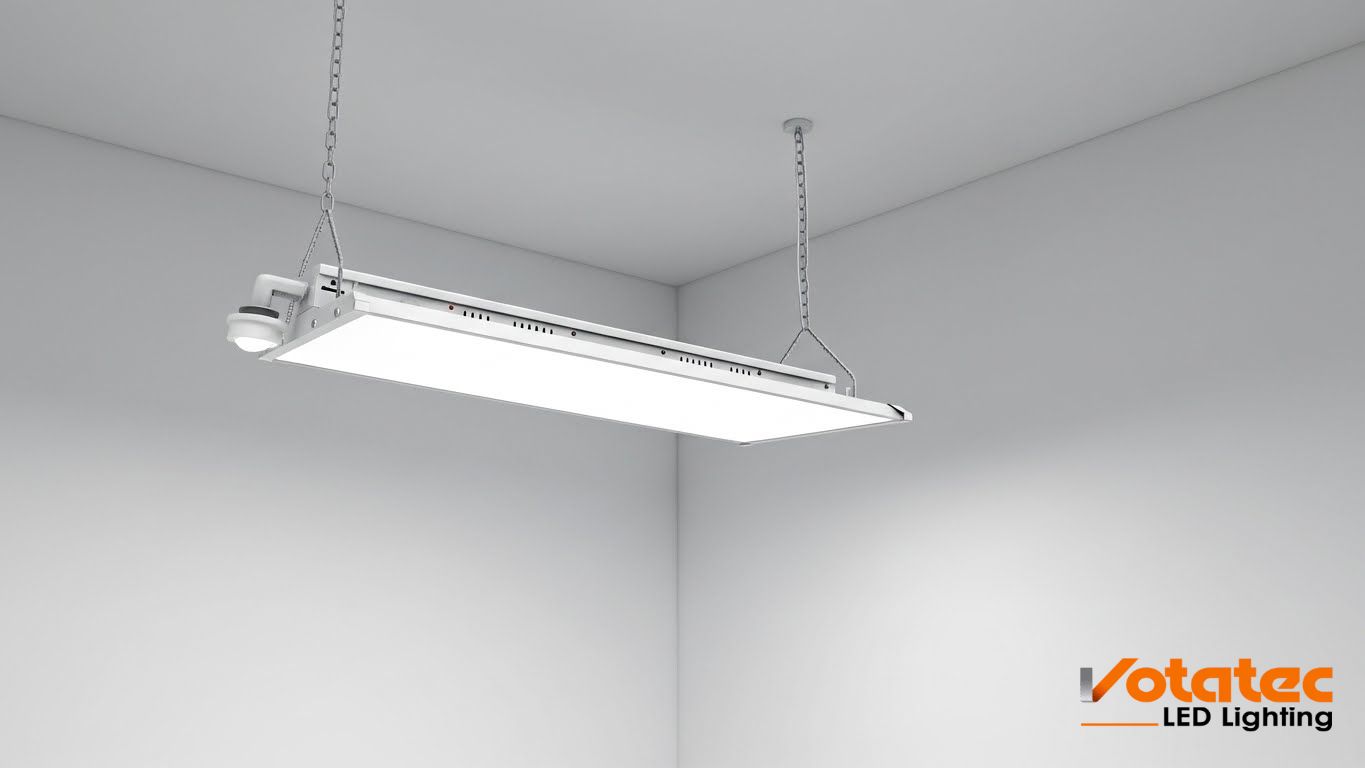
LED high bays work differently. Efficient from day one. Output stays consistent throughout their service life. No lamp replacements for 10+ years under normal operating conditions.
The sections below go through each performance category with real numbers.
How Does Energy Efficiency Compare?
This is where the difference is most direct.
A standard 400W metal halide delivers roughly 65-75 lumens per watt at the system level, including ballast losses. A modern LED high bay delivers 130-180 lumens per watt (LED Lighting Supply, 2025). That’s not a marginal improvement. It’s a different category.
Wattage by wattage:
| Metal Halide Wattage | Total System Load (incl. ballast) | LED Equivalent | Energy Reduction |
|---|---|---|---|
| 250W | ~290W | 75-100W | ~65% |
| 400W | ~458W | 150W | ~67% |
| 1000W | ~1,100W | 300-400W | ~64% |
| 1500W | ~1,650W | 450-600W | ~64% |
For a facility running 50 fixtures at 400W, 16 hours per day, 220 operating days per year, at Ontario’s approximate $0.15/kWh rate:
- Annual energy cost (metal halide): ~$16,200
- Annual energy cost (LED): ~$5,280
- Annual savings from energy alone: ~$10,920
That figure scales with fixture count, daily operating hours, and your local electricity rate. Facilities in BC and Alberta running on higher-rate time-of-use pricing see even faster payback.
How Long Does Each Technology Actually Last?
Metal halide lamps carry a rated life of 15,000-20,000 hours. That sounds adequate until you look at lumen depreciation.
In practice, most metal halide installations need re-lamping well before the rated end of life. By 8,000-12,000 hours, output has dropped far enough that the fixture is no longer delivering the lux levels the space was designed around. Light levels at 55-60% of initial output often fall below minimum recommendations for tasks like picking, quality control, or safe vehicle movement.
Lumen depreciation – the real gap:
| Time / Hours | Metal Halide Lumen Output | LED Lumen Output |
|---|---|---|
| Installation (Day 1) | 100% | 100% |
| 8,000 hours (~18 months at 2 shifts) | ~60% | ~95% |
| 15,000-20,000 hours | ~43-57% | ~90%+ |
| 50,000 hours | Lamp replaced multiple times by this point | ~70%+ (L70 rating) |
LED high bays are rated using the L70 metric: the point at which output drops to 70% of initial lumens. For quality high-bay fixtures, L70 falls between 50,000 and 100,000 hours (Access Fixtures, 2024). That’s 10-20+ years in a two-shift operation.
Your metal halide fixtures are getting dimmer every year while drawing the same electricity. Your LED fixtures are doing essentially the same work at year 10 as they were on day one.
What Does Metal Halide Maintenance Actually Cost?
This is the part that often surprises people who’ve only looked at energy comparisons.
A metal halide lamp replacement isn’t just the cost of the lamp. In a typical warehouse or distribution centre, high-bay fixtures are mounted at 8-15 metres. You need an aerial work platform to access them. That means lift rental, operator time, and possibly a maintenance contract with an electrical contractor.
Realistic per-cycle cost per fixture:
- Lamp: $20-$40
- Ballast (when due): $80-$150
- Lift rental (allocated per fixture): $120+
- Licensed electrician time: $150-$300
A 50-fixture facility replacing lamps every 18-24 months can expect $12,200 or more in annual maintenance costs (Luma Energy, 2025). That number includes the ballast failures that happen mid-cycle – ballasts fail on their own schedule, not yours.
With LED high bays, that cost drops to near zero for the first decade. No lamps, no ballasts, no lift rental for re-lamping. Maintenance is limited to keeping optics clean, which applies to any fixture type.
What Is the Real Payback Period for LED High Bays in Canada?
LED high bays carry a higher upfront cost than metal halide fixtures. The relevant question is how quickly that investment pays for itself.
An analysis of 50 real commercial retrofit projects showed an average payback period of 2.1 years for LED high-bay retrofits, with warehouse and distribution facilities averaging 1.9 years (WattMath, 2025).
Combined annual savings for a 50-fixture Ontario warehouse:
| Savings Category | Annual Amount |
|---|---|
| Energy savings (400W to 150W, 16h/day, 220 days, $0.15/kWh) | ~$10,920 |
| Maintenance cost elimination | ~$12,200 |
| Total annual savings | ~$23,120 |
Add applicable provincial rebates and the payback timeline tightens further. Ontario’s IESO and most major Canadian utilities – BC Hydro, Hydro-Québec, FortisBC, Enbridge Gas – offer commercial lighting rebate programmes that typically cover $25-$150 per qualifying LED fixture. Some Ontario facilities with standard warehouse layouts are seeing post-rebate paybacks under 18 months.
Ten-year ROI for a typical warehouse retrofit sits at 380-400% on the initial investment (WattMath, 2025). Few building upgrades deliver this kind of return at comparable speed.
Is the Light Quality Actually Better with LED?
Energy savings drive most retrofit decisions. Light quality closes the argument.
Colour rendering index (CRI)
Metal halide fixtures typically have a CRI of 60-75. LED high bays are rated at 80-95+. CRI measures how accurately colours appear under artificial light compared to natural daylight. At CRI 60-75, workers may struggle to distinguish similar packaging shades, spot damage on products, or read labels under the fixture.
At CRI 80-90, everything looks sharper and more natural. Distribution centres with diverse SKU ranges often report fewer picking errors after switching to higher-CRI LED.
Warm-up and re-strike time
Metal halide takes 1-15 minutes to reach 90% brightness from cold start. After being switched off, it requires a 15+ minute cooling period before it can re-strike (Stouch Lighting, 2024). LED high bays reach full output in milliseconds.
The operational consequence: metal halide is incompatible with occupancy sensors. If you switch it off during a quiet period, it’s out of service for 30+ minutes. Facilities keep it running continuously in zones with intermittent traffic – storage areas, corridors, dock areas – even when those zones are empty.
LED high bays work with any occupancy sensor or daylight dimming control. Zones with variable occupancy typically see an additional 15-30% energy reduction on top of the base efficiency gain.
Heat output
A 400W metal halide converts about 70% of its energy input into heat rather than light. Multiple fixtures in an enclosed space raise ambient temperature. This adds to cooling loads in summer and creates uncomfortable conditions for workers in high-density picking areas. LED high bays produce minimal heat by comparison.
Metal Halide vs LED High Bays: Wattage Equivalents
When specifying a retrofit or comparing bids, use this table as a starting point. LED initial lumen output is often lower than metal halide’s initial output, but LED maintains that output over its full service life while metal halide drops significantly.
| Metal Halide | LED Equivalent | Approximate Lumen Output (LED) | Typical Application |
|---|---|---|---|
| 150W | 50-60W | 7,000-9,000 lm | Low-ceiling spaces under 6m |
| 250W | 75-100W | 12,000-16,000 lm | Small warehouses, mezzanines |
| 400W | 150W | 19,500-21,000 lm | Standard warehouse bays (8-12m) |
| 1000W | 300-400W | 35,000-50,000 lm | High-ceiling facilities (12-18m) |
| 1500W | 450-600W | 50,000-80,000 lm | Very high bays (18m+) |
Your specific installation will depend on ceiling height, mounting pattern, and required maintained lux level. A qualified lighting designer or your LED supplier can run a photometric calculation for your floor plan.
Can You Retrofit Existing Metal Halide Fixtures?
Two paths forward.
LED retrofit lamps (ballast bypass): LED retrofit lamps designed as direct replacements for metal halide are available and require the existing ballast to be bypassed. Labour costs are lower since you’re keeping the housing. The downside: you’re working with an aging housing, reflector, and optic that may be 10-15 years old.
New LED high bay fixtures: Full fixture replacement costs more upfront but delivers the performance of current LED design – optimised optics, integrated thermal management, and up-to-date efficacy ratings. Payback periods are comparable to retrofit because the performance gains are proportionally higher.
For fixtures over 10 years old, new LED high bays are usually the better investment. The retrofit lamp approach makes more sense for newer, well-maintained metal halide housings where the housing condition is still good.
In both cases, installation must be done by a licensed electrical contractor. High-bay work at height requires proper equipment, and ballast bypass work must meet the Canadian Electrical Code.
Frequently Asked Questions about Metal Halide vs LED High Bays
How many watts of LED replaces a 400W metal halide high bay?
A 150W LED high bay is the standard equivalent for a 400W metal halide fixture. Including ballast losses, the metal halide system actually draws about 458W total. The LED draws 150W. That’s a 67% reduction in electricity per fixture, every hour the lights are on.
How long does a metal halide lamp actually last in real-world use?
The rated lamp life is 15,000-20,000 hours, but most facilities re-lamp at 8,000-12,000 hours. Lumen depreciation reduces output by 35-45% before the lamp physically fails. Light levels fall below minimum recommendations for the tasks in the space, so practical service life is shorter than the specification suggests.
What is an L70 rating for LED high bays?
L70 is the point at which an LED fixture maintains 70% of its initial lumen output. It’s the industry standard for defining LED service life. Quality LED high bays are rated L70 at 50,000-100,000 hours (Access Fixtures, 2024). That means 10-20+ years at 70% or better output before performance degrades to the level a brand-new metal halide lamp starts at.
Are there rebates for LED high bay retrofits available in Canada?
Yes. Ontario’s IESO, BC Hydro, Hydro-Québec, FortisBC, Enbridge, and most major provincial utilities run commercial lighting rebate programmes. Typical rebates range from $25-$150 per fixture for qualifying LED replacements. Programme details and eligibility criteria change regularly. Contact your utility or a local lighting contractor to confirm current incentives before purchasing.
Is a 2-year payback realistic for a Canadian warehouse?
For facilities running two shifts, yes. An analysis of 50 commercial high-bay retrofit projects showed a 1.9-year average payback for warehouses (WattMath, 2025). This accounts for energy savings only. Adding maintenance cost elimination and applicable provincial rebates, some Ontario facilities see paybacks under 18 months.
Does higher CRI actually matter for warehouse lighting?
For bulk storage only, CRI 70-80 is adequate. For distribution centres with diverse SKU ranges, any space where workers identify damage or read labels under the fixture, CRI 80-90 LED makes a measurable difference. Picking errors decrease. Workers find the lighting less fatiguing. The improvement is visible within days of switching from older metal halide.
Final Thought about Metal Halide vs LED High Bays
Metal halide built the industrial lighting market. For decades, it was the right choice for high bays. LED high bays have changed that.
The performance gap keeps widening. A 150W LED high bay outperforms a 400W metal halide on energy, maintenance, lifespan, and light quality. The economics work at almost every facility size across Canada, with or without utility rebates.
If you’re running metal halide high bays in a warehouse, distribution centre, manufacturing plant, or government facility, the question isn’t whether to upgrade. It’s when, and which product fits your specific application.