










 (+1) 905 597 5955


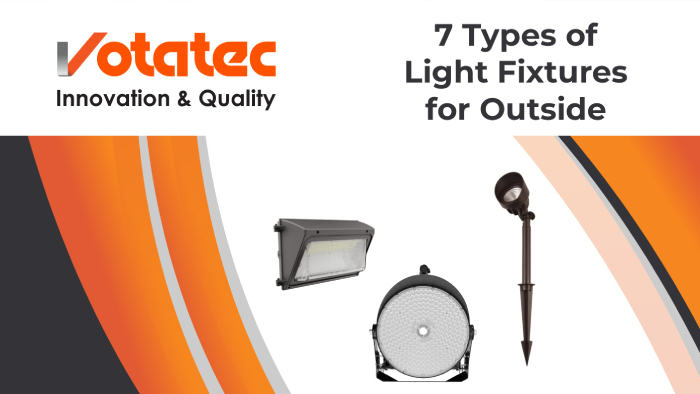

Picking the right light fixtures for outside comes down to one question: what job does the fixture need to do? A wall pack that lights a loading dock is the wrong tool for a walkway. A bollard that guides foot traffic can’t light a parking lot. Match the fixture to the task and the spec sheet almost writes itself.
This guide covers the 7 outdoor fixture types you’ll spec most often on commercial and institutional jobs. For each one, you get the job it does, where it mounts, and the ratings that matter on a Canadian site. If you’re bidding a retrofit, it also flags the certifications that keep the project rebate-eligible. Let’s get to it.
What to check before you spec outdoor light fixtures
Every exterior luminaire, no matter the type, has to clear the same short list. Get these right first, then choose the fixture.
- Wet vs damp location rating. Anything exposed to rain, snow, or sprinklers needs “Suitable for Wet Locations.” A fixture marked “Suitable for Damp Locations” is only good for covered, protected spots like a soffit or deep canopy. Wet-rated covers wet, damp, and dry; damp-rated does not cover wet. These markings follow CSA luminaire certification standards and tie back to Section 30 of the Canadian Electrical Code.
- IP rating. Ingress Protection tells you how sealed the housing is. IP65 blocks dust and low-pressure water jets. IP66 handles powerful jets. For exposed pole and wall gear, IP65 is the working minimum.
- DLC or ENERGY STAR listing. If your client wants a rebate, this isn’t optional. Roughly 70% of North American efficiency programs require the fixture to be listed by DLC or ENERGY STAR. No listing, no cheque.
- BUG rating. Backlight, Uplight, and Glare, scored 0 to 5 each, from the IES TM-15-11 standard and backed by DarkSky International. Lower is better. Many municipalities now write dark-sky limits into their bylaws, so check the local rules before you order.
- Colour temperature (CCT). DarkSky caps its approved commercial luminaires at 3000K to cut blue light spill. 4000K still shows up on plenty of sites, but 3000K is the safer choice near residential property lines.
Keep that checklist handy. Now the fixtures.
1. Wall pack lights: perimeter and entrance security
Wall packs are the workhorse of building-mounted outdoor lighting. They bolt to an exterior wall and throw light down and out across the ground below. That makes them the default choice for building perimeters, back doors, loading areas, and egress paths.
The job: cover the ground next to a building for safety and security. Not decoration.
Older wall packs used a drop lens that spilled light sideways and up, which reads as glare and light trespass. Modern full-cutoff LED wall packs push light down where it’s needed and score better on the BUG scale. Spec a full-cutoff or semi-cutoff model near a property line to keep backlight off the neighbour’s yard.
Mounting height usually runs 8 to 15 feet. Add a photocell so the fixture runs dusk to dawn without a timer, or a motion sensor for low-traffic areas where you want light only on demand.
Browse Votatec’s LED wall pack lights for full-cutoff and adjustable options.
2. Area lights: parking lots, roadways, and yards
Area lights, also called shoebox or pole lights, mount on top of a pole and light large open ground. Parking lots, storage yards, campus roadways, and transit lots all run on area lights.
The job: even, wide coverage across a big horizontal surface from height.
Pole height drives the whole design. A 20-foot pole covers less ground than a 30-foot pole, so lumen output and optics have to match the layout. Most manufacturers offer distribution types (Type II, III, IV, V) that shape the beam for the pole’s position. Type III suits perimeter poles along a lot edge; Type V throws a square or round pattern from a centre pole.
For area lights, glare and uplight matter to more than the neighbours. A tight BUG rating keeps light on the pavement instead of the sky, which is exactly what dark-sky bylaws want. Pair the fixtures with a photocell or a networked control system if the client wants dimming schedules.
See Votatec’s LED area lights for pole-mount options by distribution type.
3. Flood lights: facades, signage, and targeted throw
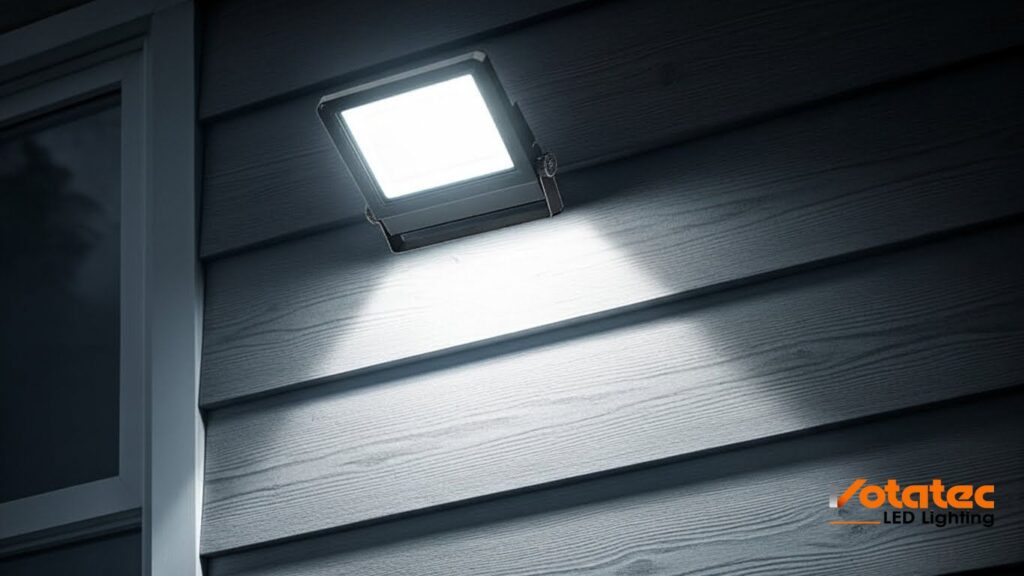
Flood lights do one thing well: aim a concentrated beam at a target. Building facades, wall signs, flagpoles, sports fields, and security zones all call for floods.
The job: light a specific object or area you point the fixture at, not the ground under it.
Beam angle is the spec to watch. A narrow 15 to 30 degree beam reaches a tall facade or a distant target. A wide 60 degree or greater beam washes a broad wall. Get this wrong and you either miss the target or blast light past it.
Floods live outdoors and often take the full weather, so wet-rated housings and IP65 or better are the baseline. Adjustable knuckle or trunnion mounts let the installer aim the beam on site, which beats guessing the angle from a drawing.
One caution: floods are glare machines if aimed carelessly. Point them down and toward the target, never up and out toward drivers or windows.
Check Votatec’s LED flood lights for beam-angle and wattage ranges.
4. Canopy lights: gas stations, drive-throughs, and soffits
Canopy fixtures mount flush into or under a ceiling structure that’s open to the air. Gas station forecourts, drive-through lanes, parkade ceilings, covered entries, and building soffits are canopy territory.
The job: light the space under a roof that has no walls, with a low-profile fixture that sits tight to the ceiling.
Because a canopy is covered, some interior spots may only need a damp rating. Anywhere wind-driven rain or snow can reach, go wet-rated. Forecourt canopies see plenty of weather at the edges, so most contractors just spec wet-rated across the board and move on.
Uniformity is the quiet win here. A gas station forecourt needs even light so cameras read plates and customers feel safe. Space the fixtures to the manufacturer’s photometric layout rather than eyeballing it.
Explore Votatec’s canopy lighting for recessed and surface-mount forms.
5. Bollard lights: walkways and wayfinding
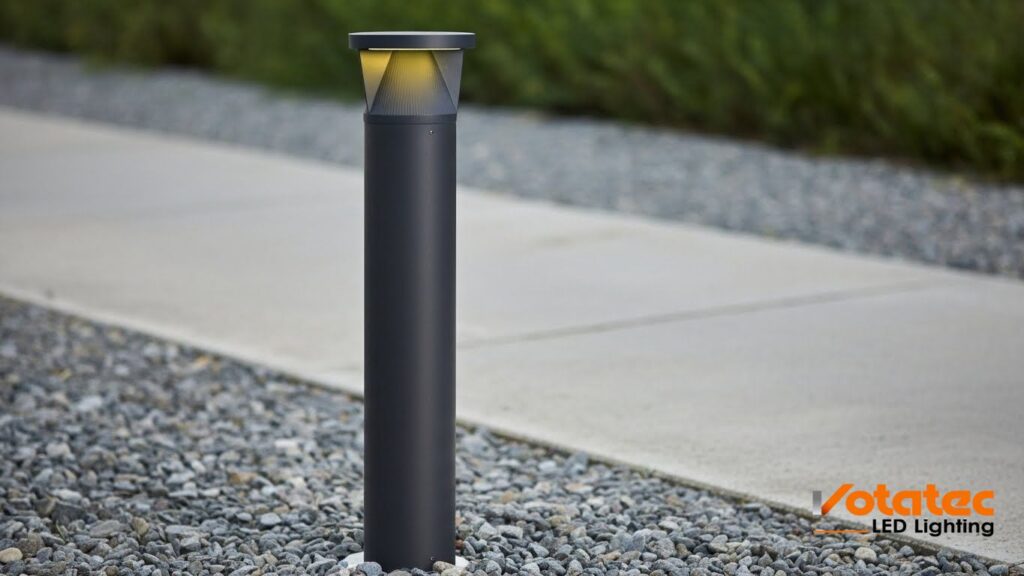
Bollards are short post fixtures, usually 3 to 4 feet tall, planted along the ground. They line walkways, plaza edges, campus paths, and building approaches.
The job: guide people along a path at ankle-to-knee height, with low glare and no light blasting into eyes.
Bollards aren’t about flooding an area. They mark a route and add a layer of pedestrian safety. Because they sit low and close to people, glare control is the whole point. Look for shielded or louvered optics that push light down onto the path.
Durability matters more than most people expect. Bollards get hit by carts, bikes, snow equipment, and the occasional bumper. Spec a cast-aluminum or steel body and confirm the base detail suits the mounting surface, whether that’s concrete, pavers, or soil.
For path and grounds fixtures, start with Votatec’s landscape lighting range.
6. Outdoor wall sconces and lanterns: entrances and facade appeal
Wall sconces and lanterns are the decorative cousin of the wall pack. They mount beside doors, along facades, and at building entrances where looks count as much as light output. Hospitality, multi-residential, retail, and office entrances all use them.
The job: light an entrance while adding to the building’s exterior style.
These fixtures put out less raw lumen output than a wall pack, and that’s fine. Their job is a welcoming pool of light at a doorway, not floodlit ground. Match the finish and form to the building, and confirm the fixture is wet or damp rated for its exact spot. A sconce fully exposed to rain needs wet-rated; one tucked under a deep overhang can run damp-rated.
Dusk-to-dawn versions with a built-in photocell save a switching headache on multi-unit sites, where nobody wants to flip entrance lights by hand.
See Votatec’s outdoor wall lights for entrance-grade styles.
7. Landscape and accent lighting: grounds and curb appeal
Landscape fixtures light the grounds around a building: trees, garden beds, signage, retaining walls, and architectural features. On commercial sites they drive curb appeal and after-hours presence.
The job: shape the look of the property at night with directional accent light on features, not broad coverage.
Most landscape systems run on low-voltage (12V) circuits fed by a transformer, which keeps the wiring safer and simpler to run under mulch and soil. Size the transformer to the total connected load plus headroom, and plan the runs to hold voltage across the longest cable path.
Fixture types in this family include well lights (in-ground uplights), spotlights for trees and signs, and path lights. All of them need a wet rating and a corrosion-resistant body, since they sit in wet ground year-round.
Pair fixtures from Votatec’s landscape lighting with a matched low-voltage transformer.
How the 7 types compare at a glance
| Fixture type | Main job | Typical mount | Rating minimum |
|---|---|---|---|
| Wall pack | Perimeter and door security | Wall, 8-15 ft | Wet, IP65 |
| Area / shoebox | Parking lots, yards, roads | Pole top | Wet, IP65 |
| Flood | Facades, signage, targets | Wall, ground, pole | Wet, IP65 |
| Canopy | Forecourts, soffits, parkades | Ceiling flush/surface | Damp or wet |
| Bollard | Walkways, wayfinding | In-ground post | Wet, IP65 |
| Wall sconce / lantern | Decorative entrances | Wall, beside door | Wet or damp |
| Landscape / accent | Grounds, trees, features | In-ground, low voltage | Wet, IP65+ |
Don’t forget the controls
The fixture is half the job. Controls decide when it runs and how much energy it burns.
- Photocells switch fixtures on at dusk and off at dawn, no timer to reset for seasonal daylight. A photoelectric sensor is the simplest energy win on any exterior job.
- Motion sensors cut runtime in low-traffic areas like back lots and side entrances. Light on demand, dark the rest of the night.
- Networked controls let facility teams set dimming schedules and monitor whole sites. Note that as of January 2025, standard lighting controls moved into Ontario’s Save on Energy Instant Discounts program, while networked controls stay under the Retrofit program.
Adding controls also stacks extra rebate value on top of the fixture incentive on many programs. Worth pricing into the bid.
Frequently asked questions
What are the best light fixtures for outside on a commercial site?
There’s no single best fixture, only the right one for the job. Wall packs handle building perimeters, area lights cover parking, floods target facades and signage, and bollards guide walkways. Pick by task, then confirm the fixture is wet-rated and DLC or ENERGY STAR listed for rebate eligibility.
What’s the difference between wet-rated and damp-rated outdoor fixtures?
A wet-rated fixture handles direct exposure to rain, snow, and sprinklers, and it also covers damp and dry spots. A damp-rated fixture only suits covered, protected areas like a soffit or deep canopy where water can’t hit it directly. When in doubt on an exposed location, spec wet-rated.
What IP rating do outdoor light fixtures need?
IP65 is the practical minimum for exposed exterior fixtures. It blocks dust and low-pressure water jets. For fixtures that take direct high-pressure spray or heavy weather, step up to IP66. Covered spots under a canopy can sometimes run lower, but IP65 is a safe default.
What colour temperature is best for outdoor lighting?
For commercial exteriors, 3000K to 4000K covers most cases. DarkSky caps its approved commercial luminaires at 3000K to reduce blue light and light pollution, so 3000K is the safer choice near homes or in dark-sky zones. 4000K reads crisper and still appears on many parking and industrial sites.
Do outdoor LED fixtures need to be DLC listed for rebates?
Usually, yes. Most Canadian commercial lighting rebate programs require the fixture to be listed by DLC or ENERGY STAR and to appear on the current eligible measures list. Ontario’s Save on Energy Instant Discounts program applies the rebate right on the distributor invoice, so listing status decides whether the discount shows up.
How much energy do LED outdoor fixtures save?
Switching exterior fixtures from HID or halogen to LED typically cuts lighting energy by around 75%, with a rated life of 50,000 hours or more. On a parking lot or building perimeter that runs dusk to dawn every night, that adds up fast, and rebates shorten the payback further.
The bottom line
Spec outdoor fixtures by the job first. Wall packs and area lights handle security and coverage, floods and canopy lights handle targets and covered spaces, and bollards, sconces, and landscape fixtures handle paths, entrances, and grounds. Confirm the wet or damp rating, the IP rating, and the DLC or ENERGY STAR listing on every line item, and add photocells or motion sensors to trim runtime.
Ready to spec a project? Browse Votatec’s full LED light fixtures catalogue or read the Commercial LED Lighting in Canada buyer’s guide for rebate and retrofit details.