










 (+1) 905 597 5955


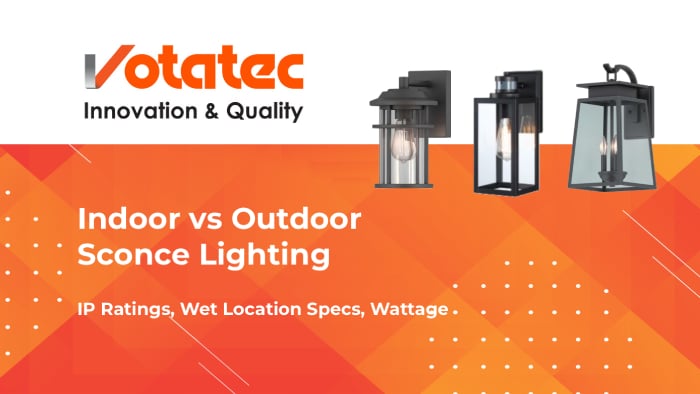

A contractor orders 40 wall sconces for a condo corridor refit. They show up, get installed, and two months later the building manager calls. Six fixtures on the exterior walkway have water in the driver housing. Why? The sconces were rated for damp locations, not wet. Different world.
That’s the problem with sconce lighting specs. One wrong rating, and you’re pulling fixtures under warranty while the client watches. Indoor wall sconces and outdoor wall sconces look almost identical on the spec sheet. They aren’t.
Here’s the short answer. Indoor sconces need basic dust protection (IP20 is fine). Covered outdoor sconces need IP44 minimum, CSA damp-location marked. Fully exposed outdoor sconces need IP65 or better, CSA wet-location marked. Wattage sits between 10W and 28W for most LED sconces, depending on lumen target.
Now the full breakdown.
What Is Sconce Lighting?
Sconce lighting is a wall-mounted luminaire that projects light up, down, or both. Unlike ceiling fixtures, sconces attach directly to a vertical surface and serve as ambient, accent, or task lighting. Commercial sconces show up in corridors, stairwells, building entries, parking garages, and exterior facades.
Two big categories: indoor and outdoor. The split comes down to moisture exposure, certification, and how much punishment the fixture can take.
Indoor vs Outdoor Sconce Lighting: The Core Difference
It’s not really about where you mount it. It’s about what touches the housing.
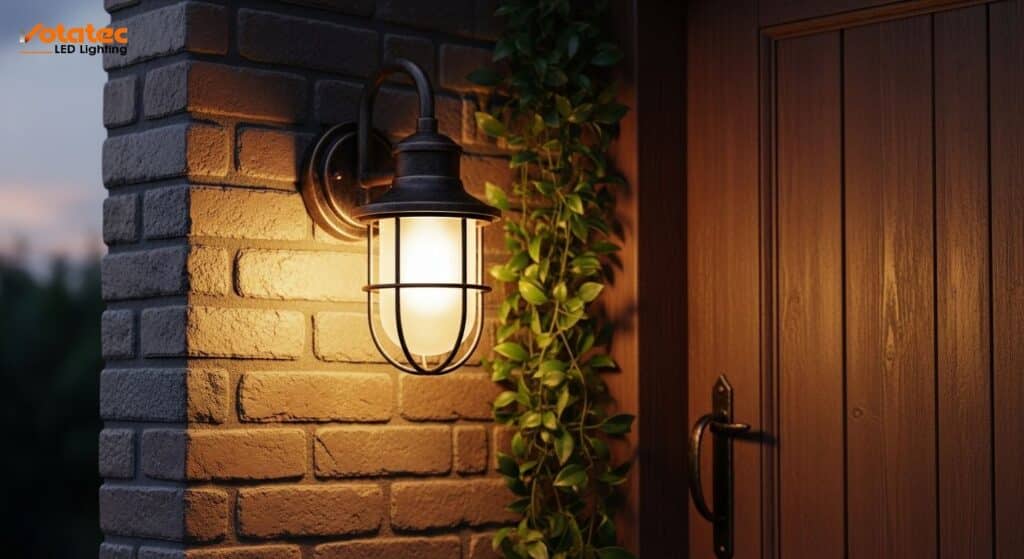
An indoor sconce assumes dry, climate-controlled air. No rain. No snow melt dripping down from a roof. No condensation from temperature swings. The housing doesn’t need to seal out water, so manufacturers keep costs down with simpler gaskets, exposed driver vents, and thinner aluminum.
An outdoor wall sconce lives in a different world. Freeze-thaw cycles. Road salt spray near entries. Horizontal rain off Lake Ontario. Snow drifts piling against the wall. Even a “protected” entryway in Vancouver gets hit with fog and mist year-round.
Here’s the deal. The CSA and NEC don’t care about indoor or outdoor labels. They care about three moisture classifications: dry, damp, and wet. Every commercial sconce carries one of these ratings, and matching it to the install location is on you.
Dry Location Sconces
Interior walls, climate-controlled spaces, no moisture source nearby. Think hotel corridors, office building elevator lobbies, retail store accent walls. Any standard CSA-listed interior sconce works. No IP rating minimum required by code, though most modern LED sconces carry at least IP20 by default.
Damp Location Sconces
Protected from direct weather but subject to moderate moisture. Covered porches. Exterior soffits under an overhang. Underground parking entries with roof coverage. Bathroom walls in residential or commercial buildings. The CSA definition calls out locations “not subject to saturation with water” but exposed to humidity or splash. Minimum IP44 is the typical spec.
Wet Location Sconces
Direct contact with rain, snow, sprinkler spray, or standing water. Uncovered building facades. Parking lot pole bases at grade. Signage below the roofline. The fixture gets tested to withstand water that drips, splashes, or flows against the housing per CSA C22.2 No. 250.0. Minimum IP65 is the working spec for most Canadian commercial installs.
Sound familiar? Maybe not. Most contractors learned this on a warranty call.
IP Ratings Decoded
IP stands for Ingress Protection, an international standard (IEC 60529). Every rating has two digits. First digit is solids (dust, debris). Second digit is liquids (water).
Here’s what they mean for sconce lighting:
| IP Rating | Solids Protection | Water Protection | Typical Sconce Use |
| IP20 | Fingers and large tools | No protection | Interior dry walls only |
| IP44 | Tools and small wires | Splashing water from any angle | Covered entries, sheltered balconies |
| IP54 | Limited dust ingress | Water splashes | Covered patios, exterior lobbies |
| IP65 | Dust-tight | Low-pressure water jets | Exposed facades, building perimeters |
| IP66 | Dust-tight | Powerful water jets | Pressure-wash zones, loading docks |
| IP67 | Dust-tight | Temporary submersion | In-grade fixtures, flood zones |
Big difference between IP44 and IP65. Most contractors don’t realize how much.
A fixture marked IP44 will survive a rain splash hitting the side of the housing. It won’t survive a downpour driven sideways by wind off the Atlantic. An IP65 fixture shrugs off both. Worth paying the extra maybe $30 to $60 per fixture when the install is anywhere near a corner, roof edge, or wind-exposed wall.
And this matters for the driver too. Not just the housing. An IP65 sconce has the LED driver sealed inside the same protected cavity. An IP44 sconce might have the driver in a less-protected area. That’s where water usually gets in first.
Wet Location vs Damp Location: The Certification That Actually Matters
IP ratings are global. But Canadian code relies on CSA and UL wet/damp markings. Both matter. Let me explain why.
The Canadian Electrical Code (CSA C22.1) and the NEC (NFPA 70) classify luminaires by environment. CSA C22.2 No. 250.0-2021 is the current trinational luminaire standard, harmonized with UL 1598 and the Mexican standard. That’s what your electrical inspector references when checking the fixture label.
A CSA-certified damp location luminaire carries a label like “Suitable for Damp Locations” or “CSA Certified, Damp.” It’s tested to withstand humidity, condensation, and indirect moisture. Not direct water.
A CSA-certified wet location luminaire gets tested differently. Water literally sprays at it. The fixture has to keep electrical parts dry while water drips, splashes, or flows against it. Label reads “Suitable for Wet Locations” or “CSA Certified, Wet.”
NEC Section 410.10(A) says luminaires in wet or damp locations must be installed so water can’t enter or accumulate in wiring compartments, lampholders, or other electrical parts. OSHA requires third-party certification for damp-location fixtures in commercial settings.
Translation: the label on the fixture isn’t decoration. It’s what the inspector checks. Install a damp-rated sconce in a wet location, and the inspector fails the install. Your crew comes back, rips it down, and now you’re eating labour twice.
Just being practical here.
Where Damp vs Wet Gets Misread
A few common traps:
- Covered entrance with a wind-driven rain exposure. Looks sheltered. Isn’t. Wet-rated fixture only.
- Parkade interior near the vehicle entry. Rain gets dragged in on tires, water pools. Wet-rated, not damp.
- Balcony sconce under the floor above. Usually damp-rated is fine, but check prevailing wind direction and how deep the overhang is. If rain can reach the wall, go wet.
- Exterior stairwell with roof coverage. Damp-rated works. But snow drifts can pile against the fixture in winter. Consider IP65 anyway.
Honestly, this one’s underrated: when in doubt, spec wet-rated. The upcharge is tiny compared to a warranty claim or failed inspection.
Wattage and Lumens: How Much Light for Each Application
Wattage by itself tells you nothing. An old 60W incandescent sconce puts out maybe 800 lumens. A modern 10W LED sconce puts out 1,000 lumens and runs 50,000 hours. Wattage is input. Lumens are output. Both matter.
Here’s what typical commercial LED sconces deliver in 2026:
| Application | Wattage | Lumen Output | Mounting Height |
| Corridor accent | 8W to 12W | 600 to 900 lm | 6 to 7 ft |
| Stairwell | 12W to 18W | 1000 to 1400 lm | 7 to 8 ft |
| Building entry | 15W to 25W | 1200 to 2000 lm | 7 to 9 ft |
| Exterior facade | 20W to 35W | 1800 to 3000 lm | 8 to 12 ft |
| Parking perimeter | 30W to 50W | 3000 to 5000 lm | 10 to 15 ft |
| Wall pack equivalent | 40W to 100W | 4000 to 12000 lm | 12 to 20 ft |
Rough rule for indoor sconces: 10 to 20 lumens per square foot of corridor or room. Bathrooms and kitchens jump to 70 to 80 lumens per square foot because task lighting. A 12 x 12 bedroom needs around 4,000 lumens total from all sources. One or two bedside sconces at 600 to 800 lumens each, combined with ceiling fixtures, hits the target.
For a 20 ft corridor with sconces spaced every 8 ft, three to four 10W sconces at 800 lumens each gives plenty of ambient light without overdoing it.
Outdoor wall sconces scale up because the light spreads further and fights ambient darkness. A commercial building entry in Mississauga typically runs 15W to 25W LED sconces on either side of the door, each putting out 1,500 to 2,000 lumens. Gives clear visibility for security cameras and ADA compliance without blinding anyone walking up. For wider facades or parking perimeter coverage, LED wall packs handle the heavier throw distances better than a standard sconce.
And all of this should meet L70 50,000-hour standards. That means the fixture still puts out 70% of its original lumen output after 50,000 hours of operation. Anything less and you’re replacing fixtures every 5 to 7 years. Not a good commercial deal.
Colour Temperature and CRI for Sconces
Quick sidebar on colour. Two specs you’ll see on every sconce cut sheet:
- CCT (correlated colour temperature): Measured in Kelvin. 2700K to 3000K is warm white, typical for interior accent and residential-style commercial spaces. 4000K is neutral white, best for corridors and general office lighting. 5000K is cool white, common for parkades, loading docks, security lighting.
- CRI (colour rendering index): 0 to 100 scale. 80+ is standard for commercial. 90+ is premium, used where colour accuracy matters (retail, hospitality, healthcare).
Most commercial LED sconces come in 3000K or 4000K with CRI 80. Higher-end specs hit 90 CRI. For exterior facade lighting, 3000K tends to feel more welcoming at night than cool white. But municipal bylaws in some cities cap outdoor lighting at 3000K to cut light pollution, so check local rules.
Common Mistakes Contractors Make with Sconce Lighting
Five things I see on every sconce project that went sideways:
1. Picking the wrong IP rating for the microclimate. A building entry in Calgary handles a different kind of weather than one in Halifax. Salt air. Freezing rain. Wind direction. Don’t just match the label to the spec sheet. Think about what hits the wall.
2. Ignoring the driver location. Some sconces have the driver inside the housing, fully sealed. Others use a remote driver that sits in a junction box behind the wall. Remote drivers need their own NEMA or CSA enclosure rating. Forget that, and you have a sealed fixture with an exposed driver failing at 18 months.
3. Undersizing wattage for mounting height. A 10W sconce at 12 ft mounting height barely reaches the ground. For taller mounts, calculate the throw distance and scale wattage up. Rule of thumb: double mounting height means roughly quadruple the lumens for the same ground-level illumination (inverse-square law).
4. Mixing colour temperatures across a project. Nothing screams amateur like a strip of 3000K sconces next to 4000K ones. Lock the CCT at spec stage. Order all fixtures with the same kelvin value.
5. Skipping DLC and ENERGY STAR verification. For any commercial rebate program in Canada, the fixture needs to be on the DLC Qualified Products List (see DesignLights.org). Non-listed sconces don’t qualify for SaveOnEnergy, Efficiency Nova Scotia, or BC Hydro incentives. That’s money left on the table. Pair DLC-listed sconces with motion sensor LED bulbs on exterior entries for another 30% to 50% energy reduction on top of the base savings.
Installation Code Requirements (Canada)
A few CSA and Canadian Electrical Code points that apply to most commercial sconce installs:
- Mounting height above grade: Outdoor sconces should sit above the splash zone. Minimum 300 mm above finished grade for wet-rated fixtures, typically.
- Junction box rating: Outdoor sconces need a weatherproof box (CSA listed for wet locations) behind the wall. Indoor sconces use standard octagon or square boxes.
- Conductor type: Exterior wiring into a wet-rated sconce should use wet-location-rated conductors (typically marked “W” or “WET”).
- Bonding: All metal sconce housings need to be bonded to ground per CEC Section 10.
- GFCI protection: Outdoor receptacles near sconces (for holiday lighting, camera power, etc.) require GFCI per CEC 26-700.
For the full installation requirements, refer to the Canadian Electrical Code and your provincial amendments. Ontario jobs should also check ESA for inspection bulletins.
Spec Checklist Before You Buy
Print this and walk it through your sconce spec sheet:
- CSA or cUL certification (Canadian market requirement)
- Wet or damp location marking matches the install environment
- IP rating meets or exceeds the microclimate
- Wattage matches the lumen target for the space
- CCT locked at 3000K, 4000K, or 5000K across the project
- CRI 80 minimum (90 for hospitality or healthcare)
- L70 50,000-hour rating or better
- DLC Qualified Products List verified (for rebate eligibility)
- Driver location (internal vs remote) documented
- Dimming compatibility (0-10V, DALI, or phase-cut), see our guide on the advantage of dimming switches
- Warranty 5 years minimum, 10 years preferred for exterior
Miss any of these at spec, and you’re likely eating the cost at the back end.
FAQ
What’s the difference between a damp-rated and wet-rated sconce?
A damp-rated sconce is tested for humidity, condensation, and indirect moisture exposure (typically IP44). A wet-rated sconce is tested for direct water contact including rain, splash, and spray (typically IP65 or higher). Damp-rated fixtures work in covered areas like porches and overhangs. Wet-rated fixtures work in fully exposed outdoor locations.
Can I use an indoor sconce outside under a roof overhang?
No, not unless the sconce carries a CSA or UL damp-location certification. Even under a roof, exterior walls see humidity, condensation, wind-driven moisture, and freeze-thaw cycles that indoor fixtures aren’t built to handle. Using an indoor sconce outside voids the warranty and fails electrical inspection in most Canadian jurisdictions.
How many lumens does a commercial hallway sconce need?
Commercial hallway sconces typically need 600 to 1,200 lumens each, depending on corridor width and sconce spacing. Aim for 10 to 20 lumens per square foot of corridor floor area. For a standard 8 ft wide hallway with sconces every 8 ft, about 800 lumens per fixture hits the target without over-lighting.
What IP rating do I need for a Canadian exterior building entrance?
For fully exposed Canadian building entrances, spec IP65 minimum with CSA wet-location certification. For covered entrances with good overhang protection, IP44 damp-rated may be acceptable, but IP65 is safer given Canadian weather including freeze-thaw cycles, snow accumulation, and wind-driven rain.
Do LED sconces qualify for Canadian energy rebates?
Yes, if the fixture is listed on the DesignLights Consortium (DLC) Qualified Products List and meets the rebate program’s efficacy requirements. Programs like Ontario’s SaveOnEnergy, BC Hydro’s Product Incentive Program, and Efficiency Nova Scotia cover up to 50% of material cost on qualifying LED sconces. Always verify DLC listing and your specific rebate program’s current eligibility criteria before ordering.
How long do commercial LED sconces last?
Quality commercial LED sconces rated L70 at 50,000 hours will maintain 70% of original light output for about 12 to 15 years of typical commercial operation (10 to 12 hours per day). Cheaper fixtures without L70 ratings might dim significantly after 3 to 5 years. For exterior installs, look for 50,000+ hour L70 ratings and 5 to 10 year manufacturer warranties.
Bottom Line
Sconce lighting isn’t a single product category. It’s three. Dry-rated for interior commercial. Damp-rated for sheltered exteriors. Wet-rated for fully exposed walls. Match the rating to the environment, check the IP number, confirm the wattage hits your lumen target, and verify DLC listing for rebate eligibility.
Get those four things right, and the sconces do their job for the next decade. Get them wrong, and you’re on the roof in February replacing fixtures.
Need help spec’ing sconce lighting for a Canadian commercial or institutional project? Browse the Votatec wall sconce catalogue for CSA-listed indoor and outdoor options, or request a quote with your building type, mounting locations, and lumen targets. We’ll match fixtures to your environment, confirm CSA compliance, and flag available provincial rebates.