










 (+1) 905 597 5955




The short answer: 7 to 10 puck lights covers a standard 10-foot (120″) cabinet run for most applications.
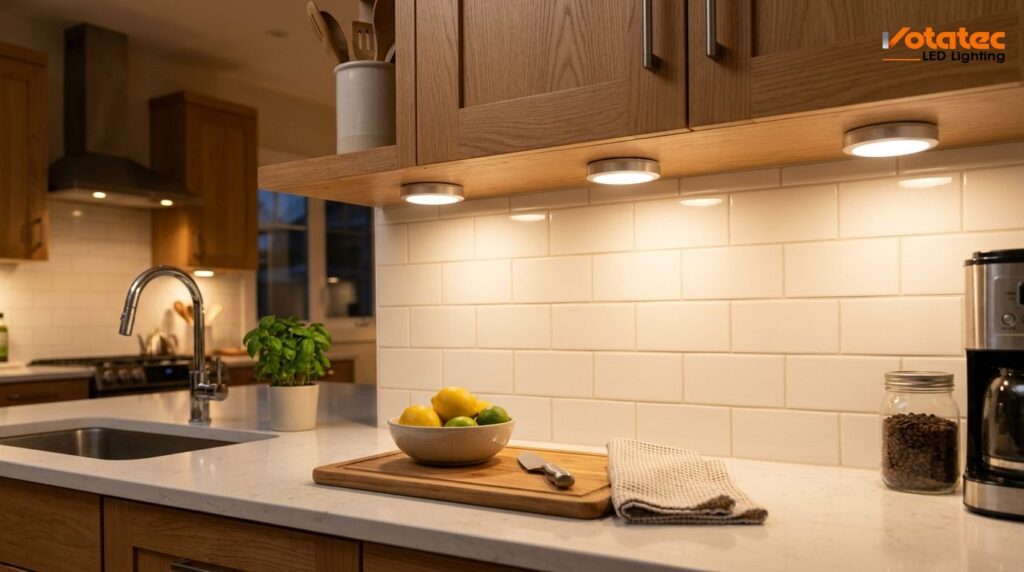
For task-critical zones like a prep counter or reception desk, space fixtures every 12 to 15 inches. That puts you at 8 to 10 pucks across 120 inches. For accent or display purposes, you can stretch the spacing to 16 to 18 inches and get away with 7 fixtures.
Those numbers are a starting point. The right count depends on how bright you need the surface, what beam angle your fixtures produce, and whether the zone is task-critical or decorative. The following guide walks through the full calculation so you’re not guessing.
What Actually Determines the Count?
Three variables drive the number of puck lights in any cabinet run.
1. Target illuminance
Task lighting on a work surface needs 200 to 500 lumens per linear foot, depending on the activity. A food-prep counter or pharmacy counter sits closer to the 400-500 end. A retail display shelf can sit at 200 to 300 lm/ft. Decorative or accent millwork only needs 100 to 200 lm/ft.
2. Fixture output (lumens per puck)
Standard commercial LED puck lights output 150 to 300 lumens each. Higher-output models reach 400 lumens. Pull the actual lumens from the product spec sheet. Wattage alone tells you nothing about brightness. Two fixtures both labelled “5W” can differ by 60% in light output depending on the LED chip and driver quality.
3. Beam angle
A 120° beam angle spreads light wide, so fixtures can be spaced farther apart without dark banding between them. A 60° narrow beam concentrates light in a tighter pool; you need closer spacing or you’ll see scalloping: bright spots with dark gaps between each fixture.
LED Puck Light Spacing Formula
Here’s the rule most electrical contractors apply:
Space puck lights every 12 to 18 inches for even coverage.
- 8 to 12 inches: task-critical zones (food prep, laboratory, pharmacy counters)
- 12 to 15 inches: standard commercial (office millwork, general retail, healthcare cabinetry)
- 15 to 18 inches: accent or display (backlit shelving, decorative millwork, furniture displays)
For a 10-foot (120-inch) run, that translates to:
| Spacing | Pucks Needed |
|---|---|
| 8″ | 15 |
| 10″ | 12 |
| 12″ | 10 |
| 15″ | 8 |
| 18″ | 7 |
The most common installation for a 120″ run is 8 to 10 fixtures. If you’re unsure, start at 10 fixtures spaced 12 inches apart and you’ll have a solid baseline to evaluate on site before final commitment.
How to Calculate the Lumen Load for 10 Feet
Spacing alone doesn’t confirm you’re hitting the right brightness. Run the lumen calculation to be sure.
Step 1: Set your target lumen density
- Task zones: 300 lm/ft is a reliable working target for most commercial applications
- Accent zones: 175 lm/ft is adequate for display and decorative purposes
Step 2: Multiply by run length
- Task: 300 lm/ft × 10 ft = 3,000 lumens needed
- Accent: 175 lm/ft × 10 ft = 1,750 lumens needed
Step 3: Divide by your fixture output
- 3,000 lumens ÷ 300 lm per puck = 10 puck lights
- 3,000 lumens ÷ 200 lm per puck = 15 puck lights
- 1,750 lumens ÷ 250 lm per puck = 7 puck lights
This is why fixture output matters more than spacing alone. A high-output 400-lumen puck at 15-inch spacing gives you far better coverage than a 150-lumen puck at 12-inch spacing.
Task Lighting vs. Accent Lighting: Different Counts for the Same Run
The number changes based on what the light is doing.
Task Lighting (counters, prep zones, work surfaces)
Commercial food-prep counters and workstations need 28 to 50 foot-candles at the surface. That’s 300 to 500 lm/ft.
For a 10-foot prep counter:
- Target: 3,500 lumens
- Fixture output: 350 lm per puck
- Result: 10 pucks at 12-inch spacing
Use warm white (3000K) for restaurant and hospitality settings. Go 4000K to 4500K for healthcare or laboratory environments where colour accuracy is important. Both work fine for office millwork, though 3500K is a popular middle ground.
Accent and Display Lighting (shelving, retail, décor millwork)
Display shelving doesn’t need the same raw output, but coverage uniformity still matters or the display looks uneven.
For a 10-foot retail display run:
- Target: 2,000 lumens
- Fixture output: 250 lm per puck
- Result: 8 pucks at 15-inch spacing
Colour temperature for display depends on what’s being shown. Warm white (2700K to 3000K) is preferred for food, clothing, and home décor. Cool white (4000K+) suits electronics and technical product displays where a clinical, crisp look is intentional.
Beam Angle and Why It Changes Everything
Many spec sheets only list wattage and lumens. Beam angle is equally important and often overlooked.
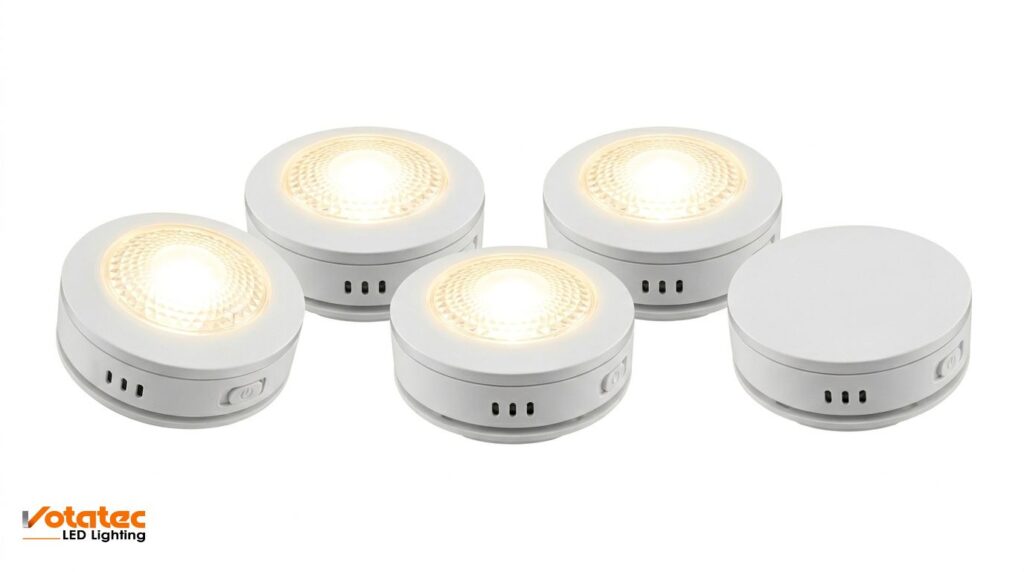
120° beam (wide spread): Common in most standard puck lights. Light spreads broadly, minimising dark patches between fixtures. Works well for even counter coverage and is forgiving if spacing isn’t perfectly even.
60° beam (medium flood): More directional. Good for display shelving where you want the light pointed at specific items. Requires tighter spacing than a 120° fixture to avoid noticeable scalloping.
30 to 40° beam (narrow spot): Accent or retail display use only. Highlights individual objects but creates pronounced bright-and-dark banding if used for general counter coverage. Not suitable for task lighting across a 10-foot run.
A practical rule: if you’re lighting a work surface, choose 100 to 120° beam angle. If you’re lighting a display, 60° gives a more deliberate, retail feel.
Common Mistake: Specifying by Wattage Instead of Lumens
Wattage tells you the power draw. It doesn’t tell you how bright the light is.
A 5-watt LED puck from one manufacturer might output 250 lumens. Another brand’s 5W puck might output 400 lumens. That’s a 60% difference in actual brightness at the same wattage.
Always specify puck lights by:
- Lumens – actual light output
- CRI – colour rendering index (80+ for commercial, 90+ for display and retail)
- CCT – colour temperature in Kelvin
- Beam angle – degrees
- Voltage – 12V DC or 24V DC (affects transformer selection)
Wattage is only relevant when calculating the load per circuit and sizing your transformer or driver.
Puck Lights vs. LED Strip for a 10-Foot Run
Puck lights aren’t always the right choice. It’s worth comparing them to LED strip lights and linear bar fixtures before specifying.
LED puck lights are the better fit when:
- You need focusable, directional light on defined zones
- You’re retrofitting into existing cabinetry with limited depth or no raceway
- The installation is hardwired to separate switch legs for zone control
- The design calls for visible, punctuated pools of light
LED strip lights work better when:
- You need continuous, even illumination across the full 10 feet with no visible breaks
- The cabinet has a lip, channel, or raceway to conceal the strip and driver
- First cost matters (strip per linear foot is lower than individual pucks)
- New construction where wiring access is straightforward
Linear bar fixtures sit between the two: they’re discreet, easy to daisy-chain, and produce even coverage without the dark banding you can get between widely spaced pucks. They’re a common choice in commercial millwork where a clean, uninterrupted ceiling look is required.
For most commercial millwork in office, retail, and institutional settings, contractors choose puck lights when the design calls for focused lighting across a patterned cabinet layout, and strip or bar when continuous diffuse coverage is the goal.
Installation Tips for a Clean Result
Position pucks toward the front of the cabinet base, not flush to the back wall. Mounting too far back throws light onto the cabinet wall instead of the countertop surface. The ideal mounting point is 3 to 4 inches from the front edge of the cabinet base.
Centre each fixture on a cabinet door where the layout allows. This distributes light evenly across the full run and looks intentional in the finished installation, especially in retail and office environments.
Use a wire clip or cable channel to keep the feed cable tight along the cabinet base. Visible cable loops below the cabinet line are the most common contractor complaint in the field.
Test the layout before drilling. Temporarily position fixtures with painter’s tape and check for dark banding at counter level. Adjusting spacing now takes five minutes. Adjusting after the mounting plates are screwed in takes considerably longer.
Check your mounting surface depth before ordering. Some flush-mount puck fixtures require 1 to 1.5 inches of recess. Surface-mount versions need only a few millimetres. Get this wrong and you’re returning product.
Transformer and Wiring for 10 Puck Lights
Ten puck lights in a 10-foot run typically daisy-chain from a single hardwired feed or a plug-in transformer. Here’s how to size it correctly.
Wattage calculation:
- 10 pucks × 5W each = 50W load
- Choose a 60W or 75W transformer minimum
- Keep the load under 80% of the transformer’s rated capacity for longevity and code compliance
Hardwired installations:
The transformer or driver connects to your branch circuit and feeds the low-voltage puck chain. In Canada, both the transformer and the fixtures must be CSA-certified. Confirm the fixtures and power supply carry CSA or cUL marks before purchasing.
Plug-in installations:
For tenant improvements or retrofit projects where hardwiring isn’t practical, plug-in sets with a CSA-listed power brick are code-compliant for most jurisdictions. In kitchens lighting and wet-area applications, confirm the receptacle feeding the plug-in adapter is GFCI-protected.
Daisy-chaining limits:
Most puck light systems are designed to daisy-chain with a maximum fixture count per run, often 8 to 12 fixtures per cable chain before voltage drop becomes an issue. For runs over 10 pucks, check the manufacturer spec for maximum chain length or use 24V DC fixtures, which handle longer runs with less voltage drop than 12V systems.
Frequently Asked Questions about LED Puck Lights
How far apart should LED puck lights be placed under a cabinet?
Space puck lights 12 to 18 inches apart for most under-cabinet applications. Use 12-inch spacing for task-critical areas like food-prep counters, and 15 to 18 inches for accent or display purposes. Test the spacing with tape before committing to the final mounting positions. It’s much easier to adjust before the mounting plates are installed.
How many lumens do I need for under-cabinet task lighting?
Aim for 200 to 500 lumens per linear foot for task lighting. A 10-foot run needs between 2,000 and 5,000 lumens total, depending on the activity. 300 lumens per foot is a reliable baseline for commercial kitchen and office millwork applications.
Can I add more puck lights to an existing run if it’s too dim?
Yes. Most puck light systems are designed to daisy-chain, so adding fixtures after the initial install is straightforward. Before adding fixtures, check the maximum load rating on your transformer. If you’re already near 80% of its rated capacity, you’ll need a higher-rated driver before extending the chain.
What colour temperature is best for under-cabinet puck lights?
3000K (warm white) is the standard for restaurant, hospitality, and residential-style kitchens. 4000K (neutral white) works well for offices, healthcare, and retail environments where colour accuracy matters. Avoid going above 5000K for under-cabinet lighting, as the light becomes harsh at close range on a work surface.
Do LED puck lights need a special transformer in Canada?
Yes. LED puck lights require a low-voltage driver or transformer matched to the fixture’s voltage (typically 12V DC or 24V DC). The transformer must be rated for the total fixture wattage with at least 20% headroom. In Canada, both the transformer and the fixtures must carry a CSA or cUL certification mark to meet electrical code requirements.
What’s the difference between a puck light and a disc light?
The terms are used interchangeably by most suppliers. “Puck light” typically refers to a surface-mount or semi-recessed round fixture, while “disc light” often describes a thin, flat-profile version designed for flush mounting. Functionally they’re the same product category. The distinction is mostly cosmetic and varies by brand.
Summing Up
For a 10-foot cabinet run, 7 to 10 LED puck lights gets you there in most commercial and institutional applications. The exact count comes down to two things: your target lumen density and the actual lumen output of the fixture you’re specifying.
Start with 8 fixtures at 15-inch spacing for a typical accent or display run. Move to 10 fixtures at 12-inch spacing for task surfaces. Pull the lumens-per-fixture number from the spec sheet and run the calculation. Don’t guess based on wattage.
If you’re specifying LED puck lights for a commercial, institutional, or contractor project in Canada, Votatec carries CSA-certified fixtures across multiple output levels and colour temperatures. Contact us for a fixture recommendation and quantity takeoff based on your specific run dimensions.