










 (+1) 905 597 5955



Your office ceiling is probably full of fluorescent troffers right now. And if you’ve been replacing T8 tubes every 18 months, dealing with that annoying flicker, and watching your hydro bill climb, you already know something’s got to change.
Here’s the thing. Canada is phasing out fluorescent lamps starting January 1, 2026. The first wave of the ban is already in effect, with a full phase-out by 2030. So this isn’t really a “should we upgrade?” conversation anymore. It’s a “how do we upgrade smart?” one.
This guide covers everything about LED troffer lights, the direct drop-in replacement for fluorescent ceiling panels. You’ll get the specs, the real energy savings numbers, Canadian rebate programmes that can cover up to 90% of the cost, and a clear breakdown of which size and type works best for your space. Let’s get into it.
What Is an LED Troffer, Exactly?
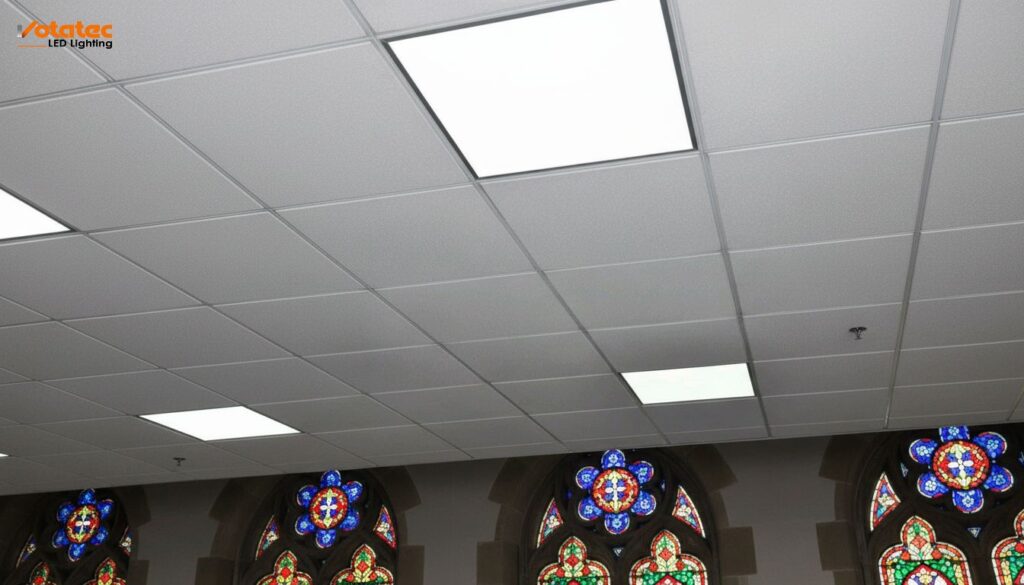
An LED troffer is a rectangular light fixture, sometimes called a flat panel LED light, that sits inside a standard drop ceiling grid. Same form factor as the fluorescent troffers you already have. Same T-bar grid. Different technology entirely.
Traditional fluorescent troffers use T8 or T12 tubes filled with mercury gas. They produce light by exciting phosphor coatings inside those tubes. Works fine when it’s new. Gets dimmer over time. And that mercury? It’s why Canada signed onto the Minamata Convention and started banning these lamps.
LED troffers use semiconductor diodes instead. No mercury. No warm-up time. Completely flicker-free. They turn on instantly at full brightness and stay consistent for their entire lifespan.
Pretty straightforward swap, honestly.
The two standard sizes are 2×2 (2 feet by 2 feet) and 2×4 (2 feet by 4 feet). These match the grid openings in virtually every commercial drop ceiling in Canada. If you’ve got a suspended ceiling with those familiar rectangular panels, an LED troffer drops right in.
Looking for a direct replacement? Browse Votatec’s full range of LED troffer lights – all CSA-certified for the Canadian market.
LED Troffer vs Fluorescent: Why the Switch Makes Sense
So why are facility managers across Canada pulling out fluorescent troffers and switching to LED panel lights? A few big reasons.
Energy Savings That Actually Show Up on Your Bill
A University of Michigan study found that LED lighting is 18% to 44% more efficient than T8 fluorescent tubes, depending on the specific product. Other industry data puts the savings even higher, up to 75% compared to older T12 fluorescent fixtures.
Here’s what that looks like in practice. A typical 2×4 fluorescent troffer runs two or three T8 tubes at 32 watts each, plus a ballast that adds another 8 to 12 watts. Total draw: maybe 76 to 108 watts per fixture. A modern LED troffer delivering the same light output? Around 30 to 50 watts. Sometimes less.
That’s real money.
The Lifespan Gap Is Huge
Fluorescent T8 tubes last around 20,000 to 25,000 hours in ideal conditions. In a commercial setting with frequent on-off cycling, you’re probably getting closer to 15,000 hours. That means replacing tubes every 2 to 3 years.
LED troffers are rated for 50,000 hours or more. At 10 hours per day, 260 working days per year, that’s over 19 years before you need to think about replacement. Big difference.
And here’s something people don’t always consider. Every time you relight a fluorescent troffer, you’re paying for the tube, the ballast (which also dies eventually), and the labour. With a commercial facility running hundreds of fixtures, those maintenance costs add up fast.
Better Light Quality
LED troffers deliver a CRI (colour rendering index) of 80 or higher. Many hit 90+. Fluorescent tubes typically land around 75 to 82 CRI. Higher CRI means colours look more natural and accurate under the light. For offices, healthcare facilities, and retail spaces, that matters more than you’d think.
Plus, no flicker. Fluorescent tubes operate on a 60Hz cycle that causes a subtle but measurable flicker. Some people are more sensitive to it than others, but studies have linked it to headaches, eye strain, and reduced productivity in office environments. LED troffers use constant-current drivers. Zero flicker.
How to Choose the Right LED Troffer for Your Space
Not all LED troffers are the same. Here’s what to look at when you’re specing a project.
Size: 2×2 vs 2×4
The size you need depends on your ceiling grid. Most Canadian commercial buildings use either 2×2 or 2×4 grid openings. Measure first. Don’t assume.
2×4 LED troffers are the most common in offices, schools, and government buildings. If you’re searching for LED panel lights 2×4, this is the size you want. They deliver more total lumens per fixture, up to 6,500 lumens depending on wattage, and cover a wider area. If you’re replacing standard 2×4 fluorescent fixtures, this is your one-for-one swap.
2×2 LED troffers are popular in smaller rooms, corridors, and spaces with tighter ceiling grids. You’ll sometimes see these listed as LED panel light 2×2 in product catalogues. They output up to around 4,000 lumens and work well where you need even spacing in a compact layout.
| Spec | 2×2 LED Troffer | 2×4 LED Troffer |
|---|---|---|
| Typical wattage | 20W to 40W | 30W to 50W |
| Lumen output | 2,400 to 4,000 lm | 3,500 to 6,500 lm |
| Replaces | 2-tube T8 fluorescent | 3 or 4-tube T8 fluorescent |
| Best for | Small offices, corridors | Open offices, classrooms, retail |
Selectable Wattage and CCT: The 2026 Standard
Here’s something that’s changed a lot in the last couple of years. Most quality LED troffers now come with selectable wattage AND selectable colour temperature (CCT) built right into the fixture. One product, multiple settings.
Selectable wattage means you can adjust brightness after installation. A typical 2×4 LED troffer might offer 30W, 40W, and 50W options via a switch on the driver. Why does this matter? Because the lighting designer might spec one wattage, but the actual space might need more or less once it’s occupied. Selectable wattage lets you fine-tune without swapping fixtures.
Selectable CCT works the same way but for colour temperature. Common options are 3500K (warm neutral), 4000K (cool neutral), and 5000K (daylight). For most commercial spaces in Canada, 4000K is the sweet spot. It’s bright and clear without feeling harsh. Schools and healthcare facilities sometimes prefer 3500K for a warmer feel. Warehouses and workshops lean toward 5000K.
Want to learn more about picking the right colour temperature? Check out our guide to different types of LED ceiling lights.
DLC Certification: Why It Matters for Rebates
If you want to qualify for provincial utility rebates, your LED troffer needs to be on the DesignLights Consortium (DLC) Qualified Products List. Full stop.
DLC certification means the fixture has been independently tested for:
- Minimum efficacy (lumens per watt)
- Colour quality and consistency
- Driver reliability and compatibility
- Lumen maintenance over time
DLC Standard is the baseline. DLC Premium means even higher efficiency, and some rebate programmes offer bigger incentives for Premium-listed products.
When you’re comparing LED troffers, look for the DLC listing number on the spec sheet. A DLC certified LED troffer is your ticket to rebate eligibility. No DLC listing, no rebate. Simple as that.
Real-World Savings: What Does an LED Troffer Upgrade Actually Cost?
Let’s talk numbers. Because this is where people either commit to the upgrade or keep kicking it down the road.
The Mike’s Office Park Story
Mike manages a 40,000 square foot office complex in Mississauga. The building had 320 fluorescent 2×4 troffers, each running about 96 watts (three T8 tubes plus ballast). His annual lighting electricity cost was around $38,000 based on Ontario rates.
He replaced all 320 fixtures with 40W LED troffers. Total project cost: $48,000 installed. His new annual lighting cost dropped to about $15,200. That’s $22,800 per year in savings. But here’s where it gets interesting. Mike applied through Ontario’s SaveOnEnergy programme and got $9,600 back in rebates, bringing his net investment down to $38,400.
Payback? About 20 months. And he hasn’t touched a single fixture for maintenance since. That was three years ago.
Quick ROI Math for Your Building
Here’s a formula you can use for your own facility:
Annual savings per fixture = (old watts – new watts) x annual hours x electricity rate / 1,000
Say you’re replacing a 96W fluorescent troffer with a 40W LED troffer. Building runs lights 3,000 hours per year. Ontario electricity rate is around $0.13/kWh.
(96 – 40) x 3,000 x $0.13 / 1,000 = $21.84 per fixture per year
For 100 fixtures, that’s $2,184 in annual energy savings alone. Not counting maintenance savings, which can be another $5 to $15 per fixture per year depending on how often you’re replacing tubes and ballasts.
Most commercial LED troffer upgrades in Canada pay for themselves in 12 to 30 months. With rebates, sometimes faster.
Canadian Rebate Programmes: Up to 90% Coverage
This is honestly the part that surprises most facility managers. The rebate programmes in Canada right now (as of early 2026) are extremely generous for LED lighting upgrades. Here’s a province-by-province breakdown of the major ones.
Ontario: SaveOnEnergy
Ontario’s SaveOnEnergy programme offers direct incentives for commercial and industrial lighting retrofits. Small businesses with 50 or fewer employees can get up to $3,000 in lighting incentives, including a free site assessment and direct installation in some cases. Larger facilities qualify for custom project incentives based on verified energy savings.
British Columbia: BC Hydro
BC Hydro covers up to 75% of LED lighting upgrade costs for eligible commercial and industrial projects. And right now, there’s a 30% bonus incentive for projects submitted between June 2025 and February 2026. Industrial facilities can get 25% to 50% coverage, with higher incentives for bigger energy savings.
Quebec: Hydro-Quebec
This is the big one. Hydro-Quebec’s Efficient Solutions programme reimburses up to 90% of the cost of LED conversions for small business customers. Larger commercial and industrial facilities can receive up to 75%. That’s not a typo. Ninety percent.
If you’re running fluorescent troffers in a Quebec facility, there’s almost no financial reason not to upgrade. The utility is practically paying for it.
Other Provinces
Alberta, Manitoba, Saskatchewan, and the Atlantic provinces each have their own utility incentive programmes with varying coverage levels. Most fall in the 25% to 50% range for commercial LED upgrades. Check with your local utility or contact Votatec for help navigating your specific programme.
Ready to see what rebates your project qualifies for? Browse Votatec’s DLC-certified LED troffers and start your upgrade with fixtures that qualify for every major Canadian rebate programme.
Canada’s Fluorescent Ban: The Timeline You Need to Know
This isn’t some vague future regulation. It’s happening now.
The Government of Canada amended the Products Containing Mercury Regulations in June 2024. Here’s the phase-out schedule:
- January 1, 2026: Manufacturing and importing most fluorescent lamps is prohibited. This includes screw-base CFLs, T5, T8, and T12 tubes.
- 2026 to 2027: A two-year transition period allows replacement lamps for existing fixtures. But no new fixtures.
- January 1, 2029: HID lamps (metal halide, high-pressure sodium) for general lighting are also banned.
- January 1, 2030: Complete phase-out. No manufacturing, importing, or selling of fluorescent replacement lamps.
By 2035, Environment Canada expects these regulations to reduce mercury released from lamps into the environment by 91%, about 681 kilograms less mercury.
So if you’re still running fluorescent troffers, replacement tubes are going to get harder to find and more expensive over the next few years. The smart move is to plan your LED troffer upgrade now while the rebates are still strong.
Installation: Three Ways to Switch
You’ve got three basic approaches for replacing fluorescent ceiling panels with LED troffers. Each has trade-offs.
Option 1: Full Fixture Replacement (Recommended)
Pull out the old fluorescent troffer entirely and drop in a new LED troffer. This gives you the best performance, the longest warranty, and qualifies for the highest rebates. Most modern LED troffers are designed for quick installation, 15 to 20 minutes per fixture for an experienced electrician.
This is what we recommend for most commercial lighting upgrades. You get a brand new fixture with the latest features (selectable wattage, selectable CCT, 0-10V dimming) and a clean 5-year warranty.
Option 2: Retrofit Kit
A retrofit kit lets you keep the existing troffer housing and replace the internals with an LED module. You remove the fluorescent tubes and ballast, mount the LED panel inside the old frame, and wire it to the existing junction box.
Cost is lower than a full replacement, maybe $25 to $40 per fixture versus $40 to $70 for a new complete troffer. But you’re limited by the old housing. And some rebate programmes don’t qualify retrofit kits at the same incentive levels as full replacements.
Option 3: Direct Wire LED Tubes (Type B)
This is the budget option. You remove the fluorescent ballast and wire LED tubes directly to line voltage. Cheapest upfront, but the light quality and distribution aren’t as good as a purpose-built LED troffer or flat panel. And you’re basically putting new technology in an old fixture designed for a completely different light source.
For a handful of fixtures in a utility closet? Fine. For a full office or school? Go with a proper LED troffer.
The Community Centre Story
Jennifer manages a community centre in Surrey, BC. The building has 180 fluorescent 2×4 troffers across three floors: an activity hall, office spaces, and a large multipurpose room. She’d been replacing burned-out tubes constantly, maybe 30 per year at $8 to $12 each plus volunteer time.
She got quotes for a full LED troffer replacement. Total project: $22,500 installed. Through BC Hydro’s incentive programme (including the 30% bonus), she got $12,375 back. Net cost: $10,125.
Annual energy savings came in at about $7,200. So her payback on the net investment? Under 17 months. Plus, the multipurpose room went from dim, yellowish fluorescent light to bright, even 4000K LED light. The recreation coordinator told her the room “feels completely different” now.
Worth it.
What to Look for on the Spec Sheet
When you’re comparing LED troffers, here are the specs that actually matter.
Lumens per watt (efficacy): Higher is better. Look for 130+ lm/W minimum. Top performers hit 150 lm/W or more. This directly affects your energy savings and rebate eligibility.
CRI (colour rendering index): 80 is the baseline for commercial spaces. If you’re in healthcare or retail where colour accuracy matters, look for CRI 90+.
Driver type: 0-10V dimming is standard for commercial applications. Make sure the driver is compatible with your building’s dimming controls.
Warranty: 5 years minimum. Some manufacturers offer 7 to 10 years on DLC Premium products.
Operating temperature: Matters more than you’d think, especially in unconditioned spaces like warehouses or covered parking. Look for fixtures rated to at least 40 degrees Celsius.
CSA or cUL certification: Required for installation in Canada. Don’t even consider a fixture without it.
LED Troffers for Different Applications
Different spaces need different lighting approaches. Here’s a quick guide.
Offices
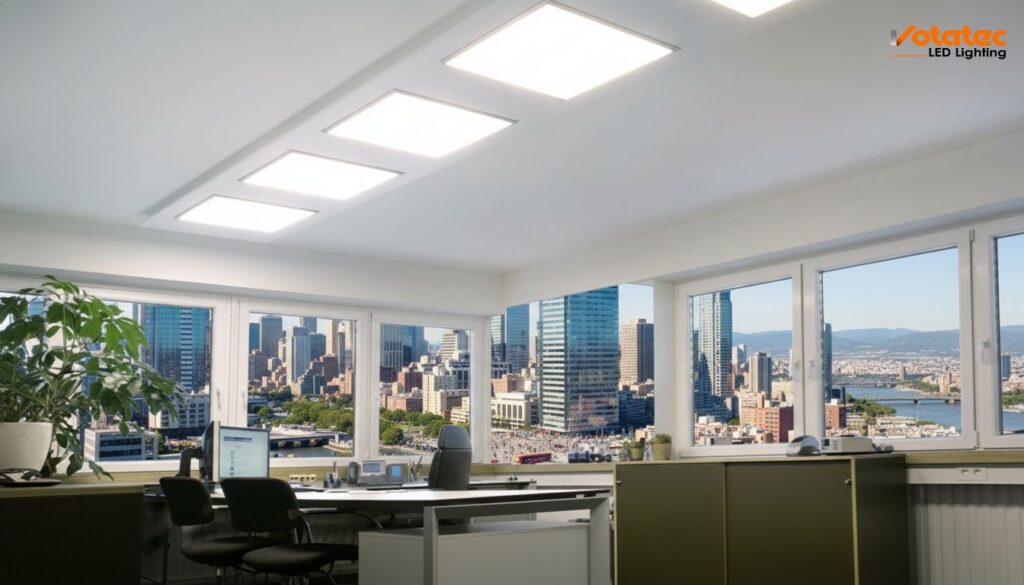
4000K colour temperature, 30 to 40 foot-candles at desk level. The IES (Illuminating Engineering Society) recommends 300 to 500 lux for general office work. LED panel lights in the ceiling are the standard solution here. A 40W 2×4 LED troffer in a standard 8-foot ceiling delivers this easily. For open-plan office lighting, space troffers 8 to 10 feet apart in a regular grid pattern.
Schools and Classrooms
Similar to offices but with a preference for slightly warmer tones. 3500K to 4000K works well. Classrooms need even light distribution to avoid glare on whiteboards and screens. LED troffers with prismatic or microprismatic lenses are ideal here because they scatter light more uniformly than flat diffusers.
Healthcare Facilities
CRI 90+ is preferred for healthcare. Accurate colour rendering matters when medical staff are assessing patient conditions. Many healthcare facilities also require emergency battery backup in corridor troffers, something to spec separately.
Retail
Retail is tricky because you want the ceiling to “disappear” while the merchandise gets all the attention. Recessed LED troffers work for general ambient lighting, but you’ll probably want to combine them with other commercial lighting like track lights for accent and display lighting.
Warehouses and Industrial
For spaces with standard-height drop ceilings (under 15 feet), LED troffers work fine. Once you get above 15 feet, you’re better off with high bays. But plenty of industrial facilities have office areas, break rooms, and utility spaces with drop ceilings where troffers are the right call. LED wrap lights are another option for corridors and work areas without grid ceilings.
Frequently Asked Questions About LED Troffers
Can I replace a fluorescent troffer with an LED troffer myself?
Technically, you could. But in most Canadian provinces, electrical work needs to be done by a licensed electrician. For a commercial building, you definitely want a certified contractor. They’ll make sure the wiring meets code and your insurance stays valid.
Do LED troffers work with existing dimmer switches?
Most LED troffers use 0-10V dimming, which is the standard for commercial lighting controls. If your building has a 0-10V dimming system already in place, the LED troffers will work right away. If you’re on older toggle switches, you can still install LED troffers, you just won’t have dimming until you upgrade the controls.
How many LED troffers do I need per room?
General rule: one 2×4 LED troffer per 60 to 80 square feet for a standard office environment with 8 to 9 foot ceilings. So a 600 square foot office needs about 8 to 10 fixtures. But spacing depends on ceiling height, desired light levels, and the specific fixture’s light distribution pattern. A lighting layout from your supplier is always a good idea for larger projects.
Are LED troffers compatible with T-bar grid ceilings?
Yes. That’s exactly what they’re designed for. Standard 2×2 and 2×4 LED troffers fit the same grid openings as the fluorescent fixtures they replace. The mounting clips and brackets are included with the fixture. In most cases, it’s lift out the old, drop in the new.
What’s the difference between an LED troffer and a flat panel LED light?
Good question. They’re similar but not identical. A flat panel LED light, sometimes listed as “led panel lights ceiling” in product catalogues, is typically thinner (sometimes under an inch thick) and uses edge-lit LED technology for a very uniform, sleek appearance. An LED troffer is usually a bit thicker and may use back-lit or direct-lit LED arrays. Both fit in the same ceiling grid. Flat panels tend to look more modern and minimalist. Troffers are the tried-and-true standard for most commercial spaces. Either way, both are massive upgrades from fluorescent.
Bottom Line
LED troffers are the most practical, cost-effective replacement for fluorescent ceiling panels in Canadian commercial buildings. The energy savings are real, 40% to 75% depending on what you’re replacing. The lifespan is 3 to 4 times longer. The light quality is noticeably better. And with Canada’s fluorescent lamp ban already underway, the clock is ticking on those old tubes.
The rebate programmes available right now, especially Hydro-Quebec’s 90% coverage and BC Hydro’s 75% plus 30% bonus, make this one of the cheapest times in history to upgrade your lighting.
Don’t wait until replacement fluorescent tubes become scarce and expensive. Plan your upgrade now.
Browse Votatec’s CSA-certified LED troffer lights or request a quote for your facility’s LED troffer upgrade project.