












 (+1) 905 597 5955


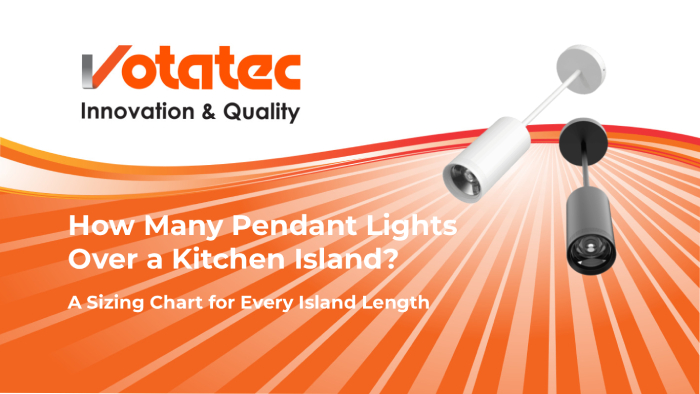

Quick answer: For pendant lights over a kitchen island, install one pendant for every 2 feet (0.6 m) of island length, and hang the bottom of each fixture 30 to 36 inches (76 to 91 cm) above the countertop. A 4 to 6 foot island needs two pendants. An 8 to 10 foot island needs three. Space pendants 24 to 32 inches apart and centre the run on the island.
Key facts at a glance
- Pendant count: one pendant per 2 feet of island length (odd numbers preferred).
- Hanging height: 30 to 36 inches above the countertop, on a standard 8 foot ceiling.
- Ceiling adjustment: add 3 inches for every extra foot of ceiling above 8 feet.
- Spacing: 24 to 32 inches between pendants; end pendants set 6 to 15 inches in from the island ends.
- Light level: 30 to 50 foot-candles on the work surface, per the Illuminating Engineering Society.
- Colour rendering: 90+ CRI over food prep areas.
This guide from Votatec, a Canadian LED lighting wholesaler, turns those rules into a length-by-length chart and covers the spec details that matter on real projects: spacing maths, hanging height for tall ceilings, light levels, colour temperature, and the rough-in mistakes that force rework.
What is the rule for how many pendant lights over a kitchen island?
The rule for how many pendant lights over a kitchen island is one pendant for every 2 feet (0.6 m) of island length. Measure the island, divide the length by two, and that is your starting pendant count.
Applied to common island sizes:
- A 4 foot island takes 2 pendants.
- A 6 foot island takes 2 pendants if they are wide, or 3 if they are slim.
- An 8 foot island takes 3 pendants.
- A 10 foot island takes 3 pendants, sometimes 4.
Fixture diameter adjusts the count. Two wide 12 inch pendants cover the same span as three slim 6 inch pendants. Wide island, wide pendants, fewer of them. Slim island, slim pendants, one more.
Designers favour odd numbers because they read as balanced. Three centred pendants over a kitchen island usually look better than two that leave the middle dark. Two large statement pendants over a compact island is also a clean, valid look.
Sizing chart: how many pendant lights by island length
This chart shows how many pendant lights to use over a kitchen island by island length. Confirm the count against fixture diameter and the light level you need.
| Island length | Pendants (typical) | Best for | Notes |
|---|---|---|---|
| Under 4 ft (under 122 cm) | 1 large, or 2 small | Condos, galley kitchens, staff kitchenettes | A single statement fixture keeps a tight island uncluttered |
| 4 to 6 ft (122 to 183 cm) | 2 | Most residential and multi-unit islands | The most common configuration |
| 6 to 8 ft (183 to 244 cm) | 2 to 3 | Standard family kitchens | Three if pendants are slim, two if they are wide |
| 8 to 10 ft (244 to 305 cm) | 3 | Large residential, model suites | Odd number, evenly spaced across the run |
| 10 to 12 ft (305 to 366 cm) | 3 to 4, or 1 linear | Open-concept and hospitality islands | A linear suspension gives an even wash over long spans |
| 12 ft and over (366 cm+) | 4, or 1 to 2 linear | Commercial, amenity, multi-unit builds | Plan the circuit load early |
For islands longer than 10 feet, a single linear suspension often beats a row of pendants. A linear suspension delivers an even light spread, needs one junction box, and keeps the ceiling line clean. That advantage matters most on commercial and amenity-space islands with long runs.
What size pendant lights should you use over an island?
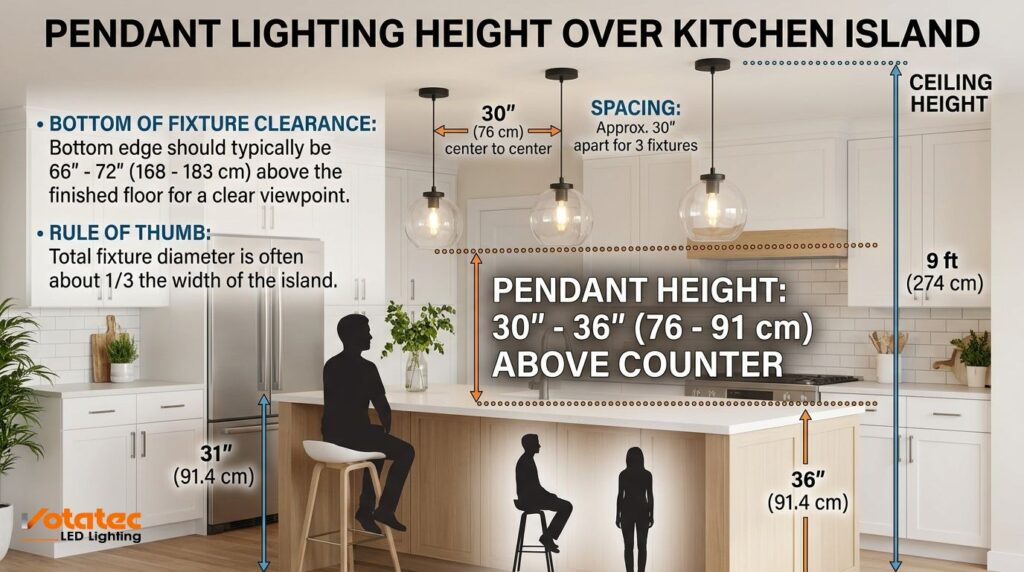
Each pendant over a kitchen island should measure about one-third the width of the island in diameter, and the combined width of all the pendants should stay well under the island’s length. For a 36 inch wide island, that points to a pendant around 12 inches in diameter. It is the sizing rule interior designers apply across kitchen projects.
Three quick sizing formulas designers use:
- Diameter by island width: pendant diameter is roughly the island width divided by 3.
- Diameter by island length: keep each pendant no wider than 25% of the island length.
- Subtract-12 rule: take the island width in inches and subtract 12; the result is the maximum single-pendant diameter.
Scale is the fault most people notice without knowing why. A cluster of small pendants looks lost over a wide island. One oversized drum can overwhelm a narrow one. When you spec, match the fixture diameter to the island first, then confirm the count against the light level you need.
What types of pendant lights work best over a kitchen island?
The best pendant type for a kitchen island depends on whether you want task light, ambient light, or a design statement. Here is how the common shapes perform over an island.
| Pendant type | Light pattern | Best use over an island |
|---|---|---|
| Open-bottom / dome | Directs light down onto the surface | Strong task lighting for prep and cooking |
| Clear glass globe | Spreads light in all directions | Ambient glow, softer task light, open feel |
| Drum / shade | Diffused, downward-biased | Balanced task and ambient, hides the bulb |
| Cage / exposed bulb | Decorative, lower usable output | Accent and style, pair with recessed task light |
| Linear suspension | Even wash along a long axis | Long islands, commercial and amenity spaces |
For islands used heavily for food prep, open-bottom or dome pendants put the most usable light on the surface. For islands that are more about gathering and looks, globes and cage styles work, but back them up with recessed or under-cabinet task lighting so the surface stays bright enough to work on.
How high should pendant lights hang over a kitchen island?
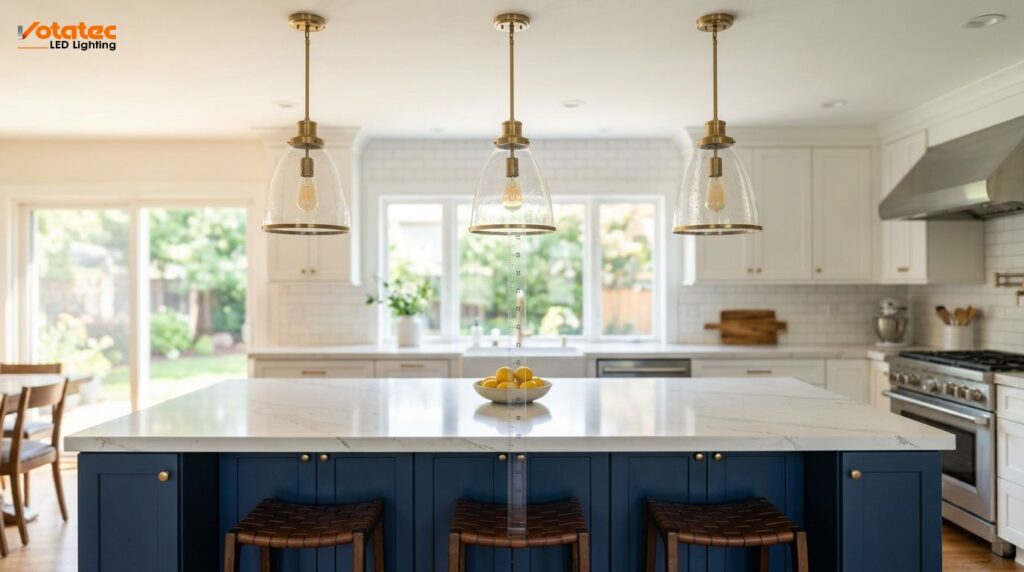
The correct pendant lighting height over a kitchen island is 30 to 36 inches (76 to 91 cm) above the countertop, measured to the bottom of the fixture. This is the range professional designers have specced for years, and it has not changed.
The 30 to 36 inch height clears sightlines so people can talk across the island, keeps the bulb out of standing eye level, and puts the light close enough to the surface to work as task lighting. Nail the pendant lighting height over a kitchen island and the fixtures earn their place. Get it wrong and they either blind people or float uselessly near the ceiling.
How do you adjust pendant height for tall ceilings?
For ceilings taller than 8 feet, add about 3 inches to the hanging height for every extra foot of ceiling.
- 8 ft ceiling: hang pendants 30 to 36 inches above the counter.
- 9 ft ceiling: hang pendants 33 to 39 inches.
- 10 ft ceiling: hang pendants 36 to 42 inches.
Go to the higher end of the range for taller users, oversized fixtures, or when the island is a visual centrepiece. Adjustable-cord and adjustable-rod pendants make final tuning easy at install.
How far apart should pendant lights be over an island?
Pendant lights over a kitchen island should sit 24 to 32 inches (61 to 81 cm) apart, with the end pendants set 6 to 15 inches in from the island ends and the whole run centred on the island’s centre line.
Three rules govern the spacing:
- Centre the run on the island, both across the width and along the length.
- Keep 24 to 32 inches between fixtures. Tighter crowds them. Wider leaves dark gaps.
- Set end pendants in from the ends, not flush to the tips.
Here is the clean way to space an even run. Divide the island length by the number of pendants to get equal sections, then place one pendant at the centre of each section. The maths centres the run and balances the end gaps automatically.
Worked example: A 9 foot (108 inch) island with three pendants. Divide 108 by 3 to get 36 inch sections. The pendants land at 18, 54, and 90 inches from one end. Even spread, balanced ends, no guesswork.
How much light do pendant lights over an island need?
Pendant lights over a kitchen island should deliver 30 to 50 foot-candles on the work surface, which is the range the Illuminating Engineering Society recommends for kitchen task areas, per the IES foot-candle guide. An island used for prep, homework, and food service sits at the higher end.
Spec notes for hitting that level:
- Total output matters, not per fixture. Add up the delivered lumens across all pendants against the island surface area.
- Colour temperature: 2700K to 3000K for warm residential kitchens. 3500K to 4000K for commercial and amenity spaces.
- Colour rendering: spec 90+ CRI over food prep and serving areas so ingredients show true colour.
- Dimming: spec dimmable LED drivers and a compatible dimmer, since islands double as prep stations and entertaining surfaces.
Match the pendant colour temperature to the recessed cans and under-cabinet lighting in the same room. Mixed colour temperature is the most common finished-kitchen complaint, and it is fully avoidable at the spec stage.
How many lumens do pendant lights over an island need?
Pendant lights over a kitchen island need roughly 35 to 50 lumens per square foot of island surface, which lines up with the 30 to 50 foot-candle target. Multiply the island area by that figure to size the total output.
Worked example: a 3 ft by 5 ft island is 15 square feet. At 35 to 50 lumens per square foot, that island needs about 535 to 750 lumens total across all the pendants.
In LED terms, that is modest. One 8W to 12W LED lamp delivers 800 to 1,100 lumens, so two mid-output LED pendants clear the target for most home islands with headroom to dim. For a large or commercial island, scale the total output up and split it across more fixtures rather than pushing one pendant to full brightness. Always stay within each fixture’s rated maximum lamp wattage.
Pendant lights or a linear suspension: which is better over an island?
Choose individual pendants for islands up to about 10 feet, and a linear suspension for longer islands or where you want an even wash with a single fixture. Both light a kitchen island well; the island length and the look you want decide it.
| Factor | Individual pendants | Linear suspension |
|---|---|---|
| Best island length | Up to 10 ft | 8 ft and longer |
| Light spread | Pools of light with gaps between | Even wash along the length |
| Junction boxes | One per pendant | One |
| Design read | Traditional, flexible, layered | Modern, minimal, clean ceiling |
| Rough-in risk | Count and spacing must be exact | Simpler, one box location |
Pendants give you flexibility to layer light and mix finishes. A linear suspension gives you an even result and a simpler rough-in on long runs. On commercial, hospitality, and multi-unit islands where consistency across units matters, a single linear fixture per island is often the safer spec.
How do you light a kitchen island with seating?
For a kitchen island with seating, centre the pendants over the working part of the counter, not the overhang where stools sit, and keep the same 30 to 36 inch hanging height so the light lands on the surface, not in a seated person’s eyeline.
A few placement rules for islands with seating:
- Position pendants over the prep zone, then confirm they do not glare into the eyes of anyone seated across the island.
- On an island with a seating overhang, treat only the working counter length when you divide up pendant spacing.
- Pick pendants with a shade or diffuser if seats face the fixtures, so nobody stares into a bare bulb.
Islands with seating do double duty as prep stations and eating counters, so dimming earns its place here. Bright for cooking, low for dining.
Spec and rough-in notes for trade buyers
When you spec for a client or buy pendant lights wholesale for a multi-unit build, the count decision happens earlier than most people expect. These notes prevent callbacks.
Lock the pendant count at rough-in, not at trim-out. The electrician sets ceiling junction boxes before drywall. If the count or spacing changes later, you are patching drywall and moving boxes. Decide two versus three before the boxes go in.
Confirm box support for fixture weight. Heavier pendants and any linear suspension need a fixture-rated box with proper support. Check the fixture weight against the box rating.
Spec CSA-certified fixtures. In Canada, kitchen island lighting falls under the Canadian Electrical Code (CEC), not the US NEC. Buy fixtures carrying CSA or equivalent certification accepted by your local authority having jurisdiction.
Watch for damp locations. Over a bar sink, in a humid amenity space, or near an exterior wall, spec damp-rated fixtures. Dry-rated pendants are not built for moisture.
Plan the circuit load. A long island with four pendants or a high-output linear suspension can share a circuit, but confirm the total load and dimmer compatibility before ordering.
Buying pendants through a wholesale account keeps the fixture line consistent across every unit and protects margin. Consistent colour temperature and CRI across a build is far easier when the whole order ships from one catalogue.
How to plan pendant lighting over a kitchen island, step by step
To plan pendant lighting over a kitchen island, work through these seven steps in order. Getting the sequence right is what keeps the count, size, and rough-in aligned.
- Measure the island. Record the length and width in inches, and note the ceiling height.
- Set the count. Divide the island length by 2 for your starting pendant count, then favour an odd number.
- Size the fixture. Set each pendant diameter to about one-third of the island width, and check the combined width stays under the island length.
- Pick the type. Choose open-bottom or dome pendants for task light, diffused shades for balance, or a linear suspension for long islands.
- Calculate the light. Multiply island area by 35 to 50 lumens per square foot to size total output, then split it across the pendants.
- Mark the layout. Divide the island length by the pendant count, centre one pendant per section, and confirm 24 to 32 inch gaps.
- Confirm the rough-in. Give the electrician the final count and box positions before drywall goes up.
Run the steps in that order and the spec holds together. Change the count after step 7 and you are moving junction boxes.
Do LED pendant lights save energy over a kitchen island?
Yes. ENERGY STAR certified LED pendant lights are up to 90% more efficient than incandescent bulbs and last at least 15 times longer, according to Natural Resources Canada. An 8W to 12W LED lamp produces the same 800 to 1,100 lumens as a 60W to 75W incandescent bulb, so an island lit to the same brightness draws a fraction of the power.
That efficiency matters most on the islands trade buyers spec in volume. Multiply the saving across a multi-unit build or a commercial kitchen with dozens of fixtures running daily, and the difference in operating cost and relamping labour adds up fast. Certified LEDs also produce almost no heat, which keeps warmth off the counter and out of the prep zone.
For Canadian projects, choose fixtures and lamps that carry ENERGY STAR Canada certification, and check current provincial utility rebate programs before you order, since some cover a share of the upgrade cost. Votatec supplies LED pendants and fixtures and LED lamps built for Canadian commercial and multi-unit work, certified for use here.
Common mistakes to avoid
- Guessing the count before rough-in. Boxes end up in the wrong spot and you cut drywall to fix it.
- Hanging too low or too high. Too low blocks sightlines. Too high kills the task light.
- Mismatched colour temperature. Pendants that do not match the recessed cans read as a mistake.
- Undersized fixtures over a big island. Three small pendants look lost over a 10 foot island. Scale up or add a fourth.
- Skipping dimming. Clients notice on day one.
- Ignoring fixture diameter when choosing two versus three. Width drives the count as much as length does.
Are pendant lights over islands still in style in 2026?
Yes. Pendant lights over the kitchen island remain the default choice for island lighting in 2026, and search demand for kitchen island pendants is up year over year. What is shifting is the look, not the fixture type. Current specs lean toward oversized single statements, clean linear suspensions on long islands, warm metallic and matte finishes, and mixed metals rather than matched sets. Slim, low-profile pendants are replacing bulky glass drums.
For a project that should feel current, spec a simple, well-scaled fixture in a warm finish, hung and spaced by the numbers above. Timeless beats trendy over a surface that stays in place for 15 years.
Browse the full LED pendant and fixture range and the decorative lighting collection to match finishes across a project. For home builds, see Votatec’s residential lighting solutions.
Frequently asked questions
How many pendant lights over a 6 foot island?
Use two pendant lights over a 6 foot island in most cases. Go to three if the fixtures are slim (around 6 inches or narrower) or the island is used heavily for task work. Two wider pendants read cleaner on a wide island.
How many pendant lights over an 8 foot island?
Use three pendant lights over an 8 foot island. Space them evenly by dividing the length into three equal sections and centring one pendant in each. Odd numbers look balanced and cover the span without dark gaps.
How many pendant lights over a 10 foot island?
Use three pendant lights over a 10 foot island, or four if the fixtures are small. On a 10 foot island, a single linear suspension is also a strong option for an even light spread. Confirm the count at rough-in so the junction boxes land correctly.
How high should pendant lights hang over a kitchen island?
Hang pendant lights 30 to 36 inches (76 to 91 cm) above the kitchen island countertop, measured to the bottom of the fixture. For ceilings taller than 8 feet, add about 3 inches for every extra foot of ceiling height.
How far apart should pendant lights be over an island?
Space pendant lights 24 to 32 inches (61 to 81 cm) apart over an island, and set the end pendants 6 to 15 inches in from the island ends. Centre the whole run on the island’s centre line for a balanced look.
Should you use two or three pendant lights over an island?
Use three pendant lights when you want a balanced, evenly lit island, since odd numbers read as balanced and cover the span well. Use two pendant lights over compact islands or when the fixtures are large. Fixture diameter and island length decide it: wide pendants and short islands favour two, slim pendants and longer islands favour three.
What size pendant lights should you use over an island?
Each pendant should measure about one-third the width of the island in diameter. For a 36 inch wide island, that points to a pendant around 12 inches wide. When you use several pendants, keep their combined width well under the island length so the run does not look crowded.
How many lumens do pendant lights over an island need?
Pendant lights over a kitchen island need about 35 to 50 lumens per square foot of island surface. A 15 square foot island needs roughly 535 to 750 lumens total, which two mid-output LED pendants deliver with room to dim.
How do you light a kitchen island with seating?
Centre the pendants over the working part of the counter, not the overhang where stools sit, and keep the 30 to 36 inch hanging height. Choose shaded or diffused pendants if seats face the fixtures, and spec dimming so the island works bright for prep and low for dining.
Summary
- Count: one pendant per 2 feet of island length, odd numbers preferred.
- Height: 30 to 36 inches above the counter, plus 3 inches per foot of ceiling over 8 feet.
- Spacing: 24 to 32 inches apart, end pendants set in from the ends, run centred.
- Light level: 30 to 50 foot-candles on the surface, 90+ CRI over prep areas, matched colour temperature.
- Trade tip: lock the count at rough-in, spec CSA-certified and damp-rated fixtures where needed, and buy the whole run from one catalogue.
This guide was written by the Votatec lighting team using designer placement standards, Illuminating Engineering Society light-level recommendations, and Canadian Electrical Code requirements. Speccing island lighting for a project or a multi-unit build? Contact Votatec for wholesale pricing and to match fixtures across your catalogue.