










 (+1) 905 597 5955




The best LED for can lights is a retrofit LED module for most existing cans, a canless wafer for new or shallow ceilings, and a screw-in BR or PAR bulb for fast, low-cost swaps. A retrofit module gives the best mix of light quality, cost, and a 15-minute install. Canless is the more flexible choice when there’s no usable housing.
Here’s the quick verdict before the detail:
| Your situation | Best LED type | Why |
|---|---|---|
| Existing cans in good shape | Retrofit module | Clean look, no drywall work, drops into the can |
| New build or shallow ceiling | Canless wafer | Less than 2 inches of clearance, place anywhere |
| Rental or fast budget swap | Screw-in BR/PAR bulb | Cheapest, reversible, 60-second change |
| Bathroom, shower, or covered exterior | Wet/damp-rated module or canless | Most bulbs aren’t wet-rated |
| Commercial retrofit with a rebate | DLC-listed module or canless | Rebate eligibility plus matched fixtures |
The rest of this guide answers the exact questions buyers ask, in order, so you can pick with confidence.
What’s the difference between retrofit modules, canless, and screw-in bulbs?
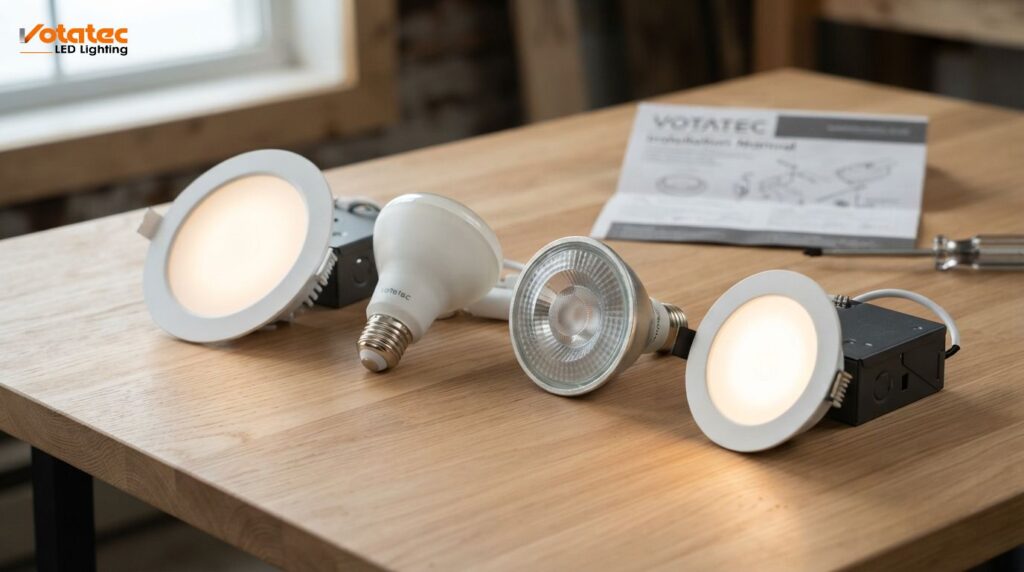
The three options put LED light into a ceiling opening in different ways, and that changes cost, install, and performance. Here are the plain definitions:
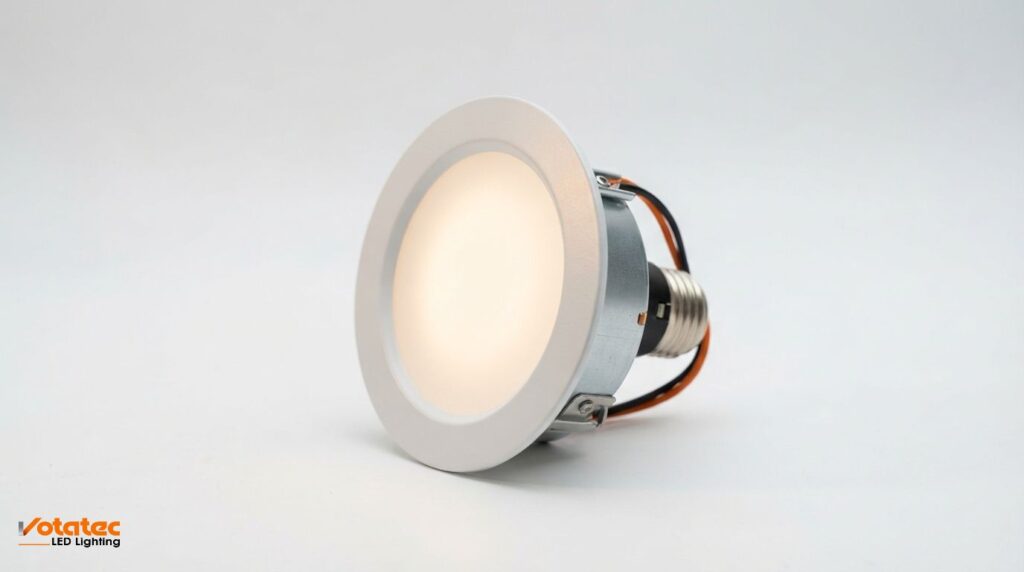
- A retrofit LED module is a sealed light engine that clips into an existing can and replaces both the bulb and the trim in one piece. You screw an E26 adapter into the old socket, plug in the module, and push it up. Torsion springs hold it flush.
- A canless wafer light is a thin integrated LED fixture, often under 1 inch thick, that wires straight to a junction box with no housing at all. It needs less than 2 inches of clearance and snaps into a cut hole.
- A screw-in LED bulb is a BR or PAR lamp that threads into the existing socket like any bulb. It’s the simplest swap, but it sits up inside the old reflector, so glare and spread depend on the old trim.
| Feature | Retrofit module | Canless wafer | Screw-in bulb |
|---|---|---|---|
| Needs existing can | Yes | No | Yes |
| Install time | 10-15 min | 20-30 min (wiring) | 60 seconds |
| Relative cost | Mid | Mid | Low |
| Light quality | High | High | Basic |
| Replace when it fails | The module | The whole fixture | The bulb |
Can you put LED bulbs in existing can lights?
Yes, you can put LED bulbs in existing can lights if the can has a standard E26 socket. Unscrew the old halogen or incandescent flood, thread in an LED BR30, BR40, or PAR38, and it works right away. No wiring or drywall is needed.
The one thing to check is the fixture type. If your can is sealed, airtight, or in a wet location, the bulb has to be rated for that, which the next section covers.
Why can’t you use some LEDs in enclosed fixtures?
You can’t use some LED bulbs in enclosed fixtures because trapped heat damages the bulb’s driver and shortens its life. LEDs run cooler than halogens, but the electronics inside still need airflow. A sealed can holds that heat against the bulb.
The fix is simple. Look for “enclosed fixture rated” on the package. If the bulb isn’t rated for it, pick a sealed retrofit module instead, since modules are built to handle the heat inside a closed can.
What bulbs are best for can lights?
The best bulbs for can lights are BR30 or BR40 LED floods for general ceiling lighting, and PAR38 LED spots for focused or accent light. BR bulbs spread a soft, wide beam around 110 degrees, which suits living rooms and hallways. PAR bulbs throw a tighter, brighter beam for task zones or artwork.
Match the bulb to the can size. BR30 and PAR30 fit 4-inch and 5-inch cans. BR40 and PAR38 suit 5-inch and 6-inch cans. For sealed or damp locations, confirm the bulb is rated for it before you buy.
How do you choose LED recessed lighting? 7 specs that decide
Choosing LED recessed lighting comes down to seven specs. Read these in order, and use specific values, not round guesses, when you compare products.
1. Lumens (brightness)
Lumens measure brightness; watts only measure power draw. A 4-inch trim usually needs about 600 to 750 lumens, while a 6-inch trim needs roughly 850 to 1,100 lumens for general lighting. Task zones like kitchen counters want the top of that range. A typical 9W LED downlight replaces a 65W incandescent.
2. Colour temperature (CCT)
Colour temperature in Kelvin sets the mood. Use 2700K for warm living spaces, 3000K for a popular all-round white, 3500K to 4000K for kitchens and offices, and 5000K for garages and workshops. Selectable CCT (5CCT) units let you flip a switch between all five on the job, so one product covers every room.
3. CRI (colour rendering)
CRI measures how true colours look, on a scale to 100. Spec CRI 90 or higher for kitchens, bathrooms, retail, and hospitality, where skin, food, and merchandise need to look right. CRI 80 is fine for garages and storage. A 93 CRI selectable unit now costs barely more than an 80 CRI one.
4. Dimming and flicker
Dimming needs two matched parts: a fixture marked dimmable and an LED-rated dimmer. Old leading-edge (TRIAC) dimmers buzz and flicker with low-watt LED loads. A trailing-edge (ELV) dimmer cuts the back of the AC wave and runs smoother and quieter. Always check the maker’s dimmer compatibility list before a bulk order.
5. IC and airtight rating
IC (“insulation contact”) means the fixture can touch ceiling insulation without overheating, which is required under insulated attics. Airtight (AT) seals the fixture so conditioned air doesn’t leak into the attic, and many energy codes require it on insulated ceilings. Look for both marks together for attic installs.
6. Wet and damp rating
Damp-rated suits humid spots with no direct water, like a covered patio or a bathroom outside the shower. Wet-rated handles direct water, like inside a shower or an open soffit. Most screw-in bulbs carry no wet rating, so use a sealed module or canless unit in those spots.
7. Certifications
Certifications prove quality and unlock rebates. Look for cETLus or cUL safety listing for Canada, ENERGY STAR for efficiency, and DLC (DesignLights Consortium) for commercial rebate eligibility. On a rebate job, confirm the exact model is on the DLC qualified list before you submit.
What are the brightest LED can lights?
The brightest LED can lights for a 6-inch trim usually output 1,000 to 1,200 lumens, with high-output commercial modules going higher. For a 4-inch trim, the brightest options land near 750 to 900 lumens. Pair maximum output with a 4000K colour temperature for the crispest, brightest feel in kitchens and workspaces.
Watch the trade-off. More lumens in a small room can glare. It’s easier to dim a bright fixture than to brighten a dim one, so spec slightly high and add an LED-rated dimmer.
Is 4000K or 6500K better for can lights?
For most indoor can lights, 4000K is better than 6500K. 4000K is a clean neutral white that reads bright and modern without a harsh blue cast. 6500K is very cool daylight that can feel clinical inside a home.
Save 5000K to 6500K for garages, workshops, and warehouses where you want maximum crispness. For living rooms and bedrooms, drop to 2700K or 3000K. This is exactly why selectable CCT is worth it: you set the colour per room at install.
Do LED can lights need a special dimmer?
LED can lights usually need an LED-rated dimmer, ideally a trailing-edge (ELV) model. LEDs draw so little power that old incandescent dimmers can buzz, flicker, or refuse to dim low. A dimmer built for LED loads fixes that.
Before buying in bulk, confirm the fixture is marked dimmable, pick an LED-rated dimmer, and set its low-end trim so the light stays stable near minimum. For commercial work, ask the supplier for the driver’s tested-dimmer report.
How many recessed lights do you need?
A simple starting rule: divide the ceiling height in feet by two to get the spacing in feet between fixtures. An 8-foot ceiling lands fixtures about 4 feet apart. Keep the outer ring 1.5 to 2 feet off the walls so you light the room, not just the centre.
Adjust by purpose. Task zones like counters want tighter spacing or extra fixtures. Accent lighting wants gimbal trims aimed at the wall. Add up the lumens of every fixture and sanity-check it against the room’s size before you order.
Retrofit module or canless: which is better?
Neither is better overall; each solves a different problem. Choose a retrofit module when sound cans already exist, since you keep the housing, skip the drywall, and finish in minutes. Choose canless when there’s no can, the cavity is shallow, or you’re cutting new openings.
For a building owner replacing dozens of working cans, modules roll out faster and cheaper. For a gut renovation or new build, canless wins on flexibility. The old can is now a legacy platform whose main job is hosting retrofits.
What does an LED can light retrofit cost?
Sticker price tracks performance: screw-in bulbs are cheapest, retrofit modules sit in the middle, and high-CRI or canless commercial units cost a bit more. The number that matters, though, is total cost over the fixture’s life, which is purchase plus energy plus replacement labour.
Quality LED downlights use far less power than the halogens they replace and last 50,000 hours or more. Fewer ladder trips and lower hydro bills usually pay back the upgrade in a few years, faster when a utility rebate covers part of the install.
What’s the best LED for a commercial can light retrofit?
The best LED for a commercial can light retrofit is a DLC-listed selectable-CCT module or canless unit with 90+ CRI. DLC listing keeps the project rebate-eligible, selectable CCT standardises one SKU across mixed spaces, and 90 CRI suits retail, healthcare, and hospitality. Match dimming to any controls you add.
Canadian utility rebates make the case stronger. BC Hydro’s business program can offset up to 75% of an energy-efficiency project’s cost, and most programs require DLC-certified products. Ontario’s Save on Energy runs retrofit incentives too. Terms and deadlines change often, so confirm current offers with the utility before you set a budget.
Planning a multi-site or government retrofit? Votatec supplies project-quantity recessed downlights, retrofit modules, and canless wafers with DLC and cETLus options. Request a project quote and we’ll spec output, colour, and ratings to your ceilings and your rebate.
What’s the difference between can lights and recessed lights?
Can lights and recessed lights are the same thing. “Recessed light” is the technical term for any fixture set into a ceiling so the trim sits flush. “Can light” is the common name for the metal housing, or “can,” that older recessed fixtures use. Today, “can light” often means a fixture with a housing, while canless recessed lights skip the can entirely.
So all can lights are recessed lights, but not all recessed lights have a can. When someone says they want to upgrade their can lights, they usually mean the round recessed fixtures already in the ceiling.
What size can light do I need?
The most common can light sizes are 4-inch, 5-inch, and 6-inch, measured by the opening diameter. Use 4-inch trims for accent light, tight spacing, and smaller rooms. Use 6-inch trims for general lighting in living rooms, kitchens, and hallways. The 5-inch size splits the difference and often shares trims with 6-inch housings.
Match the new LED to the existing opening. Many retrofit modules and canless units are sold as 5-inch or 6-inch adjustable, so one product fits both.
How long do LED can lights last?
Quality LED can lights last 50,000 hours or more, which is roughly 20 to 45 years at normal household use. That’s far longer than the 1,000 to 2,000 hours of an old incandescent or the 10,000 hours of a halogen. Longer life means far fewer ladder trips to change lamps.
Heat is the main enemy. A well-ventilated fixture, or a module rated for enclosed cans, hits its full rated life. A cheap bulb baking in a sealed can fails much sooner.
Are LED can lights worth it?
Yes, LED can lights are worth it for almost every space. They use up to 75% less energy than incandescent or halogen lighting, last decades, and run cool enough to cut cooling load in summer. The energy and replacement savings usually pay back the upgrade within a few years.
For commercial buildings, the case is stronger. Utility rebates can cover a large share of the install cost, and lower maintenance frees up facility budgets.
Common mistakes to avoid
Even a simple recessed upgrade goes sideways in predictable ways. Watch for these.
- Buying by watts, not lumens. A “9W” label says nothing about brightness. Read the lumen number.
- Skipping the dimmer check. A great LED on an old dimmer still flickers. Match the dimmer.
- Ignoring the enclosed-fixture rule. A non-rated bulb in a sealed can dies early.
- Mixing colour temperatures. Three different “whites” in one room look wrong. Standardise CCT.
- Forgetting DLC on rebate jobs. No DLC listing usually means no rebate cheque.
- Choosing 6500K for living spaces. Too cold. Most homes want 2700K to 3000K.
Frequently asked questions
What is the best LED for can lights?
For most existing cans, a 90 CRI selectable-CCT retrofit module is the best LED for can lights. It drops into the old housing, controls glare, and lets you set the colour on site. For new or shallow ceilings, a canless wafer fits better. Screw-in BR or PAR bulbs suit fast, low-cost swaps.
Can you put LED bulbs in can lights?
Yes. If the can has a standard E26 socket, an LED BR30, BR40, or PAR bulb screws straight in. Check the package for “enclosed fixture rated” if your cans are sealed or airtight, since trapped heat shortens the life of bulbs that aren’t rated for it.
What is the brightest LED for a 6-inch can?
Most 6-inch retrofit and canless units output 850 to 1,200 lumens, and high-output commercial modules go higher. For a bright kitchen or workspace, aim for the top of that range and pair it with a 4000K colour temperature for a crisp look.
Are canless recessed lights better than retrofit cans?
It depends on the job. Canless suits new construction, remodels, and shallow ceilings because it’s thin and flexible to place. Retrofit modules suit sound existing cans, since you skip drywall and finish in minutes. Canless replaces the whole unit when it fails; a module keeps the can.
Do LED can lights need a special dimmer?
Usually yes. LEDs draw little power, so old leading-edge dimmers can buzz or flicker. Use an LED-rated dimmer, ideally a trailing-edge (ELV) model, and check the maker’s compatibility list. Always confirm the fixture itself is marked dimmable.
Is 4000K or 6500K better for can lights?
For indoor spaces, 4000K is better. It’s a clean neutral white without the harsh blue of 6500K. Reserve 5000K to 6500K for garages and workshops. Use 2700K to 3000K for living rooms and bedrooms.
The bottom line
There’s no single best LED for can lights. There’s the best one for your job: a retrofit module for sound existing cans, a canless wafer for new or shallow ceilings, and a screw-in bulb for fast, reversible swaps.
Then nail the seven specs: enough lumens for the room, 90+ CRI where looks matter, selectable CCT for consistent colour, an LED-rated dimmer to kill flicker, and the right IC, airtight, and wet ratings for the location. On commercial work, lock in DLC listing so the rebate goes through.
Ready to spec your recessed lighting? Votatec carries retrofit modules, canless wafers, and recessed downlights for homes, businesses, and government projects across Canada. Browse recessed downlights or request a project quote.