










 (+1) 905 597 5955



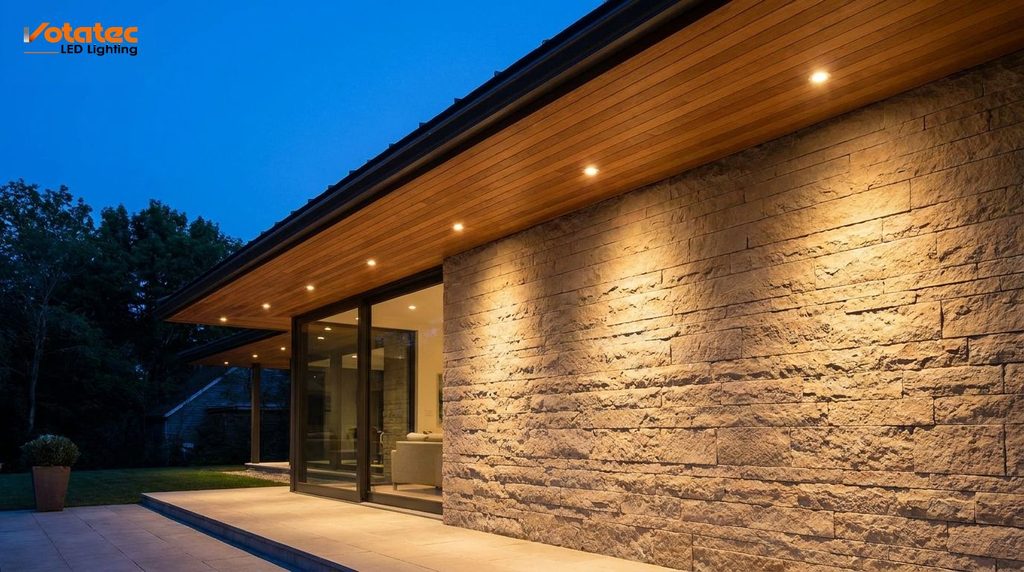
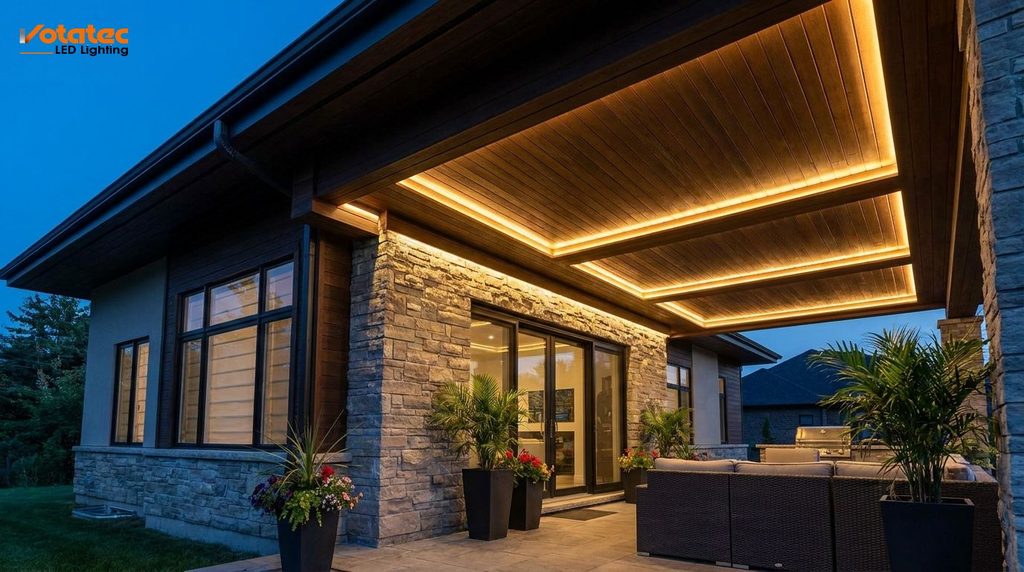
Soffit lighting is any fixture mounted into the underside of your roof overhang, pointing down. That’s it. The soffit is the flat panel tucked under your eaves, and recessing a downlight into it washes light down your exterior wall instead of blasting it sideways into your neighbour’s bedroom.
Most homeowners searching for soffit lighting want one of two completely different things, and nobody on page one separates them. Let’s fix that first.
What Is Soffit Lighting, Exactly?
Soffit lighting is recessed or surface-mounted exterior downlighting installed in the horizontal underside of a roof overhang, soffit, or eave. Fixtures are typically 2 to 6 inches in diameter, wet-location or damp-location rated, hardwired to a 120V circuit, and aimed straight down to light walls, entries, walkways, and garage aprons without glare at eye level.
Short version? Soffit lighting is pot lights, outside, in your eaves.
The Two Things People Mean by “Soffit Lighting”
Here’s the deal. Search volume for soffit lighting spikes every November in Canada and the United States. Not because people discover architectural lighting in the fall. It’s Christmas.
Type 1: Recessed soffit downlights (white, architectural)
Individual recessed downlights spaced along the soffit run, giving clean pools of white light down the face of the house. Normal switch or photocell. They stay in the soffit forever. This is what an electrician means by soffit lighting, and what this guide covers.
Type 2: Permanent RGB track systems (holiday lighting)
A continuous channel of colour-changing LED pucks clipped along the soffit edge, app-controlled, sold to replace stapling up Christmas lights every December. Different product, budget, and install.
Both get called soffit lighting. Only one lights your front walk at 2am in February.
| Recessed soffit downlights | Permanent RGB soffit track | |
|---|---|---|
| What it does | White task and accent light | Colour effects, holidays |
| Fixture spacing | Every 1.8 to 3 m | Continuous channel |
| Cut into soffit? | Yes, one hole per light | No, edge-mounted clips |
| Runs year round | Yes | Usually seasonal |
| Typical Canadian cost | $100 to $350 per light installed | $3K to $8K per home |
Why Homeowners Pick Soffit Lighting Over Wall Sconces
I’ve walked a lot of finished exteriors. The pattern is consistent: houses with wall-mounted fixtures have glare, and houses with recessed soffit lighting have light.
It’s geometry. A sconce sits at 1.9 m, right at eye height, so you see the lamp before you see the ground. Soffit lighting sits at 2.7 m or higher and points away from your eyes. You see the wall, the steps, the driveway. Never the source.
More reasons soffit lighting wins outside:
- Invisible by day. A 2-inch trim disappears into a white soffit.
- No bugs at the door. Insects swarm the fixture, not the person under it.
- Weather protection built in. The overhang shields it from rain and falling ice.
- Even coverage. Six spaced soffit lighting fixtures beat two bright sconces.
- Security that doesn’t look like security. Shadows gone, no prison-yard floodlight.
Soffit lighting doesn’t replace everything, though. You still want a fixture beside the door and path lights along a long walk. Our guide on choosing modern outdoor wall lighting for a patio covers where sconces make sense.
Wet-Rated or Damp-Rated? The Soffit Lighting Question That Trips Everyone
This is the one that costs people money. A fixture in a soffit is outdoors. It needs an outdoor location rating, and “it’s under the overhang so it stays dry” is not a rating.
The Canadian Electrical Code covers this in Section 30. Rules 30-316 through 30-322 set the requirements for luminaires in damp or wet locations, including totally enclosed gasketted luminaires and equipment exposed to flying objects. The code is published as CSA C22.1, and the current 26th edition landed in March 2024. Confirm the edition and scope through CSA Group.
So what do you buy for soffit lighting?
- Damp-location rated is the floor. Covers a fixture shielded from direct rain in humid air. A deep, well-drained overhang usually qualifies.
- Wet-location rated is what I’d specify anyway. Wind-driven rain reaches soffits on exposed elevations, drifting snow reaches them on all of them. Same hole, roughly the same price.
Which rating you have isn’t a guess, and it isn’t whatever the product page says. For recessed downlights it’s on a public register. ENERGY STAR sunset its general lamps and luminaires programme, but recessed downlights got a carve-out and kept a live specification, so certified models are searchable through the ENERGY STAR certified products list. Pull the model number, read the rating off the record.
Worth doing. Pulling Votatec’s 50 certified recessed downlight records on 2026-09-08 returns 29 wet-location rated and 20 damp-location rated. Same catalogue, split almost down the middle. Assume, and you’ll be wrong about 40% of the time.
Our dedicated piece on wet-rated versus damp-rated exterior can lights has the full breakdown. Read it before you order.
Don’t forget the IC rating
Separate rating, separate problem. IC means the housing may touch insulation. Non-IC needs 75 mm of clearance. Canadian soffit cavities often carry blown-in insulation that has migrated past the baffle, so IC-rated soffit lighting is the safer buy.
Those same 50 records break down as 35 Type IC, 6 Type IC Airtight, 4 Type Non-IC, and 5 blank. Air tight is a third, separate rating. An “IC rated” badge tells you nothing about air sealing.
What Size and Beam Angle Should Exterior Soffit Lighting Use?
Smaller than you think.
Interior pot lights are usually 4 or 6 inch. For soffit lighting, 2 inch and 3.5 inch trims look far better, because a small aperture reads as a detail rather than a hole. Output per fixture matters more than diameter.
Starting specs for residential soffit lighting:
- Aperture: 2 in to 4 in
- Output: 600 to 900 lumens per fixture
- Wattage: 8W to 12W
- Beam angle: 35° to 45° for wall washing, 60° for area coverage
- CRI: 90 or better, so brick reads as brick
- Colour temperature: 2700K or 3000K
- Trim colour: black baffle on a dark soffit, white on white
A real example from Votatec’s LED downlight range: the VO-RP4W9-120-D-5WAY is a 4-inch, 9W, 750-lumen, Type IC, wet-location-rated downlight with five selectable colour temperatures. That’s 83 lumens per watt, suited to outdoor soffit lighting with no modification.
The beam spread math nobody shows you
You can predict the pool of light:
Beam diameter = 2 × mounting height × tan(beam angle ÷ 2)
Run it for a single-storey soffit at 3 m above grade:
- 40° beam: 2 × 3 × tan(20°) = 2.2 m pool
- 60° beam: 2 × 3 × tan(30°) = 3.5 m pool
- 24° beam: 2 × 3 × tan(12°) = 1.3 m pool
That one calculation drives your whole outdoor soffit lighting layout. Space a 40° fixture wider than its own pool and you get scallops with black holes between. Looks unfinished. Costs the same to install.
Two-storey soffits sit at 5.5 m or more, where the same 40° fixture throws a 4 m pool at much lower intensity. Narrower and brighter up high, wider and softer down low.
Want adjustability? Gimbal trims tilt 20° to 35° off vertical so you can aim soffit lighting at a feature wall or away from a window. Our gimbal recessed light guide explains the trade-offs, and the trimless downlight sizing guide covers aperture choice.
Soffit Lighting Placement and Spacing: How Far Apart?
Start at 2.4 m centres for 40° fixtures on a single-storey soffit. Tighten to 1.8 m for a continuous wash with no scalloping. Open to 3 m for distinct pools, which suits a modern facade.
Then walk the elevation and adjust:
- Centre a fixture on each window, not between two. Off-centre soffit lighting over a window looks like a mistake because it is one.
- Two lights on a double garage, one per door, a third in from each end.
- One per corner, about 600 mm back so the light wraps both faces.
- Front entry gets its own, pushed toward the door rather than the middle of the porch.
- Skip the gable peaks. Soffit lighting there hits nothing but air.
- Mind the address numbers. A fixture directly above them puts them in shadow.
One thing I see constantly: full-spacing soffit lighting on a rear elevation nobody stands on, while the walkway to the side door has none. Light where people walk. The back can take half the fixture count.
Can You Put Recessed Lighting in a Vented Soffit?
Yes, carefully. This is where soffit lighting differs most from interior pot lights.
Your soffit is the air intake for the whole attic. Cool air enters at the eaves, rises, exits at the ridge. The National Building Code of Canada sets attic venting at 1 square foot of net free vent area per 300 square feet of attic floor where a vapour barrier is present, 1:150 without one. Block enough intake and you get ice dams, condensation, rotten sheathing. Expensive.
Rules for soffit lighting in a vented soffit:
- Cut between the vent strips, never through them.
- Count your losses. Each 4-inch hole removes roughly 0.09 square feet. Ten lights is about 0.9 square feet, and on a house with only 4 square feet of intake, that matters.
- Use canless, air-tight fixtures. They seal the hole instead of leaving a path into the attic.
- Keep insulation off non-IC housings, 75 mm minimum.
- Check cavity depth before you order. Aluminum and vinyl panels often have 100 mm or less behind them before a lookout or sheathing. Slim canless trims fit. Traditional cans don’t.
No room behind the panel? Use surface mount soffit lighting instead. Votatec’s surface mount LED lights sit flat on the soffit face, need only a wire, and give the same downward light without cutting into your attic intake. Slightly more visible. Much less risk.
What Does LED Soffit Lighting Cost in Canada?
Two numbers matter: the install, and the run.
Installed cost, 2026 market rates. Soffit lighting lands between $100 and $350 per fixture installed, and where you fall is mostly about access. Vancouver pot light installs run $150 to $350 each, typically $200 to $250 once you’re doing four or more. GTA jobs come in around $400 to $900 for a 4 to 6 light install, $1,500 to $3,500 for 10 to 15 lights.
Ground-floor soffits with attic access above are cheap. Two-storey soffits with no access mean lift rental and fishing wire, so roughly double.
Running cost. This is where soffit lighting stops looking like a luxury. Six 9W fixtures on dusk-to-dawn control average about 12 hours a night across the year, so 4,380 hours annually.
- 6 × 9W LED = 54W → 237 kWh/yr
- 6 × 50W halogen = 300W → 1,314 kWh/yr
At the Ontario off-peak rate of 9.8¢/kWh, set by the Ontario Energy Board’s regulated price plan and in effect until 2026-10-31, that’s about $23 a year for LED soffit lighting versus $129 for halogen. Around $106 saved annually, on six lights.
It tracks the national picture too. Natural Resources Canada reports the shift to LEDs and similar efficient lighting cut lighting energy use per Canadian household by 25%, from 4.7 GJ to 3.5 GJ. Their residential sector energy data has the full series.
One honest note: don’t buy soffit lighting expecting a utility rebate. Residential LED downlights sit outside the commercial rebate programmes that fund troffer and high bay retrofits. The payback is the hydro bill, not a cheque.
Colour Temperature, CRI, and Not Annoying Your Neighbours
Pick 2700K or 3000K. Not 4000K, and definitely not 5000K.
Cool white soffit lighting makes a brick or stone house look like a car dealership after hours. Warm light flatters masonry, wood, and stucco, and throws far less blue light sideways. Dark-sky guidance caps approved outdoor fixtures at 3000K for that reason.
CRI 90 or better is the other half. Below CRI 80, red brick goes brown and cedar goes grey. You paid for the material. Light it properly.
Then there’s light trespass, the polite name for shining into someone’s window. Anything crossing your property line qualifies, and plenty of municipalities have bylaws about it. Recessed soffit lighting is already the good choice, because the trim shields the source and nothing goes above horizontal. Two ways to stay out of trouble:
- Aim gimbals inward and downward, never out toward the lot line.
- Keep the last fixture in a run 1.5 m back from the property edge.
Many Votatec downlights ship with five selectable colour temperatures on a switch, so you set 2700K at commissioning and change your mind later without new fixtures. Handy on a soffit lighting job at 5.5 m.
Controls: Photocell, Timer, or Smart Switch?
Soffit lighting you have to remember to switch on is soffit lighting that stays off. Pick one of these:
- Photocell (dusk to dawn). Cheapest, most reliable. No programming, no clock drift. Votatec’s photoelectric sensors run a whole soffit lighting circuit from one device.
- Astronomical timer. Follows sunrise and sunset by date and location. Good if you want off at midnight rather than dawn.
- Photocell plus timer. What I’d specify. On at dusk, off at a set hour.
- Smart switch. Fine, one caveat: it depends on your Wi-Fi, and soffit lighting is partly a security system.
- Motion. Skip it. Motion belongs on a dedicated fixture at the side door, not on an architectural wash that fires every time a raccoon crosses the driveway.
Put the whole soffit lighting run on one dedicated circuit. Easier to troubleshoot, easier to extend.
Will Soffit Lighting Survive a Canadian Winter?
Better than most things on your house.
LEDs like cold. Lower ambient temperature lowers junction temperature, nudging efficacy up, so soffit lighting is marginally brighter in January than July. The chip isn’t the weak link.
The driver is. Cheap drivers spec -20°C and quit in a real cold snap. Quality outdoor drivers are rated to -40°C. Ask for the range before buying soffit lighting for a Prairie or northern Ontario install, and treat a missing spec as a no.
Three more Canadian realities for soffit lighting:
- Ice. The overhang protects the fixture, but sliding ice shears trims off a soffit edge. Set fixtures 150 mm in from the fascia.
- Snow reflection. Fresh snow bounces light up, so soffit lighting feels a third brighter in winter. Aim slightly low.
- Thermal cycling. Going -25°C to +30°C over a year works gaskets loose. Wet-location rated, with a real gasket.
Six Soffit Lighting Mistakes I Keep Finding on Finished Jobs
- Interior pot lights in the soffit. Dry-location trims outside. They last one season, then water gets in and the driver dies.
- Spacing measured from the corner instead of centred on features. Mathematically even, visually wrong. Windows and doors set the rhythm.
- 4000K on a warm brick house. The most common soffit lighting regret, and the hardest to undo once the holes are cut.
- Blocked soffit vents. Lights punched through the vent strip instead of between. Shows up two winters later as an ice dam.
- No photocell. Manual switch, so the lights run when someone remembers. Which is never.
- Mixed trims across elevations. Two brands of soffit lighting on one house, slightly different white points, obvious from the street.
How to Buy LED Soffit Lighting in Canada
Votatec is a wholesale distributor, so pricing is quote-based and we sell through contractors and distributors rather than retail. For homeowners that’s usually better anyway: in Ontario, hired electrical work must be done by a Licensed Electrical Contractor, and almost all electrical work requires a notification filed with the Electrical Safety Authority before it starts.
Practical path for a soffit lighting project:
- Count and place fixtures using the spacing rules above. Sketch the elevation.
- Fix your specs. Aperture, lumens, beam angle, CCT, wet-location rated, IC rated.
- Check cavity depth behind one panel before ordering anything.
- Send the list to your electrician and have them quote fixtures plus labour together.
- Verify model numbers on the ENERGY STAR register before the order goes in.
Browsing first? Start with the LED downlight category for recessed soffit lighting, surface mount fixtures for shallow cavities, and outdoor wall lights for the entry fixture soffit lighting doesn’t replace. Going past the house? The landscape lighting range and our install guide pick up there, and where to buy quality LED downlights in Canada covers sourcing.
Frequently Asked Questions About Soffit Lighting
What lights should you use in a soffit?
Use wet-location or damp-location rated LED recessed downlights, 2 to 4 inches in aperture, 600 to 900 lumens each, at 2700K or 3000K with CRI 90 or better. Canless air-tight trims are best, because soffit cavities are shallow and double as your attic air intake. Never use dry-location interior pot lights.
Is soffit lighting worth it?
For most Canadian homes, yes. Soffit lighting costs roughly $23 a year in electricity on a six-fixture run, versus about $129 for halogen. Install runs $100 to $350 per fixture. It also improves night-time safety on steps and driveways without the eye-level glare of wall-mounted floodlights.
How far apart should soffit lights be spaced?
Space soffit lighting at 2.4 m centres for 40° beam fixtures on a single-storey soffit about 3 m above grade. Tighten to 1.8 m for a continuous wash, or open to 3 m for distinct pools. Centre a fixture on each window and door rather than spacing purely by measurement.
Can you install soffit lighting yourself?
In Ontario, homeowners may do electrical work in their own home but must meet the Ontario Electrical Safety Code and file a notification with the ESA first. Hired work must go through a Licensed Electrical Contractor. Since soffit lighting means working at height, cutting attic ventilation, and running a 120V exterior circuit, most people should hire it out.
What’s the difference between soffit lighting and permanent Christmas lights?
Soffit lighting is recessed white downlights installed in the eave to light walls and walkways year round. Permanent holiday lighting is a colour-changing RGB LED channel clipped along the soffit edge and run from an app. Different products, different prices. Some homeowners install both, on separate circuits.
Bottom Line
Soffit lighting is the cleanest way to light a house exterior, and it’s a specification problem more than a design problem. Get five things right:
- Location rating. Wet-location rated, verified on the register, not assumed from the product page.
- IC rating. Type IC or IC Airtight, because insulation moves.
- Beam and spacing. 40° at 2.4 m centres, then adjust to your windows and doors.
- Colour. 2700K or 3000K, CRI 90+. Never 5000K on a residential facade.
- Ventilation. Cut between the vent strips and count the intake you’re removing.
Do that and your soffit lighting looks intentional for 20 years. Skip the location rating and you’re back up the ladder in 18 months.
Ready to spec a soffit lighting job? Votatec supplies wet-location rated LED downlights and surface mount fixtures to contractors and distributors across Canada, shipping from the GTA. Request a quote with your fixture count and we’ll match the specs.