










 (+1) 905 597 5955



For a 12-20 ft ceiling, low bay LED lights are almost always the right pick. They run lower wattage, roughly 80W to 150W per fixture on most commercial jobs, and they push light through a wide beam of about 90° to 120°. That wide spread lets neighbouring fixtures overlap before the light reaches the floor. High bay LED lights are built for 20 ft and up, where a narrower 60° to 90° beam has to throw light a long way down.
That’s the short answer. The longer one matters more, because the line between low bay LED lights and high bays isn’t where most guides put it. The DesignLights Consortium (DLC), the list most Canadian utility programmes check, draws it at 25 ft, not 20. And Ontario’s Instant Discounts programme doesn’t look at your ceiling at all. It sorts fixtures by lumens and watts.
So low bay LED lights you hang at 16 ft can be listed, and discounted, as high bays. Confusing? A little. Below you’ll get a ceiling-height table and a worked layout for a 16 ft room. You’ll also see the mistakes that cause glare and dark aisles, plus a Canadian buying checklist for low bay LED lights.
What Are Low Bay LED Lights?
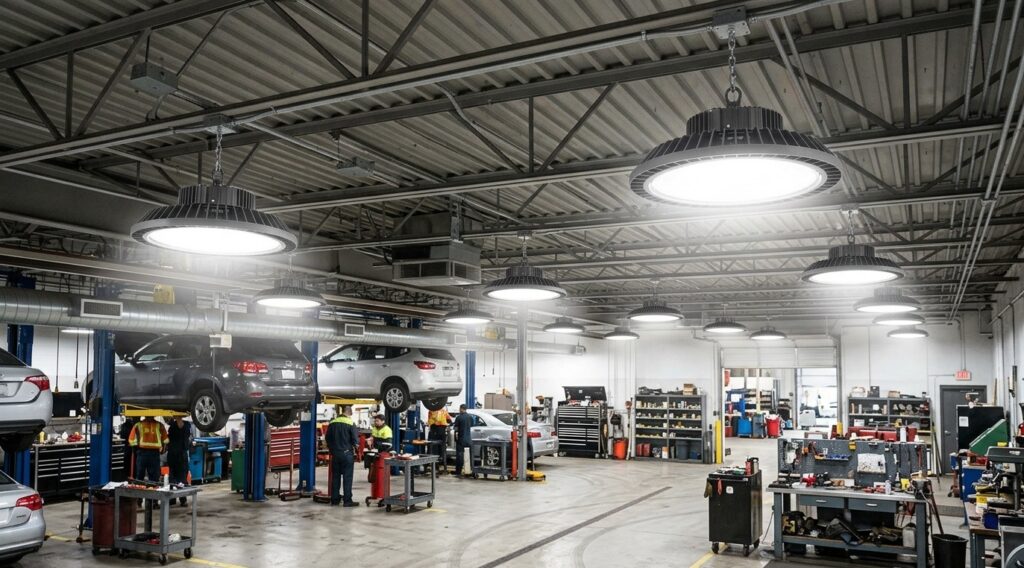
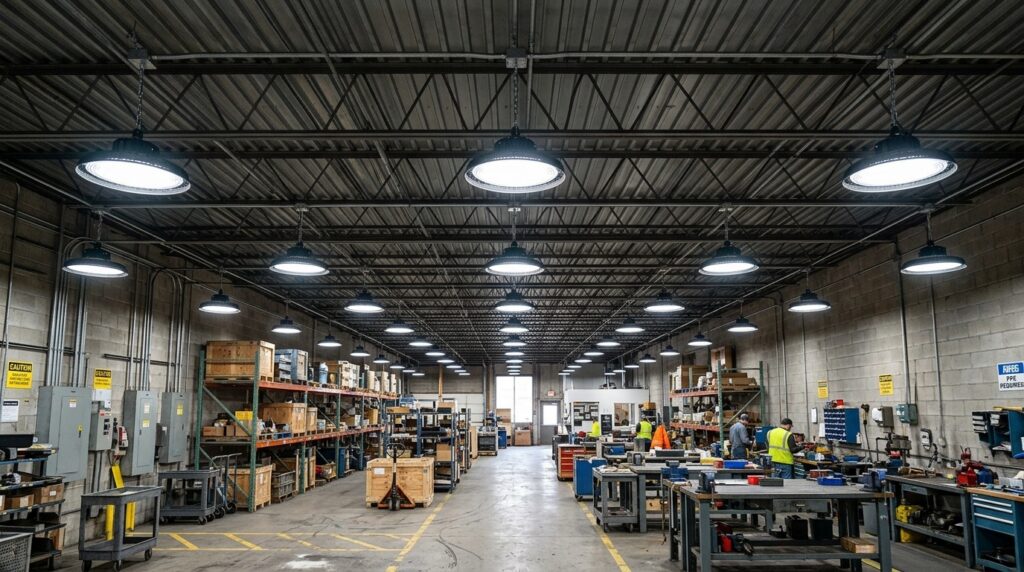
Low bay LED lights are commercial ceiling fixtures made for indoor spaces with roughly 12 to 20 ft of mounting height. They pair moderate output with wide-beam optics, so light spreads evenly across the floor without hot spots or harsh glare at eye level. The DLC classes low bay LED lights as fixtures intended for ceilings under 25 ft.
You’ll find low bay LED lights in places like these:
- Light-industrial units, small warehouses and distribution mezzanines
- Retail floors, garden centres and showrooms with exposed ceilings
- Service garages, loading areas and maintenance shops
- Multipurpose rooms, older school gyms and community halls with lower decks
- Cold rooms and food-processing areas, where the fixture also needs a wet or damp rating
Here’s the thing most buyers miss. Low bay LED lights usually look exactly like high bays. Same two shapes: round UFO-style heads and rectangular linear bodies. Often low bay LED lights come from the same product family as high bays, run at a lower wattage setting with a wider lens. So “low bay” describes the job more than the hardware. For the wider family of commercial fixtures, see our guide to types of LED fixtures.
That’s also why low bay LED lights don’t always say “low bay” on the box. Plenty of manufacturers, Votatec included, sell a 2ft linear high bay that’s really doing low bay work once you set it to 80W or 110W.
Low Bay vs High Bay LED Lights: The Key Differences
Here’s how low bay LED lights stack up against high bays. Numbers are typical ranges, not hard rules.
| Feature | Low bay LED lights | High bay LED lights |
|---|---|---|
| Ceiling height (trade rule) | About 12-20 ft | 20 ft and up |
| Ceiling height (DLC definition) | Under 25 ft | 25 ft and up |
| Typical wattage | 60W-150W | 150W-300W+ |
| Typical output | 5,000-22,000 lumens | 20,000-45,000+ lumens |
| Beam angle | Wide, about 90°-120° | Narrower, about 60°-90° |
| Glare risk at its own height | Low | High if hung too low |
| Common shapes | 2ft linear, UFO with a wide lens | UFO, 4ft linear |
| DLC light output class | 5,000-10,000 lumens | 10,000 lumens and up |
| Ontario Instant Discount tier | Under 10,000 lm and under 100W | 10,000 lm and up |
Notice the last two rows. They don’t line up with the first two. We’ll come back to that in the rebate section, because it changes which fixtures pay off.
Mounting Height: The 20 ft Rule vs the 25 ft Line
Ask a contractor and you’ll hear “20 feet.” Below that, you buy low bay LED lights. Above it, high bay. It’s a decent field rule and it’s what nearly every retail guide on low bay LED lights repeats.
The DLC draws it differently. Its primary use designations define high-bay luminaires as fixtures “intended for ceilings ≥25′”. Low-bay luminaires are “intended for <25′.” That leaves a 20-25 ft grey zone where the trade says high bay and the DLC says low bay.
Does that matter on a 12-20 ft ceiling? Not much. Your space calls for low bay LED lights under both definitions. It matters more for what you’re buying, which we’ll cover next.
Beam Angle Does the Real Work
Mounting height gets the headlines. Beam angle does the work.
A light’s beam spreads like a cone. The circle it lights on the floor gets wider the further away the fixture is. Here’s the geometry for low bay LED lights hung 15 ft above the floor:
- 60° beam: lights a circle about 17 ft across
- 90° beam: about 30 ft across
- 120° beam: about 52 ft across
Hang that same 60° fixture at 30 ft and its circle grows to about 35 ft. So a narrow optic that works perfectly in a 30 ft warehouse leaves a 15 ft room with tight pools of light and dim bands between them. Low bay LED lights fix that with wider optics, so each pool overlaps its neighbour.
Lumens and Wattage
Light also gets weaker with distance, and fast. Illuminance falls with the square of the distance, so halving the height roughly quadruples the light directly underneath.
That’s why a 30,000-lumen high bay that’s perfect at 30 ft is way too much at 15 ft. You’d get a glaring bright patch under every fixture and pay for watts you don’t need. Low bay LED lights carry less output per head and spread it wider. That’s the whole case in one sentence.
Which Fixture Fits Your Ceiling Height?
This is the table most people shopping for low bay LED lights came for. Use it as a starting point, then confirm with a photometric layout.
| Ceiling height | Fixture type | Typical wattage | Beam | Votatec starting point |
|---|---|---|---|---|
| Under 12 ft | Wraps, linear strips, vapor tights | Mostly under 70W | 100°-120° | Wrap, Linear Strip, Vapor |
| 12-15 ft | Low bay LED lights, linear or UFO | 80W-110W | 100°-120° | 2ft linear at its 80W or 110W setting |
| 15-20 ft | Low bay LED lights, linear or UFO | 110W-160W | 90°-110° | 2ft linear at 110W or 160W, 150W UFO, beam-adjustable UFO at 100° |
| 20-25 ft | Grey zone: high bay optics at moderate wattage | 150W-220W | 80°-90° | 2ft linear at 220W, 240W UFO, 4ft linear |
| 25 ft and up | High bay | 220W-300W+ | 60°-90° | 4ft linear at 300W, 300W UFO |
12 to 15 ft Ceilings
Think single-storey retail, light-industrial units and service bays. This is the bottom of the range for low bay LED lights, and the most common mistake here is buying too much light.
Of all the low bay LED lights you could pick here, a 2ft linear fixture at a low setting fits best. Votatec’s 2ft Linear High Bay (160W/110W/80W) switches between three wattages and three colour temperatures, runs on 120-347V and has a beam wider than 110°. At its 150 lm/W rating, the 80W setting works out to roughly 12,000 lumens on paper. That’s plenty for most 12-14 ft rooms on a tight grid.
Lighting a workshop or a garage specifically? We’ve already mapped layouts for those spaces at 12, 18 and 22 ft on our LED workshop lights page, so start there.
15 to 20 ft Ceilings
This is the sweet spot of the question, and it’s where low bay LED lights earn their name. You’ve got enough height to use real output, but not enough to get away with a narrow beam.
Two good routes for low bay LED lights at this height:
- 2ft linear at 110W or 160W. Wide beam, long throw along aisles, low profile. Good for rows of shelving and long rooms.
- A 150W UFO. The 150W UFO switches between 80W, 100W and 150W, rated 12,000 to 22,000 lumens on a 90° beam. It hangs from a single hook, which makes it quick on open floors.
One more of our low bay LED lights is worth knowing about. The 150W UFO with an adjustable beam angle lets you pick 60°, 80° or 100° on site. Set it to 100° around 15-18 ft and 80° closer to 20 ft. Same fixture, tuned to the room. Honestly, it’s the most forgiving choice if you’re not sure about the final layout.
Browse the full UFO LED lights range if you need low bay LED lights with more wattage for the top of this band.
The Grey Zone: 20 to 25 ft
Above 20 ft, low bay LED lights start to run out of reach, and you’ll usually want high bay optics at moderate wattage. A 220W 2ft linear or a 240W UFO tends to land well here. The DLC still calls this low bay, though, so check how a fixture is listed before you assume which rebate tier it falls into.
Our high bay lighting calculator walks through spacing at these heights.
How Many Low Bay LED Lights Do You Need? A Worked Example
Let’s size low bay LED lights for a real room. Say you’ve got a 60 × 80 ft distribution space with a 16 ft ceiling, where staff check and sort packages all day.
Step 1: Area. 60 × 80 = 4,800 sq ft, or about 446 m².
Step 2: Target light level. Canada’s federal workplace rules set a minimum of 250 lux for areas where packages are frequently checked or sorted, per Schedule II of the Canada Occupational Health and Safety Regulations. That’s about 23 foot-candles. These rules bind federally regulated employers. A provincially regulated warehouse answers to provincial OHS rules, but the federal table is a solid, public benchmark either way.
Step 3: Lumens on the work plane. 250 lux × 446 m² = about 111,500 lumens.
Step 4: Allow for losses. Not every lumen reaches the work plane. Some hits walls and racking, and output drops as fixtures age and collect dust. A combined factor of about 0.6 is a reasonable planning assumption for a clean room with light-coloured surfaces. So 111,500 ÷ 0.6 = about 186,000 fixture lumens.
Step 5: Divide by fixture output. At the 110W setting, the 2ft linear’s 150 lm/W rating gives about 16,500 lumens. 186,000 ÷ 16,500 = 11.3. Round up to 12 low bay LED lights.
Lay them out 3 rows by 4 and you get 20 ft spacing both ways. That’s 1.25 times the 16 ft mounting height. Comfortable overlap, no dark bands. That’s what well-spaced low bay LED lights look like.
Now try it with fewer, bigger heads. Nine 150W UFOs at 22,000 lumens each clear the same total. But a 3 × 3 grid spaces them about 27 ft by 20 ft, which stretches one direction to about 1.7 times the mounting height. Same lumens, worse uniformity.
Why does that matter? The same federal regulations say no measured point can fall below one third of the required level. Total lumens can’t tell you whether you pass that. Spacing can. So ask for a photometric layout built from the IES file of the low bay LED lights you’re considering, before you order. If you want a lumens refresher first, our guide on how many LED lumens you need covers commercial targets room by room. Planning a full distribution centre? Our LED warehouse lighting page covers racking, aisles and docks.
What Goes Wrong When You Put High Bays on a Low Ceiling?
“What are common problems with high bay lights?” is one of the top questions people ask Google about this topic. Most of the answers come down to one thing: a high bay hung where low bay LED lights belong.
Here’s what that looks like on site:
- Glare. A 30,000-lumen source sitting 14 ft up is right in the sightline of anyone looking at a top shelf, and every forklift driver does that all day.
- Hot spots and dark bands. Narrow optics make bright circles under each fixture with darker strips between them. Your light meter average looks fine. Your staff don’t.
- Wasted energy. You pay for watts that go into over-lighting the floor directly under each fixture. Properly sized low bay LED lights avoid that.
- Too few fixtures. Big heads mean wide spacing, and wide spacing means one failed fixture leaves a noticeable dark patch.
There’s one honest exception. Tall racking with narrow aisles can call for narrower, aisle-style optics even at 18 ft, because a wide beam just lights the top of the racks. Linear low bay LED lights running parallel to the aisle usually handle this best.
If you’re already living with oversized fixtures, you may not need to replace them. Many selectable fixtures, including Votatec’s, let you switch to a lower wattage or dim through 0-10V. That turns an oversized high bay into the low bay your ceiling needed. Replacing old 250W or 400W metal halides instead? Our metal halide vs LED high bay comparison covers the swap.
Linear or UFO Low Bay LED Lights?
Both shapes work as low bay LED lights. The choice is mostly about the room.
- Linear spreads light along its length, so it suits aisles, long rooms and rows of benches. It also sits flatter against the deck.
- UFO is compact, hangs from a single hook and throws a round pattern. Good for open floors and quick installs.
We’ve covered this choice in detail in UFO vs linear high bay: when to use each, so we won’t repeat it here. The same logic holds for low bay LED lights.
Canadian Buying Checklist for Low Bay LED Lights
Most guides about low bay LED lights are written for the US market. A few things work differently here.
347V Input
A lot of Canadian commercial and industrial buildings run 347V lighting circuits. Most US-focused low bay LED lights stop at 277V, which means a step-down transformer at every drop. Check for 120-347V input on the spec sheet. All the Votatec low bay LED lights listed above take 120-347V.
DLC Listing and the 2026-12-15 Delisting Date
Most utility incentives for low bay LED lights check the DLC Qualified Products List. The DLC moved to its new SSL V6.0 requirements in 2026. Products still listed under V5.1 that weren’t updated in time come off the list on 2026-12-15.
So don’t trust a “DLC Premium” badge printed on a sheet from two years ago. Look up the DLC ID of any low bay LED lights on the QPL before you order, especially if your budget depends on a rebate. New to DLC? Read what DLC certification means.
Rebate Tiers Sort by Lumens, Not Ceiling Height
This is the part that surprises people. Ontario moved most lighting incentives from its Retrofit programme into the Save on Energy Instant Discounts Program, where the discount comes off at a participating distributor’s checkout. Its fixture tiers, as listed on 2026-10-06:
| Tier | Discount per fixture |
|---|---|
| LED low bay fixture, under 10,000 lm and under 100W | Up to $18 |
| LED high bay, 10,000 lm and up, under 105W | Up to $40 |
| LED high bay, 12,200 lm and up, under 132W | Up to $50 |
| LED high bay, 15,500 lm and up, under 178W | Up to $50 |
| LED high bay, 20,100 lm and up, under 305W | Up to $60 |
| LED high bay, 34,700 lm and up | Up to $80 |
Look at what that means for a 12-20 ft ceiling. Most low bay LED lights on a ceiling that height put out more than 10,000 lumens. So by the programme’s rules, they’re high bays, and they sit in a tier that pays two to four times more than the “low bay” tier.
In other words, efficient low bay LED lights with real output can earn a bigger discount than small fixtures labelled low bay. Eligibility still depends on the exact listed model and the programme’s current product list, so confirm before you order. Outside Ontario, see our province-by-province LED rebate guide.
Controls
Low ceilings are often in rooms with patchy occupancy: back stock, mezzanines, service bays. Low bay LED lights with motion sensors pay off there, and Ontario’s Instant Discounts list includes occupancy sensors and integrated controls too.
One catch. On some UFO models, the installation manual rules out running the motion sensor and 0-10V dimming at the same time. Pick one, or ask us which models support both.
Environment Rating
Match the rating of your low bay LED lights to the room. The UFO fixtures above are IP65 and wet-location rated. The 2ft linear is damp-location rated. Cold rooms and washdown areas need more thought, and our guide to industrial LED lighting for cold storage and harsh environments covers them.
Votatec Low Bay LED Lights for 12-20 ft Ceilings
Here’s our short list of low bay LED lights, by ceiling height:
- 12-15 ft: 2ft Linear High Bay, 160W/110W/80W, set to 80W or 110W
- 15-18 ft: 150W UFO with adjustable beam angle at 100°, or the same 2ft linear at 110W
- 18-20 ft: 150W UFO at 150W, or the 2ft linear at 160W
- Pushing past 20 ft: the Linear High Bay range, including the 220W 2ft model and the 4ft fixtures
Every one of these low bay LED lights switches wattage and colour temperature on the fixture. One part number covers several ceiling heights. That’s handy when you’re quoting a job before the final layout is locked.
Want the wider catalogue? Browse all LED fixtures, or read more guides on the Votatec blog.
Frequently Asked Questions About Low Bay LED Lights
What is the difference between high bay and low bay LED lights?
The difference is mounting height, beam angle and output. Low bay LED lights are made for ceilings of roughly 12-20 ft, with wider beams of about 90°-120° and lower wattage. High bay LED lights are made for 20 ft and up, with narrower 60°-90° beams and more lumens per fixture so light carries down to the floor.
What ceiling height is considered low bay?
In the trade, low bay LED lights go on ceilings between about 12 and 20 ft. The DesignLights Consortium uses a wider definition: anything intended for ceilings under 25 ft is a low-bay luminaire. Below about 12 ft, wraps, linear strips and vapor tights usually make more sense than low bay LED lights.
How many lumens do low bay LED lights need?
Most low bay LED lights on a 12-20 ft ceiling put out somewhere between 10,000 and 22,000 lumens. The right number depends on your target lux. Multiply lux by floor area in square metres, divide by about 0.6 for losses, then divide by one fixture’s output to get a fixture count.
Can I use high bay lights instead of low bay LED lights on a 15 ft ceiling?
You can, but you’ll usually get glare and uneven light unless the fixture can dial down. Look for selectable wattage, 0-10V dimming or an adjustable beam angle. A fixture that switches to a lower wattage and a wider beam is, in practice, a low bay.
Do low bay LED lights qualify for rebates in Canada?
Often, yes. Low bay LED lights qualify if the exact model is DLC listed and sold through a participating programme. In Ontario’s Instant Discounts Program, fixtures under 10,000 lumens and 100W get up to $18 each, while 10,000 lumens and up qualify as high bays at up to $40-$80. Rules differ by province, so check before you order.
Bottom Line on Low Bay LED Lights
- For a 12-20 ft ceiling, choose low bay LED lights: about 80W-160W, with a wide 90°-120° beam.
- Beam angle matters as much as height. A narrow high bay optic at 15 ft makes hot spots and dark bands.
- The DLC draws the line at 25 ft, not 20, and Ontario’s discount tiers go by lumens, not height.
- Size low bay LED lights by lux, area and spacing, then confirm with a photometric layout from the IES file.
- Check 347V input and current DLC listing on any low bay LED lights before you order, since V5.1 listings drop off on 2026-12-15.
Not sure which setting or how many fixtures your space needs? Send us the room dimensions, ceiling height and what happens in the space. Votatec’s team will suggest low bay LED lights for the job and a layout to match. Contact Votatec for a quote.