













 (+1) 905 597 5955




Quick answer: in most hallways, hallway ceiling lights do the main job and hallway wall light fixtures add comfort and a night setting. Pick a flush mount if your hallway has one junction box. Pick disk lights if you can run a row of them. Aim for 5 to 10 foot-candles in a home hallway, roughly 600 to 1,200 lumens from the fixtures in a 3 x 20 ft hall. Space ceiling fixtures 6 to 10 feet apart on the centre line, and mount hallway wall light fixtures about 5.5 to 6 feet high. If you add a PIR motion sensor, put it on the ceiling, not on the wall at the far end.
The rest of this guide shows why those numbers hold up, where hallway wall light fixtures beat ceiling lights, and where a motion sensor will let you down.
Hallway lighting is the job people do last. One fixture in the middle, one switch, done. No hallway wall light fixtures, no plan. Sound familiar? It’s why so many halls have a bright puddle in the centre and two dark ends.
Ceiling Lights or Hallway Wall Light Fixtures: Which Does the Job?
Both do. Ceiling lights and hallway wall light fixtures just do different jobs.
Ceiling lights put light on the floor, where your feet are. That’s the light that matters for safety. A flush mount or a row of disk lights covers the full width of a hall. Their beams are wide, about 110 to 120 degrees on the models we stock.
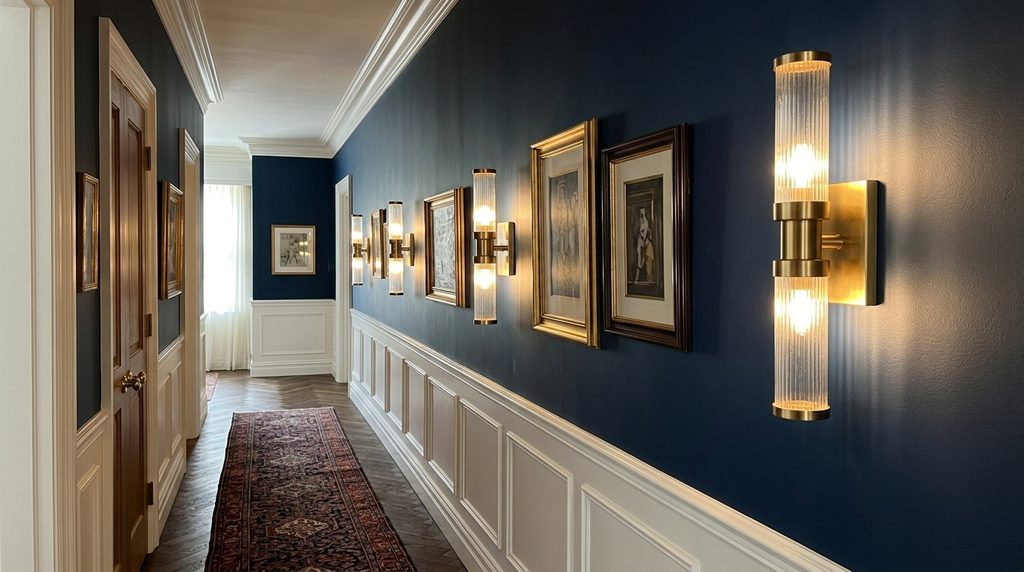
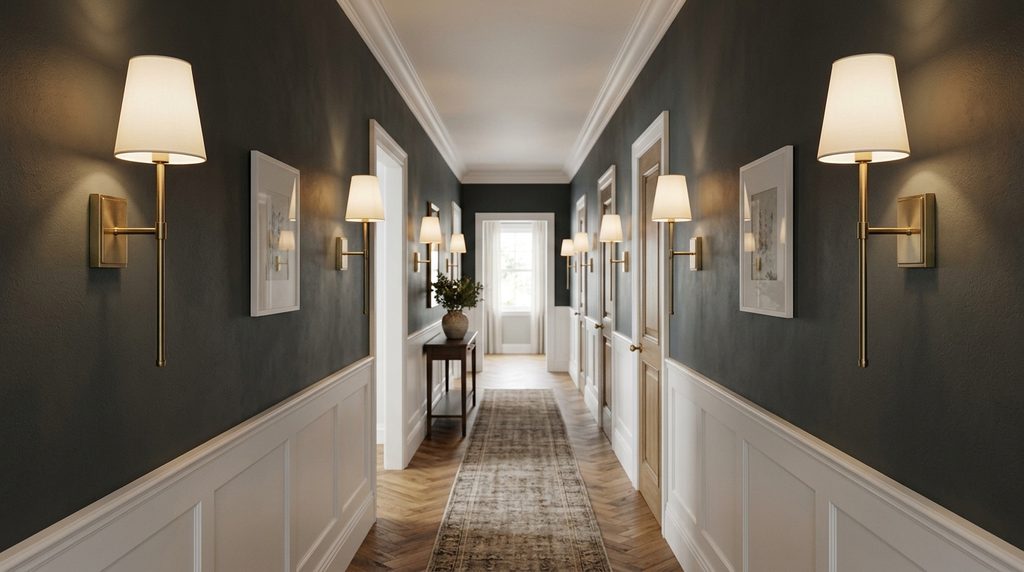
Hallway wall light fixtures, often just called hallway wall lights or sconces, put light on the walls and at eye level. They make a narrow hall feel wider, show off artwork, and give you a soft path light at night. But hallway wall light fixtures rarely light the floor evenly on their own. Their beams aim up, down or both, and the opposite wall soaks up a lot of what they throw.
Here’s how we’d split it:
- Ceiling lights only: utility halls, basement corridors and back-of-house commercial corridors.
- Hallway wall light fixtures only: short entry halls under about 10 ft with high ceilings, where a ceiling fixture would look lost.
- Both: long residential halls, condo corridors and hotel floors. Ceiling lights set the light level. Hallway wall light fixtures set the mood.
Honestly, the “both” option is underrated. A pair of low-wattage hallway wall light fixtures on their own switch gives you a night setting for free.
Flush Mount vs Disk Light vs Hallway Wall Light Fixtures
This is the hallway light fixtures decision most people came here for, and hallway wall light fixtures belong in it too. Flush mounts and disk lights are both surface-mounted LED ceiling lights with integrated LEDs, so there’s no bulb to change. The real differences are size, lumens per box, and how many boxes you have.
What a Disk Light Does Well
A disk light is a shallow round fixture, 4 to 7.5 inches across, that mounts to a junction box or an old pot light housing. It’s cheap enough to run several in a row.
Our 6″ Disk Light 3Way CCT puts out 1,000 lumens at 15W with a 120 degree beam. The catch? One disk light can’t light a long hall evenly. You need a row, and every one needs a box.
What a Flush Mount Does Well
A flush mount is usually bigger, 9 to 16 inches across, with a large diffuser that spreads light softer and cuts glare. It also packs more lumens onto a single box.
Our 12″ PIR Sensor Slim Flush Mount 5Way CCT gives 1,920 lumens from one box, and the 14″ PIR model gives 2,240. Both are under an inch thick.
Most homes have exactly one ceiling box in the hallway. That decides a lot.
Where Hallway Wall Light Fixtures Fit In
Hallway wall light fixtures need a wall box at about shoulder height, so they’re easiest in new builds or open-wall renos. They fill the gaps, light the ends, and give a softer evening option. In short halls with tall ceilings, hallway wall light fixtures can carry the whole space. In long halls, plan hallway wall light fixtures as the second layer.
Side-by-Side Comparison
| Disk light | Flush mount | Hallway wall light fixtures | |
|---|---|---|---|
| Typical size | 4 to 7.5 in. | 5 to 16 in. | Often 4 to 8 in. deep |
| Lumens per box (our range) | 700 to 1,000 | 620 to 2,240 | Varies by model, check the sheet |
| Lights the floor evenly | Yes, in a row | Yes | Partly |
| Glare looking down the hall | Small bright dot | Softer, larger lens | Low, if shaded |
| Best when | You can add boxes | You have one box | You want mood or a night light |
| Motion sensor option | 7.5″ PIR disk light | 5″, 6.5″, 9″, 12″, 14″ PIR | Rare, use a sensor switch |
Bottom line? One box, pick a flush mount. A row of boxes, pick disk lights. Add hallway wall light fixtures where the ceiling can’t reach.
For the longer comparison of mounting styles, read our post on flush mount vs surface mount lighting and our guide to types of LED ceiling lights.
How Many Lumens Do Hallway Ceiling Lights and Hallway Wall Light Fixtures Need?
Less than you’d think. Hallways are transit spaces.
The Illuminating Engineering Society’s Recommended Practice for residential lighting (RP-11) is the reference most designers use for homes. The range most often quoted from it for hallways and stairs is 5 to 10 foot-candles, about 50 to 110 lux. One foot-candle is one lumen landing on one square foot.
What Canadian Code Requires in Corridors
For homes, there’s no legal lux number. For buildings with public corridors, there is.
The Ontario Building Code sets this in Article 3.2.7.1. Exits, public corridors and corridors giving the public access to an exit need an average of at least 50 lx at floor level, with no point below 10 lx. That covers condo hallways, office corridors, schools and hotel floors. Article 3.2.7.3 adds emergency lighting at an average of 10 lx, minimum 1 lx.
Notice the minimum. A few bright fixtures can hit 50 lx on average and still fail 10 lx in the gaps. That’s a spacing problem. Hallway wall light fixtures near the ends of a corridor are one easy way to lift those dark spots.
Emergency lighting is its own system, and our explainer on EM lights vs exit signs and our emergency lighting range cover it.
Hallway Lumen Math, Step by Step
- Measure the floor. Length x width in square feet.
- Pick a target. 5 to 10 foot-candles for a home. About 5 foot-candles (50 lx) is the code average for public corridors.
- Multiply. Area x foot-candles = lumens that need to reach the floor.
- Double it for narrow halls. In a hall 3 to 4 ft wide, the walls catch a big share of the light. Plan on about twice the floor number coming out of the fixtures.
Say your hallway is 3.5 x 16 ft. That’s 56 sq ft. At 8 foot-candles you need about 450 lumens on the floor, so roughly 900 lumens out of the fixtures. One 12″ flush mount covers that. So do two small disk lights. Count hallway wall light fixtures toward the total only at about half their rated lumens, since much of their output lands on the walls.
| Hallway | Floor area | Target | Fixture lumens (approx.) | What works |
|---|---|---|---|---|
| Entry hall, 4 x 8 ft | 32 sq ft | 8 fc | 500 | One 5″ or 6.5″ flush mount, or two hallway wall light fixtures |
| Typical hall, 3.5 x 16 ft | 56 sq ft | 8 fc | 900 | One 12″ flush mount, or 2 to 3 disk lights |
| Long hall, 3.5 x 24 ft | 84 sq ft | 8 fc | 1,350 | Two flush mounts, or 3 to 4 disk lights, plus hallway wall light fixtures at the ends |
| Condo corridor, 6 x 100 ft | 600 sq ft | 50 lx avg, 10 lx min | 5,600+ | 9 to 10 small fixtures, spaced for uniformity |
Look at the last row. Ten of our 620-lumen 5″ PIR Slim Flush Mounts deliver 6,200. Bigger fixtures would overshoot and still leave gaps.
For every other room, see our room-by-room LED lumens guide.
Hallway Light Spacing: Ceiling Fixtures and Hallway Wall Light Fixtures
In a hallway, spacing sets how many hallway light fixtures you need. Lumens just set the size of each one.
Spacing for Ceiling Fixtures
For wide-beam surface fixtures like disk lights and flush mounts, keep maximum spacing to about 1.4 x the ceiling height. On an 8 ft ceiling that’s roughly 11 feet. In homes, keep it tighter:
- Disk lights: 6 to 8 ft apart, end fixtures about 3 ft from the walls.
- Flush mounts: 8 to 10 ft apart, end fixtures 4 to 5 ft from the walls.
- Centre line: always down the middle in a hall under 5 ft wide.
So a 3 x 20 ft hall gets three disk lights about 7 ft apart, or two flush mounts. Our disk light spacing guide walks through the method for every room size.
One trick worth knowing. Light the ends. A hall that’s dim at the doors feels darker than it measures. Hallway wall light fixtures on the end walls fix that nicely.
Spacing Hallway Wall Light Fixtures
Hallway wall light fixtures follow different rules, mostly from convention rather than code:
- Height: about 5.5 to 6 ft to the centre of the fixture is the usual designer range. Lower and the light hits people in the eyes.
- Spacing: hallway wall light fixtures sit 8 to 10 ft apart along one wall, or staggered on both walls in wider halls.
- Alignment: line hallway wall light fixtures up with doors and artwork, not with the ceiling fixtures. Offsetting the two spreads the light more evenly.
- Projection: this one’s a real rule in public buildings. The CSA B651 accessible design standard covers objects on a wall below 2,030 mm (about 80 in.). They can’t stick out more than 100 mm (about 4 in.) unless a cane can detect them. Many decorative hallway wall light fixtures stick out 4 to 8 inches, so check the depth before ordering for a condo or office corridor.
Step lights are the low-mounted kind of hallway wall light fixtures. Our Mini Step LED Light is a 2-inch, 1W, 18-lumen fixture that runs on 12V. Mounted about a foot off the floor, a row of them gives you a night path without waking anyone up. They need a 12V driver, so plan the wiring.
For ratings and styles of hallway wall light fixtures, see our guides to indoor vs outdoor sconce lighting and stair wall lights for condos and office towers.
Motion Sensor Hallway Lights: PIR Fixture or Sensor Switch?
Hallways are where motion sensors pay off most, on ceiling lights and hallway wall light fixtures alike. People pass through, nobody stays, and the light gets left on. A National Research Council Canada field study found occupancy sensors alone cut lighting energy by 35% on average in open-plan offices. Hallways are used far more sporadically than a desk, so the “on but empty” share is usually bigger.
How a PIR Sensor Sees a Hallway
PIR (passive infrared) sensors fire when a warm body moves from one zone to the next. So:
PIR sensors pick up movement across their zones far better than movement straight toward them.
Picture a sensor switch on the end wall of a long hallway. Someone walks straight at it, the weakest direction a PIR can see, so the light comes on late. A ceiling sensor sees people walk across its zones, which is exactly what it’s good at. For any hall longer than about 10 ft, we’d put the sensor in a ceiling fixture.
There’s one blind spot. Our 9″ PIR Sensor Slim Flush Mount has a 30 degree blind cone directly underneath. In a hallway that’s fine, because people cross the field. Over a doorway, offset the fixture a little.
Hold Time and Day/Night Mode
Hold time is how long the light stays on after the last movement.
- Our 5″, 9″, 12″ and 14″ PIR flush mounts hold for 30 seconds. About right for a corridor.
- The 7.5″ PIR disk light lets you pick 60, 180 or 300 seconds at install.
- Our Motion Sensor Switch adjusts from 5 seconds to 10 minutes across a 180 degree field. It needs a neutral in the box.
The 9″, 12″ and 14″ PIR flush mounts also have a Night mode that holds the light off until the hall drops below 10 lux. In a hall with a window, switch to Night. They ship in Day mode.
None of our PIR fixtures dim, so don’t wire them to a dimmer. Want a dim night setting? That’s a job for hallway wall light fixtures or step lights on their own switch.
Can Hallway Wall Light Fixtures Use a Motion Sensor?
Yes, through the switch. Few hallway wall light fixtures have a sensor built in, so the usual route is a motion sensor switch on the circuit that feeds the hallway wall light fixtures. Mount it where people walk across its view, like beside a bedroom door, not facing down the hall. A short hold time works for hallway wall light fixtures used as night lights.
PIR Ceiling Fixture vs Sensor Switch
| PIR ceiling fixture | Motion sensor wall switch | |
|---|---|---|
| Sees people walking along the hall | Well | Poorly, if it faces down the hall |
| Can control hallway wall light fixtures | No | Yes, if they share the circuit |
| Hold time | Fixed or preset | Adjustable |
| Wiring change | None, replaces the fixture | Needs a neutral in the box |
| Best for | Halls over 10 ft, condo corridors | Short halls, or hallway wall light fixtures |
In a long corridor, space PIR fixtures so their zones overlap. Our 14″ model covers about 3 to 5 m across 110 degrees, so fixtures 8 to 10 ft apart give continuous coverage. Neat part? That’s the same spacing that keeps the light even.
See how motion sensor light bulbs work and how to turn off a motion detector light.
One commercial rule: never let a motion sensor control emergency lighting. Normal corridor lighting, hallway wall light fixtures included, can go on sensors, as long as it meets the 50 lx average when it’s on.
Colour and Glare: Ceiling Lights vs Hallway Wall Light Fixtures
Hallways get used at 2 a.m. That changes the colour temperature you want from hallway ceiling lights.
- 2700K to 3000K for home hallways and hallway wall light fixtures near bedrooms.
- 3500K to 4000K for condo and office corridors.
- 5000K for utility halls and parking garage corridors, where hallway wall light fixtures are usually skipped.
Match hallway wall light fixtures to the ceiling lights, or go one step warmer on the walls. Our flush mounts and disk lights have a CCT switch on the fixture, and the 5-CCT models run from 2700K to 5000K. See our colour temperature guide.
Glare is the other hallway problem. You look along the ceiling while you walk, so every ceiling fixture and all the hallway wall light fixtures are in view. A flush mount’s larger frosted lens spreads the brightness and feels softer than a small disk. Shaded hallway wall light fixtures, up-down styles especially, avoid glare almost completely.
Canadian Code Checklist for Hallway Wall Light Fixtures and Ceiling Lights
A quick hallway lighting code list for Ontario. Other provinces follow the National Building Code closely, but check yours.
- Homes: OBC 9.34.2.2 requires a lighting outlet with a fixture, controlled by a wall switch, in hallways of dwelling units. Ceiling lights or hallway wall light fixtures both qualify.
- Stairs off the hall: 9.34.2.3 requires 3-way switches at the head and foot of any stairway with four or more risers.
- Public corridors: 50 lx average, 10 lx minimum at floor level (3.2.7.1).
- Emergency lighting: 10 lx average, 1 lx minimum (3.2.7.3), on a supply no sensor controls.
- Accessible corridors: hallway wall light fixtures below 2,030 mm project no more than 100 mm unless cane-detectable (CSA B651).
- Permits: new boxes or circuits usually need an electrical permit. A like-for-like swap often doesn’t, but ask your inspection authority.
Common Mistakes With Hallway Wall Light Fixtures and Ceiling Lights
- One fixture in the middle of a long hall. Bright centre, dark ends. Add fixtures, or add hallway wall light fixtures near the ends.
- A sensor switch facing straight down the hall. It sees you late. Move the sensor to the ceiling.
- Speccing on watts. Read the lumens on ceiling lights and hallway wall light fixtures alike. Two 12W fixtures can differ by hundreds of lumens.
- Hallway wall light fixtures mounted too low. Below about 5 ft, the bare source sits at eye level and glares.
- Deep hallway wall light fixtures in a condo corridor. Over 100 mm in an accessible path is a deficiency waiting to happen.
Frequently Asked Questions
What is the best light for a hallway ceiling?
A flush mount is the best hallway ceiling light when you have only one junction box, because it gives the most lumens and the softest light from that box. Disk lights are better when you can install a row. Both pair well with hallway wall light fixtures for evening use.
How many lumens do I need for a hallway?
Plan on 5 to 10 foot-candles. For a 3.5 x 16 ft hallway that’s about 450 lumens on the floor, or roughly 900 lumens from the fixtures, since narrow walls absorb a lot. Public corridors in Ontario need a 50 lux average with no point under 10 lux. Count hallway wall light fixtures at about half their lumens.
How far apart should hallway lights be?
Space disk lights 6 to 8 feet apart and flush mounts 8 to 10 feet apart down the centre line, with end fixtures 3 to 5 feet from the walls. Space hallway wall light fixtures 8 to 10 feet apart at about 5.5 to 6 feet high.
Are motion sensor lights good for hallways?
Yes. Put the PIR sensor in a ceiling fixture so people walk across its detection zones, and pick a hold time of 30 seconds or more. Avoid a wall sensor at the far end of a long hall, since PIR sees movement toward it poorly. For hallway wall light fixtures, use a sensor switch that looks across the hall.
Should hallway wall light fixtures and ceiling lights be on the same switch?
Usually not. Put ceiling lights on the main switch or a motion sensor, and hallway wall light fixtures on a second switch. You get a bright setting and a soft night setting, without a dimmer. Hallway wall light fixtures on their own circuit are also easier to put on a sensor switch later.
Bottom Line
- One box: flush mount. Room for a row: disk lights.
- Lumens: 5 to 10 foot-candles in homes, 50 lux average and 10 lux minimum in public corridors.
- Spacing: 6 to 10 ft on the centre line, with the ends lit.
- Sensors: on the ceiling, not at the end of the hall.
- Hallway wall light fixtures: for mood, night light and short halls, under 100 mm deep in accessible corridors.
Choosing hallway light fixtures for a condo floor or office corridor? Browse our surface mount LED lights and LED downlights, or contact our team for contractor pricing. We’ll match fixtures, sensors and hallway wall light fixtures to your plan.