










 (+1) 905 597 5955



Your lighting upgrade quote just landed on your desk. The contractor listed two options: fixtures with DLC certification at $185 each, and “equivalent” non-DLC fixtures at $140 each. The cheaper ones look like a no-brainer.
But here’s the thing. That $45 difference? It disappears fast when you realize the DLC certified fixtures qualify for a $75 rebate from your utility. The non-DLC ones don’t qualify for anything.
So the “expensive” option actually costs you $110 per fixture. The “cheap” option costs $140. And that’s before you factor in higher energy savings, longer warranties, and better light quality from the DLC product.
This happens all the time. Facility managers, contractors, and building owners across Canada leave thousands of dollars on the table because they don’t fully understand what DLC certification means, why it matters, and why it’s basically required for any serious commercial lighting project.
In this guide, you’ll get the full picture: what DLC certification actually is, how it differs from Energy Star, what changed with V6.0 in 2026, and exactly how it connects to rebate programs across Ontario, BC, and Quebec. Plus some real math on what skipping DLC really costs you.
What Does DLC Certification Actually Mean?
DLC certification is an independent, third-party verification that a commercial LED lighting product meets strict performance standards for energy efficiency, light output, colour quality, and longevity. It’s issued by the DesignLights Consortium (DLC) and is required by most Canadian utility rebate programs.
The DLC is a non-profit organization funded by utility companies and industry groups across North America. Their whole job? Making sure commercial LED lighting products actually perform the way manufacturers claim they do.
When a product is “DLC listed” or “DLC certified,” it means the fixture has been independently tested and verified for:
- Lumen output (how much light it actually produces)
- Efficacy (lumens per watt, so how efficiently it produces that light)
- Colour rendering (CRI of 80+ minimum, so things look the way they should)
- Colour temperature accuracy (the CCT matches what’s on the label)
- Power factor (0.9 minimum for most categories)
- Lumen maintenance (the fixture keeps at least 70% of its brightness for 50,000+ hours)
Think of it like this. DLC certification is to commercial LED lighting what a building permit is to construction. Without it, your project probably doesn’t qualify for utility incentives. And those incentives can cover 25% to 50% of your total project cost.
Pretty important detail to miss.
DLC vs Energy Star: Which One Do You Need?
This confuses a lot of people. Both programs test lighting for energy efficiency. Both involve third-party lab testing. But they cover completely different product categories.
Here’s the simple breakdown:
CCT (correlated colour temperature) tells you how warm or cool the light appears, measured in Kelvin. CRI (Colour Rendering Index) tells you how accurately the light shows true colours, measured on a 0-100 scale. You need both specs to choose the right fixture. A 4000K fixture with CRI 70 will look washed out. The same 4000K at CRI 90+ will look natural and vibrant.
| Province | Programme | What You Get |
| Ontario | Save on Energy – Retrofit | Up to $0.35/kWh saved for lighting controls |
| British Columbia | BC Hydro | Up to 75% coverage on commercial LED upgrades |
| Quebec | Hydro Quebec | $5 to $40 per fixture for DLC-certified products |
| Manitoba | Efficiency Manitoba | Standard rebates plus 50% bonus (before March 31, 2026) |
| Saskatchewan | SaskPower | Up to $200,000 total; $0.06/kWh saved |
| Nova Scotia | Efficiency Nova Scotia | Up to 75%+ of product cost |
| New Brunswick | SaveEnergy NB | 25% cash back on eligible upgrades |
| PEI | efficiencyPEI | Up to $75,000/year in rebates |
The key thing? There’s zero overlap. A product is either DLC listed or Energy Star rated. Never both. So if you’re doing a warehouse, office, or parking lot project, you need DLC. If you’re doing residential or small retail, you need Energy Star.
For commercial LED lighting projects in Canada, DLC certification is what matters. Full stop.
DLC Standard vs DLC Premium: What’s the Difference?
Not all DLC certification levels are the same. The DLC has two tiers, and the difference can mean real money in your pocket.
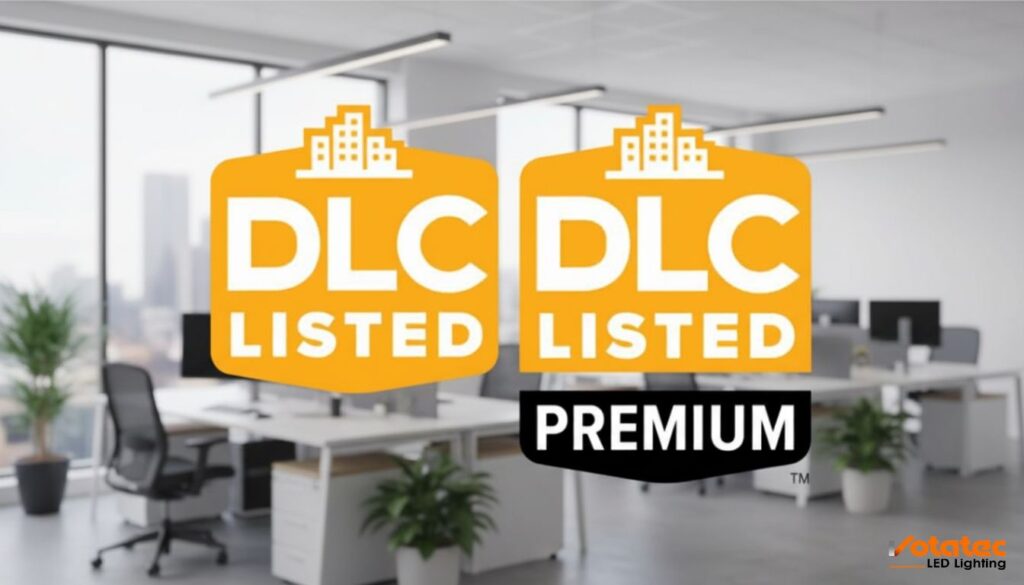
DLC Standard is the baseline. Products meet minimum requirements for efficacy, colour quality, and warranty. They get listed on the Qualified Products List (QPL) and qualify for basic utility rebates.
DLC Premium is the higher tier. Products need to hit significantly better numbers:
- Higher efficacy, typically 150 to 170+ lumens per watt depending on the category
- Controls-ready capability, meaning the fixture can dim to 10% or less through a standard interface
- Stricter lumen maintenance requirements
- Additional documentation including driver temperature testing and integral controls info
Why does this matter? Because DLC Premium triggers bonus rebates. We’re talking an extra $25 to $50 per fixture in many utility programs. On a 200-fixture warehouse retrofit, that’s an additional $5,000 to $10,000 off your project cost.
Here’s a quick example. Sarah manages facilities for a distribution company in Mississauga. She was planning a 150-fixture high bay retrofit. Her initial quote used DLC Standard fixtures.
When her contractor suggested switching to DLC Premium, the fixture cost went up by about $30 each, so $4,500 total. But the Premium rebate added $40 per fixture through Save on Energy’s program. That’s $6,000 back. She saved an extra $1,500 by spending more upfront.
Kind of counterintuitive. But that’s how it works.
Want to see how LED upgrades pay for themselves? Check out our commercial lighting upgrades guide for the full ROI breakdown.
What Changed With DLC V6.0 in 2026?
Big update. In November 2025, the DLC released Version 6.0 of its Solid-State Lighting (SSL) Technical Requirements. This is the first major update in five years, and it raised the bar across the board.
The DLC started accepting V6.0 applications on January 5, 2026. Products qualified under the old V5.1 standard won’t be delisted until December 15, 2026, so there’s a transition window. But after that date, only V6.0 products stay on the QPL.
Higher Efficacy Thresholds
Every single LED category got tougher. On average, products now need to be 14% more efficient than under V5.1. Some categories jumped even more:
| Product Category | Efficacy Increase (V5.1 to V6.0) |
| LED replacement lamps (4-foot) | 30% higher than 2015 baseline |
| 2×4 troffers | 41% higher than 2015 baseline |
| High bay fixtures | 69% higher than 2015 baseline |
| Area and roadway luminaires | 79% higher than 2015 baseline |
That outdoor jump is massive. Street lights and parking lot fixtures need to work a lot harder to make the cut now.
LUNA V2.0 Integration
V6.0 also merged the separate LUNA (Luminaire-Level Lighting Controls) requirements into a single document. If your fixtures have built-in controls, sensors, or networked capabilities, the qualification process is now streamlined.
Efficacy Allowances for Quality
Here’s something nice. V6.0 includes efficacy allowances for products that deliver higher colour rendering (better CRI) or better glare control. So manufacturers aren’t penalized for making fixtures that look better and feel more comfortable. They get a small efficacy break for prioritizing quality of light.
What This Means for Your Next Project
If you’re planning a lighting retrofit in 2026, make sure your contractor is quoting V6.0 products. After December 15, 2026, V5.1 products fall off the QPL, and products not on the QPL don’t qualify for rebates.
Ask your supplier: “Are these fixtures qualified under DLC V6.0?” Simple question. Big difference.
How DLC Connects to Canadian Utility Rebates
This is the part that really matters for your budget. Across Canada, utility rebate programs for commercial LED lighting upgrades almost universally require DLC certification. Without it, you’re paying full price.
Ontario
The Save on Energy Instant Discounts Program is Ontario’s main commercial lighting incentive. It provides point-of-sale discounts on eligible LED products, meaning you see the savings right on your invoice. No application forms, no waiting for reimbursement cheques.
But here’s the catch: eligible products must meet DLC or Energy Star certification standards. For commercial fixtures like troffers, high bays, and exterior lighting, that means DLC.
Most Ontario programs specifically prefer DLC Premium for maximum incentives.
British Columbia
BC Hydro’s commercial lighting rebate program is one of the most generous in the country. Rebates range from $16 to $570 per fixture depending on light output and product type. And there was a 30% bonus incentive for eligible projects submitted between June 2025 and February 2026.
Products must be DLC listed to qualify. That’s non-negotiable.
Quebec
Hydro-Quebec’s Efficient Solutions program covers up to 75% of lighting upgrade costs for large commercial customers. Small business customers can get up to 90% covered. Those are wild numbers.
Again, DLC qualification is the gateway.
The Bottom Line on Rebates
Here’s some real math. Say you’re retrofitting a 50,000 square foot warehouse in the GTA with 200 LED high bays.
| Scenario | Non-DLC Fixtures | DLC Premium Fixtures |
| Fixture cost (each) | $140 | $185 |
| Total fixture cost | $28,000 | $37,000 |
| Utility rebate | $0 | $15,000 (est.) |
| Net cost | $28,000 | $22,000 |
| Annual energy savings | $9,600 | $11,200 |
| Payback period | 2.9 years | 1.96 years |
The DLC Premium fixtures cost $9,000 more upfront but end up $6,000 cheaper after rebates. And they pay for themselves six months faster. Not a hard decision.
Planning a retrofit? If you’re switching from fluorescent to LED, our guide walks you through the full process, from energy audit to installation.
How Does a Product Get DLC Certified?
If you’re a building owner or facility manager, you don’t need to worry about the certification process yourself. But understanding it helps you appreciate why DLC products cost a bit more, and why that premium is worth paying.
The Testing Process
Manufacturers go through a multi-step process that takes roughly 3 to 4 weeks:
- Product testing at an accredited lab. The fixture undergoes LM-79 photometric testing (measures total light output, efficacy, colour), LM-80 LED chip testing (measures how the LED degrades over time), and in-situ temperature testing (ISTMT) to verify the LED operates within safe thermal limits.
- Application submission. The manufacturer submits test reports, product documentation, warranty information, safety certificates (UL or ETL), and pays the application fee.
- DLC review. The DLC team verifies all documentation meets requirements. They check that test results match the product’s claims.
- QPL listing. Once approved, the product appears on the DLC’s online Qualified Products List. Utilities and contractors can search the QPL to verify a product qualifies for rebates.
Why This Matters to You
Every product with DLC certification has been independently verified. The manufacturer can’t just slap a number on the spec sheet and call it a day. A third-party lab tested it. The DLC reviewed it. That’s your quality assurance.
Mike, an electrical contractor in Vancouver, learned this the hard way. He once installed 80 non-DLC high bays for a client to save money. Within 18 months, the lumen output had dropped visibly. The manufacturer’s “50,000-hour lifespan” claim turned out to be optimistic, to put it mildly. Replacing those fixtures cost his client more than the original DLC option would have.
Cheap lights are only cheap once.
What Products Does DLC Cover?
DLC certification covers a wide range of commercial and industrial DLC listed LED lights. Here’s what falls under their scope:
- Indoor commercial: LED troffers (2×2, 2×4), panel lights, linear fixtures, high bays, low bays, stairwell fixtures, commercial downlights
- Outdoor: Area lights, flood lights, street lights, parking lot fixtures, wall packs, bollards, canopy lights
- Retrofit kits: Products designed to upgrade existing fixtures to LED without full replacement
- Specialty: Horticultural lighting, hazardous location fixtures, vapor tight fixtures for cold storage and harsh environments
- Controls: Luminaire-level lighting controls (under the LUNA program)
What DLC does NOT cover:
- Residential fixtures (that’s Energy Star territory)
- Decorative fixtures
- Emergency and exit lighting
- Non-LED light sources (fluorescent, HID, incandescent)
If you’re buying commercial lighting for a warehouse, office, school, hospital, parking lot, or street, DLC is the certification to look for.
How to Verify a Product Is DLC Listed
Don’t take anyone’s word for it. You can verify any product’s DLC status yourself in about 30 seconds.
- Go to the DLC Qualified Products List at designlights.org
- Search by manufacturer name, product model, or category
- Check whether it’s listed as Standard or Premium
- Verify the qualification version (V5.1 or V6.0)
Pro tip: bookmark that QPL page. If a contractor quotes you fixtures and claims they’re DLC listed, verify before signing anything. It takes less time than making a coffee.
Choosing the right fixture type for your project matters too. Our guide to different types of LED ceiling lights covers troffers, panels, downlights, and more for different commercial applications.
Common Mistakes to Avoid
After working with facility managers and contractors across Canada, here are the mistakes we see most often:
1. Assuming All LED Fixtures Are DLC Listed
They’re not. Plenty of DLC listed LED lights on the market look identical to non-certified ones. They might be fine products, but without DLC certification they won’t qualify for commercial LED rebates in Canada. Always verify.
2. Not Checking Standard vs Premium
Your utility program might require DLC Premium for the best rebates. If your contractor quotes Standard fixtures, you could be leaving money on the table. Ask specifically.
3. Ignoring the V6.0 Transition
Products qualified under V5.1 get delisted on December 15, 2026. If you’re planning a project for late 2026 or 2027, make sure your fixtures are V6.0 qualified. Otherwise your rebate application could get rejected.
4. Filing Rebate Applications After Installation
Some rebate programs require pre-approval before you install. If you put fixtures in first and apply second, you might be out of luck. Check your local utility’s process before work begins.
5. Choosing Price Over Certification
That scenario from the introduction? It happens constantly. The math almost always favours DLC fixtures when you factor in rebates, energy savings, and longer lifespan. Run the numbers before you decide.
Quick DLC Certification Checklist for Your Next Project
Before you sign off on any commercial lighting purchase in Canada, run through this:
- Are the fixtures DLC listed? (Verify on designlights.org/qpl)
- Standard or Premium? (Premium usually means better rebates)
- V5.1 or V6.0 qualified? (V6.0 required after December 2026)
- Does your local utility require DLC for rebates? (Almost certainly yes)
- Have you applied for rebate pre-approval if required?
- Do the fixtures meet your project’s CRI and CCT requirements?
- Is there a minimum 5-year warranty? (DLC requires it)
- Are UL or ETL safety certifications included?
Frequently Asked Questions About DLC Certification
Is DLC certification mandatory for commercial LED lighting?
Not legally. But practically? Pretty much. Most utility rebate programs in Canada require DLC certification for commercial LED rebates. Without it, you pay full price for your fixtures and miss out on incentives that can cover 25% to 50% of the project. So while nobody forces you to buy DLC listed LED lights, skipping it usually costs more.
What’s the difference between DLC certification and UL/ETL/CSA safety certification?
Different things entirely. UL, ETL, and CSA certifications verify that a product is safe, meaning it won’t cause electrical fires or shock hazards. DLC certification verifies that a product performs well, meaning it delivers the promised light output, energy efficiency, and lifespan. You need both. Safety certification is a legal requirement. DLC certification is a performance and rebate requirement.
How long does DLC certification last?
A product stays on the DLC qualified products list as long as it meets the current technical requirements. When the DLC releases a new version (like V6.0 in January 2026), manufacturers have a transition period to re-qualify. Products that don’t meet the updated standards get delisted. For V6.0, the deadline is December 15, 2026.
Does DLC certification guarantee a product is good?
It guarantees the product met specific performance thresholds when it was tested. That includes minimum efficacy, CRI of 80+, proper colour temperature, and 50,000+ hour rated lifespan with at least a 5-year warranty. It’s not a guarantee of perfection, but it’s a solid baseline that filters out underperforming products.
Can I get rebates without DLC certification in Canada?
For residential and small commercial fixtures, Energy Star certification works. But for commercial and industrial LED lighting, like troffers, high bays, area lights, and street lights, Canadian utilities almost universally require DLC certification. Some programs accept DLC Standard, but many offer higher rebates for DLC Premium products.
Bottom Line
DLC certification isn’t just a sticker on the box. It’s your ticket to commercial LED rebates in Canada, your quality guarantee, and honestly, the baseline standard for any commercial LED project worth doing in this country.
The V6.0 update in 2026 raised the bar for efficiency, which means newer DLC products perform even better than before. And with Canadian utilities offering rebates that cover 25% to 50% of project costs, the financial case for DLC listed fixtures is pretty much airtight.
Whether you’re a facility manager planning a retrofit, a contractor specifying fixtures, or a building owner looking to cut operating costs, start with the DLC qualified products list. It saves time, saves money, and saves you from buying fixtures that don’t live up to their claims.
Ready to explore DLC certified LED fixtures for your project? Browse Votatec’s commercial LED lighting catalogue or request a quote for your specific application. Our team can help match the right DLC listed products to your space and your rebate program.