












 (+1) 905 597 5955



You just spent $40,000 on a full LED retrofit for your office building. The fixtures look great. The energy savings are real. But your staff keeps complaining the light feels “cold” and “clinical.” Turns out you picked 5000K panels for a space that needed 4000K. And now you’re looking at another round of replacements.
Happens more than you’d think.
Here’s the quick answer: 4000K is the safest LED colour temperature for most commercial spaces. It’s neutral, it meets Canadian building code requirements, and it doesn’t lean too warm or too cool. But “most” isn’t “all,” and the wrong commercial LED lighting colour temperature can genuinely hurt productivity, sales, and comfort in your building.
So let’s break this down properly. By the end of this LED colour temperature guide, you’ll know exactly which Kelvin rating fits your office, warehouse, retail store, or healthcare facility, and why the choice matters beyond just “looks.”
What Is LED Colour Temperature?
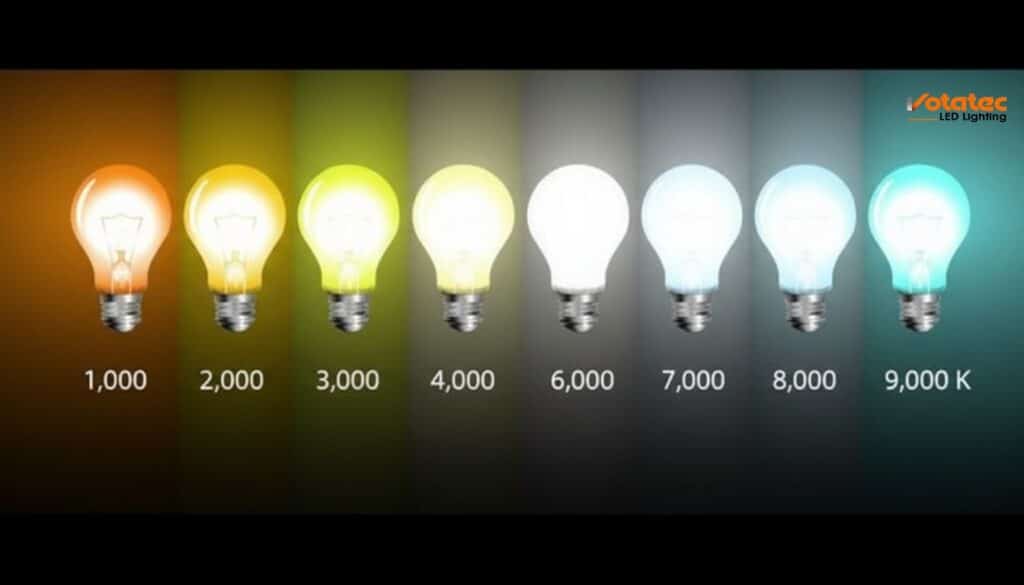
LED colour temperature, technically called correlated colour temperature (CCT), measures how warm or cool a light source appears. It’s measured on the Kelvin scale, running from about 2000K (candlelight amber) up to 6500K (overcast daylight blue).
Here’s what trips people up. Higher Kelvin numbers mean cooler, bluer light. Lower numbers mean warmer, more amber light. It’s backwards from what most people expect.
Three values dominate commercial LED lighting:
| Colour Temperature | Appearance | Common Names |
|---|---|---|
| 3000K | Warm, yellowish white | Warm white |
| 4000K | Clean, neutral white | Neutral white, bright white |
| 5000K | Crisp, slightly blue-white | Daylight, cool white |
One thing to clarify right away. Colour temperature tells you nothing about brightness. A 3000K fixture can be just as bright as a 5000K fixture. They just produce a different quality of light. Brightness is measured in lumens. Colour temperature is measured in Kelvin. Two completely different things.
So when people ask “warm white vs cool white LED, which is brighter?” the answer is neither. They can be equally bright. The difference is in how the light looks and feels.
Why Does LED Colour Temperature Matter for Commercial Spaces?
You might be thinking, “It’s just light. Does the colour really make that much difference?”
Short answer: yes. A lot more than most facility managers expect.
Research published in Scientific Reports found that lighting colour temperature directly affects mental workload, cognitive performance, and stress levels in office environments. Cooler light (around 5000K-6500K) was linked to higher alertness and reduced cognitive fatigue. Warmer light (around 3000K) reduced stress markers and perceived stress levels.
That’s not just academic theory. It plays out in real buildings every day.
Take what happened to a property management firm in Mississauga. They retrofitted their 12-storey office tower with 5000K LED panels across every floor, including the lobby, meeting rooms, and employee lounge. The energy savings were solid, around 62% lower hydro bills. But within three months, tenant complaints about “harsh lighting” jumped by 40%. The lounge sat empty during breaks because the light felt like a hospital corridor. They ended up swapping the common areas to 3000K and the meeting rooms to 4000K. Total cost of the correction? About $8,500 in labour and fixtures.
The lesson is pretty simple. The cheapest option isn’t always the best one when you factor in occupant satisfaction.
The Real-World Impact by the Numbers
- Workers under appropriate colour temperature lighting show 6% higher productivity and up to 15% more creative output (Source: WELL Building Standard research, 2025)
- The human-centric lighting market is projected to reach USD 30.6 billion by 2035, growing at 25.2% annually, which tells you how seriously the industry takes this
- IES (Illuminating Engineering Society) recommends matching colour temperature to task type, not just defaulting to the cheapest option
Ready to see which LED colour temperature fits your space? Browse Votatec’s commercial LED fixtures with selectable CCT options that let you dial in the perfect colour temperature.
3000K Warm White: Best for Hospitality and Comfort
3000K produces a warm, inviting glow. Think of the feeling you get in a nice restaurant or a hotel lobby. It’s comfortable. Relaxing. Easy on the eyes for extended periods.
If you’re comparing warm white vs daylight LED options, 3000K sits firmly on the warm end of the spectrum. It’s the closest thing to traditional incandescent lighting in the LED world.
Best Applications for 3000K
- Hospitality spaces: Hotel lobbies, restaurants, bars, lounges
- Reception areas and waiting rooms: Where you want visitors to feel welcome
- Residential common areas: Condo lobbies, hallways, amenity rooms
- Retail with warm merchandise: Furniture stores, bakeries, clothing boutiques
- Senior care facilities: Where a home-like atmosphere supports wellbeing
Recessed downlights at 3000K work especially well in reception areas and hotel lobbies where you want focused, warm pools of light.
Where 3000K Falls Short
Here’s the thing. 3000K isn’t great for task-heavy environments. It can make a warehouse feel dim even at high lumen output, and it distorts some colours in ways that matter for quality control.
In a retail food environment, 3000K makes fresh produce look slightly yellow and less appetizing. Not ideal when you’re trying to sell $6 avocados.
And in any space where people need to read fine print, check colour accuracy, or stay alert for long shifts, 3000K can actually work against you. The warmth is calming, sure. But calm isn’t always what you need at 2 PM when your team is pushing through a deadline.
4000K Neutral White: The LED Colour Temperature Sweet Spot
If you’re unsure which colour temperature for office lighting makes sense, 4000K is almost always the right call. It’s a neutral white LED that feels clean and professional without crossing into “operating room” territory.
The IES Lighting Handbook and the WELL Building Standard both support the 3500K-5000K range for workspaces, with 4000K landing right in the middle as the most commonly specified single value.
Best Applications for 4000K
- Office spaces: Open plan, private offices, boardrooms
- Schools and universities: Classrooms, libraries, admin areas
- Retail (general): Grocery, department stores, pharmacies
- Healthcare (general areas): Corridors, nurses’ stations, admin
- Government and municipal buildings: Service counters, public spaces
- Mixed-use commercial: Where multiple activities happen in one space
For offices, LED troffers at 4000K drop right into standard T-bar grid ceilings and deliver even, glare-free light across entire floors. LED wrap lights are another solid option for corridors and open areas.
Why 4000K Dominates Commercial Projects
A few reasons. First, it renders colours accurately enough for most tasks. With a CRI of 80 or above (which any decent commercial LED should hit), 4000K shows products, documents, and faces in natural-looking tones.
Second, it works with virtually any interior design scheme. Cool grey walls? Fine. Warm wood accents? Also fine. You don’t have to redesign the space around the light.
Third, and this is practical, 4000K is the default spec on most commercial LED panels, troffers, and downlights. That means better availability, more competitive pricing, and easier replacements down the road.
Consider what happened with a school board in the GTA. They were retrofitting 14 elementary schools and debated between 3500K and 4000K for classrooms. They ran a pilot in two schools, one at each temperature, for a full semester. Teacher feedback was overwhelmingly in favour of 4000K. Students seemed more focused, the whiteboards were easier to read, and the light felt “normal” rather than “warm” or “harsh.” The remaining 12 schools all went with 4000K.
Sometimes the middle ground really is the best ground.
5000K Daylight: When Cool White LED Is the Right Choice
5000K simulates natural daylight at midday. It’s bright, crisp, and gives you maximum visual acuity. That makes it ideal for environments where you need to see fine details clearly.
But it’s also the LED colour temperature that generates the most complaints when used in the wrong space. Nobody wants to eat lunch under daylight-simulation panels. It feels harsh and institutional.
Best Applications for 5000K
- Warehouses and distribution centres: Label reading, barcode scanning, forklift operation
- Manufacturing floors: Quality inspection, assembly lines
- Healthcare procedure areas: Exam rooms, operating suites, dental offices
- Parking garages and loading docks: Safety and visibility
- Art studios and print shops: Colour-critical evaluation
- Mechanical workshops: Detail work under hoods and at benches
What Colour Temperature Is Best for a Warehouse?
5000K. Pretty much every time.
When pickers are scanning barcodes at 3 AM under 30-foot ceilings, you want every possible advantage in visual clarity. Linear high bay LED fixtures at 5000K are the standard for warehouse environments across Canada.
The difference between 4000K and 5000K in a warehouse isn’t dramatic visually, but it adds up over a full shift. Fewer misreads, fewer mispicks, fewer safety incidents in aisle intersections.
And honestly? Most warehouse workers prefer 5000K once they’ve experienced it. It feels like working under natural light rather than artificial overhead lighting. That matters when you’re in a windowless building for 8-12 hours.
Where 5000K Goes Wrong
5000K in an office after 4 PM feels off. Your body’s circadian rhythm is winding down, but the light is telling your brain it’s noon. That mismatch can lead to eye strain, headaches, and general discomfort.
Same goes for retail. A retail environment under 5000K can feel sterile and uninviting. Customers spend less time browsing when the space feels clinical. That’s money walking out the door.
3000K vs 4000K vs 5000K: Side-by-Side Comparison
Here’s the full breakdown of how these three LED colour temperatures stack up against each other:
| Factor | 3000K (Warm White) | 4000K (Neutral White) | 5000K (Daylight) |
|---|---|---|---|
| Appearance | Warm amber | Clean neutral | Crisp daylight |
| Mood | Relaxed, cosy | Professional, balanced | Alert, energized |
| Best for | Hospitality, lobbies | Offices, retail, schools | Warehouses, medical |
| Colour accuracy | Good (warm bias) | Very good (neutral) | Excellent (cool bias) |
| Eye fatigue | Low (short tasks) | Low (all-day use) | Higher (extended use) |
| After-hours comfort | High | Moderate | Low |
| Energy cost | Same | Same | Same |
| Availability | High | Highest | High |
Worth repeating: energy cost is the same across all three. A 40W panel at 3000K uses the same power as a 40W panel at 5000K. The difference is purely in how the light looks and feels.
What About CRI? It Matters More Than You Think
Colour Rendering Index (CRI) is the other half of the equation that a lot of people skip over. CRI measures how accurately a light source shows the true colours of objects, on a scale from 0 to 100. Sunlight is 100. A sodium streetlight is maybe 25.
For commercial LED lighting colour temperature decisions, CRI is just as important as Kelvin. Here’s what to look for:
- CRI 80+: Minimum for offices, classrooms, general commercial. This is the baseline you shouldn’t go below.
- CRI 90+: Recommended for retail, healthcare, food service, and any space where colour accuracy drives decisions or sales.
- CRI 95+: Specialty applications like art galleries, dental offices, colour-matching labs.
Here’s a mistake that catches people. You can pick the perfect colour temperature and still end up with terrible light quality if the CRI is below 80. Cheap LED fixtures sometimes hit 70 CRI, and the result is that everything looks slightly grey and washed out. Skin tones look off. Products look flat.
Every Votatec commercial LED fixture ships with CRI 80 or higher. Many hit CRI 90+. That’s the kind of detail that separates professional-grade fixtures from the bargain bin.
Selectable CCT: The Smart LED Colour Temperature Approach for 2026
Here’s something that’s changed the game in the last couple of years. Selectable CCT fixtures, sometimes called tunable white.
These are LED fixtures with a small switch, usually on the driver or the back of the housing, that lets you toggle between colour temperatures. Typically 3000K, 3500K, 4000K, and 5000K. You pick the setting during installation, and the fixture locks to that temperature.
Why does this matter? Flexibility.
Say you’re an electrical contractor bidding on a mixed-use building. The architect spec’d 4000K throughout, but the property manager wants 3000K in the lobby. With selectable CCT fixtures, you stock one SKU. Install everywhere. Flip the switch in the lobby fixtures to 3000K. Done. No returns, no reorders, no delay.
For facility managers, it means you can adjust without replacing fixtures if tenant preferences change. New tenant wants warmer light in their suite? Flip the switch. Takes two minutes on a ladder.
The human-centric lighting market is growing at 25.2% annually, and selectable CCT is a big part of why. It’s practical, cost-effective, and future-proofs your investment.
Votatec’s LED troffers and downlights come with selectable CCT as standard on most models. One fixture, multiple colour temperature options.
Canadian Rebates: Getting Help With the Cost
If you’re retrofitting a commercial building in Canada, provincial utility rebates can cover a significant chunk of the cost. And yes, colour temperature doesn’t affect rebate eligibility. The fixtures just need to meet efficiency and DLC (DesignLights Consortium) qualification requirements.
Here’s a quick snapshot of what’s available:
| Province | Program | Coverage |
|---|---|---|
| Ontario | Save on Energy Retrofit Program | Incentives for qualifying LED upgrades |
| British Columbia | BC Hydro Business Energy-Saving Incentives | Up to 75% coverage on LED lighting upgrades |
| Quebec | Hydro-Quebec commercial programs | Rebates for energy-efficient retrofits |
| Alberta | Various municipal programs | Check local utility providers |
Programs and incentive amounts change regularly, so check directly with your provincial utility for current availability and deadlines.
Want help figuring out which rebates apply to your project? Contact Votatec’s commercial team for a consultation on fixtures that qualify for provincial incentive programs.
How to Choose the Right LED Colour Temperature
Still not sure? Here’s a straightforward way to think about it.
Ask these three questions:
1. What’s the primary activity in the space?
- Relaxing/socializing → 3000K
- Working/learning/shopping → 4000K
- Inspecting/manufacturing/detailed tasks → 5000K
2. How long do people spend in the space?
- 8+ hours daily → lean toward 4000K (it’s the least fatiguing for all-day use)
- Quick visits → match to mood (warm for welcome, cool for clarity)
3. Does colour accuracy affect outcomes?
- Yes (retail, healthcare, art) → 4000K or 5000K with CRI 90+
- Not really (corridors, parking, storage) → any CCT with CRI 80+
If you answered “4000K” to at least two of those, go with 4000K. You really can’t go wrong.
Can You Mix Colour Temperatures in the Same Building?
Good question. And yes, it’s common in well-designed commercial buildings.
The key rule: don’t mix LED colour temperatures within a single open space. Your eye notices the difference, and it looks like a mistake rather than a design choice.
But between separate spaces? Mixing works great.
A typical office building might run:
- Lobby and reception: 3000K for warmth and welcome
- Offices and meeting rooms: 4000K for focus and neutrality
- Kitchen and break room: 3500K for a relaxed-but-not-sleepy vibe
- Server room: 5000K for visibility during maintenance
- Parking garage: 5000K for safety and security
The transitions between zones should happen at doorways and corridors, where the shift feels natural. Not in the middle of an open floor plate. That’s just going to look odd.
Frequently Asked Questions
Does LED colour temperature affect energy consumption?
No. A 40W LED fixture uses 40W regardless of whether it’s set to 3000K, 4000K, or 5000K. Colour temperature only changes the appearance of the light, not how much electricity the fixture draws. Your hydro bill won’t change based on which CCT you pick.
What does 4000K light look like?
4000K looks like clean, neutral white light. It’s similar to morning daylight, about an hour after sunrise. Not yellow, not blue, just a balanced white. Most people describe it as “normal” looking light, which is exactly why it works so well in offices and retail spaces.
What CCT is best for retail stores?
It depends on what you’re selling. General retail (grocery, pharmacy, department stores) does well at 3500K-4000K. Clothing boutiques and furniture stores often prefer 3000K for a warmer, more inviting feel. Food displays and fresh produce look best under 4000K with CRI 90+ for accurate colour rendering.
Is 5000K too bright for an office?
5000K isn’t “brighter” than 4000K. It’s cooler. In the warm white vs cool white LED debate, 5000K sits firmly on the cool end, and that tone can feel harsh in an office, especially after 3-4 PM when your body naturally expects warmer light. For most offices, 4000K provides better comfort for all-day work. Reserve 5000K for task-specific areas like inspection stations or medical exam rooms.
What’s the difference between CCT and CRI?
CCT (correlated colour temperature) tells you how warm or cool the light appears, measured in Kelvin. CRI (Colour Rendering Index) tells you how accurately the light shows true colours, measured on a 0-100 scale. You need both specs to choose the right fixture. A 4000K fixture with CRI 70 will look washed out. The same 4000K at CRI 90+ will look natural and vibrant.
Bottom Line
LED colour temperature isn’t a minor detail. Pick wrong and you’re dealing with tenant complaints, reduced productivity, or a second round of installations that nobody budgeted for.
Here are the key takeaways:
- 3000K for hospitality, lobbies, and anywhere comfort is the priority
- 4000K for offices, schools, retail, and most commercial spaces (the safe bet)
- 5000K for warehouses, manufacturing, and healthcare procedure rooms
- CRI 80+ is the minimum. CRI 90+ for anything colour-critical
- Selectable CCT fixtures give you flexibility to adjust without replacing
- Canadian rebates can cover a significant portion of retrofit costs
Don’t overthink it. But don’t skip the decision either.
Explore Votatec’s full range of commercial LED fixtures with selectable CCT, high CRI, and DLC qualification for Canadian rebate programs. If you need help matching colour temperatures to your specific spaces, the Votatec team can walk you through it.