










 (+1) 905 597 5955


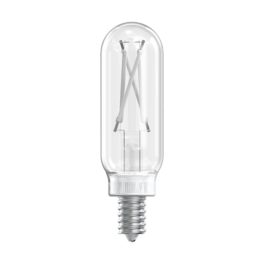
This G16.5 clear filament LED puts 600 lumens on an E12 candelabra base. Most decorative globes this size manage 200 to 350, so it's a real step up in an open chandelier, sconce or pendant.
It draws 5.5W at 120V, runs warm at 3000K, holds CRI above 80, and dims on listed Leviton and Lutron controls.
Clear glass, twin filament boards, UL listed, with full photometric test data on file.
Is G16.5 the same as E12?
No, and a fixture needs both to match. G16.5 is the glass shape, E12 is the screw base. The G number is the globe diameter in eighths of an inch, so it tells you whether the lamp clears the shade. E12 is the 12 mm candelabra thread used in chandeliers, sconces and vanity bars. This lamp is a G16.5 globe on an E12 base, so it answers a spec written either way. The same globe also sells with an E26 medium thread, and that version won't seat in an E12 socket.
What's the difference between G16 and G16.5 bulbs?
Half an eighth of an inch on paper, and in practice suppliers treat them as one lamp. G16, G16.5 and G16-1/2 all name the same small globe family, and Canadian distributors list them interchangeably. Check the base and the overall length instead, because those decide whether the lamp seats and clears the glass.
Why the output figure matters here
Decorative globes are usually the dimmest lamps in a building. Most G16.5 LEDs on the Canadian market land between 200 and 550 lumens, which is why a chandelier full of them can still read as gloomy. At 600 lumens this one carries a fixture with fewer lamps, or lifts an existing fixture without a rewire. You keep the filament look and stop paying for it in light.
Open fixtures only, and one thing to know about clear glass
This lamp isn't rated for enclosed fixtures, so check the shade before you specify it for a vanity or a closed pendant. Trapped heat shortens driver life. The photometric file also shows something the spec panel can't: two flat filament boards inside clear glass mean brightness varies by more than two to one as the lamp rotates in its socket. In an open fixture at eye level, turn the flat face towards the room.
For the full candela distribution, the beam angles and the measured input wattage, open the IES file and load it into your photometric software. Send us your fixture count and we'll come back with a wholesale quote and confirm whether your dimmer is on the tested list.