










 (+1) 905 597 5955



Stadium lights go by a few names: sports lights, sports floodlights, high-mast lights and, today, mostly LED stadium lights. They all describe the same thing. A very high-output luminaire with a narrow beam, mounted high on a pole and aimed at a playing surface. In Canada the pole is often called a light standard.
So what separates LED stadium lights from the flood light on a warehouse wall? Three things: beam angle, output per head and mounting height. A general flood throws a wide 120° spread from a low mount. LED stadium lights push 100,000 lumens or more through a 15° to 60° optic from 20 metres up. High-mast lighting is the pole system, not a fixture type, and LED stadium lights are one of the things that go on it.
Sizing comes down to four steps: pick a target light level, work out total lumens, divide by the output of your LED stadium lights, then match the beam to the pole height. We’ll walk through each one, with a worked example for a community soccer field.
What Are Stadium Lights Called? Every Name You’ll Hear
Stadium lights are high-output sports floodlights, usually called LED stadium lights, sports lights or high-mast lights, mounted on tall poles called light standards. The name changes with who’s talking, so here’s the decoder.
- Stadium lights or LED stadium lights. The everyday search term. Usually means the fixture head.
- Sports lights or sports lighting. The industry term. The IES standard is called “Lighting Sports and Recreational Areas.”
- Sports floodlights. Common with older specifiers. Accurate, since LED stadium lights are floodlights with tighter optics.
- High-mast lights. Used when the poles are very tall. Strictly, high mast describes the pole, not the fixture.
- Light standard, light pole, light tower. The structure. “Light standard” shows up in a lot of Canadian municipal tenders.
- Luminaire or head. The individual light. Spec sheets say luminaire.
Sound familiar? Most mix-ups on a quote start when someone says “flood light” but means LED stadium lights, or says “high mast” about a 12 metre pole. Get the name right and you get the right fixture.
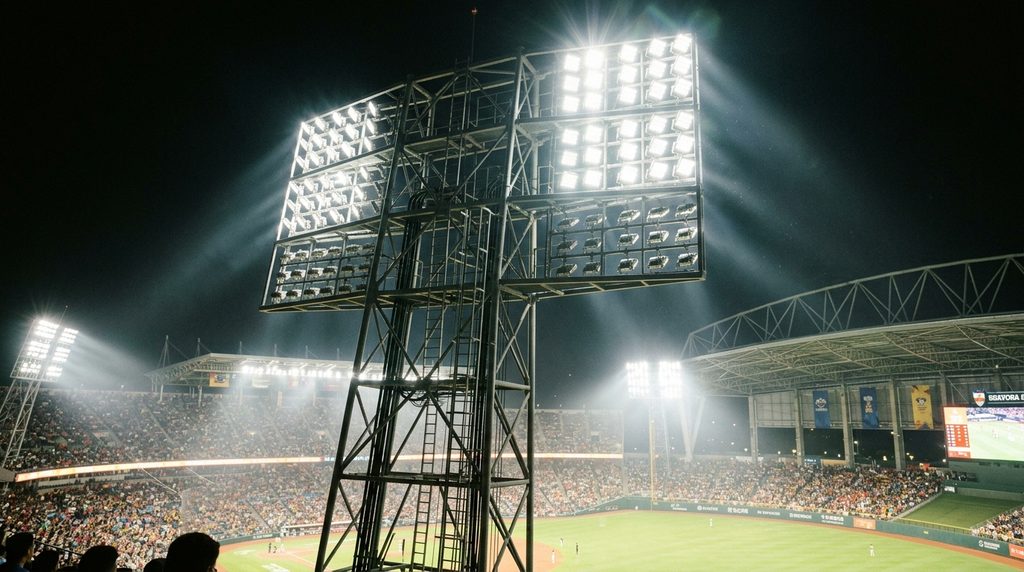
LED Stadium Lights vs Flood Lights vs High-Mast: The Real Differences
Here’s the side-by-side most buyers want.
| Feature | LED stadium lights | General LED flood lights | High-mast lighting |
|---|---|---|---|
| What it is | Fixture built for sports fields | Fixture for walls, yards, signs, facades | A pole system carrying several fixtures |
| Typical beam angle | 15° to 60°, narrow and aimable | 90° to 120°, wide wash | Depends on the heads fitted |
| Output per head | ~50,000 to 200,000+ lumens | ~5,000 to 80,000 lumens | Sum of all heads on the ring |
| Typical wattage | 300W to 1,200W+ | 30W to 500W | Often 4 to 16 heads per pole |
| Mounting height | ~15 to 30+ metres | ~3 to 12 metres | ~20 metres and up |
| Aiming | Precise, often with a laser sight | Rough tilt on a yoke | Heads on a fixed or lowering ring |
| Where you see it | Fields, rinks, ball diamonds | Parking areas, building fronts, docks | Interchanges, ports, large yards |
These ranges are typical, not hard rules. A 500W flood can light a small tennis court, and LED stadium lights can sit on a high mast at a port.
Beam Angle Is the Real Dividing Line
Beam angle is what turns a flood into a stadium fixture.
A wide flood spreads light close to the pole. On a field, most of it spills past the fence. LED stadium lights use tight optics, often 25°, to throw light a long way and put it where the players are.
Votatec’s 600W stadium light ships with a 25° optic as standard, and so does the 1200W model, with 40° and 60° lenses sold separately. Our CCT and power adjustable flood lights spread 120°. Same light source. Different job. Floods still have plenty of work on a site, from signage to loading docks, as our list of LED flood light applications shows.
Output and Wattage Per Head
LED stadium lights carry far more light per head. The 600W stadium light delivers 102,000 lumens at 5000K. The 1200W delivers 204,000. Our largest flood, the 500W CCT and power adjustable flood, tops out at 80,000 lumens.
More lumens per head means fewer LED stadium lights to aim, wire and maintain 20 metres up.
Mounting, Aiming and Access
Flood lights go on a wall or a short pole you can reach with a small lift. LED stadium lights go up where a bucket truck is a planned expense, so everything about them assumes you only touch them once.
On Votatec’s LED stadium lights, the power setting sits on a dip switch inside a sealed compartment. You set it on the ground, because nobody’s opening that plug at 20 metres. An optional laser aiming device beats aiming 102,000 lumens by eye.
Related reading: LED wall pack vs flood light covers the low-mount end of this comparison.
What Is High-Mast Lighting, and Is It the Same as Stadium Lighting?
No. High-mast lighting is a mounting system. LED stadium lights are fixtures that can go on one.
High-mast lighting puts a group of high-output luminaires on one tall pole, so a single pole covers ground that would otherwise need several. The usual threshold quoted by the IES and the US Federal Highway Administration is around 20 metres and up. Some agencies set the bar higher. The Texas Department of Transportation’s highway lighting manual defines conventional lighting as 50 feet or less, and high-mast lighting as 100 feet or more.
The same manual notes that conventional poles need a bucket truck for repairs, while one or two people with a pickup can usually maintain a high-mast system. Worth weighing before you choose between a few tall masts and many short poles.
So “high-mast stadium lights” usually means LED stadium lights on poles tall enough to count as high mast. Our 1200W model is built for that, and a four-head ring clears 800,000 lumens on a single mast.
What Type of Lights Do Stadiums Use Today?
Mostly LED. For decades it was metal halide, usually 1,000W or 1,500W lamps in big round reflectors. Most new builds and retrofits now go to LED stadium lights, for practical reasons.
- Instant on. Metal halide takes minutes to warm up, and longer to restrike after a power blip. LED stadium lights come back the moment power does.
- Dimming. Metal halide doesn’t dim well. LED stadium lights use 0-10V dimming, so practice can run at half output.
- Better aiming. The optics on LED stadium lights shape the beam and cut spill onto neighbours.
- Lower draw. Similar light on the field for roughly half the wattage, sometimes less.
Federal rules push the same way. Natural Resources Canada’s metal halide ballast regulation sets minimum efficiency for ballasts running lamps from 50W up to 1,000W, with a December 31, 2019 compliance date for 347V ballasts. Keeping an old metal halide field running gets harder every year.
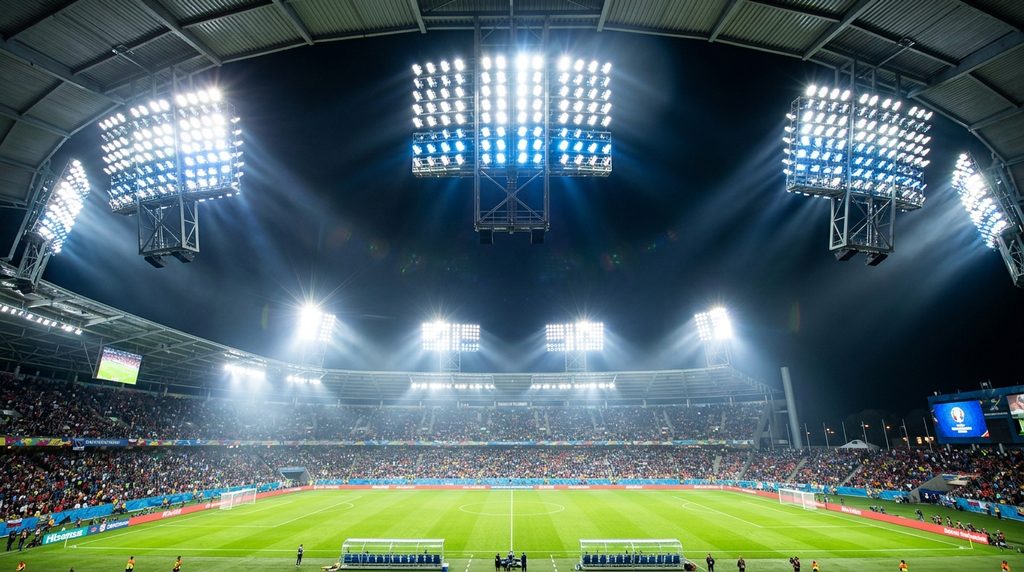
How to Size the Wattage for LED Stadium Lights
Here’s the part most guides skip. Sizing LED stadium lights isn’t about matching the old lamp. It’s about how much light the field needs.
- Pick a target light level for your sport and class of play.
- Work out the total lumens the field needs.
- Divide by the output of your LED stadium lights to get head count and wattage.
- Match the beam angle to pole height and setback.
Step 1: Find Your Target Light Level
North American sports lighting runs on ANSI/IES RP-6, “Recommended Practice: Lighting Sports and Recreational Areas.” The current edition is RP-6-24. It sorts facilities into classes of play, based mostly on competition level and spectator count.
| Class of play | Typical facility | Commonly cited target, football or soccer |
|---|---|---|
| Class I | Pro and large college venues, broadcast | ~100 fc (about 1,075 lux) |
| Class II | College and semi-pro, mid-size crowds | ~50 fc (about 540 lux) |
| Class III | High school and club competition | ~30 fc (about 325 lux) |
| Class IV | Recreational and training, few or no spectators | ~20 fc (about 215 lux) |
These are the figures most often quoted from RP-6 for outdoor football and soccer. Other sports differ, and baseball splits infield from outfield. Get the current RP-6 table from your designer before you commit. One foot-candle is about 10.76 lux.
Most Canadian municipal and school fields sit in Class III or IV. Good news. You need far fewer LED stadium lights than a pro venue. Our guide to how many LED lumens you need explains lumens, lux and foot-candles in plain terms.
Step 2: Work Out the Total Lumens
The quick estimate is the lumen method:
Total lumens = target lux × field area (m²) ÷ (coefficient of utilisation × light loss factor)
- Coefficient of utilisation (CU) is the share of light that lands on the field. For well-aimed LED stadium lights, 0.6 to 0.7 is a fair planning number.
- Light loss factor (LLF) covers dirt and lumen depreciation. 0.8 is a common planning value.
That’s a starting point, not a design. A real layout runs the IES file for your LED stadium lights through photometric software to check uniformity, glare and spill.
Step 3: Divide by Fixture Output and Pick the Wattage
Divide total lumens by lumens per head. Round up, then round again to fit your pole count.
Here’s the thing most people miss. Head wattage barely changes total system wattage. If two LED stadium lights have the same efficacy, the field needs about the same total watts either way. A 1200W head just means half as many heads as a 600W one. What changes is pole count, aiming flexibility and cost per head.
So pick the head wattage to suit your poles. High-wattage LED stadium lights suit fewer, taller poles. Lower-wattage heads suit more poles, shorter poles, or smaller areas like tennis courts.
Step 4: Match the Beam Angle to Pole Height
A rough guide that holds up on most jobs:
- Narrow (15° to 25°): tall poles, long throws, aiming at the far side of the field.
- Medium (40°): mid-height poles on a mid-size field.
- Wide (60°): shorter poles, close courts, or filling in near the pole.
Most fields mix them. Narrow LED stadium lights reach the far touchline and wider ones cover the near side. The photometric layout settles the final mix.
Worked Example: Sizing LED Stadium Lights for a Community Soccer Field
Say you’re lighting a 100 m × 64 m community pitch for Class IV recreational play.
- Area: 100 × 64 = 6,400 m²
- Target: about 200 lux (rounded down from 215 for this estimate)
- CU × LLF: 0.6 × 0.8 = 0.48
- Total lumens: 200 × 6,400 ÷ 0.48 = about 2.67M lumens
Now divide by the output of the LED stadium lights:
- 600W heads at 102,000 lm: 26.2, so 28 heads, 7 on each of 4 poles. That’s 16.8 kW.
- 1200W heads at 204,000 lm: 13.1, so 16 heads, 4 on each of 4 poles. That’s 19.2 kW.
See what happened? The 1200W layout rounded up further, so it draws a bit more. Neither choice is wrong. That’s where the dip switch earns its keep. Both Votatec LED stadium lights step down in four settings. The 600W runs at 600, 500, 400 or 300W, so each head can be trimmed to what the layout needs.
These are planning assumptions, not a lighting design. Send us your field size and pole heights, and we’ll check the LED stadium lights layout against the IES file.
Metal Halide to LED Stadium Lights: Wattage Conversion
Retrofitting existing poles? This is the table people ask for.
| Existing metal halide lamp | Typical LED stadium lights replacement |
|---|---|
| 400W MH | 150W to 200W LED |
| 1,000W MH | 300W to 500W LED |
| 1,500W MH | 600W to 750W LED |
| 2,000W MH | 800W to 1,000W LED |
Treat this as a rule of thumb, not a spec. Metal halide sports lamps lose a big share of output over their life, while LED stadium lights put more lumens where you aim them. The real conversion depends on the old system’s measured light level.
Check the old wattage at the wall, too. A 1,500W metal halide head draws more than 1,500W once ballast losses are added. That gap is part of your savings. Our metal halide vs LED high bays comparison covers the same switch indoors.
What Is a 500 Watt Stadium Light?
Depends whether the 500W is real.
A true 500W LED stadium light draws 500 watts and, at 150 to 170 lm/W, makes roughly 75,000 to 85,000 lumens. Enough for a full tennis court or a corner of a community field.
But plenty of online listings use “500W” to mean 500W equivalent. Those fixtures might draw 100W and make 15,000 lumens. Honestly, it’s the most common trap with LED stadium lights. A 32,000 lumen fixture sold as a “1200W equivalent” isn’t a 1200W stadium light. Not even close.
Real numbers look different. Our 300W CCT and power adjustable flood measured 48,486 lumens at 293.6W on a goniophotometer, about 165 lm/W, slightly above its published spec.
Simple check: divide claimed lumens by claimed watts. Good LED stadium lights land between 140 and 170 lm/W. If the math gives 300 lm/W, one number is fiction. Then ask for the IES file and LM-79 report for those LED stadium lights.
How Much Do LED Stadium Lights Cost to Run?
Votatec sells wholesale and quotes per project, so we don’t list fixture prices for LED stadium lights. Running costs are easier to estimate, and they’re usually what sells LED stadium lights to a council or school board.
A simple illustration. Say an older field runs 24 heads of 1,500W metal halide at about 1,600W each at the wall. That’s 38.4 kW. Swap in the 600W layout from our example at 16.8 kW.
- Saving: 21.6 kW
- Run time: 1,200 hours a year (4 hours a night, 300 nights)
- Energy saved: 25,920 kWh a year
- At $0.13/kWh: about $3.4K a year
Use your own rate and hours. Dim practice nights to 50% and LED stadium lights save more again. And you stop paying a lift crew to relamp metal halide, which is often the bigger number.
Check your provincial utility for incentives before you buy. Most need qualified products, so confirm the listing status of your LED stadium lights in the live database, not from a badge on the spec sheet.
A Canadian Spec Checklist for LED Stadium Lights
Most buying guides for LED stadium lights are written for the US market. Canadian fields add a few demands.
Voltage: Look for 347V
Many Canadian commercial and municipal services run 600Y/347V. Plenty of imported LED stadium lights stop at 277V. Votatec’s stadium and flood heads take AC120-347V, so they land on a 347V circuit without a step-down transformer.
Cold Rating and Certification
- Operating temperature. Votatec’s stadium light spec sheet lists -40°C to 45°C. Check this on any fixture for an outdoor rink or a northern field.
- Certification. Look for cULus or cETL for wet locations. A US-only listing won’t satisfy a Canadian inspector.
- Ingress and impact. IP66 and IK08 are a sensible baseline for LED stadium lights facing wind-driven rain and stray balls.
Wiring and Install Details
- Conductor rating. Votatec’s stadium light manual calls for supply conductors rated 105°C minimum. Many crews stock 90°C wire, so check before ordering cable.
- Dimming. 0-10V is standard. Run the dimming pair in the rough-in if you want practice and game presets.
- Generator testing. The manual warns against testing with a generator, which matters on tournament installs.
Glare, Spill and Dark Sky Rules
Neighbours complain about sports lighting more than almost anything on a municipal site. Well-aimed LED stadium lights make dark sky bylaws far easier to meet.
The DarkSky International outdoor sports lighting guidelines make a useful benchmark even if you’re not seeking certification:
- No light above horizontal once aimed, except a capped allowance for aerial sports like baseball
- At least 85% of downward lumens landing on the field plus a 10 metre border
- No more than 1,000 candelas at the glare evaluation distance
- Lights off by a curfew no later than 11:00 p.m., with dimming from 25% to 100%
Visors help a lot. See our guide to parking lot lighting that passes a Canadian dark sky bylaw. Same principles, different site.
Indoor Arenas: When You Need High Bays Instead
Searches for indoor LED stadium lights usually mean arenas and gyms. Indoors you’re rarely more than 12 metres up, and you don’t need a 25° throw. LED high bays usually do the job better and cost less per square metre.
Our high bay lighting calculator and spacing guide covers arena-style layouts. Outdoor rinks are different. They behave like a small field, and a few pole-mounted floods or compact LED stadium lights usually cover them.
Common Mistakes When Buying LED Stadium Lights
- Buying on “equivalent” wattage. Size LED stadium lights on lumens and photometrics, never on borrowed metal halide numbers.
- Copying the old head count. Your old poles may have been over-lit or under-lit. Recalculate.
- Ignoring beam angle. A 120° flood on a 20 metre pole lights the neighbours, not the field.
- Forgetting the switch is up the pole. Set wattage and check aim before lifting.
- Trusting a badge. A DLC logo on a spec sheet isn’t a listing. Check the live database.
- Skipping the IES file. Without photometrics, nobody can prove uniformity or glare.
For the wider outdoor picture, see our commercial outdoor area lighting spec guide and the LED area lights range, where both of our LED stadium lights live.
Frequently Asked Questions About LED Stadium Lights
What are the lights at a stadium called?
They’re called stadium lights, sports lights or sports floodlights, and most new installs are LED stadium lights. The pole is a light standard or light tower, and very tall pole systems are called high-mast lighting. On a spec sheet, each light is a luminaire.
How many lumens do LED stadium lights produce?
Most LED stadium lights produce 50,000 to 200,000+ lumens per head. Votatec’s 600W model delivers 102,000 lumens at 5000K and the 1200W delivers 204,000. Good LED stadium lights run 140 to 170 lumens per watt, so watts × efficacy gives a quick estimate.
How many LED stadium lights do I need for a field?
Multiply target lux by field area, divide by about 0.48 for light that misses the field and depreciation, then divide by lumens per head. A 100 m × 64 m recreational soccer field at 200 lux needs about 2.67M lumens, or roughly 28 LED stadium lights at 102,000 lumens each.
What wattage LED replaces a 1,500W metal halide stadium light?
A 600W to 750W LED usually replaces a 1,500W metal halide head, and a 300W to 500W LED usually replaces a 1,000W. Treat these as starting points. Confirm with a photometric layout, because old metal halide systems lose a lot of output over time.
Are LED stadium lights worth it for a small municipal field?
Usually, yes. LED stadium lights cut energy use roughly in half or better, switch on instantly, dim for practice nights and remove most relamping lift days. On a small field, maintenance savings often matter as much as energy savings. Check provincial utility incentives first.
Bottom Line
- Names: stadium lights, sports lights, sports floodlights and LED stadium lights mean the same kind of fixture. High mast is the pole system.
- Versus floods: LED stadium lights use narrow 15° to 60° optics, much higher output per head and much taller mounts.
- Sizing: target lux × area ÷ 0.48 gives total lumens. Divide by lumens per head, then pick a wattage that suits your poles.
- Canada: check 347V input, a -40°C rating, cULus or cETL wet location listing, and local dark sky rules.
Got a field, rink or yard to light? Contact Votatec with your field size, pole count and mounting height. We’ll send a wholesale quote, the IES file and a beam angle check for your LED stadium lights.