













 (+1) 905 597 5955


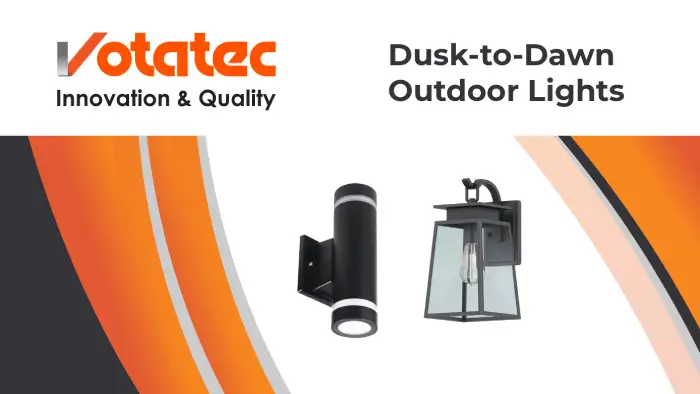

For most commercial properties, dusk to dawn outdoor lights should run on a photocell, with a timer or motion sensor layered on top. The photocell switches dusk to dawn outdoor lights on at dusk and off at dawn, every day of the year, with no clock to reset. A timer (ideally an astronomical time switch) dims or shuts off lights you don’t need after closing. A motion sensor brings them up to full output when someone walks into the zone. Alone, each control has a blind spot. Together, they cover each other.
That’s the short answer. The rest of this guide covers which control fits which part of a site and what the Canadian energy code asks of dusk to dawn outdoor lights. It also covers the mistakes that make them burn all day or cycle all night.
What Are Dusk to Dawn Outdoor Lights?
Dusk to dawn outdoor lights are exterior fixtures that switch on automatically when daylight fades and off when it returns. A small light sensor called a photocell (also sold as a photoelectric sensor or dusk to dawn light sensor) reads ambient light and opens or closes the circuit. Some dusk to dawn outdoor lights have the photocell built in. Others get a separate photocell wired into the circuit.
So a wall pack, a flood light, a pole-mounted area light or a decorative wall lantern can all be dusk to dawn outdoor lights. The control makes them dusk to dawn outdoor lights, not the housing.
You’ve got a mix of dusk to dawn outdoor lights on the building, in the lot and along the walkways, and they don’t all need the same control. Some need to be on all night for safety. Some only need to be on when someone’s there. And some should be off by 11 p.m., full stop.
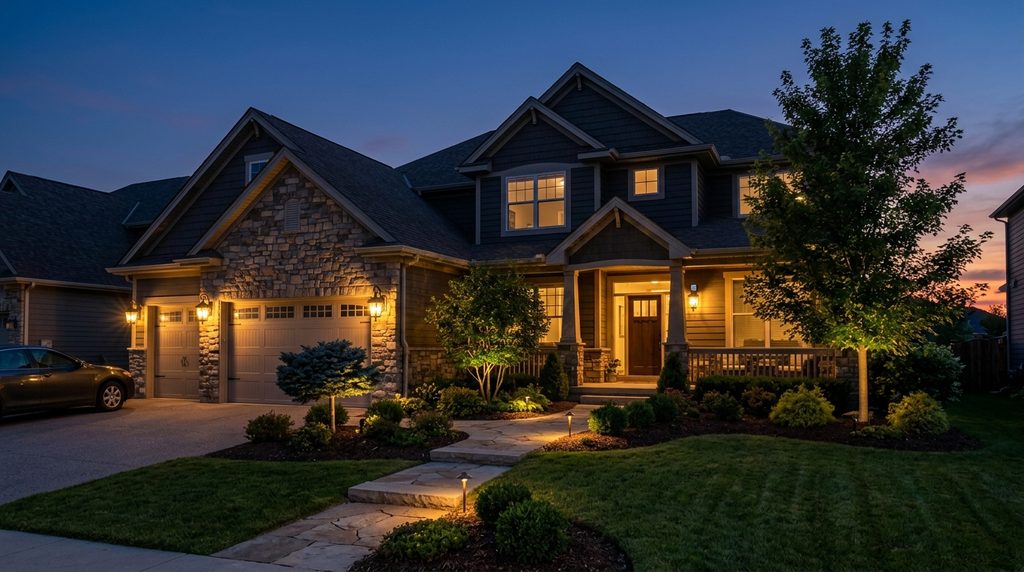
Photocell vs Motion Sensor vs Timer: Quick Comparison
Here’s how the three controls stack up for commercial dusk to dawn outdoor lights.
| Control | What triggers it | Best for | Weak spot |
|---|---|---|---|
| Photocell | Ambient light level (lux) | All-night perimeter, parking, entrances | Can’t tell 7 p.m. from 3 a.m., so dusk to dawn outdoor lights burn at full output all night |
| Motion sensor (PIR) | Moving heat source in its field | Back doors, loading docks, laneways, storage yards | Short range; wind, snow and traffic cause false trips |
| Timer / astronomical time switch | Clock time, or calculated sunrise and sunset | After-hours shutoff or dimming, signage, facades | Plain timers drift with the seasons and lose time in outages |
| Photocell + timer | Dusk to switch on, clock to switch off or dim | Retail and office lots that close at night | Needs a timer that holds through outages |
| Photocell + motion | Dusk to arm, motion to boost | Security zones with low night traffic | Needs a dimmable, bi-level fixture |
Short version? Photocell first. Then decide whether the hours after closing need a timer, a motion sensor or both.
How a Photocell Controls Dusk to Dawn Outdoor Lights
A photocell is the cheapest, simplest control you can put on dusk to dawn outdoor lights. It has no settings for anyone to get wrong. And it adjusts itself to the seasons, because it reads actual daylight, not a clock.
That’s a big deal in Canada. Sunset in Toronto moves by roughly three and a half hours between June and December. A plain timer set in summer leaves the lot dark on a January afternoon. A photocell won’t.
Switching Thresholds and the Time Delay
Every photocell has two light levels: one where it switches on, and a higher one where it switches off. The gap stops dusk to dawn outdoor lights flickering at twilight.
Take Votatec’s 120V photoelectric sensor (JL-103AG). It switches on between 10 and 20 lux and off between 30 and 60 lux. It also waits 20 to 120 seconds before acting. That delay stops passing headlights, a lightning flash or a truck’s reverse lights from flicking your dusk to dawn outdoor lights off and on.
No delay, no peace.
120V vs 347V Photocells
This one catches people out. Many Canadian commercial buildings run exterior lighting at 347V, the lighting voltage on a 347/600V service. A 120V photocell can’t sit on that circuit.
You’ve got two choices:
- Use a 347V photocell. Our 347V photoelectric sensor (JL-103EE) wires straight onto a 347VAC supply with no step-down transformer, rated 2000W tungsten or 2000VA ballast.
- Use dusk to dawn outdoor lights with a built-in, multi-voltage photocell. Several of our LED wall packs, including the full cut-off and adjustable models, run anywhere from 120V to 347V with the photocell inside.
Check the voltage before you order. Every time.
Where Photocells Go Wrong
Photocells are simple, but siting them badly is easy. The common faults:
- The photocell sees its own light. The fixture switches on, the sensor reads that as daylight, and it switches off. Then on again. That’s the classic “cycling all night” complaint. A swivel-mount photocell lets you aim the sensor away from the light it controls.
- It faces west. Low evening sun holds the cell open, so dusk to dawn outdoor lights on a west wall come on late.
- It sits under a deep canopy. The reverse problem. It’s dark enough under the overhang that dusk to dawn outdoor lights switch on in the afternoon.
- It’s worn out. A photocell that’s failed closed keeps dusk to dawn outdoor lights burning all day. You’ll spot it on a sunny afternoon.
A north-facing position, clear of other light sources and its own fixture, avoids most of this.
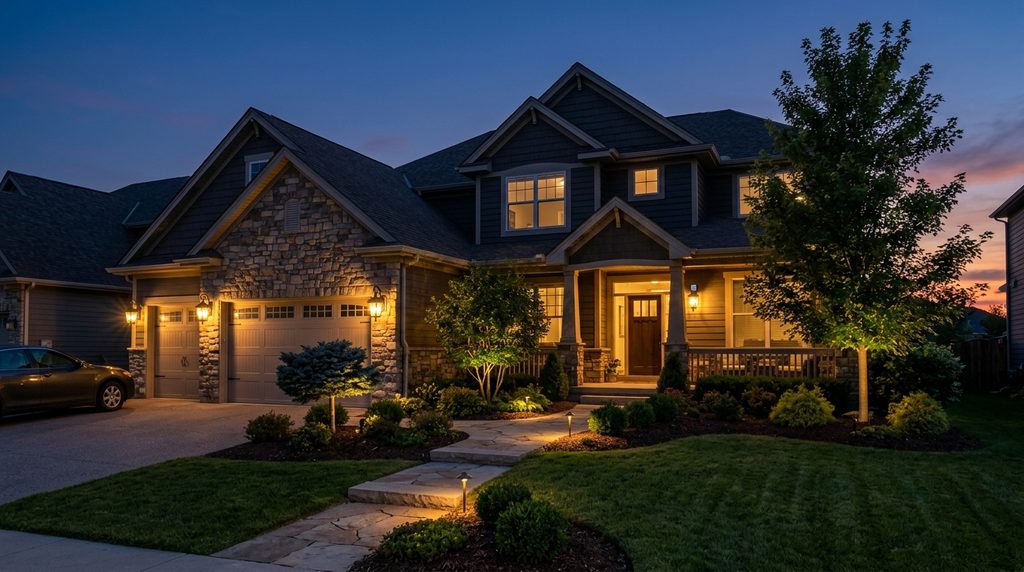
Motion Sensors on Dusk to Dawn Outdoor Lights: Where They Pay Off
Motion sensors switch lighting on movement, not daylight. Most outdoor units use passive infrared (PIR), which detects a moving heat source crossing its field.
On their own, motion sensor lights aren’t really dusk to dawn outdoor lights. They’d fire at noon too. That’s why nearly every outdoor motion fixture pairs the PIR sensor with a photocell. The photocell arms the sensor at dusk. The motion sensor decides when the light comes on, or when it goes from dim to full.
Our RIO wall light with sensor shows that pairing. It combines a 220-degree PIR sensor and a dusk to dawn photocell in one head, with a 10-metre (32.8 ft) detection range and a 2-minute hold.
For back doors and side yards, our dual-head motion security light turns two heads into motion-activated dusk to dawn outdoor lights. Its 180-degree PIR sensor reaches 16 metres, it has three sensitivity settings, and a built-in photocell holds the heads off until light drops below 50 lux.
Good Fits for Motion-Activated Outdoor Lighting
Motion sensors on dusk to dawn outdoor lights earn their keep where people show up rarely and briefly:
- Rear service doors and staff entrances
- Loading docks outside shipping hours
- Laneways and side yards between buildings
- Storage compounds and dumpster enclosures
- Rooftop access and mechanical yards
In those spots, full-output dusk to dawn outdoor lights burning 12 hours a night mostly light an empty space. A motion sensor cuts that waste and makes an intruder far more noticeable.
Poor Fits
Motion control is a bad idea for dusk to dawn outdoor lights in a busy parking lot. The sensors would trigger constantly. It’s also wrong for main pedestrian routes, where people expect to see the path before they reach it.
PIR Sensors in a Canadian Winter
PIR sensors spot the heat difference between a person and the background, and cold weather usually helps. But heavy winter clothing hides body heat, snow builds up on the lens, and blowing snow or swaying branches cause false triggers.
Check the temperature rating, too. The JL-103 photocells are rated down to -40°C. Many decorative dusk to dawn outdoor lights with motion sensors stop at -30°C. That’s fine for southern Ontario and BC, but tight for the Prairies or the North.
Why Motion Sensors Work With LED (and Didn’t With HID)
Here’s why motion control finally makes sense on commercial sites. Metal halide and high-pressure sodium lamps can take several minutes to restrike once they’re hot. Put one on a motion sensor and it’s still warming up after the intruder has left.
LEDs come on instantly at full output and dim smoothly. So LED dusk to dawn outdoor lights can sit at low output and jump to full in a split second.
Timers vs Astronomical Time Switches for Outdoor Lighting
A timer controls dusk to dawn outdoor lights by the clock, not by daylight. That’s its strength and its weakness.
The strength: it knows when your business closes. A photocell doesn’t. A photocell runs parking lot dusk to dawn outdoor lights at full output from 5 p.m. to 7 a.m. whether anyone’s there or not. A timer can shut it off, or dim it, at 11 p.m.
The weakness: a basic mechanical or digital timer has no idea when the sun sets. Set it to “on at 6 p.m.” and it’s an hour late in December and three hours early in June. And a power cut can knock a cheap timer off its schedule.
Why an Astronomical Time Switch Is the Better Timer
An astronomical time switch calculates sunrise and sunset from your location and date. It shifts itself through the year, and the better models handle daylight saving time on their own. Most hold their programme through an outage.
So one panel device can do the photocell’s job (on at dusk, off at dawn) and the timer’s job (off or dimmed after closing). It’s the control the Canadian energy code names first for dusk to dawn outdoor lights.
What the Canadian Energy Code (NECB) Requires for Exterior Lighting Controls
Building new or doing a major renovation? In provinces that have adopted it, the National Energy Code of Canada for Buildings (NECB) sets exterior lighting control requirements in Article 4.2.4.1.
In plain terms, the NECB expects exterior lighting, including dusk to dawn outdoor lights, to:
- Switch automatically on a schedule tied to sunrise and sunset, using an astronomical time switch. A photosensor (photocell) is accepted for the dusk and dawn switching.
- Reduce after hours. Triggered by a timeclock or occupancy sensor, exterior lighting should drop by at least 30% of its maximum power overnight. Switching fully off also complies.
There are exceptions, like lighting needed for safety and security, so check with your designer or the authority having jurisdiction. Provinces adopt different editions on different timelines, and Ontario has its own path through SB-10.
Natural Resources Canada says much the same for existing buildings. Its Major Energy Retrofit Guidelines for commercial buildings say that, at a minimum, exterior lighting should be controlled by a photocell that shuts it off during daylit hours. Where security doesn’t need the lights, timeclocks can cut them after business hours.
So a photocell alone gets your dusk to dawn outdoor lights to the minimum. The code wants an after-hours reduction too.
The Best Setup: Layering Controls on Dusk to Dawn Outdoor Lights
Here’s the setup that works for most commercial properties. Three layers.
- On and off: photocell or astronomical time switch. Dusk to dawn outdoor lights come on when it gets dark and go off at sunrise. No manual switches left on in the morning.
- After hours: timer. At closing (say 11 p.m. or midnight), the timer drops non-essential dusk to dawn outdoor lights to a lower level, or off, until early morning.
- On demand: motion sensor. In zones that sit at low output overnight, a motion sensor brings dusk to dawn outdoor lights back to full when someone walks in. After the hold time, they drop again.
Most sites don’t need all three everywhere. The perimeter might get layers 1 and 2. The back door gets 1 and 3. The main entrance might stay at full output on layer 1 alone.
Bi-Level Dimming With 0-10V
“Drop to a lower level” needs a dimmable fixture. Most commercial dusk to dawn outdoor lights, wall packs and area lights alike, use 0-10V dimming, where a low-voltage signal sets the output. Our full cut-off and adjustable wall packs, and the mini wall pack with photocell, support 0-10V.
That’s what lets dusk to dawn outdoor lights sit at 30% to 50% output overnight and jump to full on motion. It’s safer than switching off, because the lot never goes black. And it still meets the after-hours reduction.
A Quick Energy Example
Say you’ve got ten 100W LED wall packs running as dusk to dawn outdoor lights in southern Ontario.
- Photocell only: dusk to dawn averages about 12 hours a night across the year. That’s roughly 4,380 hours, or about 4,380 kWh a year for all ten.
- Photocell + timer dimming to 50% from midnight to 6 a.m.: you cut 6 hours a night at half power. That saves about 1,095 kWh, or 25%.
These are illustrative figures, not a site audit. But the pattern holds: the photocell decides when dusk to dawn outdoor lights run, and the timer or sensor decides how hard they work.
Which Lighting Control Goes Where on a Commercial Site?
Here’s how we’d assign controls for dusk to dawn outdoor lights across a typical commercial site.
| Area | Recommended control | Why |
|---|---|---|
| Main parking lot | Photocell or astronomical timer + after-hours dimming | Needs light all night, but not full output after closing |
| Building perimeter (wall packs) | Built-in photocell + timer dimming | Simple, reliable, meets the minimum on its own |
| Main entrance and canopy | Photocell, full output all night | Safety and wayfinding |
| Rear and service doors | Photocell + motion sensor | Rarely used at night; motion improves security |
| Loading docks | Photocell + motion, bi-level | Busy during shifts, empty after |
| Laneways and side yards | Photocell + motion | Low traffic, long runs, high security value |
| Signage and facade lighting | Astronomical time switch | Should be off after closing; often a bylaw issue |
| Pathways and bollards | Photocell or timer | Depends on overnight use |
Whatever controls you pick for dusk to dawn outdoor lights, check your municipality’s dark sky or outdoor lighting bylaw before you finalise. Some cap the hours dusk to dawn outdoor lights can run, or require full cut-off fixtures. Our guide to parking lot lighting that passes a Canadian dark sky bylaw covers what those bylaws ask for.
Built-In Photocell or Separate Dusk to Dawn Light Sensor?
Once you’ve picked a control, decide how it gets onto your dusk to dawn outdoor lights.
Built-in photocell. The simplest dusk to dawn outdoor lights. Nothing extra to wire, and one SKU covers 120V to 347V on many commercial fixtures. Pick a photocell you can disable, so the fixture can move to a timer or panel control later. Our LED wall pack range works this way.
One separate photocell per circuit. One button photocell can switch a whole circuit, within its load rating. On a large building, one sensor controls 10 or 20 dusk to dawn outdoor lights and they all switch together. Our photoelectric sensor range covers 120V and 347V, fixed and swivel.
Integrated motion + photocell. Best for doors and side entries. Our outdoor wall light collection includes a sensor version.
Panel-level control. Best for big sites, multiple buildings, or any job that has to show NECB compliance. The photocell or astronomical time switch sits in the electrical room and drives contactors, not fixtures. Pole-mounted LED area lights are usually controlled this way.
Photocell Wiring Basics for Commercial Fixtures
Photocell wiring is one of the most searched questions about dusk to dawn outdoor lights. Here’s the basic idea. Most button and stem photocells used on dusk to dawn outdoor lights are three-wire devices:
- Black: line (incoming hot)
- Red: load (out to the fixtures)
- White: neutral
The photocell sits in series between the supply and the dusk to dawn outdoor lights it controls. When it gets dark, it closes and sends power down the red wire. When it’s light, it opens.
Check two things before you buy. Total load: add up every fixture on the circuit and stay well under the photocell’s rating. And voltage: match the cell to the circuit, 120V or 347V.
In most provinces this is permitted electrical work. In Ontario, a licensed electrical contractor files with the ESA. A photocell swap on a 347V circuit isn’t a DIY job.
Common Mistakes With Dusk to Dawn Outdoor Lights
The same problems show up on commercial dusk to dawn outdoor lights over and over:
- Full output all night. A photocell alone is fine on an existing building, but it’s paying to light an empty lot at 3 a.m.
- A basic timer instead of an astronomical one. Dusk to dawn outdoor lights come on in daylight in summer and too late in winter.
- Motion sensors on the main lot. Constant triggering, no savings.
- A photocell that sees its own light. Dusk to dawn outdoor lights cycle all night. Aim the sensor away from the beam.
- Mismatched voltage. A 120V photocell on a 347V circuit fails fast.
- Forgetting the cameras. Keep dusk to dawn outdoor lights in camera zones at a level the camera can use.
- An overloaded photocell. Too much load welds the contacts shut, and dusk to dawn outdoor lights never turn off.
Frequently Asked Questions
What is the difference between a photocell and a motion sensor?
A photocell switches lights based on daylight, on at dusk and off at dawn. A motion sensor switches lights based on movement in its field. Photocells keep dusk to dawn outdoor lights running all night. Motion sensors only bring lights on, or up to full, when someone is there. Many commercial fixtures combine both.
Can you put a motion sensor on dusk to dawn outdoor lights?
Yes, and it’s often the best setup. The photocell holds dusk to dawn outdoor lights at a low level all night, and the motion sensor raises them to full output on movement. You need a dimmable (usually 0-10V) or bi-level fixture. It works well for rear doors, docks and laneways.
Do dusk to dawn outdoor lights use a lot of electricity?
LED dusk to dawn outdoor lights use far less than the HID fixtures they replace, but run time adds up. A 100W LED wall pack on a photocell alone runs roughly 4,380 hours a year, about 438 kWh. A timer or motion sensor that dims it after midnight can cut that by a quarter or more.
Why do my dusk to dawn outdoor lights stay on during the day?
Usually a failed photocell, a sensor shaded by a canopy or eave, or a photocell overloaded until its contacts welded shut. Cover the sensor, then uncover it. If the light doesn’t respond, replace the cell and check the total load against its rating.
What is the best timer for commercial outdoor lighting?
An astronomical time switch is the best timer for commercial dusk to dawn outdoor lights. It calculates sunrise and sunset from your location, adjusts through the seasons and daylight saving time, and holds its programme through outages. It can also dim or switch off lighting after business hours, which is what the NECB asks for on new buildings.
Bottom Line
Dusk to dawn outdoor lights aren’t one product. They’re a control strategy. For commercial properties:
- Start with a photocell (or an astronomical time switch) on every exterior circuit.
- Add a timer to dim or shut off dusk to dawn outdoor lights you don’t need after closing.
- Add motion sensors where people rarely go at night: rear doors, docks, laneways.
- Match voltage (120V or 347V) and check the load on every photocell that runs your dusk to dawn outdoor lights.
- Check the code and bylaws. The NECB expects an after-hours reduction, and some municipalities cap hours.
Planning a retrofit or new build and not sure which controls go where on your dusk to dawn outdoor lights? Talk to the Votatec team for a quote on photocells, wall packs and area lights. Or keep reading on the Votatec blog, starting with our commercial outdoor area lighting spec guide and our post on wireless lighting controls in commercial buildings.