













 (+1) 905 597 5955


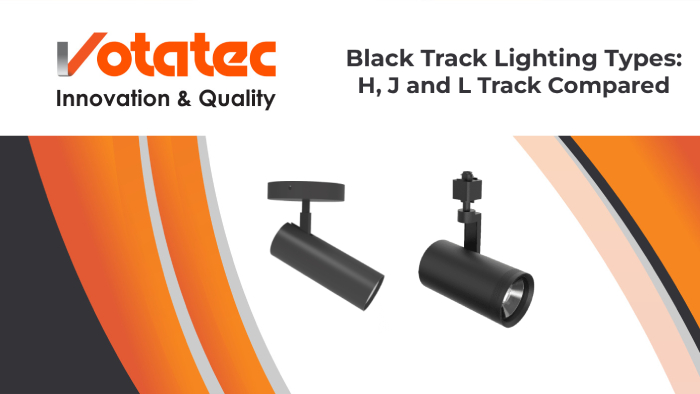

Here’s the short answer. Black track lighting comes in three connector standards, H, J and L, and they don’t mix. An H-track head won’t seat in a J-track rail. A J-track head won’t fit an L-track channel. The finish (black, white, bronze, nickel) is cosmetic. The letter is what decides whether a fixture actually powers on.
That single fact trips up more contractors and facility managers than anything else in track lighting. Buy the wrong letter and you’ve got a box of black track heads that look perfect and connect to nothing.
This guide sorts it out. You’ll learn what H, J and L mean, how to tell which one you’ve got, the exact contact differences, and how to spec the right system for a retail fit-out, an office retrofit, or a residential project. Black finish gets its own section too, because it behaves a little differently from white.
Quick comparison: H vs J vs L track
| Spec | H-Track (Halo) | J-Track (Juno) | L-Track (Lightolier) |
|---|---|---|---|
| Internal contacts | 3 | 2 | 2 |
| Wiring system | 3-wire | 2-wire | 2-wire |
| Contact spacing | Wider, 3-contact layout | ~1 inch apart | ~7/8 inch apart |
| North American availability | Most common | Common | Least common |
| Best for | New installs, widest fixture choice | Slim commercial and modern interiors | Architectural and replacement matches |
| Interchangeable? | No | No | No |
Keep that table handy. The rest of this article explains the why behind each row, so you’re not just matching letters, you’re specifying with confidence.
What are the three types of track lighting?
The three types of track lighting are H-track (Halo), J-track (Juno) and L-track (Lightolier), named after the manufacturers that created each standard. They differ in how many electrical contacts sit inside the rail and how those contacts are spaced, which is why a head built for one type won’t work in another. H is the three-contact standard and the most common across North America. J and L are both two-contact systems, separated only by contact spacing. Everything else, the finish, head style and beam angle, sits on top of that three-way choice. Get the type right and the rest is preference.
What does “black track lighting” actually mean?
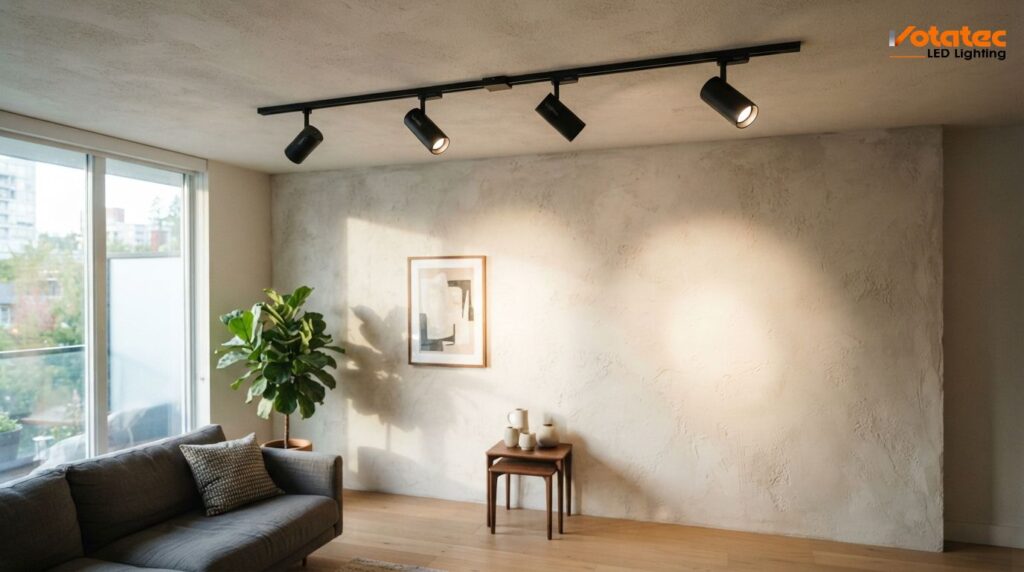
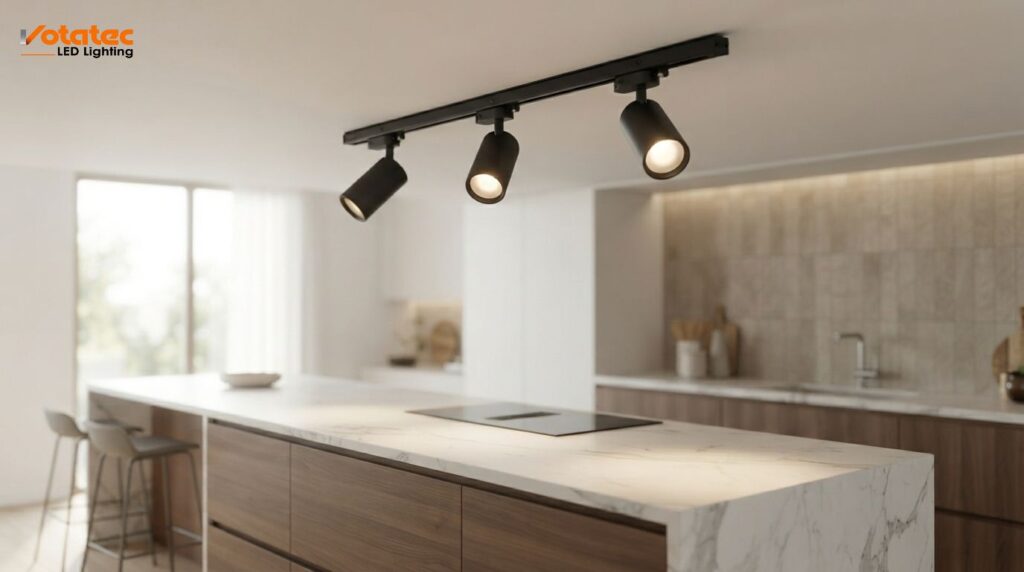
Black track lighting is a ceiling- or wall-mounted rail in a matte or satin black finish, with adjustable heads that clip in anywhere along the rail and aim wherever you point them. You move the heads, swap them, or add more without rewiring. That flexibility is why galleries, retail floors and modern kitchens reach for it.
Black is having a long moment in commercial design. It hides against dark ceilings, reads as intentional and architectural, and disappears in a way white rails can’t. For retail and hospitality especially, black track lets the merchandise or the food take the spotlight while the hardware stays invisible.
But here’s the catch worth repeating. Choosing “black” is a finish decision. Choosing H, J or L is an electrical and mechanical decision. You make both, and the second one matters more.
Related reading: New to track systems? Start with our guide on how to choose the right track lighting, then come back here to lock in the connector type.
Where do the names H, J and L come from?
They’re not shapes. People assume the letters describe the rail’s profile. They don’t.
H, J and L come from the three original manufacturers who set the standards decades ago: Halo (H), Juno (J) and Lightolier (L). Each company designed its own contact layout, and those layouts became the industry reference points. Today dozens of brands build to these three standards, so an “H-type” black track from one maker will accept H-type heads from another.
So when you read a product page that says “H-type compatible,” it’s telling you the connector geometry, not the brand. That’s the language you want to speak with your supplier.
H-Track (Halo): the default choice
H-track is the most common system across North America, and it’s usually the right starting point for a new install.
The giveaway is the three internal contacts. Look inside the rail and you’ll count three conductors instead of two. That 3-wire design supports the broadest selection of heads, connectors, corners, flex joints and accessories on the market. If you want options, H gives you the most.
Why specifiers pick H:
- Widest fixture and accessory range, so you’re rarely stuck sourcing
- Strong supply availability across Canadian distributors
- Easy to expand later without hunting for rare parts
- Works for both line-voltage (120V) and low-voltage (12V) heads with the right components
Where it fits: retail buildouts, offices, kitchens, showrooms, any project where you want long-term flexibility and a deep parts bin. When a client says “we’ll probably reconfigure this in two years,” H-track is the safe specification.
J-Track (Juno): slim and commercial
J-track runs a two-contact, 2-wire system, with the two conductors spaced roughly 1 inch apart inside the rail.
The profile tends to be slimmer and more minimal than H. That’s why J shows up so often in modern commercial spaces, boutique retail and design-forward offices where the rail itself is part of the look. A black J-track against a black ceiling reads as a thin, clean line.
Why specifiers pick J:
- Slimmer, lower-profile rail for a cleaner ceiling line
- Strong fit for contemporary commercial interiors
- Solid fixture availability, though not as deep as H
- Popular in spaces that prize aesthetics alongside function
Where it fits: galleries, upscale retail, restaurants, corporate lobbies. Anywhere the design intent leans minimal and the budget supports a considered look.
A word of caution. J and L look similar at a glance, both are 2-wire, both have two contacts. The difference is spacing, and that 1/8 inch gap is enough to make them incompatible. We’ll cover identification below.
L-Track (Lightolier): architectural and specific
L-track is the least common of the three in everyday projects, but it holds firm in architectural lighting.
It’s a 2-wire, two-contact system like J, but the contacts sit about 7/8 inch apart, and the channel profile is shaped differently. That slightly tighter spacing is the whole reason L and J can’t share fixtures.
Why L-track shows up:
- Specified in older or architecturally specific buildings
- Common as a replacement match when an existing L-system needs new heads
- Chosen for particular aesthetic or performance requirements in design projects
Where it fits: mostly replacement and matching work. If a building already runs L-track, you stay on L-track. Mixing in J heads to “save money” doesn’t work and risks damaging the fixtures.
If you’re starting fresh with no existing system to match, L is rarely the pick. H or J will serve you better on availability alone.
The exact contact differences, side by side
This is the technical heart of compatibility. The rail’s internal cross-section and the placement of its conductors decide everything.
| Feature | H-Track | J-Track | L-Track |
|---|---|---|---|
| Number of contacts | 3 | 2 | 2 |
| Contact spacing | 3-contact wide layout | ~1 inch | ~7/8 inch |
| Wire system | 3-wire | 2-wire | 2-wire |
| Visual tell | Three conductors visible | Two conductors, wider gap | Two conductors, tighter gap, distinct channel |
Force a head into the wrong rail and one of three things happens. It won’t seat at all. It seats but never makes electrical contact, so no light. Or it makes partial contact and creates a safety hazard. None of those are acceptable on a job site, so the spacing matters more than it sounds.
How do I identify which track system I have?
You can usually tell in under a minute. Here’s the field method.
- Cut the power. Always. Track carries line voltage in most commercial installs.
- Look inside the rail and count the conductors. Three metal contact strips means H-track. Two means J or L.
- If you counted two, measure the spacing. Roughly 1 inch apart points to J-track. About 7/8 inch points to L-track.
- Check the channel shape. L-track has a distinct profile that differs from J even when spacing is close.
- Bring a sample if you can. Photograph the rail end and the conductor layout, or take an existing head to your supplier. A two-minute photo saves a wrong order.
When you’re sourcing replacements, send that photo to your distributor before you buy. Guessing from memory is how the wrong letter ends up in the box.
Are H, J and L track lights interchangeable?
No. H, J and L track systems are not interchangeable, and there’s no safe, mass-produced adapter that bridges all three standards.
Each standard uses different connector geometry. Different contact counts, different spacing, different channel profiles. An H head physically can’t make proper contact in a J or L rail, and J and L can’t swap with each other despite both being 2-wire.
This is the single most expensive mistake in track lighting. The fix is simple: match the letter every time. New head, new section, new corner, all of it has to match the existing standard. If you’re standardising across multiple sites, pick one letter (usually H) and write it into your spec so nobody orders off-system.
Single-circuit vs multi-circuit: a separate question
Don’t confuse the H/J/L standard with circuit count. They’re two different decisions.
- The letter (H, J, L) = the physical connector standard.
- The circuit count = how many independently switched circuits the track carries.
A single-circuit track switches every head together. A two-circuit or three-circuit track lets you control groups of heads separately, so one switch hits the display lights and another hits the general wash. Larger retail and gallery projects often want multi-circuit control for exactly that reason.
You spec both. For example: “H-track, two-circuit, black finish.” Get the letter right for compatibility, then choose circuit count for control. Our track lighting product range covers single, two and three-circuit options across finishes.
What changes with a black finish?
Black track is mostly the same hardware in a different coat, but a few things deserve attention.
Heat and dark surfaces. Black absorbs and shows heat behaviour differently than white. With modern LED heads this is a minor concern, since LEDs run cool compared to old halogen track, but it’s worth confirming your heads are LED. Pair black track with efficient LED heads and heat is a non-issue.
Dust and fingerprints. Matte black hides dust better than gloss but shows fingerprints during install. Handle with clean gloves on visible architectural runs.
Ceiling contrast. Black track on a white ceiling makes a bold graphic statement, the rail becomes a visible line. Black track on a dark ceiling nearly vanishes. Decide which effect the client wants before you order, because it changes the whole feel of the room.
Beam and head choice. Black heads with LED PAR or MR16-style lamps give you tight accent control. If you’re weighing lamp bases for the heads, our breakdown of MR16 vs GU10 helps you match base to beam angle.
Matte black vs black track lighting, what’s the difference?
There’s no electrical difference between the two. Both are the same hardware. The difference is the surface finish. “Black track lighting” is a colour description that can cover satin or semi-gloss versions, while “matte black” specifies a flat, non-reflective coat. Matte hides fingerprints and kills glare bouncing off the rail itself, which is why architects favour it on exposed ceiling runs. Satin or gloss black reflects a little more light and can look richer under spotlights, but it shows dust and prints faster. For 2026, designers are even softening pure matte black toward charcoal and iron tones that blend with warm interiors, so confirm the exact finish swatch with your supplier rather than ordering on the word “black” alone (Finish trend: Lighting New York 2026 trends).
Why is black track lighting so expensive?
Black track lighting feels pricey because you’re buying a system, not a single light. A finished run includes the rail, every head, connectors, end caps, and a transformer if you’re running low-voltage heads. Integrated LED heads cost more upfront than old halogen, and features like dimming, adjustable beam angles and multi-circuit control each add to the bill. Retail estimates in 2026 commonly run a few hundred dollars per fixture once labour is added (Source: Homewyse 2026). The payoff is real, though. LED heads cut energy use by roughly 75% versus halogen and last 50,000-plus hours, so the system usually pays back in two to three years on commercial duty cycles. Buying at wholesale or contractor pricing, rather than single-unit retail, is the fastest way to bring the per-head cost down on a larger project.
Is black track lighting still in style in 2026?
Yes. Black track lighting is still in style in 2026, though the look is maturing. Matte black never really left, but designers are now applying it more deliberately and softening it toward charcoal and iron tones that sit better against warm woods and natural textures (Sources: Lighting New York, Montclair Light Works). For commercial and retail spaces, black track stays a safe specification because it disappears against dark ceilings and keeps the focus on the product, art or architecture below it. Pair it with efficient LED heads and it reads as current, not dated.
Choosing the right system for your project
Here’s the decision shortcut by scenario.
Starting fresh, want maximum flexibility? Choose H-track. Widest selection, easiest to expand, strongest availability.
Modern commercial space where the rail is part of the design? Consider J-track for its slimmer profile, as long as you’re comfortable with a slightly narrower parts range.
Replacing or extending an existing system? Match the existing letter exactly, whether that’s H, J or L. Don’t switch standards mid-building.
Multi-site rollout? Standardise on one letter (usually H) across every location and write it into the spec sheet. Consistency saves reorders and field headaches.
Need separate control zones? Layer circuit count on top of your letter choice. H-track plus two or three circuits gives flexibility and zoned control together.
For LED lighting projects across Canada, switching to LED track heads delivers roughly 75% energy savings versus old halogen and fluorescent track, with LED heads rated for 50,000-plus hours. That’s the efficiency case that pays back the retrofit, usually inside two to three years on commercial duty cycles. (Energy savings figures: Natural Resources Canada; LED efficiency standards: ENERGY STAR.)
Common mistakes to avoid
- Ordering by finish, ignoring the letter. “Black track” tells you nothing about fit. Always confirm H, J or L.
- Assuming J and L are close enough. They aren’t. 1 inch versus 7/8 inch means no compatibility.
- Mixing standards to use up leftover stock. Forcing a wrong head risks no contact or a safety hazard.
- Forgetting circuit count. You can get the letter right and still lose the control zoning the client wanted.
- Skipping the power-off step during identification. Track carries line voltage. Cut power before you inspect.
- Specifying L-track for a new build with no reason. Availability is thinner. Default to H unless you’re matching existing.
Where to buy black track lighting in Canada
For projects in Canada, buy black track lighting from a Canadian LED wholesaler that stocks H, J and L standards and can supply matching heads, connectors and accessories from one source. That matters more than it sounds. Sourcing the rail and heads from the same supplier avoids the standard-mismatch problem entirely, because everything’s built to play together. Votatec carries black LED track lighting across H, J and L systems, in single, two and three-circuit configurations, with spot, flood, wall washer and pendant heads. We offer wholesale and contractor pricing for bulk and project orders shipped across the GTA, Vancouver, Montreal and the rest of Canada. Browse the LED track lighting range or request a project quote for volume pricing.
Frequently asked questions
What is the most common track lighting type?
H-track (Halo) is the most common track lighting standard in North America. It uses a 3-wire, three-contact system and has the widest selection of compatible heads and accessories. For most new installations, H-track is the default recommendation because of its availability and flexibility.
Can I use J-track heads on an L-track rail?
No. J-track and L-track are not interchangeable. Both are 2-wire systems, but J contacts sit about 1 inch apart while L contacts sit about 7/8 inch apart. That spacing difference prevents proper electrical contact, and forcing them together can damage the fixture.
How do I know if my track is H, J or L?
Cut the power, then count the internal conductors. Three contacts means H-track. Two contacts means J or L, and you tell those apart by spacing: roughly 1 inch is J, about 7/8 inch is L. L-track also has a distinct channel profile. Photograph the rail and show your supplier if you’re unsure.
Does black track lighting cost more than white?
No, finish rarely changes the price. Black, white, bronze and nickel track typically cost the same within a product line. Your cost is driven by the track standard, length, circuit count and the heads you choose, not the colour.
Is black track lighting good for retail?
Yes. Black track is popular in retail because it disappears against dark ceilings and keeps attention on the merchandise. Paired with adjustable LED heads, it gives flexible accent lighting that you can re-aim or reconfigure as displays change.
Can I mix track heads from different brands?
Yes, as long as they share the same standard. An H-type head from one manufacturer works in an H-type rail from another, because they’re built to the same contact layout. The brand doesn’t have to match. The letter does.
The bottom line
Black is the finish. H, J and L is the decision that determines whether your fixtures power on. Count the contacts, match the spacing, and never mix standards. H-track for flexibility and availability, J-track for slim commercial design, L-track for matching what’s already installed.
Get the letter right first, then choose finish, circuit count and head style. That order keeps you from the most common, most expensive track lighting mistake.
Need help specifying for a project? Browse Votatec’s LED track lighting range in black and other finishes across H, J and L standards, or reach out for wholesale and contractor pricing on bulk orders.





bassam ibrahim 2 weeks ago
1A11:D25A11:D33 Supply a lighting outlet on the ground floor "execluding fixture". No 625 2 Supplyf a lighting outlet on the first floor "execluding fixture". No 160 3 Supply a lighting outlet on the second floor "execluding fixture". No 366 4 Supply a lighting outlet on the third floor "execluding fixture". No 297 5 Supply a lighting device type DL1 on the ground floor. No 197 6 Supply a lighting device type L2 on the ground floor. No 99 7 Supply a lighting device type F2 on the ground floor. No 50 8 Supply of a lighting device type DL2 on the ground floor. No 52 9 Supply a lighting device type DL4 on the ground floor. No 43 10 Supply a lighting device type A3 on the ground floor. No 152 11 Supply a lighting device type L3 on the ground floor. No 25 12 Supply a lighting device type L1 on the ground floor. No 9 13 Supply a lighting device type J on the ground floor. No 25 14 Supply a lighting device type F2 on the first floor. No 18 15 Supply a lighting device type DL2 on the first floor. No 51 16 Supply a lighting device type DL4 on the first floor. No 66 17 Supply a lighting device type L1 on the first floor. No 7 18 Supply a lighting device type L3 on the first floor. No 6 19 Supply a lighting device type J on the first floor. No 23 19 Supply a lighting device type F1/U on the second floor. No 249 20 Supply a lighting device type DL2 on the second floor. No 81 21 Supply a lighting device type DL4 on the second floor. No 20 22 Supply a lighting device type F2 on the second floor. No 4 23 Supply a lighting device type J on the second floor. No 10 24 Supply a lighting device type L1 on the second floor. No 2 25 Supply a lighting device type F1 on the third floor. No 90 26 Supply a lighting device type F2 on the third floor. No 12 27 Supply a lighting device type DL2 on the third floor. No 58 28 Supply a lighting device type DL4 on the third floor. No 58 29 Supply a lighting device type J on the third floor. No 20 30 Supply a lighting device type L1 on the third floor. No 8 please I want unit rate price for each one. If possible submitted commercial offer