











 (+1) 905 597 5955




Quick answer: LED lights flicker when the current reaching the diode isn’t steady. The most common cause is an incompatible dimmer switch, followed by a low-quality driver, loose wiring, voltage drops from overloaded circuits, and cheap bulbs. Most flicker is fixed in minutes by reseating the bulb, matching the bulb to an LED-rated dimmer, or replacing a low-quality bulb. Flicker paired with buzzing, heat, or a burning smell is a wiring fault, so cut the power and call a licensed electrician.
The 7 causes, ranked by how often they’re the culprit:
- Incompatible dimmer switch
- Cheap or failing LED driver
- Loose wiring or connections
- Loose bulb in the socket
- Voltage fluctuations on the circuit
- Overloaded circuit
- Low-quality bulbs
Why Do LED Lights Flicker in the First Place?
LED lights flicker because they convert power differently than the bulbs they replaced. An LED runs on low-voltage DC, but a home runs on 120V AC that cycles 60 times a second. A component called the driver converts AC to smooth DC, and when that conversion is imperfect, or the voltage feeding it swings, the light output modulates and you see flicker.
Incandescent bulbs hid this. Their filament stayed hot between cycles, so the glow never dropped. An LED has no such buffer, and it reacts to voltage changes almost instantly. That’s why the same wiring that ran a halogen bulb without issue can make an LED shimmer.
There are two kinds of flicker, and only one is obvious to the eye.
| Flicker type | Frequency | Visible to the eye? | Why it matters |
|---|---|---|---|
| Visible flicker | Below 100 Hz | Yes | Annoying, and below 65 Hz it can trigger seizures in people with photosensitive epilepsy |
| Invisible flicker | Above 100 Hz | No, but the brain still registers it | Linked to eye strain, headaches, and fatigue, and common in low-cost fixtures |
What Does IEEE Say Is a Safe Level of LED Flicker?
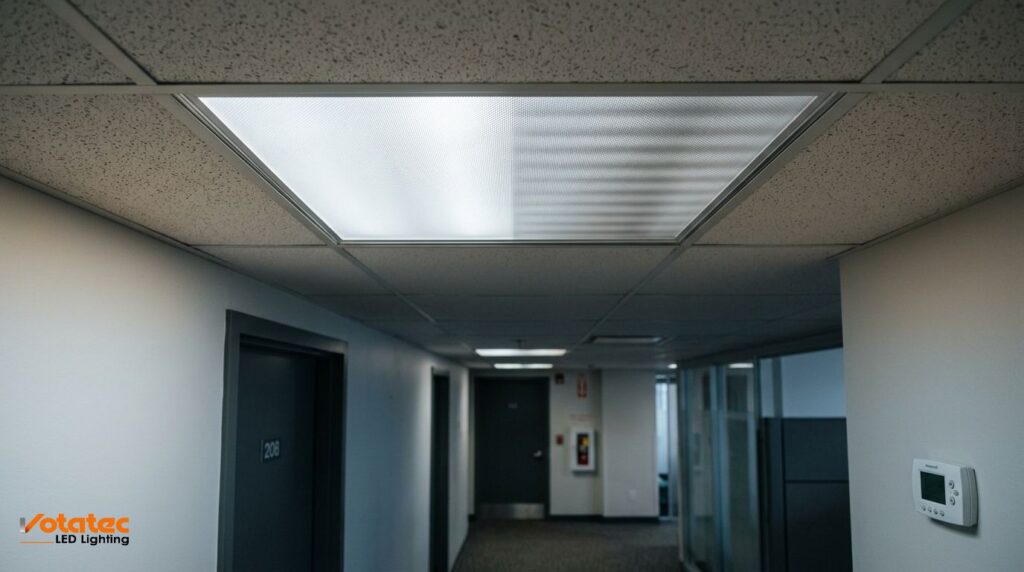
According to IEEE 1789-2015, the recommended practice for LED flicker, safety depends on two factors together: modulation frequency and modulation depth (percent flicker). The standard sets three risk zones by frequency. Below 90 Hz is high risk and should be avoided. Between 90 Hz and 1250 Hz is acceptable depending on depth. Above 1250 Hz is generally safe for viewers.
For percent flicker at 120 Hz, IEEE 1789-2015 treats anything below 8% as low risk and below 3% as having no observable effect. Quality LED products from reputable manufacturers are engineered to stay inside these limits. Low-cost bulbs often aren’t, which is why they’re the ones people notice flickering.
Flicker isn’t only a nuisance. At the wrong frequency and depth, it’s a health signal, and it’s a real reason to buy tested product rather than the cheapest unit on the shelf.
LED flicker at a glance
| Metric | Figure | Source |
|---|---|---|
| Low-risk percent flicker at 120 Hz | Below 8% | IEEE 1789-2015 |
| “No observable effect” percent flicker at 120 Hz | Below 3% | IEEE 1789-2015 |
| High-risk frequency zone | Below 90 Hz | IEEE 1789-2015 |
| Generally safe frequency zone | Above 1250 Hz | IEEE 1789-2015 |
| Seizure-risk threshold (photosensitive epilepsy) | Below 65 Hz | IEEE 1789-2015 |
| LED driver voltage tolerance before flicker | Roughly 10 to 20% | Manufacturer driver specs |
| Brightness level where dimmer flicker appears | Below 20 to 30% | Field observation |
| Energy an ENERGY STAR LED uses vs incandescent | Up to 90% less | Natural Resources Canada |
How Do You Diagnose Which Cause You Have?
You can narrow an LED flicker problem to its cause by matching the symptom to the pattern below. The pattern of when and where the flicker happens tells you more than the flicker itself. Start here before you change anything.
| Symptom / pattern | Most likely cause | Where to look |
|---|---|---|
| Flickers only when dimmed, worse at low brightness | Incompatible dimmer | Dimmer type and bulb dimmability |
| One bulb flickers, others fine | Loose bulb or a single bad bulb | That socket and bulb |
| Flicker started with no change to the setup | Aging or failing driver | The bulb or fixture driver |
| All lights on one circuit flicker together | Loose shared connection or overload | Junction box, circuit load, panel |
| Lights dip when an appliance switches on | Voltage drop / overloaded circuit | Appliance load, circuit sizing |
| Whole house dims or flickers at once | Utility supply or main connection | Call the utility or an electrician |
| Flickers or glows faintly when switched off | Residual voltage or illuminated switch | Switch type, wiring, driver |
| Flicker plus buzzing, heat, or a smell | Wiring fault, fire risk | Stop, cut power, call an electrician |
Run the free checks first. Reseat the bulb, then try a known-good bulb in the same socket. If the good bulb behaves, you’ve found it. If every light on the circuit acts up together, the cause is upstream of the bulb.
What Are the Most Common Causes of Flickering LED Lights?
Seven causes account for nearly all household LED flicker. Here they are at a glance, with the quick fix for each. Detail follows below.
| # | Cause | How common | Quick fix |
|---|---|---|---|
| 1 | Incompatible dimmer switch | Most common | Use a trailing-edge / LED-rated dimmer |
| 2 | Cheap or failing driver | Common | Choose bulbs with a full-featured driver |
| 3 | Loose wiring or connection | Common, and the one to respect | Power off, tighten, or call an electrician |
| 4 | Loose bulb in socket | Common, easiest to rule out | Reseat the bulb |
| 5 | Voltage fluctuations | Occasional | Better driver, or dedicated appliance circuit |
| 6 | Overloaded circuit | Occasional | Redistribute load, add a circuit |
| 7 | Low-quality bulbs | Underlying many of the above | Buy tested product from a reputable supplier |
1. Incompatible dimmer switch (the #1 cause)
An incompatible dimmer is the single most common reason LED lights flicker. Older leading-edge (TRIAC) dimmers were built for high-wattage halogen and incandescent loads, and they chop the AC waveform in a way a low-wattage LED driver can’t process cleanly. The result is a shimmer that shows up most below 20 to 30% brightness. Many older dimmers also need a higher minimum wattage than a few LEDs can supply, which triggers flicker on its own.
The fix: Use a trailing-edge or adaptive LED dimmer, and pair it with a bulb the manufacturer lists as dimmable. Votatec’s LED dimmer switches are matched to LED loads for exactly this reason.
2. A cheap or failing LED driver
The driver is the small power supply that feeds the diode. A low-cost driver can’t filter out the ripple left over from AC-to-DC conversion, so the current pulses and the light flickers. Drivers also degrade with heat over time, so a fixture that was fine last year can start flickering as its driver ages. This is why flicker sometimes appears with no change to the wiring or the dimmer.
The fix: Choose bulbs and fixtures with a proper, full-featured driver that isolates electrical noise and holds current steady. On an integrated fixture, a failed driver means replacing the fixture or its driver module.
3. Loose wiring or connections
Loose wiring causes flicker, and it’s the cause you should take most seriously. A wire that has backed out of a wire nut, or a loose terminal in the fixture or panel, creates an intermittent connection. When several lights on the same circuit flicker together, a shared connection point is the likely fault. Loose connections generate heat and are a fire risk.
The fix: With the power off at the breaker, check that wire nuts are tight and wires are seated. If you’re not comfortable doing this, or the flicker is at the panel, call a licensed electrician.
4. A loose bulb in the socket
A bulb that isn’t screwed in fully makes weak contact with the socket, and that weak contact flickers. This is the easiest cause to rule out and costs nothing to fix.
The fix: Turn the light off, let the bulb cool, and snug it into the socket. Screw-in bulbs like Votatec’s A-shape and filament LED bulbs should seat firmly without forcing.
5. Voltage fluctuations on the circuit
LEDs tolerate only a narrow voltage swing, roughly 10 to 20% depending on the driver, before output starts to modulate. When a high-draw appliance like an air conditioner, furnace fan, or well pump kicks on, it can pull the circuit voltage down briefly and make the lights dip.
The fix: A high-quality driver rides out small dips. If the flicker tracks a specific appliance cycling on and off, that appliance may need its own circuit. Persistent dimming across the whole house points to a supply issue for an electrician to check.
6. An overloaded circuit
An overloaded circuit draws more current than it’s rated for, which drops the voltage across everything on it, so every light flickers as a result. Adding fixtures, holiday lights, or space heaters to an already busy circuit is a frequent trigger.
The fix: Move some load to another circuit, or have an electrician add a dedicated one. Switching more of the home to efficient LED fixtures also cuts total circuit load, since ENERGY STAR LEDs use up to 90% less energy than the incandescent lamps they replace, per Natural Resources Canada.
7. Low-quality bulbs
Cheap LED bulbs flicker more often because they cut corners on the driver and filtering components that quality bulbs include. Budget product frequently exceeds the IEEE 1789 low-risk flicker threshold of 8% straight out of the box.
The fix: Buy tested LED bulbs and fixtures from a reputable supplier. It’s the one fix that also prevents the other causes, because good drivers handle voltage swings and dimmer signals better.
Which Dimmer Switch Works With LED Lights?
LED lights need a trailing-edge or LED-rated dimmer, not the old leading-edge dimmer that ran halogen and incandescent bulbs. Dimmer mismatch is behind most dimming flicker, so matching the control to the load is the fix that solves the largest share of complaints. Here’s how the common dimmer types compare.
| Dimmer type | How it works | Best for | LED flicker risk |
|---|---|---|---|
| Leading-edge (TRIAC) | Cuts the front of the AC waveform, high minimum load | Halogen, incandescent | High with LEDs, especially at low brightness |
| Trailing-edge (ELV) | Cuts the back of the waveform, low minimum load, smoother | Residential LED | Low when matched to a dimmable LED |
| 0-10V | Separate low-voltage control signal sets output | Commercial LED fixtures | Low, wide smooth dimming range |
| DALI | Digital addressable control, per-fixture | Large commercial and smart buildings | Very low, precise control |
Three rules keep a dimmed LED steady. First, the bulb has to be marked dimmable, since a non-dimmable LED will flicker or buzz on any dimmer. Second, the dimmer’s load rating has to match the fixtures, because too few watts on a high-minimum dimmer flickers. Third, keep to a tested pairing where possible. Many LED makers publish a compatibility list of dimmers proven with their product.
For a whole room or a project, standardizing on one tested dimmer-and-bulb pairing removes guesswork. Votatec’s LED dimmer switches are built for LED loads and low minimum wattages.
Why Do My LED Lights Flicker When the Switch Is Off?
LED lights that flicker or glow faintly when switched off are almost always receiving a tiny residual voltage. An LED needs very little current to light up, so a small leak that an incandescent bulb would have ignored is enough to make an LED glimmer or blink. It’s usually a wiring or switch issue, not a faulty bulb.
The common sources are an illuminated or neon-indicator switch that passes a trickle of current through the bulb, a two-way (three-way) switching circuit that induces voltage, a long cable run picking up induced voltage from adjacent wires, or a driver that stores a small charge. None of these are dangerous on their own, but they do shorten bulb life.
Two fixes work. Swap the switch for a standard one without an illuminated indicator, or fit a load-correction device (sometimes sold as an anti-flicker capacitor or “dummy load”) that absorbs the residual current. If you’re unsure which applies, an electrician can identify the source in a few minutes.
Why Do LED Strip Lights, Pot Lights, and Tube Lights Flicker?
Different LED formats flicker for different reasons, because each one is powered and controlled differently. Matching the cause to the fixture type gets you to the fix faster. Here’s how the common formats differ.
- LED strip lights flicker most often from an undersized or failing power supply, voltage drop along a long run, or a loose connector. A strip that dims toward the far end is a voltage-drop sign, and it’s fixed by feeding power from both ends or using a heavier gauge.
- Recessed pot lights (downlights) usually flicker from dimmer mismatch or a failing integrated driver. Because the driver is built in, a failed one means replacing the fixture or its driver module rather than a bulb.
- LED tube lights (T8 retrofits) flicker when the tube type doesn’t match the fixture wiring, for example a ballast-bypass tube installed in a fixture that still has its old ballast. Confirm the tube type matches the wiring.
- Low-voltage MR16 and G4/G9 lamps flicker when an old magnetic transformer sized for halogen can’t run a small LED load. MR16 and G4/G9 LED lamps need an electronic LED-rated driver to run cleanly.
- Smart bulbs can flicker during firmware updates, on weak Wi-Fi, or when a smart bulb is wired behind a wall dimmer. Smart bulbs should run on full power with dimming done in the app, not a wall dimmer.
How Can You Test for LED Flicker?
You can spot LED flicker with a phone camera before you ever buy or install a fixture. Point a smartphone camera at the light and watch the screen, or record in slow-motion. If dark bands roll across the screen or the light pulses in the video, the fixture is flickering even when your eye can’t see it. This is the quickest field test, and it works because the camera sensor samples faster than your eye.
For a precise number, a flicker meter reads two values that map to the IEEE 1789 limits: percent flicker (modulation depth) and flicker index. Percent flicker under 8% at 120 Hz sits in the low-risk zone. Facility managers and specifiers often ask suppliers for these figures on a spec sheet, which is a fair thing to request before a large order.
The phone test is enough for a homeowner. The meter reading matters when flicker has to be documented, for a workplace, a healthcare space, or a warranty claim.
Does LED Flicker Matter in Workplaces and Commercial Spaces?
LED flicker matters more in workplaces because people spend long hours under the light, and invisible flicker is linked to eye strain, headaches, and reduced concentration. In offices, schools, healthcare, and warehouses, low-flicker lighting is a comfort and productivity issue, not just an aesthetic one. It’s a growing part of how fixtures get specified.
Two factors make commercial flicker worse than residential. Fixtures run for far longer daily hours, so any modulation accumulates, and large installs use many drivers, so one weak batch multiplies the problem across a floor. Rotating machinery adds a safety angle, because flicker at the wrong frequency can make moving parts appear stationary under a stroboscopic effect.
For contractors and facility managers, specifying tested low-flicker product across a building removes complaints before a tenant ever calls. That’s the case for sourcing from a single LED fixture supplier that documents driver quality, dimmer compatibility, and percent-flicker figures.
How Do You Fix Flickering LED Lights? (Step-by-Step)
Work through these in order. The first three solve most household cases.
- Tighten the bulb. Power off, let it cool, and reseat it. Free, and it’s the fix a surprising share of the time.
- Check dimmer compatibility. Confirm the bulb is dimmable and the dimmer is a trailing-edge / LED model. Swap the dimmer if it’s an old leading-edge unit.
- Swap in a known-good bulb. If a quality bulb doesn’t flicker in the same fixture, the old bulb or its driver was the problem.
- Move heavy loads off the circuit. If flicker follows an appliance, redistribute the load.
- Inspect connections with the power off. Tighten wire nuts and terminals, or call an electrician if it’s inside the panel.
- Call a licensed electrician if flicker persists across multiple circuits or comes with any warning sign below.
When Should You Stop and Call an Electrician?
Stop troubleshooting and call a licensed electrician the moment flicker comes with buzzing, heat, a burning smell, visible arcing, breaker trips, or flicker across several circuits at once. These point to a wiring fault, not a bulb, and they carry a fire risk.
In Canada, permanent electrical work has to meet the Canadian Electrical Code and, in most provinces, be done by a licensed electrician. In Ontario, the Electrical Safety Authority can confirm a contractor’s licence. Reseating a bulb is DIY. Anything inside the panel is not.
How Can You Prevent LED Flicker Before It Starts?
Preventing LED flicker comes down to matching quality components to the circuit. Buy LED bulbs and fixtures with proper drivers, pair dimmable LEDs with trailing-edge dimmers rated for the load, and don’t overload circuits. Get those three right and flicker rarely appears.
For low-voltage setups, the transformer matters too. An old magnetic transformer sized for halogen often can’t run a small LED load without flickering, and an electronic LED-rated driver fixes it. On new installs, size drivers with headroom rather than running them at their limit, since a driver at full stretch heats up and ages faster.
Buying quality up front is cheaper than it looks. A flicker-free bulb that lasts its rated life beats a bargain bulb replaced twice, and for a building it saves the service calls that eat any savings on the purchase price.
Frequently Asked Questions
Why do my LED lights flicker when dimmed?
LED lights flicker when dimmed because the dimmer and driver don’t match. Most flicker at low brightness comes from an old leading-edge (TRIAC) dimmer paired with an LED, which struggles below 20 to 30% brightness. Switch to a trailing-edge or LED-rated dimmer and confirm the bulb is dimmable.
Can flickering LED lights be dangerous?
Flickering LEDs are usually harmless, but two cases matter. Flicker below 65 Hz can trigger seizures in people with photosensitive epilepsy, and higher-frequency flicker is linked to eye strain and headaches. Flicker paired with buzzing, heat, or a burning smell signals a wiring fault and a fire risk, so cut the power and call an electrician.
Do LED lights flicker as they get old?
Yes. An LED driver degrades with heat over years of use, and a worn driver filters power less effectively, so a fixture that ran cleanly can begin to flicker. On a bulb, replace it. On an integrated fixture, the driver module or the whole fixture needs replacing.
Why do my LED lights flicker with no dimmer installed?
Without a dimmer, flicker usually means a loose bulb, a loose wire, a voltage drop from an overloaded circuit, or a failing driver. Reseat the bulb first, then swap in a known-good bulb. If several lights flicker together, suspect a shared connection and have it checked.
Why do my LED lights glow or flicker when the switch is off?
An LED that glows or flickers when off is picking up a small residual voltage, most often from an illuminated switch, a two-way switching circuit, or induced voltage in a long cable run. Swap the switch for a standard one, or fit a load-correction device that absorbs the leak. It isn’t dangerous, but it shortens bulb life.
Will better-quality LED bulbs stop the flickering?
Often, yes. Quality bulbs use full-featured drivers that smooth AC ripple, handle voltage swings, and process dimmer signals, keeping percent flicker under the IEEE 1789 low-risk threshold of 8% at 120 Hz. If a tested bulb still flickers in a fixture, the cause is the wiring, dimmer, or circuit rather than the bulb.
How can I check for LED flicker I can’t see?
Point a smartphone camera at the light and record in slow-motion. If dark bands roll across the screen or the light pulses in the video, the fixture is flickering even when your eye can’t see it, because the camera samples faster than the eye. For a documented figure, ask the supplier for the percent-flicker value from a flicker meter.
The Bottom Line
- Incompatible dimmers cause most LED flicker. Match dimmable LEDs to a trailing-edge or LED-rated dimmer.
- Cheap drivers are the second cause. A quality driver smooths power and handles voltage swings.
- Loose wiring is the one to respect. Flicker with buzzing, heat, or a smell means power off and call an electrician.
- IEEE 1789 sets the safe bar: under 8% flicker at 120 Hz is low risk, and tested product stays inside it.
- Diagnose by the pattern. When and where the flicker happens points to the cause faster than the flicker itself.
- Prevention is a sourcing decision. Quality bulbs, fixtures, and dimmers from one supplier stop flicker before it starts.
Sourcing LED lighting for a project across Canada? Request a wholesale quote from Votatec for tested, flicker-rated LED bulbs, fixtures, and dimmers.