














 (+1) 905 597 5955


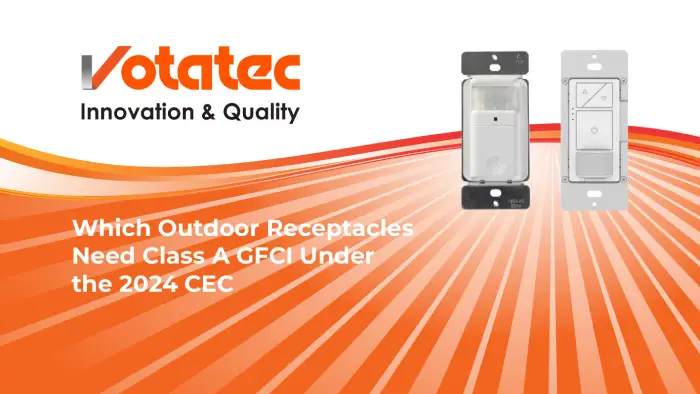

Short answer first. Under the 2024 Canadian Electrical Code, every receptacle of CSA configuration 5-15R or 5-20R installed outdoors and within 2.5 metres of finished grade must be protected by a Class A ground fault circuit interrupter. That’s Rule 26-704. It applies to all occupancies, not just houses. Outdoor receptacles on a warehouse wall, a school portable, a transit shelter or a municipal park pavilion fall under the same line of code as the plug beside your back door.
That’s the rule. The rest of this guide is the part that costs people money on inspection day: which outdoor receptacles are exempt, what “within 2.5 m of finished grade” means when the ground slopes, why GFCI protection alone still fails an inspection, and the one 2024 change most contractors haven’t caught yet.
Fair warning. Nearly everything ranking on Google for this question is written against the American NEC. The rule numbers, distances and exemptions are different here. If a source cites 210.8(A)(3) at you, it’s answering a US question.
The Short Answer: Which Outdoor Receptacles Need Class A GFCI
Here’s the compliance test. Outdoor receptacles need Class A GFCI protection when all three of these are true:
- The device is a CSA configuration 5-15R or 5-20R (the standard 125 V, 15 A or 20 A duplex)
- It’s installed outdoors
- It’s within 2.5 metres of finished grade
No residential-only limit. No square-footage threshold. Commercial, institutional, industrial, agricultural, municipal: same rule.
| Location of outdoor receptacles | Class A GFCI required? | Rule |
|---|---|---|
| House exterior wall, 400 mm above patio | Yes | 26-704 |
| Warehouse loading dock, 1.2 m above apron | Yes | 26-704 |
| Block heater post in a staff parking lot | Yes | 26-704(2) |
| Deck receptacle 2.4 m above grade | Yes | 26-704 |
| Soffit receptacle 4 m above grade | Not by 26-704 | Cover rules still apply |
| Behind a designated stationary appliance, inaccessible | No | 26-704 exception |
Look at the fifth row. Height is a real boundary, and it’s the most useful thing to know about outdoor receptacles in Canada. But “not required by 26-704” isn’t the same as “install whatever you like.”
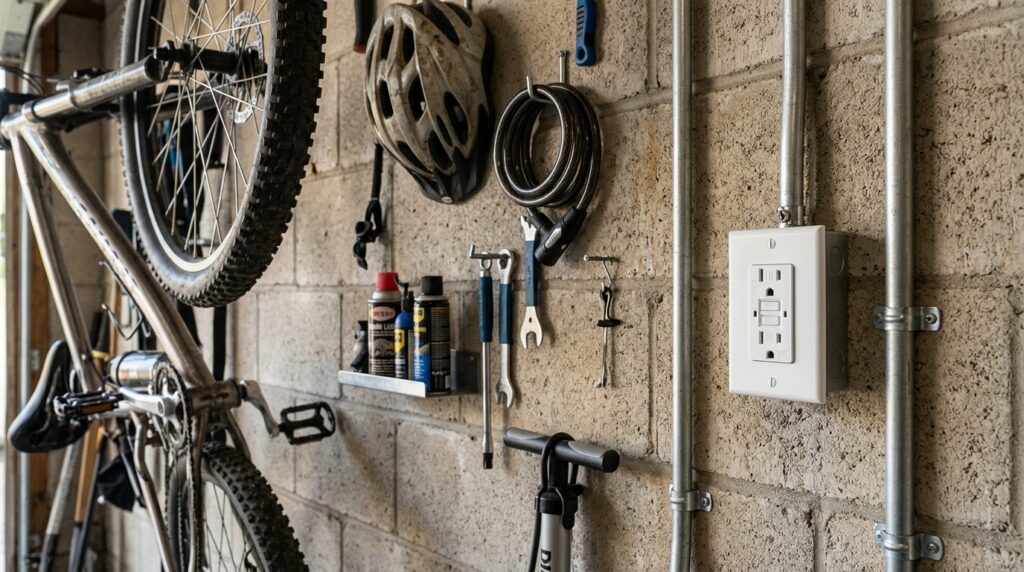
What Rule 26-704 Actually Says About Outdoor Receptacles
Rule 26-704 is titled Protection of Receptacles by a Ground Fault Circuit Interrupter of the Class A Type. In the 26th edition of the Code (CSA C22.1:24, published 2024), subrule 1 covers two situations at once: receptacles within 1.5 m of sinks, bathtubs and shower stalls, and receptacles outdoors within 2.5 m of finished grade.
Same rule, two measurements. Water is water.
The 2.5 Metre Rule, Measured From Finished Grade
Measurement is from finished grade. Not from the floor inside, not the top of the foundation, and not where the ground sat before the grading crew showed up.
That last one matters. A receptacle at 2.7 m on a bare foundation wall is outside the rule the day it’s installed. Backfill 400 mm of topsoil under it and it isn’t anymore. Same story with a deck built later, interlock poured over original grade, or a raised planter.
On sloped sites, measure directly below the device. A single run of outdoor receptacles along a wall that drops a metre can have some inside the rule and some outside it. Just protect the whole run. The cost gap between one GFCI feeding a run and an argument with an inspector isn’t close.
What “Class A” Actually Means
Class A isn’t marketing language. It’s a defined performance class, and this is where spec sheets get sloppy.
A Class A ground fault circuit interrupter interrupts the circuit when ground fault current reaches 6 mA or more, and does not interrupt at 4 mA or less. That band is the definition. A device advertising a nominal 5 mA trip sits inside it, so 5 mA and Class A aren’t contradictory claims. They’re the same claim written two ways.
The class is what protects a person. Equipment ground fault protection at 30 mA is a real product used for things like heat tracing. It’s not a substitute. If a datasheet says “ground fault protection” without naming Class A, treat that as an open question.
Look at the device face. Compliant outdoor receptacles in this category are moulded CLASS A GFCI RECEPTACLE on the body, with amperage and voltage. If it isn’t on the device, don’t assume it’s on the certificate.
The One Exception Most People Get Wrong
There is an exception, and it’s narrower than the job-site version of it.
Protection isn’t required where the receptacle is intended for a stationary appliance designated for that location, is located behind that appliance, and is inaccessible for use with general purpose portable appliances.
All three conditions. “It’s for the heat pump” is not the exemption. “It’s for the heat pump, it sits behind the heat pump, and nobody can plug a pressure washer into it” is the exemption. If a person can reach that outlet with a cord in hand, the Code sees a general purpose receptacle, whatever the drawing calls it.
Vehicle Heater Receptacles Are Not Exempt
This one catches property managers across the Prairies every winter.
Vehicle heater receptacles used to sit outside the GFCI requirement. That exclusion was removed, and Rule 26-704 now reaches them in all occupancies. A block heater post in a commercial lot, a fleet yard, a hospital staff lot or a municipal works yard needs Class A protection like any other outdoor receptacle.
One wrinkle worth designing around. CSA C22.2 No. 191 permits certain engine heaters with sheathed elements to leak up to 4 mA for the first ten minutes after power is applied. Put two or more behind one Class A device and combined start-up leakage can trip it. That’s not a defective GFCI, that’s arithmetic. Specify one protective device per post rather than ganging a row of posts behind a single protector.
Nuisance tripping can also mean a heater is failing. That’s information you want.
Which Outdoor Receptacles Are Exempt, and Which Only Look Exempt
The exempt list is short:
- Devices more than 2.5 m above finished grade
- Devices behind designated stationary appliances, inaccessible to portable loads
- Configurations other than 5-15R and 5-20R (a 6-20R or 14-50R isn’t captured by this subrule, though other rules may capture it)
Everything else outdoors is in. Here’s the trap: outdoor receptacles that fall outside 26-704 still have to satisfy the weather, cover and marking rules. Clearing 2.5 m exempts you from one rule, not from Section 26.
Soffit receptacles for holiday lighting are the classic case. At 4 m they’re outside 26-704. They’re still exposed to weather, still need a suitable cover, and honestly still deserve protection, because the load at the end of that circuit is a string of lights someone handles from a ladder in the rain. Code is a floor, not a ceiling.
The 2024 Change Nobody Is Talking About: Two Outdoor Receptacles, Not One
Rule 26-704 itself didn’t change in the 26th edition. It carried forward from 2021. But a neighbouring rule did change in 2024, and it quietly increases the device count on every new single dwelling in the country.
Rule 26-724 used to require at least one duplex receptacle outdoors, readily accessible from ground or grade level. The 2024 Code requires at least two, and tells you where:
- On two opposite sides of the single dwelling; or
- Where the dwelling has no opposite sides, on adjacent sides, separated by no less than half the width of the longest side
There’s relief for small footprints. A single dwelling with a continuous perimeter at grade of 20 m or less still needs only one.
Follow that through. Both required devices are, by definition, readily accessible from grade, which puts them squarely inside 26-704. So 2024 didn’t change the GFCI rule. It doubled the number of outdoor receptacles that rule applies to on a typical new build.
Two more from the same block: at least one duplex receptacle, readily accessible from floor or grade, is required for each car space in a garage or carport of a single dwelling, and a garage needs a receptacle within 1 m of each cord-connected overhead door opener.
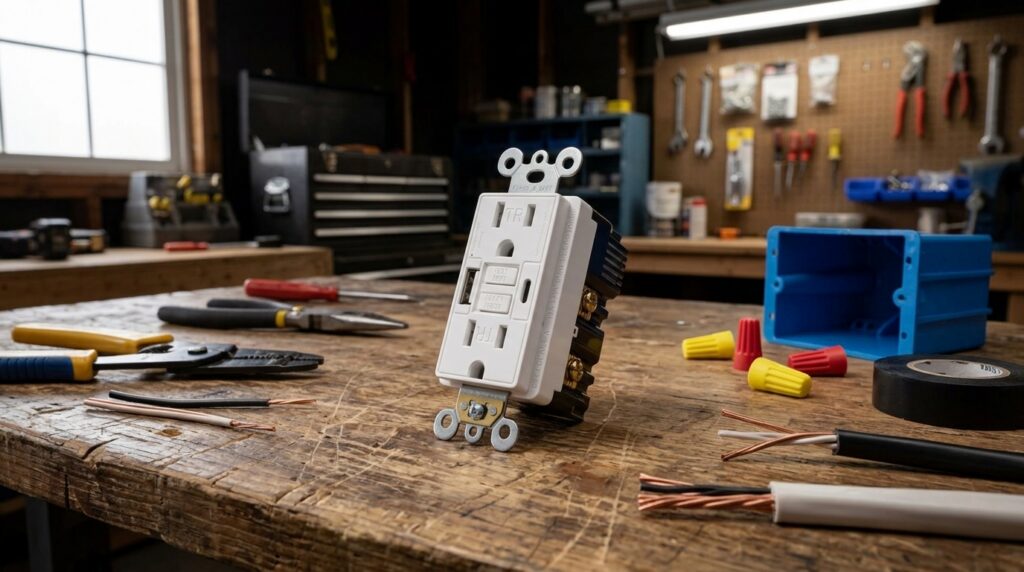
GFCI Protection Isn’t the Whole Job: WR Marking and Extra Duty Covers
You can install a perfectly good Class A device outdoors and still fail. Protection, marking and enclosure are three separate requirements.
Weather Resistant Is the Device, Weatherproof Is the Cover
A receptacle in a damp or wet location has to be a weather resistant type, marked WR on the device. Outdoors is always one or the other, so outdoor receptacles are WR territory by default.
WR is a construction rating covering UV resistance, corrosion resistance of contacts and strap, and cold-temperature impact. In a country where an outdoor receptacle sees plus 35 in July and minus 30 in January, that isn’t decorative. An indoor-grade device outdoors will chalk, embrittle and corrode, usually from the inside where nobody sees it coming.
WR doesn’t mean waterproof. That’s the cover’s job.
Extra Duty Covers and When a Standard Cover Is Still Allowed
Rule 26-708 covers receptacles exposed to the weather. Configurations 5-15R, 5-20R, 5-20RA, 6-15R, 6-20R and 6-20RA need cover plates suitable for wet locations whether or not a plug is inserted, marked Extra Duty.
That phrase is the whole point. A flip-lid cover protects an empty receptacle and nothing else. Plug a cord in and the lid props open, leaving the device exposed. An in-use cover, sometimes called a bubble cover, closes around the cord. Extra Duty is the marking that says it passed the tougher impact and UV testing in CSA C22.2 No. 42.1.
A lighter cover is permitted in two cases. Covers marked “Wet Location Only When Cover Closed” are allowed where the device is:
- Installed facing downward at 45 degrees or less from horizontal; or
- Located at least 1 m above finished grade or floor level and not in a wet location
Read the second one carefully. Both halves have to be true. A receptacle 1.5 m up an exposed wall that catches driving rain is still a wet location, so it still needs Extra Duty.
Plastic covers are permitted, and plastic covers fail first. On south and west elevations, UV takes the cheap ones apart in a few seasons.
Should the GFCI Be at the Receptacle or at the Breaker?
Both are compliant. The rule requires Class A protection, not a Class A receptacle, so a Class A breaker feeding the circuit satisfies it.
The device usually wins, and the reason is testing. GFCIs are meant to be tested monthly. A receptacle with buttons at the point of use gets tested. A breaker in a locked mechanical room three buildings away does not. Facility teams will tell you this if you ask.
Breakers make sense in three cases: where the outdoor receptacles are hard to reach, where you want protection across the whole run including the wiring method, and where vandalism means you’d rather nobody could reset them.
One rule holds either way. Protect from upstream and every downstream outlet has to be labelled GFCI Protected. Skip the label and the next person troubleshooting a dead outlet has no idea where the reset lives.
Outdoor Receptacles by Application: A Field Checklist
| Application | Typical mounting | Class A GFCI | Cover |
|---|---|---|---|
| Residential deck and patio | 300 to 600 mm above deck | Required | Extra Duty in-use |
| Multi-unit balconies | Under 2.5 m | Required | Extra Duty in-use |
| Loading dock and shipping apron | 1 to 1.5 m | Required | Extra Duty, metal preferred |
| Block heater and EV posts | 600 mm to 1.2 m | Required, one device per post | Extra Duty in-use |
| Rooftop equipment maintenance | Varies | See 26-708 to 26-712 | Wet location |
| Park pavilions, transit shelters | Under 2.5 m | Required, plus TR where applicable | Extra Duty in-use |
| Signage and holiday lighting soffits | Above 2.5 m | Not by 26-704, recommended | Wet location |
| Agricultural and yard buildings | Under 2.5 m | Required | Extra Duty in-use |
Two notes on that table. Receptacles in childcare facilities, preschools, elementary schools, hotel and motel guest rooms and dwelling units also have to be tamper resistant and marked TR under Rule 26-706, so plenty of institutional outdoor receptacles need WR and TR on one device. And Ontario adds a wrinkle: the OESC requires outdoor receptacles at a residential occupancy to be fed from at least one dedicated branch circuit, and the Electrical Safety Authority has confirmed in writing that all of them go on that circuit, not just the first one.
15 A or 20 A? Sizing Outdoor Receptacles
Both amperages are captured by 26-704, so the GFCI question doesn’t pick one for you. The load does.
Use 15 A for general purpose outdoor receptacles: patios, balconies, yard maintenance, seasonal lighting, the occasional cord-connected tool. That’s the volume device for residential and light commercial.
Use 20 A where the circuit is 20 A and loads run heavy or continuous: pressure washers, compressors, event power, patio food service, commercial grounds equipment. A 20 A receptacle on a 15 A circuit is a configuration mismatch under Rule 26-700, which requires receptacle configuration to match the rating of the circuit.
Quick reality check on ratings. A 15 A device at its rated 125 V is 1,875 W. A 20 A device at 125 V is 2,500 W. Spec sheets quoting 1,800 W and 2,400 W are calculating at 120 V. Know which number you’re comparing when you size a circuit.
Votatec’s weather resistant GFCI outlet in 15A and 20A are both Class A, both WR and TR marked, both moulded with the class on the device face. The range sits in the GFCI switches and outlets category, alongside the wider wiring devices catalogue.
Common Mistakes We See on Canadian Job Sites
Roughly ranked by how often they cost somebody a return visit.
- Quoting the NEC. American distances and rule numbers don’t apply. Canada measures 2.5 m from finished grade under 26-704, and the exemption language differs.
- Standard cover on outdoor receptacles. A flip lid protects nothing while a cord is plugged in.
- Non-WR device behind a good cover. The cover doesn’t make the device weather resistant. Both are required.
- Measuring from the wrong datum. Finished grade. Not the slab, not the sill plate, not the original ground line.
- Ganging block heater posts behind one GFCI. Cumulative leakage trips it, somebody bypasses it, and now the lot has no protection at all.
- No GFCI Protected labels downstream. Legal to protect from upstream, not legal to leave downstream outlets unmarked.
- Assuming a CE-marked device is fine. CE is a manufacturer self-declaration and isn’t recognised in Canada. Look for a mark with a lowercase c: cCSAus, cULus, cETLus.
- Testing never. Monthly TEST and RESET is the manufacturer’s instruction on every one of these devices.
That last point isn’t small. GFCIs wear out. Many current devices self-test and signal end of life with a red indicator, and the right response to that indicator is replacement, not a reset.
Which Code Edition Actually Applies to You
The national document is CSA C22.1:24, the Canadian Electrical Code, Part I, 26th edition, published 2024. It isn’t law by itself. Each province and territory adopts it on its own timetable, usually with amendments.
Ontario is the one to watch. Ontario publishes its own Ontario Electrical Safety Code, the CE Code plus provincial amendments, and rule numbers can differ from the federal text. The ESA bulletin on outdoor receptacles cites Rules 26-656, 26-704 and 26-724 together for that reason.
So before specifying anything, confirm which edition your province has adopted and whether your authority having jurisdiction has amended the rule. Two provinces can sit a full code cycle apart at the same moment.
Sourcing Compliant Outdoor Receptacles in Canada
Four things to confirm on a submittal:
- Class A stated explicitly, not “GFCI protection” or a bare trip current
- WR marking on the device, plus TR if the occupancy calls for it
- A Canadian certification mark with the lowercase c, from an accredited body
- An Extra Duty cover as its own line item, because device and cover are usually separate purchases and the cover is what gets forgotten
For background before you spec, our guide to what a GFCI outlet is and how it prevents shock covers the mechanism, and the AFCI vs GFCI code requirements in Canada section explains where each type is required. If the terminology is tripping you up, GFI vs GFCI settles that in ninety seconds.
Frequently Asked Questions About Outdoor Receptacles
What are the requirements for outdoor receptacles under the Canadian Electrical Code?
Three requirements stack. Any 5-15R or 5-20R device installed outdoors within 2.5 m of finished grade needs Class A GFCI protection under Rule 26-704. The device has to be weather resistant and marked WR, because outdoors is a damp or wet location. And Rule 26-708 requires a cover plate suitable for wet locations whether or not a plug is inserted, marked Extra Duty, unless it faces downward at 45 degrees or less, or sits at least 1 m above grade and isn’t in a wet location. Single dwellings also need at least two outdoor receptacles under Rule 26-724.
Do outdoor receptacles above 2.5 metres still need GFCI protection?
Not under Rule 26-704. The 2.5 m measurement from finished grade is that rule’s boundary, so a soffit device at 4 m isn’t captured. It still needs weather resistant construction and a suitable cover, and your authority having jurisdiction may still require protection. Grade also moves. A device clearing 2.5 m today can fall under the rule after a deck, patio or regrade, so many specifiers protect everything outdoors and stop worrying about the tape measure.
Should outdoor receptacles be 15 amp or 20 amp?
Match the circuit. Rule 26-700 requires receptacle configuration to correspond to the voltage and ampere rating of the circuit, so a 20 A device doesn’t belong on a 15 A circuit. Use 15 A for general purpose outdoor receptacles on patios, decks and balconies. Use 20 A for pressure washers, compressors, event power or commercial equipment. Both need Class A protection within 2.5 m of grade, so code doesn’t decide it for you.
Can I use a GFCI breaker instead of GFCI outdoor receptacles?
Yes. Rule 26-704 requires Class A protection, not a specific device type, so a Class A breaker feeding the circuit is compliant. Every downstream outlet then has to be labelled GFCI Protected. The argument for putting the device at the receptacle is testing: monthly TEST and RESET happens when the buttons are visible, and rarely happens when they’re in a locked panel room.
What’s the difference between a weather resistant receptacle and a weatherproof cover?
Two products solving two problems, and outdoor receptacles usually need both. Weather resistant, marked WR, rates the device for UV exposure, corrosion and cold-temperature impact. Weatherproof describes the cover or enclosure keeping water out. A WR device under a standard flip cover is exposed the moment a cord goes in. A non-WR device under an Extra Duty cover corrodes anyway. Specify the pair.
Bottom Line
- Every 5-15R and 5-20R device outdoors within 2.5 m of finished grade needs Class A protection under Rule 26-704, in every occupancy
- Class A trips at 6 mA or more and holds at 4 mA or less. Confirm it’s stated, don’t infer it
- The exception is narrow: designated stationary appliance, behind the appliance, inaccessible to portable loads
- Vehicle heater receptacles are in. One protective device per post avoids cumulative leakage tripping
- Protection isn’t enough. The device needs WR marking, the cover needs to be Extra Duty, per Rule 26-708
- New in 2024: single dwellings need two outdoor receptacles under Rule 26-724, and both land inside the GFCI rule
- Check which edition your province has adopted. Ontario runs its own OESC with its own numbering
Specifying outdoor receptacles across multiple provinces? Votatec supplies Class A, WR and TR marked GFCI devices in 15 A and 20 A to electrical contractors, distributors and public sector buyers across Canada. Request a wholesale quote and we’ll confirm certification marks and lead times before you commit to a submittal.